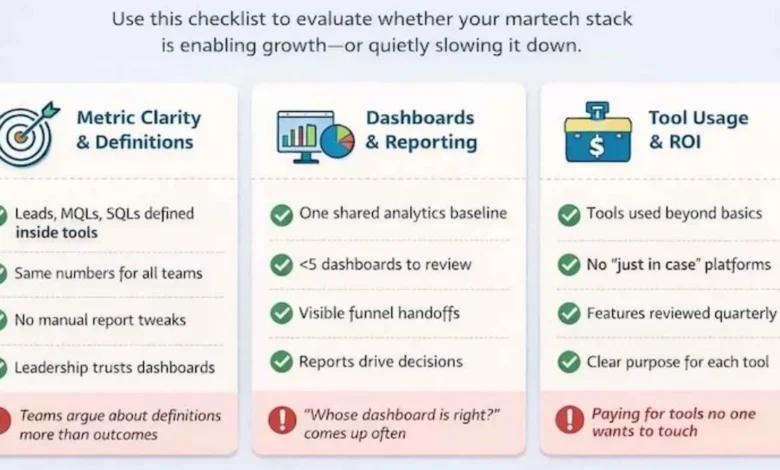
The efficiency and integration of a marketing technology (martech) stack stand as a pivotal determinant of success for modern SaaS companies, dictating everything from operational agility to customer acquisition and retention capabilities. In an increasingly competitive digital landscape, the question for many SaaS firms is not merely whether they possess a martech stack, but rather if it is a streamlined, integrated engine driving growth or a bloated, disconnected impediment to productivity. To address this critical query, Martech Overview has developed a comprehensive health-check infographic, offering a practical checklist designed to help businesses ascertain whether their martech ecosystem is a strategic asset or a debilitating liability.
The infographic, made available to interested parties via email subscription, underscores the escalating complexity of marketing operations within the SaaS sector. As these companies scale, their reliance on sophisticated digital tools for lead generation, customer relationship management, analytics, content distribution, and automation intensifies. A well-orchestrated martech stack can provide the foundational infrastructure for rapid expansion, personalized customer journeys, and data-driven decision-making. Conversely, a fragmented or poorly managed stack can lead to significant inefficiencies, data silos, redundant expenditures, and ultimately, missed growth opportunities.
The Evolving Landscape of Martech for SaaS
The journey of marketing technology has been characterized by explosive growth and continuous innovation. In the early 2000s, martech primarily consisted of rudimentary email marketing platforms and basic CRM systems. The subsequent decade witnessed a proliferation of specialized point solutions, each designed to address a specific marketing challenge, from social media management to SEO tools, content management systems, and ad-tech platforms. This period, often referred to as the "martech explosion," saw the number of available solutions grow from a mere 150 in 2011 to over 8,000 by 2020, according to industry analyses like those conducted by Chiefmartec.com.
For SaaS companies, this abundance presented both opportunity and challenge. The opportunity lay in the ability to leverage best-in-class tools for every facet of their marketing operations. The challenge, however, quickly became one of integration, data unification, and managing an increasingly complex vendor ecosystem. SaaS firms, by their very nature, are technology-centric and often early adopters of new software, making them particularly susceptible to the allure of new tools. This propensity, while beneficial for innovation, can inadvertently contribute to a "bloated" stack if not managed strategically.
By the mid-2020s, the industry has largely shifted its focus from mere acquisition of tools to the strategic integration and optimization of existing ones. The emphasis is now firmly on creating a cohesive, intelligent ecosystem where data flows seamlessly between applications, automation capabilities are maximized, and a unified view of the customer is achievable. This evolution forms the core premise behind Martech Overview’s health-check initiative: ensuring that the technology meant to empower marketing efforts does not, in fact, hinder them.
Symptoms of an Unhealthy Martech Stack
An unhealthy martech stack can manifest in several critical ways, each with tangible negative impacts on a SaaS company’s performance and bottom line. Recognizing these symptoms is the first step toward remediation:
- Data Silos: Perhaps the most pervasive issue, data silos occur when different marketing tools collect and store customer information independently, without effective integration. This prevents a holistic view of the customer, making personalization difficult and analytical insights incomplete. For a SaaS company relying on understanding user behavior across its product and marketing touchpoints, this is catastrophic.
- Redundant Tools: As companies grow and different teams adopt their preferred software, it’s common to find multiple tools performing similar functions (e.g., two email marketing platforms, several analytics tools, or overlapping project management solutions). This leads to unnecessary expenditure, duplicated effort, and confusion.
- Lack of Integration and Automation: A stack where tools do not communicate effectively requires manual data transfer, leading to wasted time, human error, and delayed campaign execution. This significantly hampers productivity and scalability, critical for a growth-oriented SaaS business.
- Poor User Adoption: If marketing teams find the martech stack too complex, cumbersome, or disjointed, they will either underutilize the tools or resort to workarounds, diminishing the return on investment for expensive software licenses.
- Inaccurate or Inconsistent Reporting: Without integrated data, generating accurate and unified reports on marketing performance becomes a laborious, often impossible task. This hinders strategic decision-making and the ability to demonstrate ROI.
- High Operational Costs Beyond Licenses: Beyond the direct cost of software licenses, an unhealthy stack incurs hidden costs through wasted employee time, integration challenges, and the need for specialized IT support to untangle disparate systems.
- Security and Compliance Risks: A sprawling, unmanaged martech stack can create vulnerabilities, making it harder to ensure data privacy and comply with regulations like GDPR or CCPA, which are increasingly important for global SaaS operations.
The Martech Overview Health Check: A Framework for Optimization
While the full details of Martech Overview’s infographic require email registration, the introductory text suggests a focus on whether the stack is "streamlined, integrated, and set up to support scaling your SaaS company." This implies the checklist likely covers several key areas vital for martech stack health:
- Data Flow and Unification: Assessing how data is collected, processed, and shared across all platforms to ensure a single source of truth for customer information.
- Automation Capabilities: Evaluating the extent to which routine marketing tasks can be automated, freeing up human resources for more strategic initiatives.
- Scalability: Determining if the current martech infrastructure can accommodate future growth in customer base, data volume, and marketing complexity without requiring a complete overhaul.
- Integration Points and APIs: Analyzing the effectiveness of existing integrations and the potential for new ones, focusing on seamless communication between critical systems.
- User Experience and Adoption: Gauging how easily marketing teams can utilize the tools, whether training is adequate, and if workflows are intuitive.
- ROI Measurement and Attribution: Assessing the ability to track and attribute marketing spend to tangible business outcomes, providing clear insights into campaign effectiveness.
- Vendor Management and Cost Efficiency: Reviewing contracts, identifying redundant tools, and negotiating better terms to optimize spend.
- Security and Compliance: Ensuring that all tools adhere to necessary data protection standards and regulatory requirements.
Industry analysts often highlight that a proactive approach to martech stack management is crucial. "The days of simply accumulating tools are over," states a recent report from a leading marketing research firm. "Modern marketing leaders must act as architects, designing cohesive ecosystems that deliver demonstrable value. Regular health checks are not optional; they are fundamental to competitive survival."
Supporting Data and Industry Imperatives
The economic impact of martech stack health is substantial. According to various industry reports:
- Martech Spend: Marketing departments often allocate 20-30% of their total marketing budget to technology, making it a significant investment that demands optimal performance.
- Number of Tools: Enterprise organizations, including many SaaS firms, typically manage an average of 98-120 martech tools, underscoring the complexity of integration.
- Integration Benefits: Companies with highly integrated martech stacks report up to 15% higher marketing ROI and 20% faster campaign execution compared to those with fragmented systems.
- Data Quality: Poor data quality, often a direct result of disconnected systems, costs businesses an estimated 15-25% of their revenue annually in lost opportunities and inefficient operations.
- Productivity Losses: Marketing teams spend a significant portion of their time (estimates range from 15-30%) on manual data manipulation and integration issues rather than strategic tasks when their martech is not optimized.
These figures underscore the imperative for SaaS companies to regularly audit and refine their martech infrastructure. The promise of advanced analytics, hyper-personalization, and efficient customer journey management can only be realized if the underlying technology stack is robust and integrated.
A Chronology of Strategic Martech and the Road to 2026
The evolution of martech strategy has followed a discernible trajectory, moving from an ad-hoc collection of tools to a deliberate, integrated ecosystem, with future trends pointing towards hyper-intelligent and ethical applications.
- 2000s-Early 2010s: The Rise of Point Solutions: This era saw the proliferation of specialized software, addressing specific marketing needs. The focus was on finding the "best-of-breed" for each function.
- Mid-2010s: Integration Challenges Emerge: As stacks grew, the difficulty of getting systems to communicate became apparent. APIs began to gain prominence, and early integration platforms-as-a-service (iPaaS) emerged.
- Late 2010s: Consolidation and Customer Data Platforms (CDPs): Companies started seeking ways to consolidate tools and gain a unified customer view. CDPs gained traction as a means to ingest, unify, and activate customer data across disparate systems.
- Early 2020s: AI and Automation as Core Components: Artificial intelligence and machine learning began to move beyond buzzwords into practical applications within martech, driving predictive analytics, content personalization, and advanced automation. Emphasis shifted to ethical data use and privacy-by-design.
- Towards 2026: Hyper-Personalization, Predictive Engagement, and Responsible AI: The trajectory suggests that by 2026, martech stacks will be characterized by highly predictive capabilities, enabling marketers to anticipate customer needs and deliver hyper-personalized experiences across all touchpoints. The integration of generative AI will likely be mature, assisting with content creation, campaign optimization, and customer service. Data governance and privacy will be non-negotiable foundations, driving trust and compliance. The ability to measure the true ROI of every marketing interaction will be paramount, requiring advanced attribution models built on integrated data.
SaaS leaders recognize that their competitive edge in 2026 will heavily depend on their ability to harness these advanced capabilities, which are only possible with a healthy, well-architected martech stack.
Connecting Martech Health to Future Event Trends for 2026
The upcoming "Your Top Event Trends for 2026" event, scheduled for Thursday, April 16, 2026, at 2:00 PM ET, presented by MarketingProfs, underscores the critical intersection of martech health and future marketing strategies. While the event’s specific agenda is yet to be fully disclosed, the title strongly suggests a focus on forward-looking practices in event marketing, which itself is becoming increasingly digital and data-driven.
A healthy martech stack is not just about internal efficiency; it is the enabler of future-forward marketing initiatives. For instance, anticipating the "Top Event Trends for 2026" would logically involve:
- Hyper-Personalized Attendee Experiences: Delivering tailored content, networking opportunities, and follow-ups based on an attendee’s profile and engagement history. This requires robust data integration across CRM, marketing automation, and event management platforms.
- Hybrid and Virtual Event Optimization: Managing complex virtual and in-person components, including registration, content delivery, engagement tools, and post-event analytics. An integrated stack ensures seamless attendee journeys and comprehensive data capture.
- AI-Powered Event Promotion and Engagement: Utilizing AI for targeted advertising, chatbot assistance, intelligent session recommendations, and real-time sentiment analysis during events. Such applications demand a well-structured data foundation and interconnected AI tools.
- Advanced Event ROI Measurement: Precisely attributing event attendance and engagement to pipeline generation and revenue. This necessitates a unified view of customer data before, during, and after the event, linking event platforms with sales and marketing automation systems.
Without a streamlined and integrated martech stack, implementing these sophisticated, data-intensive event strategies will be either impossible or prohibitively expensive and inefficient. A bloated, disconnected stack would undermine efforts to personalize, automate, and accurately measure, rendering a company ill-equipped to capitalize on the very trends discussed at such an event. Therefore, the "Your Top Event Trends for 2026" event can be seen not just as a discussion of future possibilities, but as an implicit call to ensure one’s martech foundation is robust enough to support them.
Expert Perspectives and Proactive Measures
Representatives from Martech Overview, through their initiative, implicitly advocate for a proactive and analytical approach to martech management. "The investment in marketing technology is substantial," notes an inferred statement from a Martech Overview spokesperson, "and neglecting its health is akin to investing in a high-performance engine but failing to provide it with proper maintenance. Our infographic serves as a vital diagnostic tool for SaaS firms to ensure their marketing engine is firing on all cylinders."
Industry analysts concur, emphasizing the shift from a tactical accumulation of tools to a strategic orchestration of a technology ecosystem. "SaaS executives must view their martech stack as a core strategic asset, not just a collection of software," states a leading marketing technology consultant. "It requires dedicated leadership, cross-functional collaboration, and continuous optimization. The benefits—from enhanced customer experience to accelerated growth—far outweigh the effort."
For SaaS companies looking to future-proof their marketing efforts and effectively leverage emerging trends, a systematic approach is recommended:
- Conduct a Comprehensive Audit: Utilize tools like the Martech Overview infographic to perform a detailed inventory of all marketing technologies in use, their functionalities, and their integration points.
- Define Clear Objectives: For each tool, articulate its specific purpose and how it contributes to overarching marketing and business goals. Eliminate or consolidate tools that lack clear objectives or provide redundant functionalities.
- Prioritize Integration: Invest in robust integration strategies, whether through native connectors, APIs, or dedicated iPaaS solutions, to ensure seamless data flow and automation.
- Foster a Data-Centric Culture: Implement strong data governance policies to ensure data accuracy, consistency, and compliance across the entire stack.
- Invest in Talent and Training: Ensure marketing teams possess the necessary skills to effectively utilize the martech stack. Consider hiring martech specialists or providing continuous training.
- Regular Review and Optimization: Martech stacks are not static; they require continuous monitoring, evaluation, and optimization to adapt to evolving business needs, technological advancements, and market dynamics.
- Focus on Customer Experience: Always evaluate martech decisions through the lens of how they will enhance the customer journey and improve engagement.
In conclusion, the health of a SaaS company’s martech stack is no longer a peripheral concern but a central pillar of its growth strategy. The distinction between a streamlined, integrated system and a bloated, disconnected one can mean the difference between market leadership and stagnation. As the industry hurtles towards 2026, embracing advanced marketing trends will be contingent upon a robust technological foundation. Martech Overview’s health-check infographic provides a crucial starting point for SaaS firms to assess their current state, identify areas for improvement, and ensure their marketing technology is indeed working for them, not against them, in the relentless pursuit of scalable and sustainable success.