Navigating the Deluge: How Lead Scoring Automation is Revolutionizing Sales Qualification

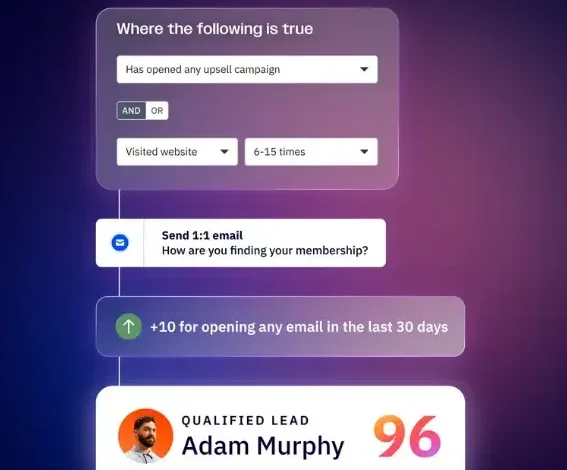
Sales teams today are no longer struggling with a lack of leads; instead, the critical challenge lies in discerning which leads genuinely matter amidst an overwhelming volume of incoming data. The proliferation of digital touchpoints, coupled with fragmented tools, manual qualification processes, and often subjective scoring methodologies, frequently leads sales professionals to misprioritize prospects, thereby significantly elongating sales cycles. Industry data from HubSpot highlights this inefficiency, revealing that a substantial 28% of sales professionals identify lengthy sales processes as the primary reason promising prospects withdraw from potential deals. This pressing issue underscores the urgent need for more sophisticated and efficient lead qualification mechanisms, which lead scoring automation tools are designed to provide.
By implementing robust lead scoring automation software, organizations can streamline workflows for sales representatives, enhance overall sales process efficiency, and foster better alignment between sales and marketing objectives. These advanced platforms consolidate data from disparate customer touchpoints, apply consistent and data-driven scoring logic, and deliver real-time insights directly to sales teams. This unified approach empowers sales professionals to concentrate their efforts on selling to the most promising prospects, rather than expending valuable resources on less qualified leads. For B2B organizations, deploying the right lead scoring automation tool is pivotal for reducing departmental misalignment, accelerating sales velocity, and ultimately focusing on leads with the highest probability of conversion.
This comprehensive guide delves into the intricacies of lead scoring automation software, exploring its fundamental principles, operational mechanisms, and the essential features that define best-in-class solutions. It also spotlights several leading lead scoring automation tools poised to make a significant impact in 2026, offering detailed insights into how these platforms can curtail manual effort, enhance synergy between sales and marketing departments, and deliver measurable improvements in conversion rates and overall sales efficiency.
The Evolving Landscape of Lead Qualification: From Guesswork to Data-Driven Precision
The evolution of sales and marketing has been marked by a continuous quest for efficiency and precision. In an earlier era, lead qualification was often a largely manual and intuitive process, heavily reliant on the experience and judgment of individual sales representatives. Leads might be sourced through cold calling, trade shows, or basic web inquiries, with qualification often occurring through initial conversations or rudimentary demographic filters. However, as the internet expanded and digital marketing channels proliferated, businesses began to generate leads at an unprecedented scale. This surge in lead volume, while ostensibly positive, created a new challenge: how to effectively manage, assess, and prioritize a continuously growing pool of prospects.
The sheer volume of data points available today—ranging from website visits and email opens to content downloads, social media interactions, and CRM activities—has made manual qualification increasingly untenable. Sales teams faced "lead fatigue," drowning in a sea of contacts without a clear method to identify those most likely to convert. This context gave rise to the initial forms of lead scoring, which typically involved assigning points based on predefined demographic and behavioral criteria. While a significant improvement, these early rules-based systems often struggled with dynamism and the capacity to adapt to rapidly changing buyer behaviors.

The modern B2B buyer journey is rarely linear; it involves multiple touchpoints across various channels, often with several stakeholders involved in the decision-making process. Understanding and responding to this complex journey requires a sophisticated approach to lead qualification. This is where lead scoring automation tools have become indispensable, transforming lead management from an art based on guesswork into a science powered by data and automation. These tools represent a crucial step in enabling revenue teams to navigate the complexities of the contemporary sales landscape, ensuring that valuable resources are directed towards genuinely high-potential opportunities.
Understanding Lead Scoring Automation Tools
At their core, lead scoring automation tools are sophisticated software platforms designed to systematically assign numerical values to leads. This scoring is based on a predefined set of criteria, observed behavioral patterns, and, increasingly, predictive signals. Their primary function is to automatically evaluate prospects by analyzing a wide array of attributes in real-time. These attributes can include explicit data such as job title, company size, and industry, as well as implicit data like website engagement, email interactions, and content consumption patterns. This automated, continuous scoring process replaces manual qualification, providing sales teams with an always up-to-date assessment of a lead’s potential.
Lead scoring automation software generally falls into two primary categories, each with distinct methodologies and advantages:
-
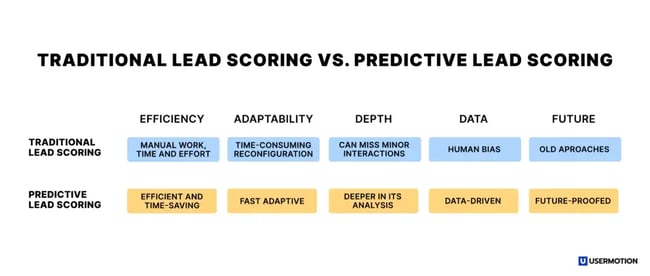
Traditional (Rules-Based) Lead Scoring: This approach relies on explicitly defined rules and criteria set by marketing and sales teams. Points are assigned or deducted based on specific actions or demographic information. For example, a lead downloading an eBook might gain 5 points, while a C-level executive from a large company might automatically start with 20 points. Conversely, a lead from an unqualified industry might lose points. This method is transparent and easy to understand, allowing teams to directly control the scoring logic based on their ideal customer profile (ICP) and historical knowledge. It works best when the criteria for a good lead are well-understood and relatively stable.
-
Predictive Lead Scoring: Leveraging advanced analytics and machine learning (ML) algorithms, predictive lead scoring moves beyond manual rules. Instead of relying on human-defined scores, these tools analyze historical data (e.g., past conversions, closed-won deals) to identify patterns and correlations that indicate a higher likelihood of conversion. The ML models automatically weigh various attributes and behaviors, often uncovering non-obvious signals that contribute to successful outcomes. This method offers greater accuracy, scalability, and adaptability, as it can continuously learn and refine its scoring logic based on new data and evolving market dynamics. Predictive models are particularly valuable for organizations with high lead volumes and complex sales cycles where manual rule sets become cumbersome and less effective.
Both traditional and predictive approaches share the overarching goal of simplifying effective lead management. They empower revenue teams to prioritize outreach efforts, allocate sales resources more efficiently, and focus their selling activities on prospects who are most likely to convert into paying customers.

How Lead Scoring Automation Tools Work: A Deeper Dive
The operational efficacy of lead scoring automation tools hinges on their ability to ingest, process, and interpret vast amounts of data across the entire customer journey. These tools function through a series of integrated steps, culminating in a composite score that quantifies a lead’s purchase intent or qualification level.
The typical workflow of a lead scoring solution involves:
- Data Ingestion: The process begins by collecting data from numerous sources. This includes CRM systems, marketing automation platforms, website analytics, email marketing tools, social media, and even third-party data enrichment services. Key data points captured include demographic information (job title, company size, industry), behavioral data (pages visited, forms submitted, emails opened, content downloaded, webinar attendance), and engagement history.
- Application of Scoring Logic: Once data is ingested, the system applies its predefined scoring logic. In rules-based systems, this involves assigning points based on the established criteria. For predictive models, the ingested data is fed into machine learning algorithms that analyze patterns from historical conversions to calculate a probability score.
- Real-time Score Updates: A crucial aspect of modern lead scoring is its dynamic nature. As a lead interacts with new touchpoints or updates their profile, the tool automatically recalculates and updates their score in real-time. This ensures that sales teams always have the most current view of a lead’s qualification status and level of engagement.
- Integration and Actionable Insights: The final score is then integrated back into the CRM or sales engagement platform, often triggering automated workflows. This could include notifying a sales rep about a high-scoring lead, assigning the lead to a specific sales pipeline, or initiating a targeted nurturing campaign.
The underlying components enabling these functionalities are:
- Centralized Data Repository: A unified database that aggregates all relevant lead data, eliminating silos between marketing and sales systems.
- Scoring Engine: The core algorithm (rules-based or machine learning) that processes data and assigns scores.
- Integration Capabilities: Connectors that allow the tool to seamlessly pull data from and push scores to various third-party applications (CRM, email platforms, web analytics).
- Workflow Automation: Features that enable automated actions (alerts, task assignments, segmentation) based on score thresholds.
- Reporting and Analytics: Dashboards and reports that provide insights into scoring model performance, lead quality trends, and conversion rates.
Essential Features for Best-in-Class Lead Scoring Automation Software
When evaluating and selecting from the diverse array of B2B lead scoring automation tools available, it is imperative to look beyond superficial functionalities. The most effective lead scoring platforms are distinguished by a set of core features that collectively ensure accuracy, dynamism, and seamless integration with broader sales and marketing operations. These features are critical for preventing fragmented decision-making and empowering revenue teams to operate with maximum efficiency.
1. Customizable Scoring Criteria
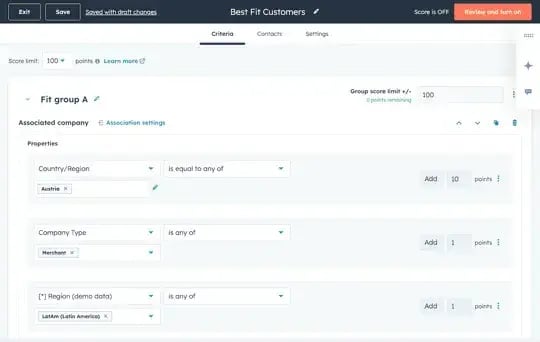
Accurate lead scoring must precisely reflect an organization’s unique business model, ideal customer profile (ICP), and specific buying journey, rather than relying on generic industry assumptions. The leading B2B lead scoring automation tools provide extensive flexibility, enabling teams to assign scores based on a granular combination of explicit demographic and firmographic attributes (such as job title, company size, industry, or revenue) and implicit behavioral signals (like website page views, content downloads, email clicks, form submissions, or interaction frequency). This high degree of customization ensures that lead scores are perfectly aligned with what constitutes a truly valuable prospect for a given business, moving beyond one-size-fits-all approaches.
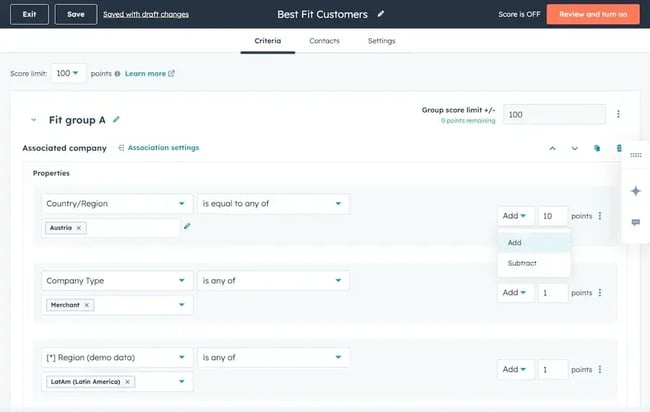
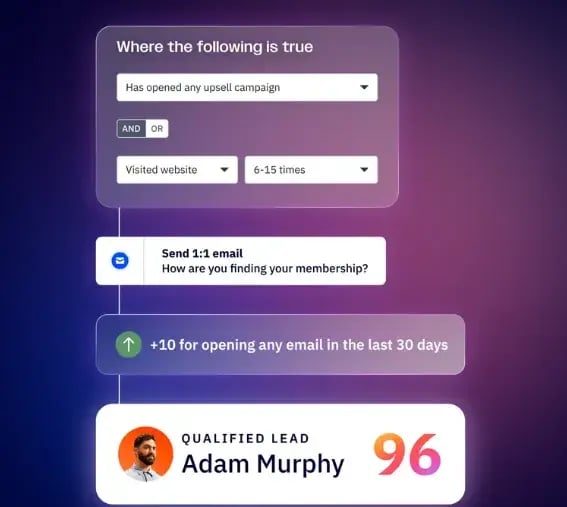
For example, HubSpot’s Lead Scoring software allows users to construct highly tailored lead scoring models using both explicit data (e.g., contact and company properties) and implicit data (e.g., engagement with marketing assets and website behavior). This capability empowers teams to:
- Define positive and negative scoring events: Award points for desired actions and subtract points for undesirable ones (e.g., visiting a career page).
- Segment leads based on score thresholds: Automatically categorize leads into different stages (e.g., Marketing Qualified Lead, Sales Qualified Lead).
- Prioritize outreach: Ensure sales teams focus on the most engaged and qualified prospects.
Such adaptability makes platforms like HubSpot practical for businesses ranging from small and medium-sized enterprises (SMBs) to rapidly scaling teams and large enterprises.
2. Real-time Score Updates Based on Behavior
The value of lead scoring diminishes rapidly if it does not dynamically update as soon as a prospect takes a new action. The most effective lead scoring tools are engineered to automatically recalculate and adjust scores in real-time whenever leads engage with critical touchpoints. This immediate responsiveness is crucial, as it allows sales teams to react at the precise moment a prospect demonstrates heightened intent, rather than operating on outdated qualification signals.
HubSpot’s Lead Scoring Software exemplifies this capability by dynamically updating lead scores as contacts interact with various marketing and sales assets, including emails, landing pages, forms, advertisements, and website content. This continuous updating ensures that sales teams always have access to the most current qualification status directly within their CRM, enabling timely and relevant follow-up actions. This immediacy significantly shortens response times, a critical factor in competitive sales environments.
3. Unified Data Across Marketing and CRM Systems
Fragmented data is a significant impediment to accurate and effective lead scoring. When marketing activity data resides in one system and CRM records in another, a complete view of the buyer’s journey is impossible, leading to incomplete or misleading lead scores. Consequently, lead scoring software that natively connects and synchronizes marketing activity data with CRM records is paramount. This unification ensures that lead scores are a holistic reflection of all buyer interactions, eliminating reliance on siloed systems or partial data sets.
HubSpot’s Lead Scoring Software is designed to unify CRM and Marketing data inherently, thereby negating the need for complex data stitching or manual reconciliation. This seamless integration ensures that all marketing techniques and sales efforts are perfectly aligned, working from a single, consistent source of truth regarding lead quality and intent. Such a unified data architecture is fundamental for creating accurate lead scores and fostering true sales-marketing collaboration.
4. Scalable Logic That Supports Automation and Growth
As organizations expand and their sales and marketing processes mature, their lead scoring mechanisms must possess the inherent capacity to scale alongside this growth. Best-in-class lead scoring software includes advanced features that support sophisticated automated workflows, precise segmentation, and efficient handoffs to sales, all without demanding constant manual intervention or extensive technical setup. This scalability ensures that the lead scoring system remains effective and manageable, even as lead volumes and process complexities increase.
HubSpot’s Lead Scoring Software seamlessly integrates lead scoring with its powerful workflow automation, list segmentation, and lifecycle automation capabilities. This integration empowers teams to scale their operations and foster growth with remarkable ease. Within the HubSpot ecosystem, once a lead achieves a predefined score threshold, teams can automatically trigger a series of next steps. These actions might include sending immediate sales notifications, automatically assigning the lead to the most appropriate sales owner, or advancing the contact to the next stage within the sales lifecycle. This level of automation not only boosts efficiency but also ensures consistency in how high-value leads are handled.
Spotlight on Leading Lead Scoring Automation Tools
Choosing the right lead scoring automation tool can be the pivotal factor distinguishing sales teams that merely chase cold leads from those that consistently close deals with high-intent buyers at precisely the right moment. The market offers a variety of solutions, each with unique strengths and target audiences. Here are five prominent lead scoring tools that consistently stand out for their capabilities and impact:
1. HubSpot Lead Scoring Software
G2 rating: 4.4/5
Best for: Mid-market and enterprise companies seeking unified sales and marketing platforms with sophisticated scoring capabilities.
HubSpot’s Lead Scoring software provides robust, enterprise-grade lead scoring capabilities embedded within its comprehensive, unified CRM platform. This ecosystem integrates marketing automation, sales engagement, customer service, and operations tools, offering a holistic view of the customer journey.
Leveraging a vast integration ecosystem, HubSpot’s lead scoring software can ingest behavioral data from a multitude of channels, extending beyond its native tools. It supports both traditional rules-based scoring, catering to organizations preferring explicit criteria, and advanced predictive lead scoring powered by machine-learning algorithms. These algorithms automatically analyze conversion patterns, identifying subtle indicators of intent. Its powerful workflow engine facilitates complex logic, including score-decay rules that automatically reduce the scores of inactive prospects. This ensures sales teams remain focused on currently engaged opportunities, preventing wasted effort on historically qualified leads that have since gone cold.
Core Features:
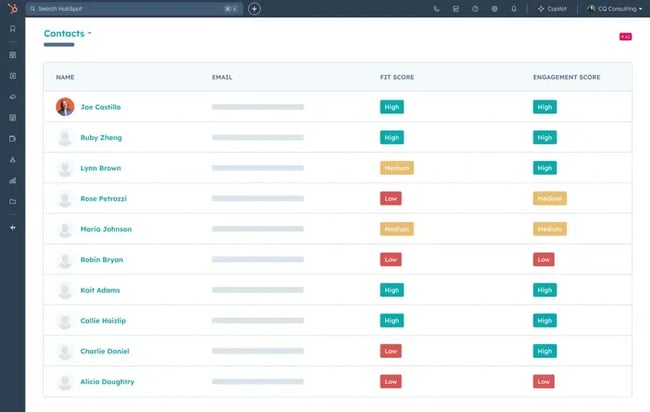
- Customizable Lead Scoring Models: Build scores based on explicit (demographic, firmographic) and implicit (behavioral) data.
- Predictive Lead Scoring (Enterprise): AI-driven models that learn from historical data to forecast conversion likelihood.
- Seamless CRM Integration: Native integration with HubSpot CRM for a unified view of lead data and scores.
- Automated Workflows: Trigger sales tasks, notifications, and lead assignments based on score thresholds.
- Score Decay Functionality: Automatically reduces points for inactive leads, maintaining score relevance.
Free trial: Yes
Pricing: Lead scoring is available in premium editions of Marketing Hub. Standard contact scoring is available in premium editions of all Hubs. Marketing Hub’s Professional Plan costs $800/month for 3 users, and the Enterprise Plan costs $3,600/month for 5 users. Teams needing only manual scoring can start with the Starter Plan ($9/month per seat for 1,000 marketing contacts).
What we like: HubSpot’s standout strengths are its seamless integration and user-friendliness. Lead scoring is not an isolated feature but an integral part of the customer lifecycle within the platform. The balance between rules-based and predictive scoring allows teams to start simply and evolve their approach.
Potential limitation: The comprehensive feature set and unified platform can lead to a higher price point, which might be restrictive for smaller companies or those with limited budgets.
2. Salesmate Lead Scoring Software
G2 rating: 4.7/5
Best for: Growing teams looking for an affordable CRM that includes basic lead scoring, integrated sales activity tracking, and multi-channel engagement.
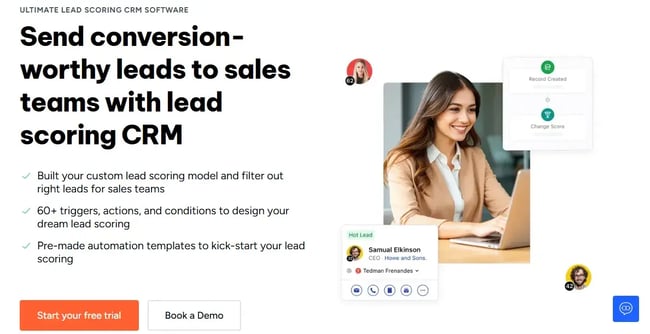
Salesmate CRM incorporates a lead scoring module that assesses leads based on their behavior, engagement levels, and demographic or firmographic criteria. This scoring system is directly integrated with Salesmate’s pipeline and task management features, enabling sales teams to efficiently prioritize high-potential prospects while automatically triggering follow-ups and reminders. It provides a straightforward path to connecting lead quality directly with sales actions.
Core Features:
- Customizable Scoring Rules: Define criteria based on lead attributes and engagement.
- Integrated CRM: Directly links lead scores to sales pipelines and contact records.
- Activity Tracking: Monitors email opens, website visits, and other interactions to inform scoring.
- Automated Follow-ups: Trigger tasks and reminders based on lead scores.
Free trial: Yes
Pricing: The Basic Plan is $23 per user/month, the Pro Plan is $39 per user/month, and the Business Plan is $63 per user/month.
What we like: Salesmate offers a solid balance of CRM functionality and lead scoring at a reasonable price, making it accessible for smaller teams looking to get started quickly. Its direct connection between scoring and actionable sales workflows eliminates the need for separate systems.
Potential limitation: Some users have reported that customer support responsiveness could be improved, which might be a consideration for teams requiring immediate assistance.
3. ActiveCampaign Lead Scoring Software
G2 rating: 4.5/5
Best for: Businesses prioritizing lead scoring deeply integrated with email and WhatsApp marketing automation.
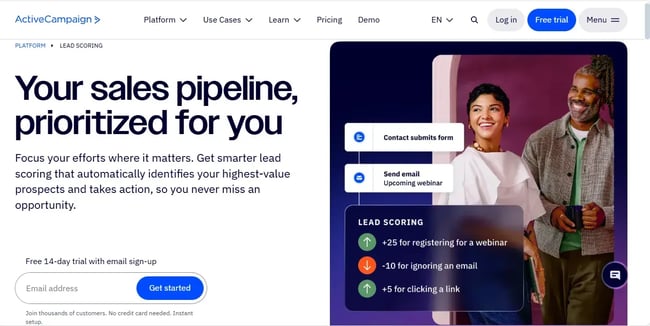
ActiveCampaign’s lead scoring capabilities allow teams to assign scores to leads based on a wide range of engagement behaviors, including email opens, clicks, website visits, and form submissions, as well as custom rules defined by user properties. The platform uniquely integrates this scoring directly with ActiveCampaign’s powerful email and WhatsApp automation workflows. This makes it exceptionally easy to trigger specific nurturing sequences, sales alerts, or segmentation based on evolving lead scores. While primarily rules-based, ActiveCampaign’s scoring offers sufficient flexibility for teams to model complex multi-channel behaviors and establish dynamic thresholds for subsequent follow-ups.
Core Features:
- Behavioral Scoring: Assign points based on email opens, link clicks, website activity, and form fills.
- Custom Rules: Define specific scoring criteria based on contact properties.
- Deep Marketing Automation Integration: Directly links scores to email and WhatsApp campaigns.
- Segmentation Capabilities: Automatically add leads to specific lists or segments based on their score.
Free trial: Yes
Pricing: Lead scoring functions are available as add-ons, starting with the Plus version at $49/user/month for the Email version. Exact charges vary based on the number of users and chosen channels (Email, WhatsApp, or both).
What we like: ActiveCampaign excels at combining lead scoring with robust marketing automation within a single platform, making it an attractive option for teams focused on nurturing through these channels. Its pricing can be appealing for teams just starting out, offering significant capabilities without requiring a complex CRM setup initially.
Potential limitation: Reviews suggest that costs can increase significantly as the contact list grows, necessitating careful long-term cost evaluation by potential buyers, beyond just the entry price.
4. Zapier for Lead Scoring Automation
G2 rating: 4.5/5
Best for: Teams seeking highly flexible, cross-platform lead scoring automation without necessarily adding a dedicated, standalone scoring tool.
Zapier, while not a traditional, dedicated lead scoring system, provides an incredibly versatile platform for building automated workflows (known as "Zaps") that can assign or update lead scores across a multitude of disparate platforms. It empowers dynamic, rules-based scoring by connecting triggers from various CRMs, web forms, marketing automation tools, spreadsheets, and other applications. This makes Zapier an ideal solution for organizations with a fragmented toolset that still require automated lead prioritization.
Core Features:
- Multi-Platform Integration: Connects thousands of apps to build custom scoring workflows.
- Rules-Based Automation: Define if/then logic to add or subtract points based on actions across connected apps.
- Flexible Data Flow: Transfer lead data and scores between different systems seamlessly.
- No-Code Automation: Enables users to build complex workflows without programming knowledge.
Free trial: Yes
Pricing: A free tier is available; Paid plans offer more features, higher task limits, and support for a larger number of users, starting at $19.99/month for the Professional Plan and $69/month for the Team Plan. Enterprise Pricing is available upon request.
What we like: Many users praise Zapier for its simplicity and ease of use in creating powerful integrations. It allows for modeling a wide range of scoring logic without requiring custom code, making it particularly strong for organizations using multiple, unconnected tools.
Potential limitation: Its native lead scoring features are inherently more limited compared to dedicated platforms. Costs can also accumulate quickly with numerous integrations and high task volumes, requiring careful management of usage.
5. Pipedrive Score CRM
G2 rating: 4.3/5
Best for: Small to mid-sized sales teams that prefer built-in lead scoring capabilities within their existing CRM.
Pipedrive Score CRM is a sales-centric lead scoring feature seamlessly integrated into the broader Pipedrive CRM platform. It specifically helps sales teams qualify and prioritize prospects based on custom criteria directly within their sales workflow. The tool enhances lead profiles by enriching them with web-sourced contact data and automates various administrative tasks, such as email triggers, deal updates, and notifications, thereby significantly reducing manual busywork. Its intuitive visual pipeline offers sales teams clear visibility into which leads are closest to conversion, enabling them to take timely action rather than indiscriminately chasing every new contact.
Core Features:
- Custom Lead Scoring: Define scoring rules based on fit and engagement criteria.
- Native CRM Integration: Lead scoring is a core feature within the Pipedrive CRM, ensuring a unified experience.
- Lead Enrichment: Automatically pulls additional contact and company data from the web.
- Automated Administrative Tasks: Streamlines follow-ups, notifications, and pipeline updates.
- Visual Pipeline Management: Integrates scores into an easy-to-understand sales pipeline view for prioritization.
Free trial: Yes
Pricing: While basic plans start at $14/user/month, lead scoring features are available starting with the Premium tier, priced at $49/user/month, and the Ultimate tier, priced at $69/user/month.
What we like: Pipedrive’s strength lies in its simplicity and deep integration of lead scoring directly within its CRM. Teams don’t need to switch between applications to understand lead quality, and the visual pipeline makes prioritization exceptionally clear and actionable.
Potential limitation: Based on user reviews, some integration issues and relatively limited customization options compared to more extensive platforms have been noted, which might affect highly specialized sales processes.
Strategic Implications and Future Directions for Lead Scoring Automation
The adoption of lead scoring automation tools carries significant strategic implications for businesses aiming to optimize their revenue generation processes. Beyond mere efficiency gains, these tools fundamentally reshape how sales and marketing functions interact and contribute to overall organizational growth.
Enhanced Sales-Marketing Alignment: One of the most profound impacts of a well-implemented lead scoring system is the fostering of greater alignment between sales and marketing teams. By collaborating to define scoring criteria, both departments gain a shared understanding of what constitutes a "good" lead. Marketing can focus on generating leads that meet these agreed-upon standards, while sales can trust that the leads handed over are genuinely qualified and ready for engagement. This shared objective reduces friction, improves lead handoff efficiency, and creates a unified revenue engine.
Optimized Resource Allocation: In any sales organization, time is a finite and precious resource. Lead scoring automation ensures that sales representatives invest their time and effort into prospects with the highest conversion potential. By systematically prioritizing leads, businesses can allocate their most experienced reps to top-tier opportunities, dedicate nurturing efforts to warm leads, and automate initial outreach for less qualified prospects. This strategic allocation maximizes the return on investment for sales efforts.
Accelerated Sales Cycles and Improved Conversion: The ability to identify and act on high-intent leads in real-time is a powerful accelerator for the sales cycle. Instead of waiting for manual qualification or sifting through large lists, reps can immediately engage with prospects who have demonstrated specific buying signals. This timeliness not only shortens the sales process but also significantly improves conversion rates, as engagement occurs when the prospect’s interest is at its peak. Data from various industry reports consistently show that companies leveraging advanced lead scoring see measurable increases in conversion rates and reductions in time-to-close.
The Role of AI and Machine Learning: The future of lead scoring is inextricably linked with advancements in artificial intelligence and machine learning. Predictive models are becoming increasingly sophisticated, capable of analyzing vast datasets to uncover subtle buying signals that human-defined rules might miss. As these technologies mature, they will offer even greater accuracy and adaptability, continuously refining scoring models based on real-world outcomes and evolving market conditions. This continuous optimization moves businesses closer to a truly proactive and intelligent sales process.
Key Questions on Lead Scoring Implementation
As organizations consider or refine their lead scoring strategies, several common questions arise regarding best practices and operational considerations.
When should you switch from rules-based scoring to predictive?
The transition from rules-based to predictive lead scoring is typically warranted when an organization reaches a critical mass of lead volume and possesses sufficient historical outcome data (e.g., won vs. lost deals). Rules-based scoring is highly effective for businesses with well-defined ideal customer profiles and moderate lead volumes, where the criteria for qualification are clear and stable. However, as lead volumes grow, buyer journeys become more complex, and human assumptions underlying rules-based systems can quickly become outdated or fail to capture nuanced conversion patterns. Predictive models, by contrast, excel at analyzing vast datasets to identify subtle, often non-obvious correlations between lead attributes, behaviors, and actual conversion outcomes. They offer superior accuracy and scalability, making the switch beneficial when manual rule management becomes unwieldy or when a higher degree of predictive power is required to optimize resource allocation at scale.
How often should you retrain predictive lead scoring models?
Regular retraining of predictive lead scoring models is a critical best practice to ensure their continued accuracy and relevance in dynamic market environments. Industry best practices suggest retraining models at least quarterly. However, more frequent retraining (e.g., monthly) may be beneficial for fast-changing industries, businesses with rapidly evolving product offerings, or when monitoring indicates a degradation in model performance. To determine retraining needs outside of a preset schedule, teams should continuously monitor and compare the model’s predicted conversion likelihoods against actual sales outcomes. Significant discrepancies or a noticeable decline in predictive accuracy serve as clear signals that intervention and retraining are required to realign the model with current buyer behavior and market realities.
What data sources should be included or excluded in your scoring engine?
Effective lead scoring models necessitate the inclusion of a comprehensive array of reliable data sources to capture a complete picture of a lead’s fit and intent. Essential data categories include:
- Behavioral Data: Website visits, page views, content downloads, email opens/clicks, webinar attendance, demo requests.
- Demographic Data: Job title, role, seniority, geographic location.
- Firmographic Data: Company size, industry, revenue, technology stack (technographic data).
- Historical CRM Outcome Data: Crucially, data on past closed-won and closed-lost deals is vital for predictive models to learn what factors truly drive conversions.
Regarding exclusion, external enrichment sources, such as third-party intent data or broader technographic signals, can enhance predictive accuracy, but only if the data is consistently reliable, ethically sourced (permissioned), and demonstrably tied to real buying behavior. Without robust certainty about the quality, consistency, and relevance of external data, it is often advisable to exclude it. Low-quality or irrelevant external data can introduce noise rather than signal, leading to reduced model accuracy and misinformed prioritization.
How do you keep AI lead scoring explainable for sales and leadership?
Maintaining the explainability of AI lead scoring is crucial for building trust and driving adoption among sales teams and leadership, ensuring that scores are perceived as actionable insights rather than "black-box" outputs. To achieve this:

- For Sales Teams: The scoring system should ideally provide visibility into the top contributing factors behind each lead’s score. For instance, a sales rep should be able to quickly see that a lead scored highly due to recent visits to the pricing page, repeat product demo engagements, or a strong match to the ideal customer profile of historically closed-won accounts. This clarifies why a particular lead has been prioritized and provides actionable context for outreach.
- For Leadership: Explainability stems from ongoing validation, transparent reporting, and continuous alignment. Leadership needs to understand how the scoring model is performing against actual conversion outcomes, which signals consistently drive revenue, and how the scoring logic is being adapted in response to evolving go-to-market strategies. Regular reviews of model performance, coupled with clear documentation of scoring criteria and their business rationale, are essential. When scoring criteria, performance metrics, and overarching business goals remain aligned and transparent, AI recommendations become easier to trust, understand, and act upon.
From Guesswork to Intelligent Lead Scoring
Lead scoring automation has fundamentally transformed from rudimentary point-based rules into highly intelligent systems. These sophisticated platforms now seamlessly combine rich behavioral data, advanced predictive analytics, and real-time workflows to empower revenue teams to focus their efforts on what genuinely drives growth. Implementing the right B2B lead scoring tools is instrumental in eliminating time-consuming manual qualification, significantly reducing friction and misalignment between sales and marketing, and enabling teams to engage with high-intent leads at the optimal moment.
However, the most substantial gains derived from lead scoring automation are not merely a function of selecting a particular tool. True competitive advantage stems from an unwavering commitment to establishing a scoring system that accurately reflects an organization’s real business priorities and ideal customer profiles. This system must then be continuously refined and adapted as markets evolve, buyer behaviors shift, and go-to-market strategies are adjusted. The most effective tools are those that robustly support this iterative process, offering flexible scoring models, a unified data architecture, and tight integration with core sales execution workflows.
HubSpot’s Lead Scoring tools exemplify this comprehensive approach, delivering both rules-based and advanced predictive scoring capabilities within a seamlessly unified CRM ecosystem. By embedding lead scoring directly into workflows, performance reporting, and lifecycle automation, HubSpot ensures that actionable insights are translated into timely engagement, while simultaneously providing the scalability necessary to grow alongside an organization’s evolving needs. The era of guesswork in lead qualification is giving way to an intelligent, data-driven approach, fundamentally reshaping the future of
Related posts: