The landscape of enterprise transformation is undergoing a seismic shift, not because Artificial Intelligence (AI) has fundamentally rewritten the rules, but because it has dramatically accelerated their application. The pervasive hype surrounding AI often suggests a complete overhaul of established business principles. However, a closer examination reveals that while AI has injected unprecedented speed and new terminology into the transformation process, the core tenets of success remain steadfast. Autonomous agents, capable of executing tasks at machine speed, are indeed forcing Chief Information Officers (CIOs) and other leaders to manage value, risk, and strategic alignment in near real-time. This is a significant evolution, but it represents an intensification of existing challenges rather than a departure from them.
The Enduring Pillars of Transformation Success
Despite the dazzling advancements in AI, the fundamental ingredients for successful enterprise transformation remain unchanged. Strategy, once a deliberate, often lengthy process, now demands an even greater degree of precision, as poorly conceived strategies are exposed and fail much faster. The expectation for measurable outcomes, a long-standing metric of credibility, is now amplified, with stakeholders anticipating results at an accelerated pace. Furthermore, capability assessments are more critical than ever, with the crucial addition of integrating generative AI and its supporting technologies into an enterprise’s existing toolkit. In essence, the language and tools of transformation have evolved, but the underlying exercise – the strategic imperative to adapt and improve – remains the same.
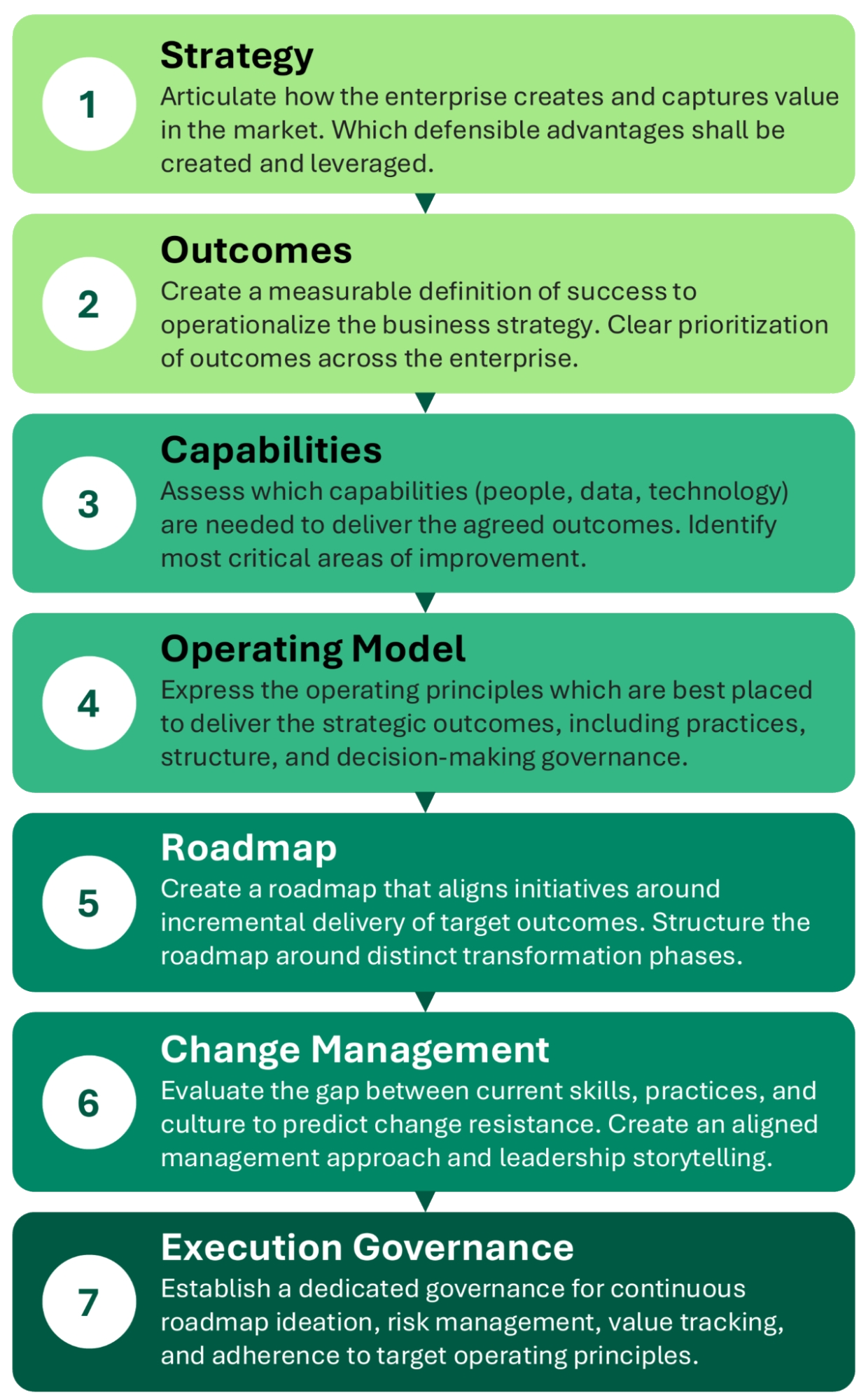
This perspective is echoed in established frameworks for enterprise transformation. A typical program, regardless of technological advancements, generally follows a structured path. This often begins with defining a clear vision and strategic objectives, followed by a comprehensive assessment of current capabilities, including technology, talent, and processes. The subsequent phases involve designing the future state operating model, developing a roadmap for execution, and crucially, managing organizational change to ensure adoption and buy-in. Finally, continuous monitoring and iteration are vital for sustained success. AI’s impact lies in its ability to compress these phases, demanding agility and a heightened focus on execution within each step.
What, Then, is Truly New?
The undeniable novelty lies in the velocity and scale at which AI enables these established processes. Generative AI, in particular, has captured the imagination of businesses worldwide. Its capacity to create novel content, automate complex cognitive tasks, and provide sophisticated analytical insights presents a powerful new set of tools. However, the core playbook for leveraging these tools effectively remains consistent:
- Strategic Decision-Making: Clearly deciding where to focus AI initiatives and how they align with overarching business goals is paramount.
- Outcome Definition: Defining specific, quantifiable outcomes that AI is expected to achieve ensures that investments are directed towards tangible business value.
- Capability Assessment: Understanding existing organizational capabilities and identifying the gaps that AI can fill, or the new capabilities it necessitates, is crucial.
- Operating Model Design: Integrating AI into the existing operating model, including decision-making processes, workflows, and governance, is essential for seamless adoption.
- Incremental Execution: Implementing AI solutions in manageable increments allows for learning, adaptation, and de-risking of larger deployments.
- Organizational Alignment: Bringing the entire organization along through clear communication, training, and change management is vital for widespread adoption and sustained impact.
The ultimate winners in this new era will be those organizations that can perform these fundamental tasks with exceptional proficiency, albeit at a significantly faster pace and with fewer opportunities for procrastination or excuse.
The AI Acceleration Effect: A Deeper Dive
The notion that AI has simply "sped up" enterprise transformation warrants further exploration. Consider the traditional timeline of a digital transformation initiative, which might have spanned several years. This often involved extensive planning, pilot projects, phased rollouts, and significant organizational adjustments. AI, particularly generative AI, can compress these timelines considerably.
For instance, in strategy formulation, AI can analyze vast datasets to identify emerging market trends, competitive landscapes, and customer preferences far more rapidly than human analysts. This allows organizations to pivot their strategies with greater agility. Similarly, outcome definition can be enhanced by AI’s predictive capabilities, enabling more accurate forecasting of potential results and risks.
The capability assessment phase is perhaps where AI’s impact is most direct. Generative AI can automate the creation of synthetic data for training other AI models, accelerate code generation, and even assist in identifying security vulnerabilities within existing systems. This means that an enterprise’s ability to adopt and leverage new technologies can be assessed and enhanced at an unprecedented speed.
When it comes to designing decision-making within the operating model, AI can inform more data-driven and real-time decisions. Autonomous agents, as mentioned, can execute tasks based on predefined parameters and learning, freeing up human resources for higher-level strategic thinking. This necessitates a re-evaluation of governance structures and accountability frameworks to effectively manage these intelligent agents.
Execution in increments becomes more feasible with AI. Instead of lengthy, large-scale projects, AI can enable rapid prototyping and iterative deployment of new features or services. This allows for continuous learning and adaptation based on real-world performance data. Finally, bringing the organization along is a perpetual challenge, but AI can aid in this by personalizing training materials, providing intelligent support to employees, and facilitating communication through advanced natural language processing.
Supporting Data and Industry Trends
The increasing investment in AI technologies underscores this acceleration. According to a recent report by Statista, global spending on AI is projected to reach $1.8 trillion by 2030, indicating a strong market confidence in AI’s transformative potential. This investment is not just in foundational AI research but in practical applications across various business functions.
A key area of impact is in customer engagement. Companies are leveraging AI-powered chatbots and virtual assistants to provide 24/7 customer support, answer queries, and even guide customers through complex purchasing decisions. This not only improves customer satisfaction but also frees up human agents to handle more nuanced and high-value interactions. The speed at which these interactions can occur, and the sheer volume of queries that can be handled simultaneously, represents a significant acceleration of traditional customer service models.
In product development and innovation, AI is revolutionizing R&D. Generative AI can assist in designing new materials, optimizing product configurations, and even simulating performance under various conditions. This dramatically reduces the time from concept to market. For instance, the pharmaceutical industry is using AI to accelerate drug discovery, identifying potential new compounds and predicting their efficacy at a pace unimaginable just a decade ago.
The marketing and sales functions are also experiencing profound changes. AI algorithms can personalize marketing campaigns, predict customer churn, and optimize pricing strategies in real-time. This allows for a much more dynamic and responsive approach to market engagement, moving away from static, batch-oriented processes. Forrester’s own research, as indicated in related content, highlights how AI is reshaping B2B brand and communications investments, with marketers becoming more selective about agency spend as AI enables more in-house capabilities. This suggests a shift in how organizations allocate resources and manage their external partnerships, driven by AI’s efficiency gains.
Timeline and Chronology of AI’s Influence
While AI has been a subject of research for decades, its widespread impact on enterprise transformation is a more recent phenomenon, accelerating significantly in the last few years, particularly with the advent of powerful generative AI models.
- Early 2010s: The rise of cloud computing and big data provided the foundational infrastructure for AI advancements. Machine learning algorithms began to gain traction in specific analytical applications.
- Mid-to-Late 2010s: Deep learning emerged as a breakthrough, leading to significant improvements in areas like image recognition and natural language processing. AI started to be integrated into enterprise solutions, albeit often in specialized roles.
- Early 2020s: The widespread availability of large language models (LLMs) and generative AI tools marked a pivotal moment. These technologies democratized access to advanced AI capabilities, enabling a broader range of applications and accelerating the pace of transformation across industries.
- Present Day: Enterprises are actively integrating generative AI into their core operations, focusing on efficiency, innovation, and enhanced decision-making. The challenge now is not just adopting AI but doing so strategically and responsibly.
This accelerated timeline means that organizations that were already on a transformation journey are now finding their existing plans being significantly compressed or requiring re-evaluation due to AI’s capabilities. The speed of iteration and the ability to quickly test and deploy new AI-driven solutions are becoming key competitive differentiators.
Implications and Broader Impact
The implications of AI acting as an accelerator rather than a disruptor of fundamental transformation principles are far-reaching.
For CIOs and IT Leaders: The primary challenge shifts from simply implementing new technologies to managing the immense speed and complexity that AI introduces. CIOs must now focus on establishing robust governance frameworks for AI, ensuring data privacy and security, and fostering a culture of continuous learning and adaptation within their IT departments. The need for near real-time management of value, risk, and alignment means that traditional IT project management methodologies may need to be rethought.
For Business Leaders: The pressure to demonstrate tangible results from AI investments will be immense. Leaders must possess a clear understanding of their strategic objectives and ensure that AI initiatives are directly contributing to these goals. The ability to make quick, informed decisions based on AI-generated insights will become a critical leadership skill. Misalignment between AI capabilities and business strategy can lead to wasted resources and missed opportunities.
For the Workforce: The acceleration of transformation means that employees will need to adapt to new tools and processes at a faster rate. Upskilling and reskilling initiatives will be more crucial than ever. While AI can automate many tasks, it also creates new roles focused on AI development, management, and ethical oversight. The key will be to leverage AI to augment human capabilities rather than replace them entirely, fostering a collaborative environment.
For Enterprise Strategy: The traditional notion of a multi-year strategic plan may become less relevant. Organizations will need to adopt more agile and iterative strategic planning processes, allowing for rapid adjustments in response to market dynamics and technological advancements. The ability to "decide where to play" will be an ongoing process, informed by continuous AI-driven analysis.
In conclusion, while the advent of AI, particularly generative AI, has undeniably transformed the how of enterprise transformation, it has not altered the fundamental why or the core what. The principles of sound strategy, measurable outcomes, capability development, and organizational alignment remain the bedrock of success. AI’s role is to supercharge these processes, demanding a higher level of agility, precision, and strategic foresight from organizations that wish to thrive in this accelerated era. The future belongs to those who can harness AI’s power not to circumvent established best practices, but to execute them with unprecedented speed and efficacy.