Driving Enterprise AI Adoption: Strategies for Go-To-Market Leaders to Bridge the Gap Between Pilot and Profit

The promise of artificial intelligence to revolutionize business operations, particularly within Go-To-Market (GTM) functions, remains largely untapped in many enterprises, despite widespread investment and pilot programs. While AI models demonstrate increasing sophistication, a significant chasm persists between technological capability and tangible business impact, primarily due to failures in organizational integration and employee adoption. This critical challenge underscores the urgent need for robust strategies to move AI from experimental projects to core operational assets that drive measurable growth and efficiency.
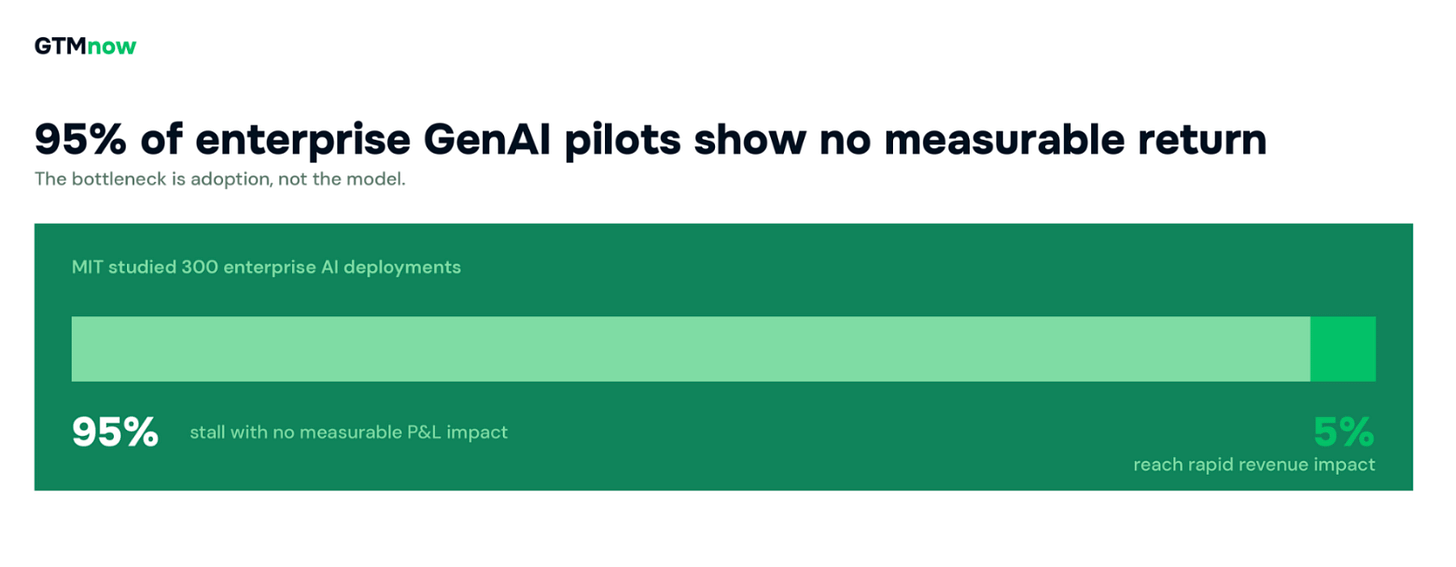
The rapid proliferation of generative AI (GenAI) tools has ignited a fervor across industries, with companies eager to leverage their transformative potential. However, a sobering report from MIT’s NANDA initiative, which analyzed over 300 enterprise deployments, revealed a stark reality: a staggering 95% of GenAI pilots failed to deliver any measurable impact on profit and loss statements. This finding challenges the common assumption that the models themselves are the primary impediment. Instead, the data unequivocally points to a systemic failure in integrating these advanced tools into daily workflows and securing widespread employee adoption.
This disconnect has given rise to a "shadow AI economy" within many organizations, where individual employees, recognizing the power of AI, independently experiment with various tools to enhance their personal productivity. While such grassroots innovation can be a positive indicator of demand, its value remains fragmented and limited when not scaled across teams. The true compounding effect of AI – the exponential gains in efficiency, insight, and strategic advantage – materializes only when an entire team or organization embraces and integrates these technologies collaboratively. Recognizing this pivotal moment, GTMnow Network conducted an extensive inquiry, engaging 21 prominent GTM leaders to uncover the practical strategies that successfully translate AI potential into concrete business outcomes. Their collective insights coalesce into six core approaches, each proven to significantly boost AI adoption and deliver tangible benefits.

The Strategic Imperative: Bridging the AI Adoption Gap
The journey from AI aspiration to operational reality is fraught with challenges, primarily human and organizational rather than purely technological. Leaders must navigate employee anxieties, overcome inertia, and establish clear pathways for integration. The competitive landscape demands not just access to AI, but its strategic and pervasive application to accelerate Go-To-Market speed and ultimately, growth trajectory.
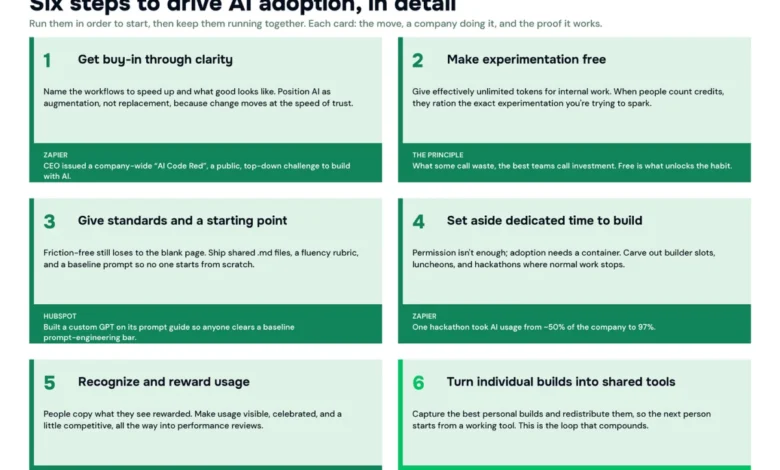
1. Cultivating Buy-in Through Unwavering Clarity
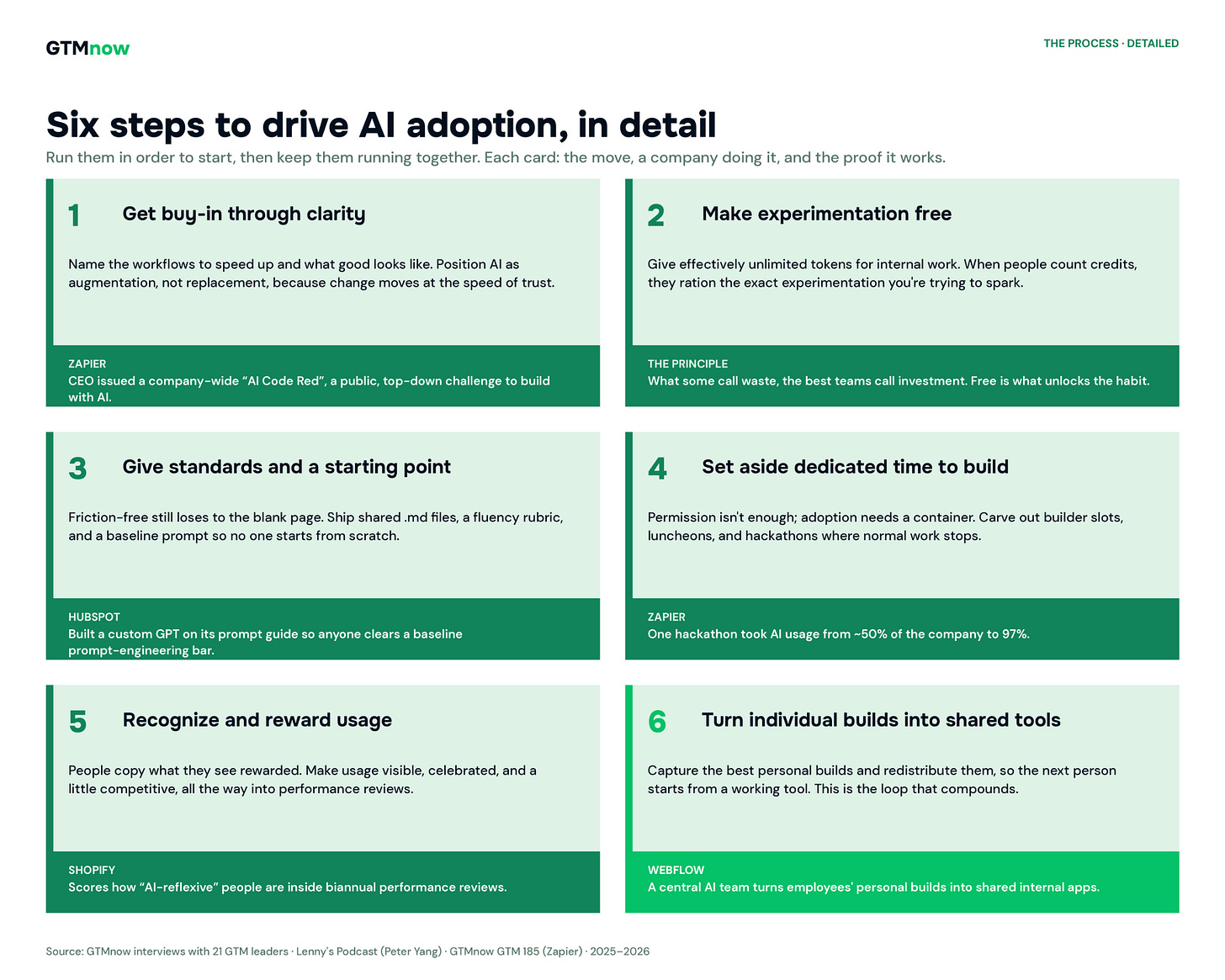
One of the foremost hurdles in AI adoption is the lack of clear direction and the pervasive fear of job displacement. Simply urging employees to "use AI more" is an abstract and ineffective mandate. Instead, leaders must articulate precise objectives: identify specific workflows targeted for acceleration, define what constitutes successful AI integration, and establish clear metrics for evaluating impact. This clarity transforms aimless experimentation into purposeful innovation.

The deeper, often unspoken, blocker is fear. Employees frequently perceive AI as a threat to their roles, leading to resistance or superficial engagement. Leaders who fail to address this fear head-on risk undermining any adoption initiative. It is imperative to explicitly position AI as an augmentation tool, designed to eliminate tedious, repetitive tasks and enhance human capabilities, rather than a replacement for human capital. This narrative shift, backed by transparent communication, is fundamental to building trust. As one GTM leader succinctly put it, "Change only happens at the speed of trust."
Zapier, a prominent automation platform, offers a compelling case study in driving clarity. In 2023, CEO Wade Foster issued a company-wide "AI Code Red," a public declaration challenging every employee to actively engage with AI and identify practical applications to enhance company operations. This top-down initiative succeeded because it framed AI as a shared responsibility for collective efficiency, explicitly dispelling notions of human replacement. By making it a company-wide mission with clear objectives, Zapier fostered an environment where employees felt empowered and motivated to explore AI’s potential, rather than threatened by it.
2. Decoupling Experimentation from Cost: The "Free Token" Strategy
The financial implications of AI tool usage, often measured in "tokens" or usage credits, can inadvertently stifle innovation. When every prompt carries a perceived cost, employees tend to ration their experimentation, thereby bottlenecking the very learning and discovery process that AI adoption requires. A consistently successful strategy identified by GTM leaders is to eliminate this friction by providing employees with effectively unlimited tokens for internal work and experimentation. This "free experimentation" model removes a significant barrier, encouraging broad engagement and uninhibited exploration of AI’s capabilities.

However, this strategy comes with an important caveat, as highlighted by examples like Amazon, which reportedly scaled back internal leaderboards tracking employee AI token consumption due to instances of "tokenmaxxing" – employees using tokens excessively without clear productive outcomes. This underscores a crucial distinction: while encouraging usage is vital early on to familiarize staff with the tools, the ultimate focus must shift from input (token usage) to output and measurable impact. Leaders should transition from tracking mere activity to evaluating concrete outcomes such as hours saved, new tools developed, inefficient workflows replaced, or roles where AI augmentation eliminates the need for backfilling. This ensures that experimentation is purposeful and contributes to organizational value.
3. Establishing Standards and Providing Starting Points
Even with free and unlimited access, the "blank page problem" can be a significant deterrent. Friction-free access is insufficient if employees lack clear standards or a practical starting point for their AI endeavors. Without benchmarks or guidance, individuals may struggle with prompt engineering, consistency, or understanding what "good" AI application looks like within their specific roles.
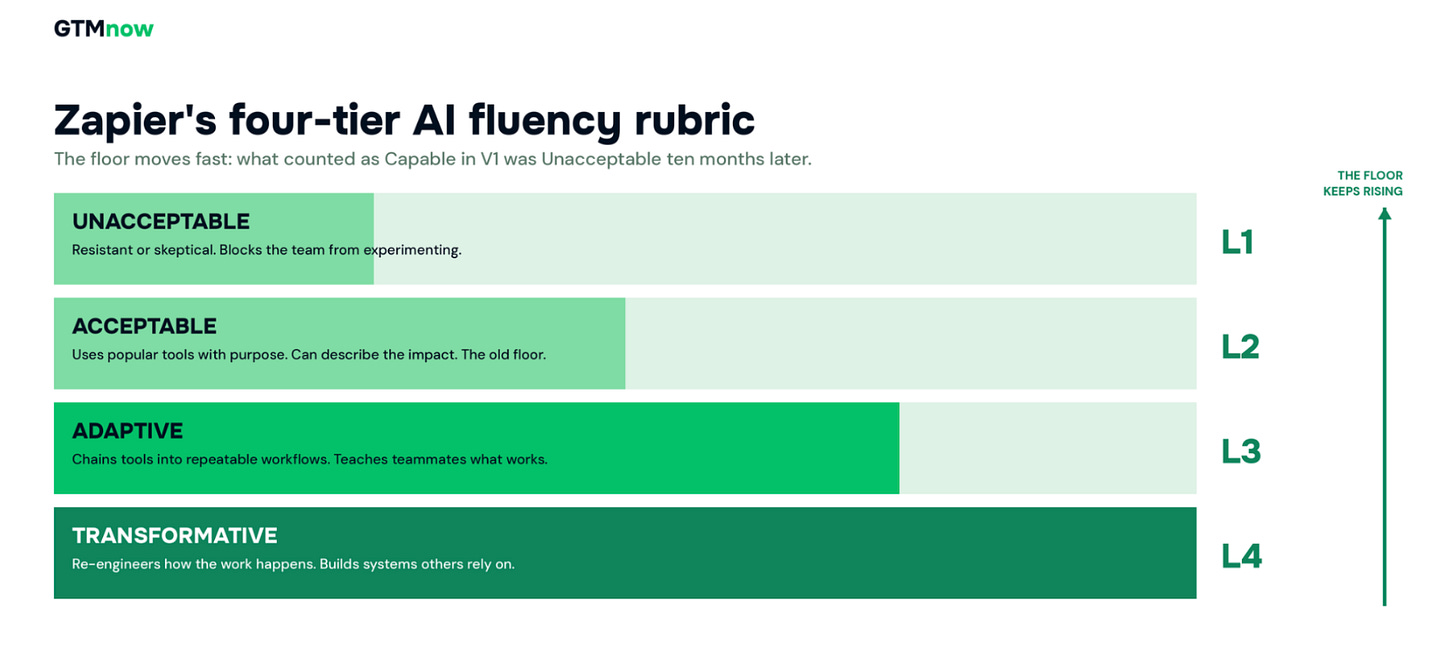
Zapier’s approach to this challenge is exemplary. They developed a four-tier AI fluency rubric, ranging from "Unacceptable" to "Acceptable," "Adaptive," and "Transformative." This rubric was co-created by identifying power users within each function and distilling their insights into baseline AI skills. This initiative transformed the abstract concept of "good AI usage" into a gradable and understandable framework. Critically, Zapier also recognized the dynamic nature of AI proficiency; what was considered "Acceptable" in the initial version of the rubric became "Unacceptable" just ten months later, emphasizing the need for continuous learning and adaptation. As Zapier leaders note, they now prioritize "slope" – how fast an individual is improving – over their current standing.
Complementing such rubrics, organizations can distribute shared assets, such as standard Markdown (.md) files containing essential context like the company’s Ideal Customer Profile (ICP), brand voice guidelines, or data definitions. This ensures that employees inherit necessary context for effective prompting rather than rebuilding it from scratch. Furthermore, treating prompting as a learnable skill, not an inherent talent, is crucial. HubSpot’s teams, for instance, leveraged a custom GPT built on a comprehensive prompt guide, enabling anyone to achieve a baseline level of prompt engineering proficiency from day one. This foundational support accelerates skill development and democratizes AI usage.
This shift in required competencies is also reshaping hiring practices. Companies like Nooks now explicitly test for "AI-literacy" by presenting candidates with an unfamiliar AI tool and observing their learning approach. This evaluates a candidate’s adaptability and willingness to engage with new technologies, reflecting the growing sentiment that AI proficiency is no longer a bonus but a fundamental job requirement for success in contemporary enterprises.
4. Allocating Dedicated Time for Building and Innovation
Permission alone is insufficient for driving deep AI adoption; it requires protected time. Merely telling employees they are "allowed" to use AI yields minimal results if their calendars remain saturated with traditional tasks that AI is intended to absorb. Leaders must actively carve out dedicated periods where standard work is paused, and the explicit mandate is to build and implement internal AI-powered workflows.
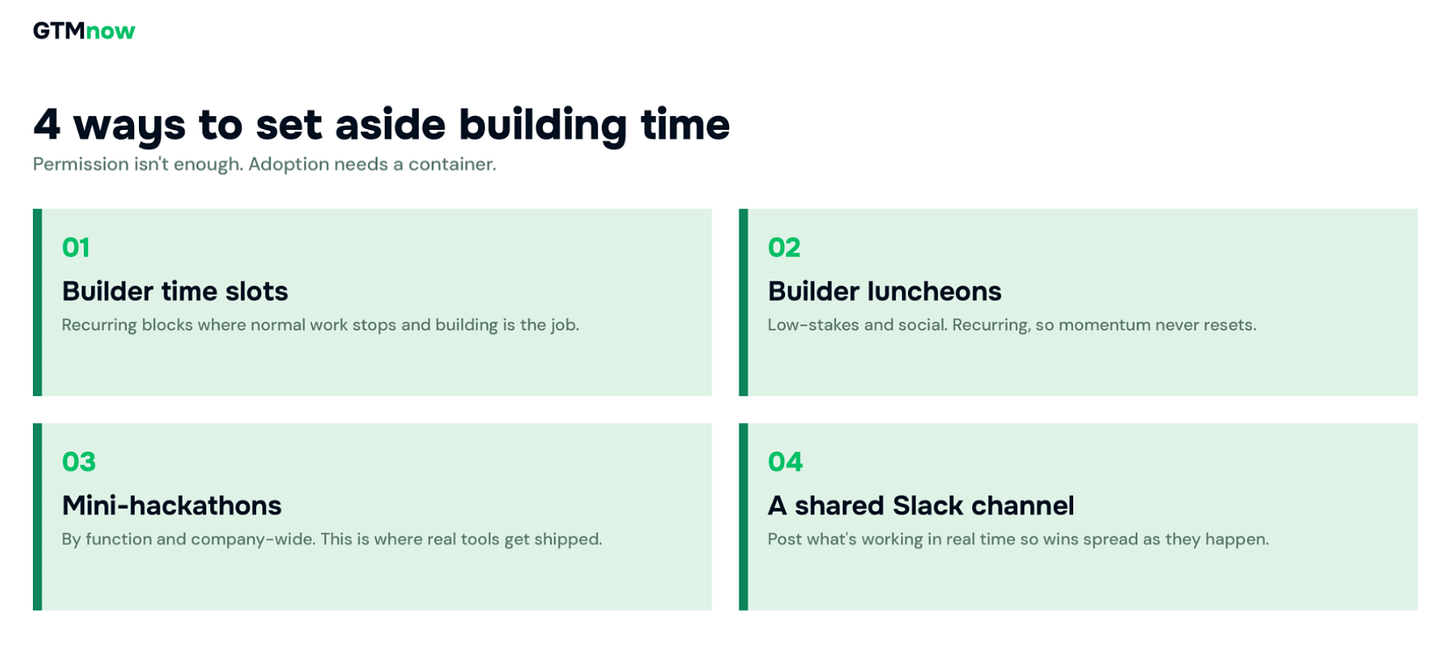
The most successful returns are observed when organizations deploy multiple "containers" for this dedicated time. This could involve recurring "builder time slots" where AI development is the primary focus for an hour or two, hosting "builder luncheons" to foster a social, low-stakes environment for collaborative experimentation, or organizing mini-hackathons tailored to specific functions or company-wide challenges. Maintaining a shared Slack channel where employees can post real-time discoveries and successful applications further amplifies learning and engagement. These structured opportunities not only provide the necessary bandwidth for experimentation but also generate crucial proof points that underpin the subsequent strategies for broader adoption.
5. Recognizing and Rewarding AI Pioneers
Human behavior is inherently influenced by incentives and recognition. When early AI adopters are publicly spotlighted, gain status, or receive additional resources, it creates a powerful ripple effect, encouraging more employees to follow suit. Conversely, if AI usage remains invisible, it will invariably remain optional. Leaders must actively make AI integration visible, celebrated, and even inject a healthy dose of competition.
A critical first step for leaders is to reframe their own role. Instead of presenting themselves as AI experts who will "teach" others, a more effective posture is to embrace the role of "chief figure-it-out officer." This public display of learning and experimentation lowers the psychological barrier for others, signaling that it is acceptable – and even encouraged – to be in a discovery phase.
As Sei Suriyakumar eloquently states, "Arm evangelists with a stage, a spotlight, and more investment dollars. Make them superstars at the company so they can inspire others and keep building." This proactive celebration of AI champions is vital.
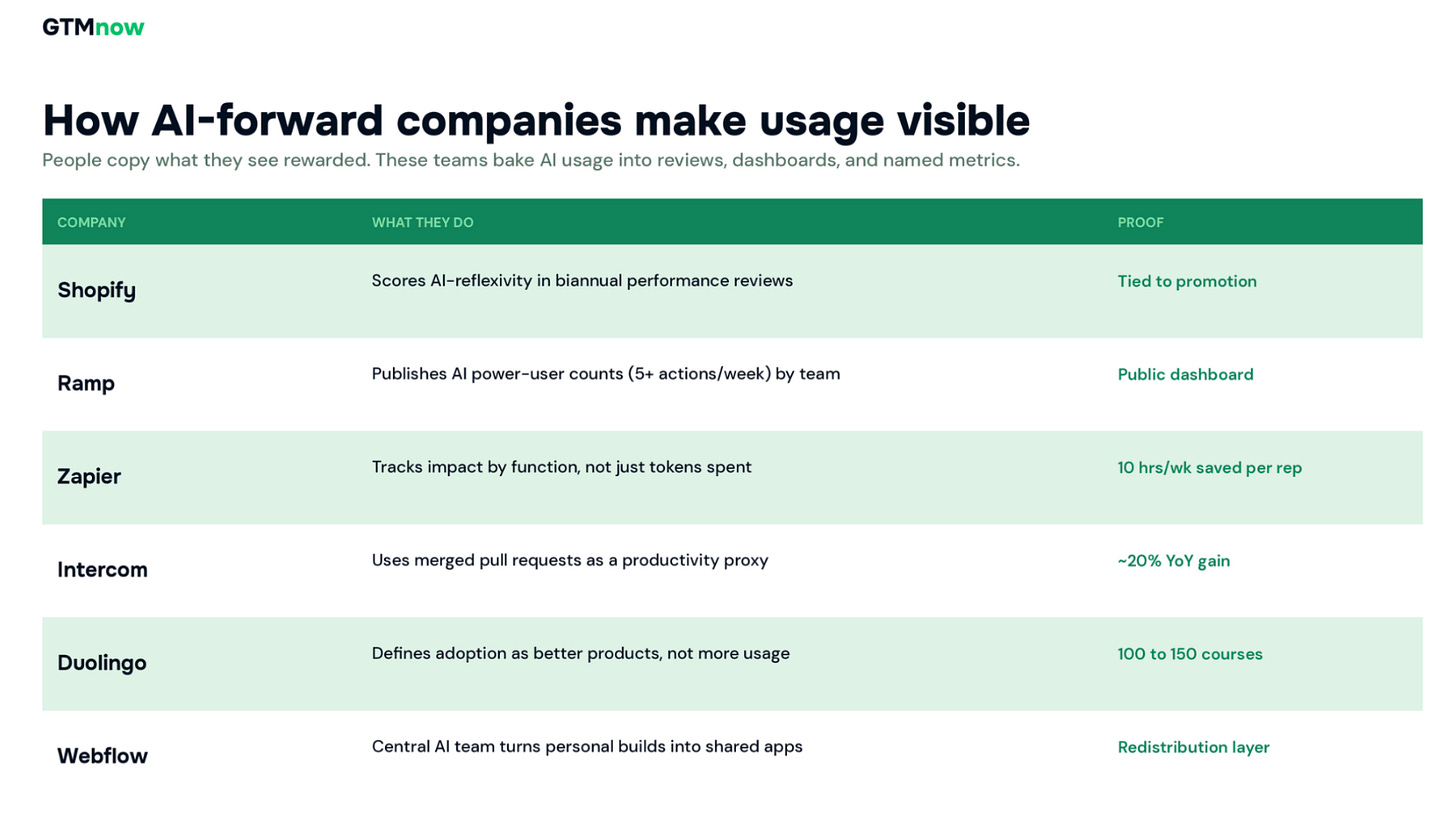
Organizations are devising diverse methods to measure and reward AI-driven productivity. Shopify, for instance, incorporates an "AI-reflexive" score into biannual performance reviews, assessing how readily employees turn to AI tools when confronted with a problem. Ramp publicly tracks and publishes AI power-user counts (defined as 5+ actions per week) by team for tools like Cursor, Claude Code, and ChatGPT, fostering transparency and healthy internal accountability. Intercom, aiming for a "2x productivity" goal, uses metrics such as merged pull requests as a proxy for AI’s impact on developer efficiency.
Lighter-weight tactics also prove highly effective. Brandon Barton emphasizes the importance of "over-celebrating small wins" with new adopters, recognizing that the initial successful build is often the most critical and challenging. Joe Goldberg advocates for internal leaderboards and subtle gamification to keep AI usage top of mind. These strategies, while not necessarily expensive, collectively send a clear and unequivocal message: AI proficiency and application are now highly valued organizational assets.
6. Transforming Individual Builds into Shared Organizational Tools
The first five strategies cultivate a rich environment for individual AI experimentation and generate a "pile" of personal builds. The sixth and final strategy is where this individual innovation scales into compounding organizational leverage: systematically capturing the most effective personal builds and productizing them into shared tools. This ensures that subsequent users start with a validated, working solution rather than a blank prompt, creating a virtuous cycle where each successful build lowers the barrier for the next.
Webflow provides an excellent operational model for this. They established a central AI team specifically tasked with identifying promising individual builds and transforming them into accessible, shared applications for the entire organization. This structure allows an individual to solve a personal problem once, then empowers a dedicated team to refine, standardize, and deploy that solution for collective benefit. This strategic centralization ensures that valuable insights and tools developed at the individual level are not siloed but become shared assets, maximizing return on investment and accelerating company-wide AI adoption.
Broader Industry Trends and Market Activity
The imperative for AI adoption is reshaping the broader GTM landscape, as evidenced by recent mergers, acquisitions, and the emergence of innovative startups. These market movements underscore a clear trend: companies are prioritizing AI-powered solutions to enhance customer understanding, optimize marketing and sales, and streamline operational efficiencies.
-
Mergers and Acquisitions Reflecting AI Focus:
- Zoom’s acquisition of Common Room signifies a strategic move to close the loop on its AI revenue platform. Common Room excels at converting fragmented buyer signals into granular, person-level intelligence, empowering sales representatives with critical "in-market" insights before customer interactions even begin. This acquisition highlights the growing demand for AI tools that provide actionable intelligence to GTM teams, improving targeting and conversion rates.
- HubSpot’s acquisition of Warmly, an AI agent platform for marketing and sales teams, further illustrates the integration of AI into established GTM ecosystems. Warmly, with its 223 paying customers deeply integrated with HubSpot, represents a natural evolution for an AI product built from the ground up on HubSpot’s platform. This move reflects the trend of acquiring specialized AI capabilities to augment existing offerings and deliver more comprehensive, intelligent solutions to customers.
-
Emerging AI Innovations Across Industries:
- 8090, having raised a substantial $135 million Series A round led by Salesforce, is positioned as Chamath Palihapitiya’s AI Software Factory for highly regulated industries. By building, refactoring, and accelerating entire systems for sectors like healthcare, insurance, aerospace, and government, 8090 demonstrates the potential for AI to tackle complex, high-stakes challenges where precision and compliance are paramount.
- Pocket, which secured $11 million from Accel and YC, represents an innovative application of AI in personal productivity. This credit card-sized device records conversations, allowing users to remain present while AI handles note-taking. With 130,000 units sold and no subscription required for core features, Pocket illustrates a consumer-facing demand for AI that simplifies daily tasks and enhances human interaction.
- Taxwire, raising $25 million in Series A funding led by Headline VC, targets a significant pain point for finance teams: sales tax management. By aiming to completely automate the process of remitting the annual $600 billion in US sales tax, Taxwire exemplifies AI’s potential to eliminate burdensome, non-core tasks, freeing up valuable human resources for more strategic initiatives.
The Evolving Go-To-Market Role
The shift towards AI-driven GTM strategies also fundamentally alters the skill sets required for success. As James Underhill, Head of GTM Ops at Profound, observes, the traditional business partner role is diminishing. Empowering field leaders with direct access to data, often facilitated by AI-driven analytics and insights platforms, negates the need for intermediaries. This evolution necessitates a new breed of "GTM engineering" professionals, increasingly requiring genuine engineering capabilities and strong technical fluency, with GitHub proficiency becoming a key hiring proxy. The ability to understand, integrate, and even build AI-powered solutions is rapidly becoming indispensable across GTM functions.
In conclusion, the journey to truly harness enterprise AI is less about acquiring cutting-edge models and more about cultivating an organizational culture of clarity, experimentation, standardization, dedicated effort, recognition, and systematic scaling. The insights from GTM leaders underscore that successful AI adoption is a holistic, human-centric endeavor, requiring visionary leadership to dismantle barriers, foster trust, and strategically integrate these powerful tools into the fabric of daily operations. Companies that master these six strategies will not only bridge the gap between pilot and profit but also secure a decisive competitive advantage in the rapidly evolving digital economy.