Compliance with Bilingual Labeling Requirements for Antimicrobial and Non-Agricultural Products with Acute Toxicity Category I Is December 29, 2026

The countdown has officially begun for manufacturers, registrants, and distributors of high-hazard chemical products as a major federal regulatory milestone looms on the horizon. The fast-approaching December 29, 2026, deadline marks a critical compliance threshold under the Pesticide Registration Improvement Act of 2022 (PRIA 5), introducing mandatory bilingual labeling for antimicrobial products and non-agricultural pesticides falling under Acute Toxicity Category I. Enacted by Congress to enhance worker safety, public health awareness, and emergency response capabilities, this sweeping legislative update fundamentally alters how the highest-toxicity chemical products must be presented to the American public and commercial users. As regulatory enforcement agencies prepare to scrutinize domestic inventories and international shipments alike, regulated entities must navigate a complex framework of translation standards, digital compliance reporting mechanisms, and strict statutory penalties to maintain their market access.
Legislative Origins and Regulatory Framework
The roots of the current bilingual labeling mandate trace back to the broader modernization of pesticide regulation embodied in PRIA 5, which was signed into law on December 29, 2022. This legislation introduced critical amendments to the Federal Insecticide, Fungicide, and Rodenticide Act (FIFRA), long serving as the foundational statute governing the registration, distribution, sale, and use of pesticides in the United States. Recognizing a persistent demographic shift within the domestic agricultural, industrial, and janitorial workforces—where a substantial percentage of handlers and end-users are native Spanish speakers—Congress mandated the inclusion of Spanish language translations for health and safety sections on end-use product (EP) labels released for shipment.
Under the statutory framework, these translations are required wherever corresponding text is available in the United States Environmental Protection Agency’s (EPA) Spanish Translation Guide for Pesticide Labeling. The overarching objective is to bridge communication gaps in high-risk environments where improper handling, accidental exposure, or misapplication of toxic chemicals can lead to severe health consequences. By ensuring that precautionary statements, signal words, and first-aid instructions are accessible in both English and Spanish, the regulatory regime seeks to mitigate occupational hazards and improve emergency medical interventions.
Compliance Options and Technical Pathways
Recognizing the practical design and physical space limitations inherent to product packaging, the EPA and PRIA 5 established flexible pathways for registrants to fulfill their bilingual labeling obligations. For end-use pesticide labels, companies are granted the option of printing the Spanish language translation directly onto the pesticide product container or embedding a scannable technology—such as a quick-response (QR) code—or utilizing other electronic methods that allow users to readily access the translation directly from the product label.
However, the regulatory requirements vary depending on the specific product classification. For antimicrobial pesticide products and non-agricultural, non-restricted-use pesticides (RUP), registrants may satisfy the bilingual labeling mandate by providing a digital link to the Safety Data Sheet (SDS) written in Spanish, entirely bypassing the need to print localized label text or specialized QR links on the physical container. Furthermore, lawmakers deliberately exempted certain categories from these burdens; PRIA 5 explicitly excludes manufacturing use products (MUP) and experimental use permits (EUP) from the bilingual labeling mandate, focusing the regulatory enforcement strictly on end-use formulations that reach downstream handlers and consumers.
The EPA Spanish Translation Guide and Accuracy Standards
To assist industry stakeholders in meeting these statutory obligations, the EPA developed and maintains its comprehensive Spanish Translation Guide for Pesticide Labeling. This reference document provides standardized Spanish translations for vital health and safety sections required on pesticide labels, including hazard statements, precautionary measures, environmental hazards, and directional warnings for safe use. Additionally, the guide features practical examples of label language tailored to agricultural requirements, complete with restricted entry interval (REI) data and specific handling precautions.
Despite the availability of this official resource, the ultimate legal responsibility for translation accuracy rests squarely on the shoulders of the registrant. The EPA strongly encourages companies to utilize the phrasing provided in the guide to ensure uniformity and precision, though adopting the exact wording from the guide is not strictly mandatory. Registrants may draft their own translations, provided they can legally and linguistically guarantee that the Spanish text is a true, exact, and complete translation of the English text approved on the master label. To maintain transparency, PRIA 5 mandates that the EPA notify registered entities within ten days of any official updates or modifications made to the translation guide.
Phased Implementation Timeline
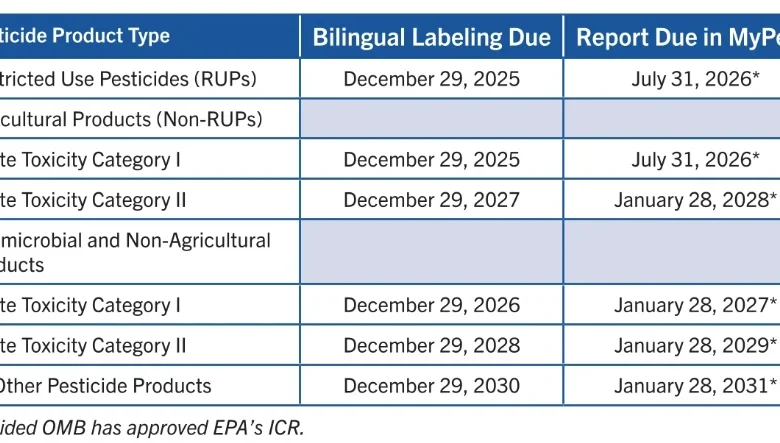
The rollout of bilingual labeling is not a single, simultaneous event across all chemical sectors; rather, it follows a carefully orchestrated rolling schedule spanning from December 2025 through December 2030. This tiered approach prioritizes products based on their inherent toxicity levels and specific use patterns, ensuring that the most hazardous and toxic formulations incorporate Spanish translations first.
- December 29, 2025: End-use product labels on Restricted Use Products (RUP) and agricultural use products classified under Acute Toxicity Category I were legally required to feature Spanish language translations.
- July 31, 2026: The deadline for registrants to formally certify bilingual compliance for these initial high-priority agricultural and RUP categories.
- December 29, 2026: The approaching statutory deadline for antimicrobial products and non-agricultural pesticides falling under Acute Toxicity Category I (products bearing the signal word DANGER) to incorporate bilingual labeling.
- January 28, 2027: The mandatory reporting deadline in the EPA’s MyPeST tracking portal for antimicrobial and non-agricultural products in Acute Toxicity Category I.
- December 29, 2028: The subsequent compliance deadline for antimicrobial and non-agricultural pesticide products falling under Acute Toxicity Category II (products bearing the signal word WARNING).
- January 29, 2029: The MyPeST compliance reporting deadline for Category II products.
- December 2030: The ultimate final horizon by which all remaining registered pesticide labels across all applicable categories must incorporate Spanish language translations.
Digital Tracking and Reporting via MyPeST

To monitor and administer this monumental transition, the EPA utilizes MyPeST, its specialized web-based portal designed for pesticide regulatory submissions, tracking, and data management. MyPeST serves as a centralized digital ledger that displays detailed product information, helping registrants verify their specific compliance deadlines based on EPA-approved master labels.
To fulfill reporting obligations, companies must navigate the MyPeST platform and check designated boxes next to each applicable end-use product indicating that bilingual labeling has been successfully integrated. Alternatively, for products subject to the mandate that have not yet had the physical or digital labeling added—but which will not be released for shipment until compliance is achieved—registrants must check a corresponding administrative box. The system also features dedicated data fields allowing companies to paste the precise Uniform Resource Locator (URL) linking directly to the product’s Spanish translation or Spanish-language SDS. For antimicrobial and non-agricultural products under Acute Toxicity Category I, this electronic reporting verification must be completed in MyPeST on or before January 28, 2027.
The Non-Notification Process and Administrative Flexibility
To alleviate potential regulatory bottlenecks that could overwhelm agency resources, FIFRA, as amended by PRIA 5, dictates that bilingual labeling modifications must be implemented through the streamlined non-notification procedure governed by Pesticide Registration (PR) Notice 98-10. Under this administrative mechanism, a product’s labeling may be updated to include required Spanish translations without notifying the EPA or requiring formal agency review, provided that the translation is the sole modification being made to the label.
Furthermore, registrants are permitted to add "pointer language" text—such as explanatory phrasing clarifying the function of a QR code or directing users to an online Spanish resource—via this same non-notification channel, provided the text is strictly limited to explaining the bilingual feature. This administrative efficiency spares industry stakeholders from enduring protracted review cycles, allowing them to rapidly update their packaging inventories to meet statutory deadlines.
Enforcement, Misbranding, and Import Restrictions
The legal ramifications of failing to meet these statutory deadlines are substantial. Under Section 2(q) of FIFRA, any pesticide product whose final printed label fails to incorporate the mandated translations by the applicable compliance date is officially classified as misbranded. Distributed, sold, or imported misbranded products expose corporate entities to rigorous enforcement actions by federal regulators.
In recent years, federal enforcement regarding pesticide misbranding has trended upward, characterized by aggressive civil penalties scaled according to the volume of sales or distributions. Beyond domestic distribution, federal oversight of imported chemical shipments has intensified correspondingly. If customs inspectors or EPA officials discover that imported pesticide shipments lack the required bilingual labeling elements, the federal government possesses the legal authority to issue a Notice of Recommendation to Refuse Admission (NORRA). Such an action typically results in the physical detention of the shipment, forcing the importer to export the goods out of the country at their own expense to correct the labeling deficiencies before attempting re-importation.
Implications for Industry Stakeholders and Ongoing Maintenance
Industry analysts and legal experts emphasize that bilingual compliance must not be treated as a static, one-time administrative chore. Rather, it represents an ongoing, dynamic commitment to regulatory maintenance. Whenever a registrant modifies, updates, or revises the English text on an end-use product label that falls under the bilingual mandate, the company is legally obligated to generate and append the corresponding Spanish translations. Importantly, these subsequent updates must be processed via non-notification after the revised English text has received formal EPA approval.
Moreover, because the EPA routinely reviews and updates its Spanish Translation Guide, companies must maintain active oversight of regulatory literature. When the agency publishes an updated translation guide, registrants are held responsible for ensuring their product labels incorporate translations for all newly added or modified sections. The compliance window for these post-publication updates varies by product sector: agricultural use pesticide labels must be updated within one year of the updated guide’s publication date (or the latest EPA-approved label date, whichever is earlier), whereas antimicrobial and non-agricultural use pesticide labels are granted a two-year window to integrate the updated terminology.
Strategic Takeaways for Affected Businesses
Corporate compliance officers and regulatory affairs teams must immediately audit their active product portfolios to identify any registered antimicrobial or non-agricultural end-use products bearing the signal word DANGER (Acute Toxicity Category I). For these specific formulations, all physical or digital label integrations must be finalized by December 29, 2026, followed immediately by compliance reporting in the MyPeST portal by January 28, 2027. Companies possessing exclusively non-end-use items or products outside these specific toxicity parameters are exempt from immediate action, though they must prepare for subsequent waves of regulations hitting categories like Category II in late 2028 and early 2029. By proactively managing translation accuracy, utilizing streamlined non-notification procedures, and adhering strictly to MyPeST reporting timelines, regulated businesses can successfully safeguard their operations, protect public and occupational safety, and ensure uninterrupted market distribution across the United States.