Global Enterprises Hesitate to Fully Embrace AI for Translation, Lokalise Survey Reveals

A recent survey conducted by Lokalise, a prominent localization management platform, indicates that the majority of global companies are not yet relying solely on AI-powered tools to manage their translation requirements. The comprehensive study, which polled 500 leaders with decision-making authority over their company’s localization strategy, underscores a nuanced approach to artificial intelligence within the critical domain of global communication. This finding suggests a prevailing sentiment that while AI offers significant advantages, human oversight and expertise remain indispensable for ensuring accuracy, cultural relevance, and strategic impact in international markets.
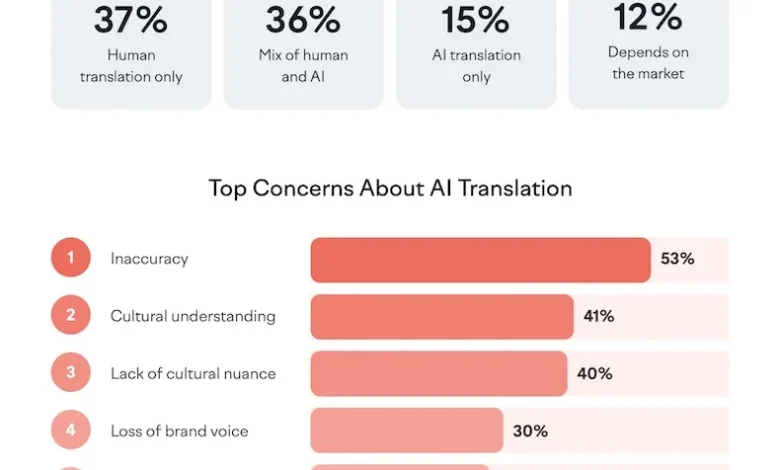
The research delves into various facets of how global enterprises are currently navigating the complexities of translation and localization. Key areas of investigation included current translation handling methodologies, levels of satisfaction with existing translation processes, and, crucially, business leaders’ primary concerns regarding the increasing integration of AI into translation workflows. An accompanying infographic, released by Lokalise, vividly illustrates these pivotal findings, offering a snapshot of the contemporary localization landscape. This data provides valuable insights for businesses aiming to refine their global expansion strategies and for technology providers developing the next generation of language solutions.
The Evolving Landscape of Corporate Translation
For decades, global companies have grappled with the challenge of communicating effectively across diverse linguistic and cultural boundaries. The need for accurate and culturally appropriate translation and localization has grown exponentially with the rise of the internet and the globalization of commerce. Initially, this task was almost exclusively the domain of human translators and specialized localization service providers (LSPs). These experts brought not only linguistic proficiency but also deep cultural understanding, crucial for adapting content to resonate with local audiences, avoiding missteps, and preserving brand integrity.
The advent of machine translation (MT) marked a significant technological shift. Early MT systems, based on rule-based and statistical methodologies, offered speed and cost-efficiency but often struggled with nuance, idiom, and contextual accuracy, making them unsuitable for high-stakes or sensitive content without extensive human post-editing. The past decade, however, has witnessed a revolution with the emergence of Neural Machine Translation (NMT), powered by deep learning algorithms. NMT has dramatically improved the fluency and contextual understanding of machine-generated translations, leading to wider adoption across various industries. These advancements have propelled AI-powered tools to the forefront of discussions around the future of translation, promising unprecedented speed, scalability, and cost reduction.
Lokalise Survey Highlights: A Closer Look at the Findings
The Lokalise survey’s central revelation—that most global companies are not solely relying on AI for translation—speaks volumes about the current state of technological integration. This implies a prevalent hybrid model, where AI tools are employed strategically, often in conjunction with human linguists. Companies might be leveraging AI for initial drafts, high-volume content with lower sensitivity (e.g., internal communications, basic product descriptions), or to assist human translators in increasing efficiency. However, for critical content such as marketing campaigns, legal documents, medical instructions, or financial reports, human review, editing, and cultural adaptation remain paramount.
The infographic further unpacks how global companies are managing these processes. It likely details the various combinations of in-house teams, freelance translators, LSPs, and technology platforms being utilized. Satisfaction levels with current translation approaches are a key metric, providing an indicator of whether companies feel their investments are yielding desired results in terms of quality, speed, and cost-effectiveness. A lower satisfaction rate might point towards inefficiencies in existing workflows or a mismatch between expectations and outcomes, potentially driving further exploration of advanced AI solutions or a re-evaluation of human-centric processes.
Crucially, the survey illuminates business leaders’ top concerns regarding AI translation. While the specific concerns are not detailed in the initial snippet, industry knowledge suggests common anxieties include:
- Accuracy and Quality: The fear of errors, misinterpretations, or loss of nuance, especially in brand-critical or highly technical content.
- Cultural Sensitivity: AI’s potential inability to fully grasp cultural contexts, idioms, humor, or sensitivities, leading to inappropriate or offensive translations.
- Data Privacy and Security: Concerns about feeding proprietary or sensitive company data into external AI models, raising questions about confidentiality and compliance.
- Domain Expertise: The challenge of AI accurately translating highly specialized terminology in fields like law, medicine, engineering, or finance without human expertise.
- Ethical Implications: The broader ethical considerations of AI, including potential biases embedded in training data and the impact on human employment.
- Integration Complexity: The practical challenges of integrating AI translation tools into existing enterprise workflows and technology stacks.
These concerns collectively explain why a wholesale shift to AI-only translation is not yet the norm, reinforcing the need for a balanced, strategic approach.
The Imperative of Localization in Global Expansion
The global localization market is a significant and growing industry, estimated to be worth tens of billions of dollars annually. Its importance cannot be overstated for companies looking to expand beyond their domestic markets. Effective localization goes far beyond simple translation; it involves adapting a product, service, or content to a specific locale, taking into account language, culture, technical standards, and legal requirements. This includes everything from software interfaces and websites to marketing materials, legal documents, and customer support.
Companies like Apple, Google, Amazon, and Microsoft owe a substantial portion of their international success to robust localization strategies. By presenting their products and services in local languages and with cultural sensitivity, they foster trust, increase user adoption, and drive revenue. Conversely, failures in localization can lead to significant financial losses, reputational damage, and missed market opportunities. A famous example includes a car model name that translated poorly in a foreign market, hindering sales despite the product’s quality.
The Lokalise survey’s focus on leaders with decision-making authority for localization strategy highlights the increasing recognition at the executive level of localization’s strategic importance. It’s no longer just a tactical task but a critical component of global business strategy, directly impacting market penetration, customer engagement, and ultimately, profitability.
Chronology of AI in Translation: A Brief Timeline
![Humans vs. AI: How Global Companies Are Handling Translation [Infographic]](https://i.marketingprofs.com/assets/images/site/icons/v3/topics/other.png)
The journey of artificial intelligence in translation is a testament to rapid technological evolution:
- 1950s-1960s: Rule-Based Machine Translation (RBMT): Early systems relied on vast dictionaries and hand-coded linguistic rules. While groundbreaking, they were rigid and struggled with complexity.
- 1980s-1990s: Statistical Machine Translation (SMT): These systems learned translation patterns from large parallel corpora (texts translated by humans). They improved fluency but often lacked grammatical accuracy and struggled with rare words.
- 2000s-2010s: Hybrid Approaches and Phrase-Based SMT: Combining elements of RBMT and SMT, alongside advancements in phrase-based models, led to more sophisticated but still imperfect results. Computer-Assisted Translation (CAT) tools, Translation Memory (TM), and Terminology Management (TMG) became standard for human translators, enhancing efficiency.
- Mid-2010s onwards: Neural Machine Translation (NMT): This marked a paradigm shift. NMT models, powered by deep learning, process entire sentences rather than individual words or phrases. This contextual understanding dramatically improved translation quality, making machine output much more fluent and accurate, especially for common language pairs. Companies like Google, Microsoft, and DeepL became pioneers.
- Late 2010s-Present: AI-Augmented Localization Platforms: The integration of NMT into comprehensive localization management platforms (like Lokalise) allows for seamless workflow automation, quality assurance, and project management, often combining AI with human post-editing capabilities. Further advancements include adaptive NMT, which learns from human feedback, and domain-specific NMT, trained on specialized corpora.
This timeline clearly illustrates the progressive sophistication of AI in translation, leading to the current state where AI is a powerful assistant but rarely a sole operator for critical business needs.
The Indispensable Role of Human Linguists
Despite the remarkable progress in NMT, the Lokalise survey’s findings reaffirm the irreplaceable value of human expertise. Human linguists bring a unique set of skills that AI currently cannot replicate:
- Cultural Nuance and Contextual Understanding: Humans understand the subtle layers of meaning, humor, irony, and cultural references that AI often misses. They can adapt content to be not just linguistically correct but also culturally appropriate and resonant. This is crucial for transcreation, where the goal is to recreate an emotional impact rather than just translate words.
- Creativity and Brand Voice: Crafting compelling marketing copy, slogans, or creative content requires a deep understanding of brand identity and target audience psychology. Human translators excel at maintaining brand voice and injecting creativity into localized content.
- Subject Matter Expertise: For highly technical, legal, medical, or financial documents, human translators often possess specialized knowledge in those fields, allowing them to accurately interpret and translate complex terminology and concepts.
- Quality Assurance and Error Detection: While AI can generate fluent text, humans are better at identifying subtle errors, awkward phrasing, or potential misinterpretations that could have significant consequences.
- Ethical Judgment: Humans can navigate ethical dilemmas in translation, ensuring that content aligns with local values and avoids perpetuating stereotypes or biases.
The survey implicitly suggests that business leaders recognize these limitations of AI, opting for a model that leverages AI’s speed and scalability while retaining human precision and cultural acumen.
The Hybrid Future: Augmenting Human Intelligence
The most probable trajectory for translation and localization is a continued evolution towards highly integrated hybrid models. This paradigm, often referred to as "augmented intelligence," positions AI not as a replacement for human translators but as a powerful tool to enhance their productivity and expand their capabilities.
In this hybrid future:
- AI for First Pass & Volume: NMT engines will continue to handle large volumes of content, especially for initial drafts, internal communications, or user-generated content where "good enough" is acceptable.
- Human Post-Editing (MTPE): Professional linguists will extensively post-edit AI-generated translations, refining them for accuracy, style, cultural appropriateness, and adherence to brand guidelines. This significantly speeds up the translation process compared to translating from scratch.
- AI-Powered CAT Tools: Computer-Assisted Translation tools will become even more sophisticated, integrating advanced NMT suggestions, smart terminology management, and predictive text features, all designed to make the human translator more efficient.
- Adaptive NMT: AI models will learn from human corrections and preferences, continuously improving their output for specific clients and domains.
- Quality Assurance (QA) Automation: AI will assist in automated quality checks, identifying potential errors or inconsistencies, freeing human editors to focus on higher-level linguistic and cultural nuances.
- Content Globalisation Workflows: Localization platforms will orchestrate complex workflows, seamlessly integrating human and AI tasks, managing terminology, translation memories, and review processes across distributed teams.
This collaborative model addresses both the need for speed and cost-efficiency (driven by AI) and the demand for high-quality, culturally sensitive, and accurate content (provided by humans).
Broader Context: "Your Top Event Trends for 2026"
The Lokalise survey findings resonate strongly with the themes likely to be explored at upcoming industry events, such as MarketingProfs’ "Your Top Event Trends for 2026." Scheduled for Thursday, April 16, 2026, at 2:00 PM ET, this event signifies the ongoing industry focus on anticipating future challenges and opportunities. MarketingProfs is a well-regarded resource for marketing professionals, offering insights, training, and community. Their events typically cover a wide array of topics, from digital marketing strategies and content creation to technological advancements and global market trends.
The integration of AI in localization, as highlighted by Lokalise, is intrinsically linked to broader marketing trends. As companies expand globally, effective localized content becomes crucial for successful marketing campaigns, customer engagement, and brand building. Event trends for 2026 will undoubtedly touch upon:
- Hyper-Personalization at Scale: AI-driven tools enabling personalized content delivery to diverse audiences, which requires robust localization infrastructure.
- Global Reach and Accessibility: The imperative for events and content to be accessible to a worldwide audience, necessitating advanced translation and interpretation solutions.
- Technological Integration in Marketing: The increasing use of AI, VR, AR, and other emerging technologies to create immersive and engaging marketing experiences, all of which often require localization.
- Data-Driven Decision Making: Leveraging data from localization efforts to refine global marketing strategies and improve ROI.
The discussion around human-AI collaboration in translation is therefore not just a niche topic but a fundamental component of future-proofing global marketing and business strategies, making it highly relevant for an event focusing on 2026 trends. The continued importance of localization, fueled by both human expertise and intelligent technology, will be a cornerstone of global business success.
Implications for Businesses and the Localization Industry
The Lokalise survey carries significant implications for various stakeholders:
- For Global Businesses: Companies must adopt a strategic and nuanced approach to AI in translation. Blindly adopting AI-only solutions risks quality and brand reputation, while ignoring AI altogether means missing out on efficiency gains. The optimal path involves careful selection of tools, integration into existing workflows, and investment in training both human linguists and project managers to effectively leverage AI.
- For Localization Service Providers (LSPs): LSPs must adapt their business models. Those that fail to integrate AI effectively or upskill their human teams risk falling behind. The future for LSPs lies in offering value-added services built on hybrid models, focusing on quality assurance, cultural adaptation, transcreation, and managing complex AI-human workflows.
- For Human Linguists: The role of the human translator is evolving from pure translation to post-editor, quality assurance specialist, cultural consultant, and content adapter. Continuous learning, particularly in using AI tools and understanding AI outputs, will be critical for career longevity and success.
- For AI Developers: The survey indicates a clear market need for AI translation tools that address current concerns, particularly around nuanced understanding, cultural sensitivity, data security, and domain-specific accuracy. Future development should focus on these areas to build greater trust and broader adoption among global enterprises.
In conclusion, the Lokalise survey provides a timely and essential snapshot of the current dynamics between human expertise and artificial intelligence in corporate translation. While AI has undeniably transformed the capabilities and efficiency of language services, the findings confirm that human judgment, cultural understanding, and strategic oversight remain paramount for most global companies. The future of localization is not one of either/or, but rather a powerful synergy, where AI augments human intelligence, enabling businesses to communicate globally with unprecedented speed, scale, and, crucially, accuracy and cultural resonance. As businesses look towards 2026 and beyond, understanding and strategically implementing this hybrid model will be key to unlocking sustained global growth and market leadership.