The marketing landscape is undergoing a profound transformation, driven by the ascendancy of artificial intelligence in search. While many marketing teams meticulously execute traditional SEO strategies, a growing discrepancy reveals itself when they query AI-powered platforms like ChatGPT, Perplexity, Gemini, or Google’s AI Overviews: their brands are often conspicuously absent from the generated answers. This emerging challenge, characterized by a fundamental shift in how information is retrieved and presented, is precisely what the innovative FSA Framework has been developed to address. This framework posits that success in the age of generative AI hinges on optimizing for Freshness, Structure, and Authority, rather than solely focusing on conventional search engine rankings.
The Evolution of Search: From Resources to Answers
For nearly two decades, the prevailing wisdom in digital marketing dictated that robust SEO practices would naturally lead to visibility and, consequently, revenue. This assumption, largely built on the model of search engines prioritizing the most relevant resource (a web page) in a ranked list, proved highly effective for many brands. However, the advent and rapid integration of generative AI into search interfaces have rendered this traditional approach increasingly insufficient. The core problem is not that SEO is broken; rather, it is performing exactly as designed for its original purpose. The crucial distinction lies in the differing objectives of traditional search engines and modern answer engines. While the former aims to rank the best resource, the latter is engineered to synthesize and provide the best answer. These are two distinct computational paradigms, each rewarding different attributes of content.
The shift began subtly in the early 2020s, gaining significant momentum with the widespread public adoption of large language models (LLMs) in late 2022. Suddenly, users were no longer just seeking lists of links; they were asking complex questions and expecting direct, concise, and comprehensive answers. Industry data from sources like Statista and various market research firms indicate a substantial increase in conversational search queries, with a projected compound annual growth rate (CAGR) for the global AI in search market expected to exceed 25% over the next five years. This rapid technological evolution has necessitated a parallel evolution in content optimization strategies.
Introducing the FSA Framework: Freshness, Structure, and Authority
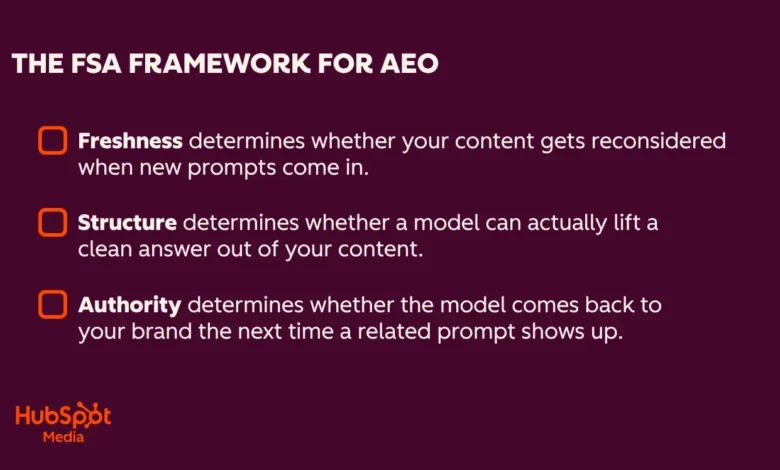
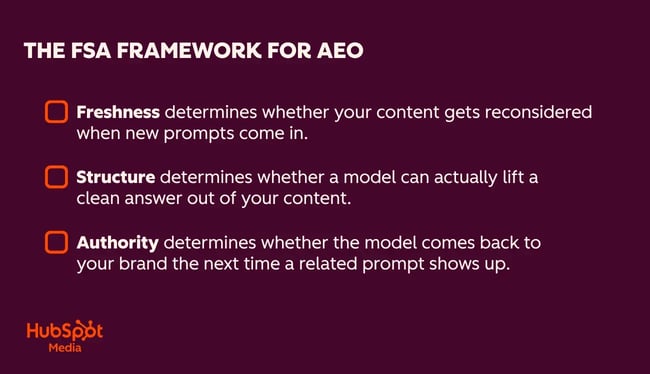
The FSA Framework, an acronym for Freshness, Structure, and Authority, identifies the three pivotal signals that answer engines predominantly evaluate when selecting sources to cite within a generated response. It serves as a diagnostic tool for marketers to understand why their brand may or may not be appearing in AI-generated answers across major platforms and provides a clear roadmap for remediation. Each pillar of the framework plays a distinct, interdependent role:
- Freshness: Signifies the recency, relevance, and reinforcement of content.
- Structure: Refers to the organization and extractability of information for AI models.
- Authority: Denotes the entity-level expertise and consistent recognition of a brand on a specific topic.
Neglecting any one of these pillars can undermine the effectiveness of the others. When all three are harmonized, content transcends being merely a candidate for citation and becomes the preferred, obvious choice for inclusion in AI-generated answers.
The Genesis of AEO: Real-World Experimentation
The foundation of the FSA Framework emerged from rigorous, real-world experimentation. In recent years, a pioneering approach involved transforming a personal website into a live laboratory for answer engine optimization (AEO). The hypothesis was simple: if AI models process information differently, then content optimized specifically for their mechanisms should outperform even highly authoritative traditional SEO content. Experiments were conducted across leading AI platforms, including ChatGPT, Perplexity, Gemini, and Google’s AI Overviews, meticulously tracking what content surfaced for various prompts and, critically, what did not.
One notable experiment involved updating a single web page using the nascent principles of what would become the FSA Framework. The topic was one where a legacy publisher, boasting immense domain authority (the kind traditional SEO experts would covet), had consistently dominated AI citations for months. Within a mere 96 hours of the update, the AI Share of Voice for the experimental site on that specific topic surged from approximately 27% to an astounding 72.7%. Concurrently, the legacy publisher’s visibility plummeted to 0% within the same timeframe. Remarkably, this dramatic shift occurred without any new backlinks or promotional campaigns. The only significant change was a more effectively structured, fresher, and easily extractable version of the same information.
Under conventional SEO logic, such a rapid displacement of a legacy publisher by a solo strategist’s site would be deemed impossible. Traditional rankings simply do not exhibit such volatility or speed. However, through the lens of AEO, this outcome was entirely logical. The legacy page had become outdated, and its structure, optimized for traditional web crawlers, was ill-suited for AI information extraction. Subsequent analysis of numerous tests revealed a consistent pattern: AI engines frequently bypassed high-authority domains, instead favoring content that was recently updated, clearly structured, consistently referenced across multiple sources, and readily extractable into an answer. The same three signals—Freshness, Structure, Authority—consistently emerged as the driving forces across every AI model tested.
Why a New Framework is Indispensable
Traditional SEO operates on the premise that a user inputs a query, the search engine identifies the most relevant pages, and these pages then compete for position on a results page. The web page is the ultimate destination, and the objective of SEO is to elevate that destination higher on the list. This model implicitly assumes two critical elements that AI-powered answer engines no longer uphold:
- Users want a list of resources to navigate: Traditional search users expected to browse a list of links to find their answer.
- The search engine’s job is done once the list is provided: The engine’s role concluded with presenting the search results page.
AI models fundamentally diverge from this paradigm. They retrieve information from a multitude of sources, synthesize it, and present the user with a single, confident, and comprehensive answer. The user receives a summary, not a directory. Within this summary, sources are mentioned not as a reward for high ranking, but as credible evidence supporting the accuracy and trustworthiness of the generated answer.
The fundamental question posed by the engine has thus entirely transformed. It is no longer, "Which page should we show?" but rather, "Which sources help us explain this clearly and accurately?" While this might appear as a subtle semantic distinction on paper, in practice, it redefines the very purpose and design of content. Your content is no longer merely a destination; it has become an input, a component in a larger synthesis. Internalizing this profound shift makes the FSA Framework not just a novel set of tactics, but the only logical and effective response to the operational mechanics of contemporary answer engines.
The FSA Framework Breakdown in Detail
The efficacy of the FSA Framework lies in its detailed components and their synergistic interaction:
Freshness: The Lifeline of AI Content
In AEO, freshness is a critical weighting factor that directly influences an AI model’s confidence in reusing content, the frequency with which it re-evaluates content for new prompts, and even its eligibility to appear in synthesized answers. Stale content risks being entirely removed from the candidate pool. Freshness encompasses three interconnected dimensions:
- Recency: How recently the content was published or substantially updated.
- Relevance: Whether the content’s language and information align with current discourse and facts on the topic.
- Reinforcement: The degree to which the information is corroborated by other current, reputable sources.
All three elements contribute to the freshness signal. A page can falter on any one of them and lose significant ground in AI visibility. Answer engines do not require an explicit "last updated" timestamp to ascertain content currency. Instead, they detect outdated language, references to obsolete tools, or when the broader topic discussion has evolved beyond what the page describes. For dynamic sectors such as SaaS, AI, and FinTech, content typically maintains relevance for approximately 90 days. For more evergreen subjects, this window extends to about six months. Beyond these periods, content risks being excluded from the AI answer pool. The practical implication is a strategic pivot: prioritizing consistent, substantive updates over infrequent, minor edits. One meaningful refresh per quarter significantly outperforms multiple superficial changes monthly. Freshness ensures content is reconsidered, but usability is equally vital.

Structure: Optimizing for AI Extraction
The concept of content structure for AI models differs significantly from structure optimized for traditional web crawlers, and these two approaches are not always congruent. AI models do not "read" a page in a linear, human-like fashion. Instead, they parse content, scanning for clear hierarchies, self-contained explanations, and explicitly labeled sections that can be extracted and integrated into an answer without requiring the surrounding context. Content that excels in AI answers exhibits several common structural characteristics:
- Clear Headings and Subheadings (H1, H2, H3): Providing a logical content hierarchy.
- Direct Answers at the Beginning of Sections: Presenting the core information upfront.
- Self-Contained Paragraphs and Sections: Ensuring each segment can stand alone meaningfully.
- Lists and Bullet Points: Facilitating easy scanning and extraction of key information.
- Summaries or Key Takeaways: Providing concise distillations of complex information.
If a critical insight is embedded deep within a paragraph that relies on preceding sections for context, an AI model will likely bypass it. This is not due to the idea’s lack of merit, but its lack of extractability. The common pitfall for marketing teams is optimizing structure for crawlers—focusing on meta tags, clean header hierarchies, and internal linking—and erroneously assuming this satisfies AI requirements. Traditional crawler structure emphasizes navigability; AI structure prioritizes extractability. The fundamental question to ask of any content piece is: "Can an AI model extract a clean, accurate, and complete answer from this without needing the rest of the page?" If the answer is no, a structural problem exists, irrespective of how well-nested the headings might be.
Authority: The Rise of Entity-Centric Recognition
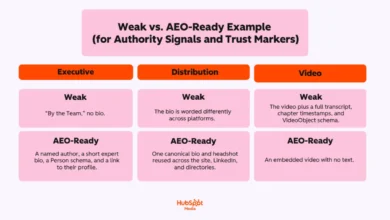
In traditional SEO, authority was synonymous with domain authority, a metric built over years and notoriously difficult to dislodge. Entire agency models revolved around link acquisition. In the realm of AEO, authority has evolved into entity authority. The question is no longer, "How strong is this domain?" but rather, "Is this brand the recognized expert that consistently explains this specific topic across all accessible channels?"
Entity authority is cultivated incrementally, mention by mention, largely independent of backlinks. Every instance where a brand appears in a source an AI model can learn from—be it a podcast, a Reddit discussion, a guest post, a quote in a third-party article, a LinkedIn update, or its own website—contributes to the model’s understanding of that entity. While a single mention is a data point, repeated mentions in similar contexts across diverse channels establish a discernible pattern, fostering model confidence. This confidence is the precursor to citation.
Intriguingly, within AI answers, smaller brands are increasingly triumphing in competitive arenas where they would traditionally stand no chance. Upon closer inspection, the reason becomes evident: smaller brands often focus their content creation efforts intensely on a niche core audience and leverage social media and influencer marketing to establish brand authority across multiple surfaces, not just their proprietary website. When an AI model consistently encounters these brands discussing a specific topic, it develops confidence in reusing their explanations. Conversely, large publishers, with myriad contributors covering a vast array of topics, often fail to cultivate a recognizable entity around specific, user-focused subjects. Their distribution might be minimal beyond their own site, relying on outdated SEO wisdom that domain authority alone suffices. In such scenarios, the AI model lacks a clear anchor for consistent attribution. Authority work in the AEO era more closely resembles cross-channel reputation management than traditional link building. While these efforts may not align with conventional SEO campaigns, they are precisely how a brand becomes a recognized and trusted entity by AI models.
Practical Application of the FSA Framework
Understanding the theoretical underpinnings of the FSA Framework is the first step; applying it strategically is the next. The practical application of FSA dictates a shift in marketing priorities and methodologies.
1. Conduct a Comprehensive Audit Focused on "Money Prompts"
Before initiating any content modifications, a thorough audit of current visibility within AI answers is paramount. This involves running actual prompts—the questions buyers are genuinely asking when evaluating solutions, comparing options, or assessing fit—in platforms like ChatGPT, Perplexity, and Gemini. These are the "money prompts," distinct from keyword lists. Examples include:
- "What are the best [product/service category] for [specific need]?"
- "How does [Your Brand] compare to [Competitor Brand]?"
- "What are the pros and cons of [solution type]?"
- "Explain [complex industry term] in simple terms."
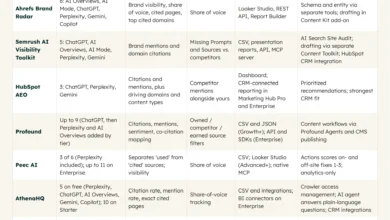
Analyze whether your brand appears, who your competitors are, and what the AI-generated answer states about your industry. This exercise provides invaluable insight into actual AI visibility, far surpassing traditional keyword reports. Tools like HubSpot AEO can facilitate this by tracking mentions across various answer engines. Following this initial scan, audit your top five performing pages through the FSA lens, honestly assessing where each pillar—Freshness, Structure, Authority—is strong or weak. This diagnostic step is crucial before implementing any tactics.
2. Transition from Volume Targets to Refresh Targets
In the AEO paradigm, the consistent maintenance and strategic updating of existing content contribute more significantly to AI visibility than the incessant publication of new content. Marketing teams should recalibrate their editorial calendars to prioritize meaningful refreshes of top-performing pages on a consistent monthly or quarterly basis, rather than focusing solely on the volume of new posts.
3. Structure Content for Extraction, Not Just Indexing
Audit your most critical pages with one overarching question: Can an AI model extract a clean, complete answer from the initial few hundred words of a section? If not, restructure the content to incorporate:
- Concise, direct answers to common questions at the beginning of relevant sections.
- Clear, semantically distinct headings and subheadings that encapsulate self-contained ideas.
- Strategic use of bullet points, numbered lists, and bold text for easy parsing.
- Explicit summaries or "key takeaways" at the end of longer sections.
4. Cultivate Entity Authority Across Diverse Channels
The influence of a brand’s website alone is diminishing. Answer engines learn from a diversified content presence, meaning brands must strategically distribute their expertise across multiple surfaces:
- Social media platforms (LinkedIn, X, industry-specific forums).
- Podcasts and webinars where brand representatives are featured.
- Guest posts on authoritative industry blogs.
- Quotes and mentions in third-party articles or news outlets.
- Community engagement in relevant online groups.
Brands that build a consistent, expert presence across these varied surfaces are the ones AI models learn to trust and cite.
5. Measure AI Share of Voice, Beyond Traditional Rankings
AI Share of Voice quantifies how frequently a brand is cited within AI-generated answers relative to its competitors. It is a zero-sum metric: one brand’s gain is another’s loss. Modern AEO tools allow marketers to track this metric, providing granular insights into brand performance in answer engines and identifying gaps where competitors are being favored. This data-driven approach is essential for targeted optimization.
6. Prioritize One Pillar for Initial Focus
Given the complexity, it is advisable to select one FSA pillar for initial remediation rather than attempting to overhaul all three simultaneously.
- If Freshness is lacking, implement a consistent content refresh schedule.
- If Structure is the issue, prioritize optimizing key pages for AI extractability.
- If Authority is weak, focus on building cross-channel entity recognition.
Most AI visibility challenges can be clearly categorized into one of these three areas. Often, what appears to be a general visibility problem is, in essence, an underlying authority deficit. Pairing the FSA Framework with comprehensive AEO best practices creates a robust and adaptive content strategy.
Implications for Future Content Strategy
The FSA Framework serves as a crucial diagnostic lens, enabling brands to understand the precise reasons for their visibility (or lack thereof) within AI-generated answers. It allows for a data-informed approach, moving beyond guesswork to targeted, effective action. While the specific signals weighed by answer engines will undoubtedly evolve with technological advancements, and the tactics built upon this framework will require adaptation as interfaces shift, the core logic—favoring freshness, rewarding clarity, and trusting consistency—has remained steadfast across all tested AI models. This foundational principle is expected to endure as answer engines continue their development.
The brands poised for success in the AI-driven search landscape of the coming years will not be those merely chasing every new tactical trend. Instead, victory will belong to those who deeply comprehend the mechanics of AEO, honestly assess their visibility gaps, and strategically address the most critical pillars first. By building content strategies on these enduring principles, the FSA Framework provides a resilient and adaptable approach, ensuring relevance and visibility even as the digital search environment continues its rapid transformation.
Related posts: