The AI Race: Why "Growth Context" is the Undiscovered Key to Business Transformation, Not Just Data or Models

In an era increasingly defined by technological acceleration, businesses globally are grappling with a pervasive paradox: despite significant investments in artificial intelligence, many find themselves questioning why these advanced tools fail to deliver tangible, needle-moving results. From automated email campaigns that elicit no response to lead generation systems surfacing already-closed deals, and content creation processes that yield generic, undifferentiated output, the promised revolution often feels more like a costly exercise in frustration. Industry leaders are pouring resources into new tools and extensive training, yet the fundamental question persists: why is AI not truly impacting core business outcomes?
The prevailing narrative often points to issues with AI models themselves or the quality of underlying data. However, a growing consensus among technology experts and platform providers like HubSpot suggests that the real impediment lies elsewhere: in the profound absence of "context." This context encompasses the unique knowledge of a business, a deep understanding of its customers and their immediate needs, and the intricate dynamics of how its teams operate. It is arguably the most challenging problem to solve in the current AI landscape, and one that the industry has been notably slow to address comprehensively.
The Critical Distinction: Data Versus Context
To fully grasp this challenge, it is essential to distinguish between data and context. Data represents discrete, historical facts – what happened. For instance, a Customer Relationship Management (CRM) system might record that a deal closed eighteen months ago. This is pure data. Context, however, provides the meaning surrounding these events. It illuminates why they matter, their broader implications, and crucially, what actions should be taken as a result.
Consider the CRM example: while the data point indicates a closed deal, context reveals that the deal materialized only after the original champion switched companies, the pricing model underwent three significant adjustments, and this particular customer now consistently refers new business while vehemently disliking automated communications. A human salesperson, having nurtured this account, possesses this invaluable context intuitively. Yet, the vast majority of AI platforms currently lack the sophisticated architecture to capture, store, and dynamically leverage such nuanced business intelligence. This represents not a model gap, nor merely a data gap, but a profound context gap—a void that solutions like HubSpot’s Agentic Customer Platform aim to fill.
Yamini Rangan, HubSpot’s CEO, introduced the Agentic Customer Platform earlier this year, emphasizing its foundation: a unified repository where all customer data and critical business context converge. This centralized hub ensures that both human teams and AI agents have immediate access to the relevant information precisely when needed. The aspiration is for this foundational infrastructure to operate invisibly, seamlessly adapting as the business evolves, eliminating redundancy, and freeing teams from repetitive manual inputs. This benchmark of unobtrusive, intelligent operation is one that current AI tools frequently fail to meet.
The Hidden Economic Burden of Context Gaps
The absence of adequate context imposes a substantial, often unquantified, cost on businesses. This "briefing tax," as it has been termed, refers to the constant investment of time and effort required to furnish AI with sufficient background information to produce genuinely useful outputs. Teams routinely find themselves explaining their brand voice, pasting in extensive account histories, detailing pricing structures, outlining competitive landscapes, and defining customer profiles before every significant AI-driven task. The following day, the process often repeats itself.
This iterative re-briefing highlights a fundamental flaw: current AI systems frequently lack the ability to truly learn and retain dynamic business knowledge. While they may recall previous conversational threads, they often possess no persistent connection to the underlying, evolving business reality. The true cost extends beyond the lost hours spent on re-briefing; it lies in the vast opportunity cost—the profound insights and strategic advantages AI could have delivered if it genuinely understood the business’s intricate workings.
Beyond this daily friction, a more insidious problem unfolds over time. Business environments are dynamic: competitive positioning shifts, ideal customer profiles evolve, and playbooks are continually updated. Without an active, continuous connection to these changes, AI operates on an outdated version of reality. For Go-To-Market (GTM) teams—spanning marketing, sales, and customer success—this translates into AI that is "confidently wrong." As projects pivot and teams adapt, the AI continues to draw from obsolete context, leading to outputs that are misaligned and recommendations that no longer serve current objectives. When AI remains disconnected from the comprehensive, dynamic picture, it is perpetually constrained to function merely as a tool, unable to ascend to the role of a trusted, intelligent teammate.
The Evolution of AI and the Rise of Contextual Intelligence
The journey of artificial intelligence in enterprise applications has been long and varied. Early expert systems of the 1980s attempted to encode human knowledge into rules, a precursor to today’s contextual understanding, though limited by static rulesets. The advent of machine learning and big data in the 2000s shifted focus to pattern recognition from vast datasets. Deep learning and neural networks further refined this, enabling breakthroughs in areas like image recognition and natural language processing. However, even with these advancements, a critical gap persisted: the ability of AI to understand the why and how within a specific business’s operational framework.
The recent explosion of Large Language Models (LLMs) has brought AI capabilities to an unprecedented level of accessibility and fluency, fueling the current wave of enterprise AI adoption. These models excel at generating human-like text, summarizing information, and performing creative tasks. Yet, their foundational training on general internet data inherently limits their depth of understanding regarding specific business nuances, proprietary processes, and the unique relationships a company cultivates. This generalist nature underscores the necessity for a specialized layer of "context" that can bridge the gap between generalized AI intelligence and specific business requirements.
Industry analysts like Gartner and Forrester have increasingly highlighted the importance of "intelligent applications" that embed AI directly into workflows, moving beyond standalone tools. This shift necessitates AI that is not only smart but also inherently aware of its operational environment. Reports from McKinsey and PwC indicate that while AI adoption rates are high, a significant percentage of businesses struggle to demonstrate clear ROI, often citing integration challenges and a lack of alignment with business objectives—problems directly attributable to a deficit in contextual understanding. The global AI market, projected to reach trillions of dollars in the coming decade, will see its true value unlocked only when these contextual challenges are effectively addressed.
Growth Context: A New Dimension for Enterprise AI
Not all forms of context are created equal. Personal AI tools, such as consumer-facing chatbots, focus on building personal context—user preferences, conversation history, and communication style. Enterprise search and knowledge management platforms, like Glean, concentrate on organizational context, indexing documents, wikis, and institutional knowledge. HubSpot’s approach introduces a distinct category: Growth Context. This concept refers to the rich, high-quality, and precise understanding that AI requires to drive measurable outcomes across the core functions of marketing, sales, and customer success.
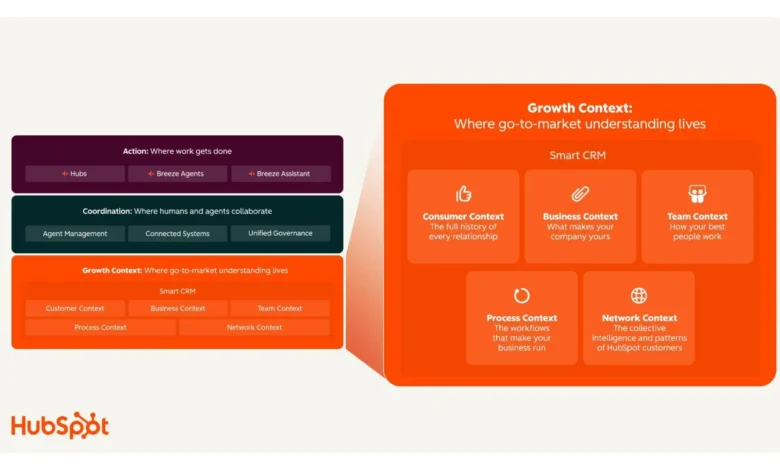
This isn’t merely a theoretical construct; it involves building robust infrastructure designed to both capture and dynamically maintain this critical context for customers, while also empowering them with self-management capabilities. Growth Context is envisioned across five crucial dimensions:
- Customer Context: A comprehensive, real-time understanding of each customer’s journey, preferences, pain points, past interactions, and future potential. This moves beyond basic CRM data to include qualitative insights from conversations, support tickets, and engagement patterns.
- Business Context: The intricate details of a company’s offerings, pricing models, internal processes, competitive differentiators, and strategic goals. It includes product roadmaps, service level agreements, and internal best practices.
- Team Context: An understanding of how individual teams operate, their specific workflows, preferred communication styles, historical successes, and areas needing improvement. This includes roles, responsibilities, and team-specific knowledge.
- Market Context: Awareness of industry trends, competitor activities, regulatory changes, and broader economic factors influencing the business and its customers. This provides external validation and strategic foresight.
- Historical Context: A deep dive into past successes and failures, learning from previous campaigns, sales cycles, and customer service resolutions to inform future actions and strategies.
This multi-dimensional approach ensures that AI agents operate with a holistic view, enabling them to make more informed decisions, offer more relevant recommendations, and automate tasks with a higher degree of precision and effectiveness. For example, an AI agent with Growth Context would not merely suggest a product based on past purchases but would factor in the customer’s current sentiment, their industry’s economic outlook, the specific challenges their team is facing, and how your product has historically solved similar problems for comparable clients.
The Agentic Customer Platform: A Framework for Contextual AI
HubSpot’s Agentic Customer Platform is designed to be the architectural backbone for Growth Context. The term "agentic" refers to AI systems that can operate autonomously, make decisions, and take actions on behalf of a user or business, often coordinating with other agents or systems. This contrasts with simpler AI tools that merely perform specific tasks on command. An agentic platform, deeply infused with Growth Context, can:
- Proactively Identify Opportunities: Rather than just processing requests, it can analyze customer interactions and market shifts to suggest new sales opportunities or preempt potential customer churn.
- Personalize at Scale: Beyond basic personalization tokens, it can tailor communications and offerings based on a nuanced understanding of individual customer needs and preferences, drawing from all five dimensions of Growth Context.
- Automate Complex Workflows: It can handle multi-step tasks that require decision-making and adaptation, such as orchestrating a personalized marketing campaign that adjusts based on real-time customer engagement.
- Provide Strategic Insights: By connecting disparate pieces of information, it can surface insights that would be difficult for humans to uncover manually, informing broader business strategy.
This vision implies a shift from AI as a mere assistant to AI as an active, intelligent participant in core business processes, capable of learning, adapting, and contributing strategically.
Evaluating AI: Asking the Right Contextual Questions
As businesses evaluate AI solutions, the focus often gravitates towards model capabilities—how sophisticated the underlying algorithms are, or how vast the training data is. However, the emerging reality dictates that these questions, while relevant, are increasingly commoditized. The true differentiators, and therefore the crucial evaluation points, revolve around context.
Key questions that executives and GTM leaders should pose to potential AI vendors and internal development teams include:
- How does this AI solution capture and dynamically update our unique business processes, competitive landscape, and strategic priorities?
- Can the AI understand and adapt to the specific nuances of our customer relationships, including their historical journey, individual preferences, and evolving needs, beyond mere transactional data?
- Does the AI system learn from our team’s workflows, successful strategies, and communication styles, integrating these insights into its future actions and recommendations?
- Is the AI capable of proactively identifying and incorporating external market shifts, industry trends, and regulatory changes relevant to our operations?
- How does the platform ensure that the context it uses is always current and reflective of our present business reality, rather than a static snapshot from the past?
Answering "no" to any of these questions signals a significant vulnerability. It indicates that the AI is not truly working with the business but rather operating on a version of the business that no longer exists. Such a disconnect renders even the most advanced models ineffective and potentially detrimental, leading to misinformed decisions and wasted resources.
The Broader Implications and Future Outlook
The companies that successfully integrate and leverage Growth Context will not merely use AI better; they will establish a compounding competitive advantage. Each interaction, each learned nuance, and each strategic insight gained will propel them further ahead, creating a virtuous cycle of intelligent growth. This emphasis on context also has profound implications for data governance, privacy, and the future of human-AI collaboration. Ensuring that sensitive business and customer context is handled securely and ethically will become paramount.
Moreover, the shift towards agentic platforms powered by Growth Context suggests a future where AI moves beyond task automation to become a true strategic partner. This partnership will free human teams from repetitive, low-value tasks, allowing them to focus on creativity, complex problem-solving, and deep customer relationships—areas where human intuition and empathy remain irreplaceable. The real AI race is not about who has the biggest model or the most data, but who can most effectively imbue their AI with the deep, dynamic, and ever-evolving context that defines a successful business. This understanding is the true frontier of enterprise AI, promising to unlock unprecedented levels of efficiency, personalization, and sustained growth.