ChatGPT Transforms Sales Prospecting Landscape, Offering Unprecedented Efficiency and Personalization for Modern Sales Teams

The landscape of sales prospecting, long characterized by its laborious and time-intensive nature, is undergoing a profound transformation with the advent of advanced artificial intelligence tools like ChatGPT. Historically, sales professionals have grappled with a significant allocation of their workweek to non-selling activities. Data from Salesforce’s 2024 State of Sales Report starkly illustrates this challenge, revealing that sales representatives dedicate only a meager 30% of their week to actual selling. The vast majority of their time—a staggering 70%—is consumed by foundational yet often manual tasks such as market research, crafting personalized email communications, updating customer relationship management (CRM) systems, and a myriad of other administrative duties. This imbalance has historically limited the potential for genuine customer engagement and pipeline acceleration.
ChatGPT, a generative AI model, is fundamentally altering this equation by compressing hours of manual effort into mere minutes. Its integration into the sales workflow is not merely an incremental improvement but a paradigm shift, enabling sales teams to refocus their energy on high-value interactions. The core stages of the prospecting cycle that experience the most dramatic acceleration include comprehensive account research, the nuanced personalization of outreach messages, and the strategic creation of follow-up sequences. Sales organizations that have proactively integrated ChatGPT into their prospecting methodologies consistently report a marked reduction in preparation time, allowing for a substantial increase in meaningful, high-value conversations with qualified prospects. This shift represents a strategic advantage in an increasingly competitive market, where speed and relevance are paramount.
The Evolving Sales Landscape and the AI Imperative
For decades, sales prospecting has been a cornerstone of business growth, yet its execution has remained largely reliant on manual processes. Sales development representatives (SDRs) and account executives (AEs) traditionally spent hours sifting through company websites, LinkedIn profiles, news articles, and industry reports to identify potential clients, understand their challenges, and uncover trigger events. This meticulous research, while crucial, was a bottleneck, limiting the volume and depth of outreach. Crafting personalized messages for each prospect, a recognized best practice for improving engagement rates, was often sacrificed for templated approaches due to time constraints.
The rise of generative AI, exemplified by ChatGPT, arrives at a critical juncture for the sales industry. With increasing buyer sophistication, information overload, and higher expectations for personalized engagement, traditional prospecting methods are proving insufficient. AI offers a scalable solution to these challenges, promising not only efficiency but also enhanced effectiveness. A 2023 report by McKinsey & Company, "The economic potential of generative AI," underscored the broad impact of AI tools, projecting productivity boosts of up to 40% across various business functions. For sales, this translates into a direct impact on revenue generation and operational efficiency. The imperative for sales organizations is no longer if, but how quickly and effectively they can leverage these transformative technologies.
Key Pillars of AI-Powered Prospecting
ChatGPT significantly automates and enhances three of the most time-consuming yet critical tasks in the prospecting lifecycle:
-
Company Research and Intelligence Gathering: Before AI, compiling a comprehensive profile of a target account involved navigating disparate data sources, often leading to fragmented insights. ChatGPT can ingest vast amounts of public information—from financial reports and press releases to social media activity and job postings—and synthesize it into structured, actionable briefings. This capability allows sales professionals to quickly grasp a company’s strategic priorities, recent challenges, and potential needs, drastically cutting down the 20-45 minutes typically spent on manual research to mere seconds. This speed allows reps to focus on analysis rather than data collection.
-
Outreach Personalization: Generic, templated emails are largely ignored in today’s crowded inboxes. Effective personalization requires understanding a prospect’s specific context, recent activities, and potential pain points. Previously, achieving this level of personalization at scale was unfeasible. ChatGPT can generate highly customized outreach messages that reference specific company initiatives, recent funding rounds, leadership changes, or competitive pressures. This ensures that each communication resonates with the individual recipient, moving beyond superficial customization to demonstrate genuine understanding and relevance, thereby significantly improving reply rates.
-
Follow-Up Sequence Creation: A single outreach is rarely enough to secure a meeting. Successful prospecting often involves a multi-touch sequence across various channels. Designing these sequences—determining optimal timing, crafting distinct messages for each touchpoint, and ensuring a coherent narrative—is a creative and time-consuming endeavor. ChatGPT can generate complete multi-touch follow-up sequences, spanning email, LinkedIn messages, and even suggested phone call scripts, in minutes. This automates a process that could otherwise consume 45-60 minutes of creative writing per prospect segment, ensuring consistent engagement without repetitive messaging.
The Crucial Role of Human Oversight in AI-Assisted Sales
While ChatGPT offers unparalleled efficiency, its output is not a finished product ready for immediate deployment. Industry experts and successful sales leaders universally stress that human oversight remains not merely optional but mandatory. AI-generated prospecting content, if left unreviewed, carries inherent risks. ChatGPT can "hallucinate" company details, incorrectly identify decision-maker roles, or produce messaging that, while grammatically sound, is factually inaccurate or lacks the specific nuance of a human touch.
Therefore, AI-generated emails and scripts require rigorous human editing for factual accuracy, alignment with brand voice, and overall relevance. The most effective sales teams treat ChatGPT as a powerful "first-draft accelerator," a tool to jumpstart content creation, rather than a final content producer. This approach maintains accountability with the sales representative, ensuring that the final message reflects human judgment and strategic intent.
A practical "pro tip" shared by experienced sales managers suggests a concise review process: before sending any ChatGPT-drafted communication, ask, "Would my best customer find this specific and relevant to their situation?" This simple yet powerful filter helps catch critical errors, maintains brand integrity, and ensures the rep remains responsible for the message’s quality and impact.
AI Draft vs. Human-Edited Version: A Critical Comparison
Understanding the differences between raw AI output and a human-edited version is crucial for maximizing the effectiveness of AI in sales.
| Element | AI Draft | Human-Edited Version |
|---|---|---|
| Personalization | References company name and industry; may miss specific recent news or cultural context. | Adds a verified trigger event (e.g., funding round, leadership hire, product launch) sourced and confirmed by the rep. |
| Tone | Consistent but often generic; can sound templated across multiple emails. | Adjusted to match the rep’s natural voice, the prospect’s seniority, and the specific relationship stage. |
| Specificity | Broad pain points applicable to many companies in the same industry segment. | Pain points directly tied to the specific company’s recent announcements or known strategic initiatives. |
| Brand Voice | Default ChatGPT style; may lack the urgency, warmth, or confidence defining the sender’s brand. | Aligned with company messaging guidelines and the rep’s established email persona. |
| Call to Action (CTA) | Standard ask like ‘book a 15-minute call’; lacks urgency or context-specific framing. | Tailored CTA that matches the prospect’s stage in the buying journey and preferred format for engagement. |
| Length | Tends toward longer output; often exceeds optimal word count for cold outreach. | Trimmed to under 150 words for cold email; calibrated precisely to the specific touchpoint type and channel. |
This comparison underscores that while AI provides structure and efficiency, human input injects the judgment, specificity, and brand credibility necessary to convert a prospect into a meaningful engagement.
Strategic Implementation: Setting Up ChatGPT for Success
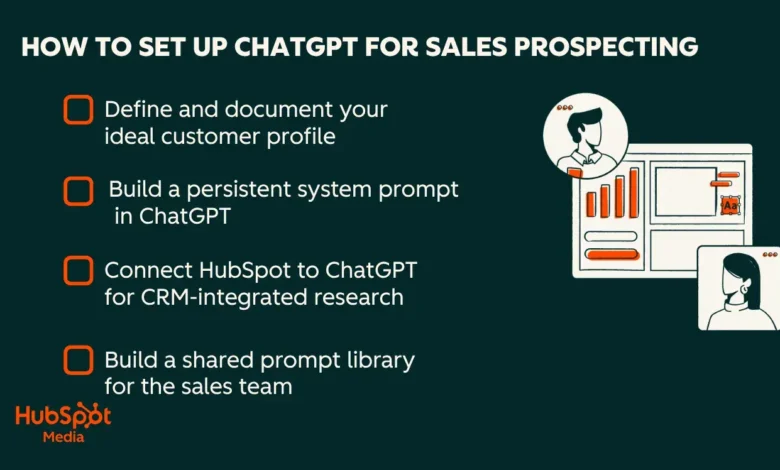
Effective integration of ChatGPT into sales prospecting workflows requires deliberate setup. Without proper context, the model will produce generic output lacking the specificity essential for effective B2B outreach. The following four setup steps are designed to dramatically improve the quality and relevance of every subsequent AI-assisted session.
-
Define and Document Your Ideal Customer Profile (ICP): The ICP is the bedrock of all effective prospecting, and thus, all ChatGPT output. Sales professionals must meticulously articulate their ICP, including:
- Target company size (e.g., SMB, mid-market, enterprise).
- Specific industries and sub-sectors.
- Typical buyer personas (titles, departments, roles).
- Common pain points and challenges these buyers face.
- Current solutions or competitors they typically use.
- Core value propositions of your product/service.
- Average deal size and sales cycle length.
This detailed information forms a reusable "context block" that should initiate every ChatGPT prospecting session, ensuring the AI’s output is consistently targeted.
-
Build a Persistent System Prompt in ChatGPT: Leveraging ChatGPT’s custom instructions feature is crucial. This allows sales professionals to save their ICP details, company description, preferred tone, and communication guidelines as persistent context. This eliminates the need to re-enter background information for each session, leading to more consistent and higher-quality output. The setup involves defining "Who you are and what you sell" in the first field and "How ChatGPT should respond" (tone, format, length, compliance) in the second.
-
Connect HubSpot to ChatGPT for CRM-Integrated Research: Modern sales demand seamless data flow. The HubSpot ChatGPT connector exemplifies this, enabling deep, CRM-integrated research directly within ChatGPT. This integration grants the AI model secure access to contact records, company data, deal history, and engagement patterns, grounding its research in verified, structured CRM data rather than solely public sources. Sales professionals can query ChatGPT to summarize a prospect’s full engagement history, identify the last meaningful touchpoint, or suggest follow-up strategies based on past interactions, all within a single interface, thereby eliminating manual data transfer.
-
Build a Shared Prompt Library for the Sales Team: To ensure consistency and accelerate onboarding, sales teams should curate and maintain a shared prompt library. This collection of proven prompts, organized by prospecting stage (e.g., research, outreach, cold call prep, follow-up, qualification), acts as a collective asset. Storing this library in a shared document (e.g., HubSpot snippet, Notion page, Slack document) ensures that all representatives benefit from optimized prompts, leading to more consistent ChatGPT output quality across the entire organization.
Transformative Use Cases in Practice
ChatGPT’s capabilities extend across various high-impact sales prospecting scenarios, each designed to address specific bottlenecks and yield measurable time savings:
-
Account Research and Company Intelligence: Beyond basic information retrieval, ChatGPT can distil complex public data into actionable intelligence. By feeding the model company names, websites, and recent news, sales professionals can prompt it to surface key buying signals, identify underlying pain points from earnings call transcripts, press releases, or even job posting trends. Integrating this with tools like Google Alerts creates a dynamic intelligence layer that feeds real-time trigger events—funding rounds, leadership changes, product launches—directly into ChatGPT research prompts, ensuring insights are always fresh and relevant.
-
Personalizing Cold Outreach Emails: This use case directly tackles the challenge of generating hyper-personalized emails at scale. ChatGPT empowers sales teams to craft messages that resonate deeply with individual prospects by referencing their specific company initiatives, recent milestones, or industry-specific challenges. This moves beyond generic "Dear [Name]" and delves into contextually rich content that significantly boosts engagement and reply rates, making hyper-personalization a scalable reality for entire prospect lists.

-
Cold Call Preparation and Objection Handling: Cold calls require quick thinking and tailored responses. ChatGPT can prepare sales representatives by generating prospect-specific opening lines, anticipating common objections based on industry and company profile, and scripting concise response frameworks. This allows reps to rehearse objection handling scenarios, boosting their confidence and effectiveness before picking up the phone, and significantly reducing the anxiety often associated with cold calling.
-
Lead Qualification and Scoring: Objectivity in lead qualification is paramount for pipeline health. ChatGPT can analyze prospect information against predefined qualification frameworks such as BANT (Budget, Authority, Need, Timeline) or MEDDIC. By inputting prospect details, the model returns a structured assessment, complete with reasoning, potential red flags, and recommended next steps. This automated, repeatable process reduces human bias, ensuring consistent lead scoring across the team and improving overall pipeline quality.
-
Multi-Channel Follow-Up Sequence Creation: Modern prospecting is rarely a single-channel endeavor. ChatGPT excels at generating comprehensive multi-touch follow-up sequences that strategically blend email, LinkedIn, and phone outreach. A well-constructed prompt can produce a 5-to-7-touch sequence in minutes, each touchpoint designed to deliver distinct new value rather than merely reiterating previous messages. This ensures persistent, relevant engagement across different platforms, maximizing the chances of connection.
Practical Tools: Essential Prompts for Sales Professionals
A curated library of ChatGPT prompts is invaluable for sales teams. The following prompts are designed for immediate deployment, utilizing a fill-in-the-bracket format to guide users in replacing placeholders with specific prospect information.
-
Prompt 1: Account Research Briefing
“You are a sales research analyst. Research [Company Name] and provide a structured briefing covering: (1) company overview and estimated revenue range, (2) key business challenges based on their industry and recent news, (3) technology investments or strategic priorities visible from public sources, (4) three specific pain points that [My Product/Service] could address. Company website: [URL]. LinkedIn description: [paste text].” -
Prompt 2: Personalized First-Touch Cold Email
“Write a cold outreach email to [First Name], [Title] at [Company Name]. They recently [specific trigger: funding round, new product launch, leadership change]. My company [Your Company] helps [target audience] [achieve specific outcome]. Keep the email under 150 words, focus on one relevant pain point, and end with a single low-commitment call to action. Tone: professional but conversational. Do not open with ‘I’ or a generic compliment.” -
Prompt 3: Cold Call Opening and Objection Prep
“Prepare me for a cold call with [First Name], [Title] at [Company Name] in the [Industry] space. They currently use [Competitor/Known Tech Stack]. Generate: (1) a 15-second opening that references a relevant pain point for their industry, (2) prepared responses to the three most common cold call objections in this sector, (3) a transition question to use if the call is going well and the prospect seems engaged.” -
Prompt 4: Lead Qualification Scoring
“Based on the following prospect information, score this lead using the [BANT/MEDDIC] framework and explain your reasoning for each criterion. Flag any red flags suggesting poor fit or low conversion probability. Prospect details—Company: [X]. Contact [X]. Company size: [X]. Industry: [X]. Recent news: [X]. Stated priority: [X]. Current solution: [X].” -
Prompt 5: LinkedIn Connection Request Message
“Write a LinkedIn connection request message to [First Name], [Title] at [Company Name]. We share [mutual contact / same alumni network / same LinkedIn group]. Keep the message under 300 characters. Mention one specific reason for connecting related to [their recent post, shared topic, or industry focus]. Do not pitch a product or service in the connection request itself.” -
Prompt 6: Follow-Up Email After No Response
“Write a follow-up email for a prospect who has not responded to my previous two outreach attempts. Previous message summary: [paste]. Add new value by referencing [a relevant industry report, case study, or company milestone]. Keep the message under 100 words. Re-ask for a 15-minute conversation without repeating the original pitch or starting with ‘Just following up.’” -
Prompt 7: Multi-Touch Outreach Sequence (7 Touches)
“Create a 7-touch outreach sequence for [Prospect Segment] in [Industry]. Mix email, LinkedIn, and phone touchpoints. Each touch must deliver distinct new value rather than simply following up on the previous message. Include: recommended timing between each touch, a subject line for each email touch, and the primary goal of each individual touchpoint in the sequence.” -
Prompt 8: Discovery Call Preparation Briefing
“I have a discovery call tomorrow with [First Name], [Title] at [Company Name]. Based on their website [URL] and LinkedIn profile summary [paste text], generate: (1) five discovery questions specific to their business context and stated priorities, (2) two relevant case study references I can cite if they ask for social proof, (3) the most likely objection I will face and a prepared, concise response.” -
Prompt 9: Sales Pitch Refinement and Sharpening
“Review this sales pitch and improve it for a [Title] at a [startup / mid-market / enterprise] company: [paste pitch]. Make it more concise, lead with a measurable business outcome, and reframe product features as specific results for the buyer. Suggest one alternative opening line that leads with a relevant industry challenge rather than a product description.”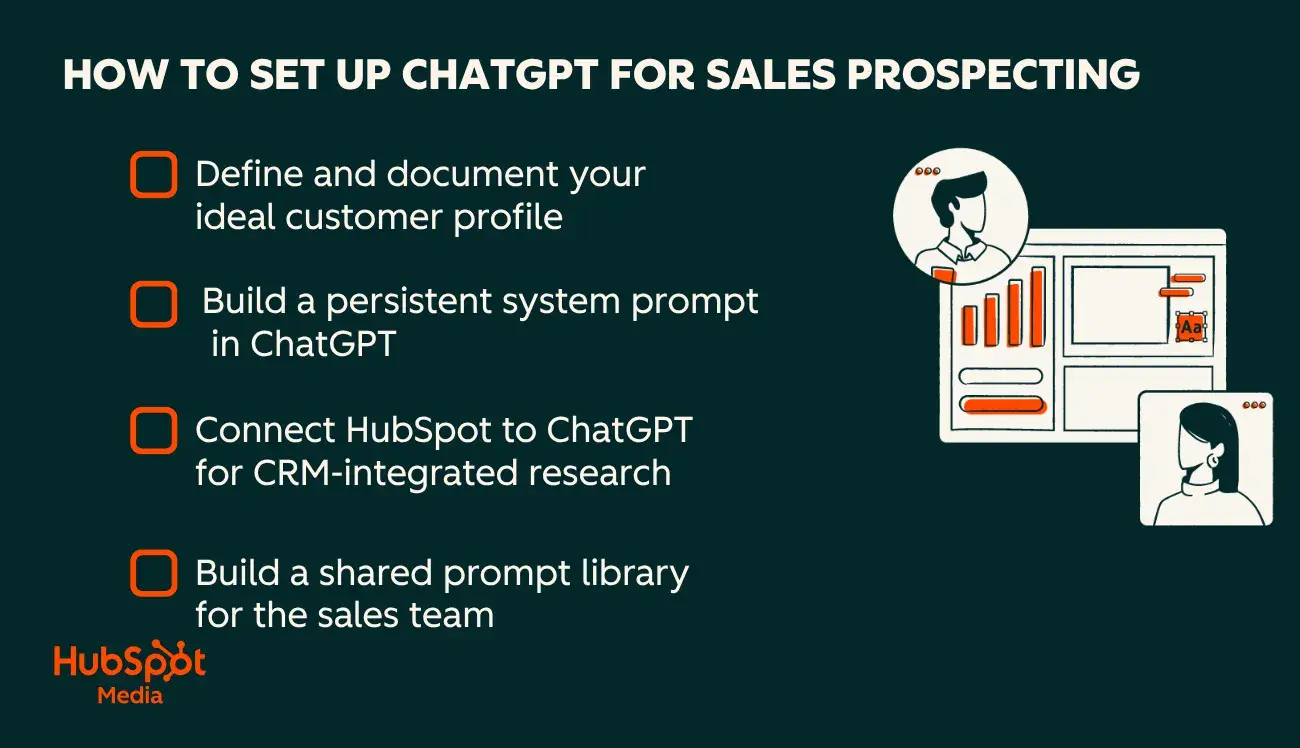
-
Prompt 10: Meeting Notes Summary and Next Steps
“Summarize the following sales meeting notes and generate three recommended next steps with clear owners and realistic deadlines. Meeting notes: [paste]. Format the output as: (1) Meeting summary in three bullets, (2) Confirmed action items with assigned owner and due date, (3) Recommended next outreach touch with suggested timing and channel.”
Navigating the Future: FAQs and Broader Implications
The integration of AI into sales prospecting raises several common questions and has broader implications for sales strategy.
-
How to achieve brand voice consistency in AI-generated emails?
Achieving a consistent brand voice requires strategic input. Sales professionals can provide ChatGPT with samples of high-performing emails from top performers, instructing the model to match their tone, sentence structure, and formality. Alternatively, an iterative "edit-and-match" process can be employed: generate a draft, manually rewrite a paragraph in the desired voice, then ask ChatGPT to analyze and apply that style to the rest of the content. This iterative refinement typically yields on-brand output within a few rounds. -
Is it safe to paste CRM data into ChatGPT?
Data privacy and security are paramount concerns. Sensitive CRM data should not be indiscriminately shared with public ChatGPT tools. Standard OpenAI models can use conversation data for training by default, posing significant data privacy and compliance risks, especially for organizations in regulated industries (e.g., healthcare, financial services). Secure alternatives, such as permission-controlled integrations offered by CRM providers (like the HubSpot ChatGPT connector), or enterprise-grade AI solutions with zero-data-retention options (e.g., ChatGPT Enterprise), are essential for protecting sensitive prospect information. -
What is the best way to combine email and LinkedIn touches?
Effective multi-channel sequences alternate between email and LinkedIn, with each touchpoint delivering distinct value. ChatGPT can generate coordinated sequences where, for example, email touches might lead with case study evidence, while LinkedIn touches open with observations related to the prospect’s recent activity or shared content. A proven structure often involves:- Touch 1 (Email): Value-driven cold outreach.
- Touch 2 (LinkedIn): Connection request with a personalized note referencing a shared interest or recent activity.
- Touch 3 (Email): Follow-up, introducing new value (e.g., relevant industry report).
- Touch 4 (LinkedIn): Direct message referencing a company update or mutual connection.
- Touch 5 (Phone): Cold call, referencing previous digital outreach.
- Touch 6 (Email): Breakup email or final value-add.
- Touch 7 (LinkedIn): Re-engagement attempt with a different angle or resource.
-
How should the impact of ChatGPT-assisted prospecting be measured beyond open and reply rates?
While open and reply rates provide initial indicators of message effectiveness, true impact is measured by quantifiable business outcomes. Key metrics include:- Meetings Set/Booked: Directly reflects the conversion of interest into engagement.
- Pipeline Created: Measures the value of opportunities generated from AI-assisted prospecting efforts.
- Win Rate of AI-Sourced Deals: Assesses the quality and fit of leads identified and nurtured with AI.
- Sales Cycle Length: Determines if AI is accelerating the overall sales process.
Tracking these metrics, often facilitated by robust CRM reporting software, allows organizations to link AI-driven outreach directly to revenue generation, enabling continuous optimization of prompts and strategies.
The Bottom Line: A New Era of Human-AI Partnership
ChatGPT for sales prospecting represents a pivotal advancement, effectively compressing the research and outreach cycles that once consumed the majority of a sales representative’s productive week. The comprehensive framework outlined in this guide – encompassing meticulous ICP context setup, structured prompts for research, personalized emails, cold call preparation, and strategic follow-up – equips sales teams with a repeatable system for AI-assisted prospecting. This system is designed not only to significantly increase output but also to maintain the critical quality necessary to drive meetings and generate robust pipelines.
The provided set of 10 prompts serves as an foundational framework for establishing a shared team library. As sales teams iteratively refine and optimize these prompts based on performance metrics such as reply rates and meetings booked, these enhanced prompts become invaluable organizational assets, fostering consistent success across the entire sales force. Tools like HubSpot’s Breeze Prospecting Agent further exemplify this integration, combining AI-powered research and outreach directly within the CRM environment, allowing sales professionals to transition seamlessly from prospect identification to initial engagement without switching between multiple applications.
Ultimately, the most substantial productivity gains stem not from the initial AI-generated draft but from the disciplined process of human review and refinement. Sales organizations that consistently excel with ChatGPT are those that have invested in meticulously defined ICPs, cultivated and maintained high-quality prompt libraries, and, crucially, fostered a culture where human judgment remains the ultimate arbiter of what gets sent. AI undeniably accelerates the process, but it is the discerning judgment and strategic insight of the sales professional that imbues the message with relevance, credibility, and the persuasive power that truly drives conversions. This marks a new era where technology empowers, but human expertise still defines, sales excellence.