The Rise of Answer Engine Optimization How E-commerce Brands Are Preparing for AI Shopping Agents


The digital commerce landscape is undergoing a fundamental transformation as traditional search engine optimization (SEO) begins to share the stage with a new discipline: Answer Engine Optimization (AEO). As artificial intelligence models like ChatGPT, Claude, and Perplexity increasingly serve as intermediaries between consumers and products, online retailers are being forced to rethink how they present information. The shift represents a move away from designing for human eyes alone toward a "data-first" architecture that caters to AI shopping agents. These autonomous or semi-autonomous tools do not browse websites for aesthetic appeal; instead, they crawl through structured data to find specific attributes that match complex user queries. For a modern e-commerce store, the difference between a sale and obscurity now rests on how clearly its data can be ingested by a Large Language Model (LLM).
The Evolution of Product Discovery: From Search to Synthesis
For over two decades, e-commerce visibility was defined by the ability to rank on the first page of Google. This involved a mix of keyword density, backlink profiles, and site speed. However, the emergence of generative AI has introduced "synthesized search," where the engine does not merely provide a list of links but generates a specific recommendation. When a shopper asks an AI agent for a "pre-seasoned 12-inch cast iron skillet compatible with induction cooktops under $100," the AI performs a high-speed extraction of data across the web.
Industry analysts suggest that by 2026, traditional search engine volume for brands could drop by as much as 25% as consumers migrate toward AI-driven conversational interfaces. This shift necessitates AEO, which focuses on providing clear, structured, and factual information that AI tools can easily parse. Unlike traditional marketing copy, which often relies on emotive language and brand storytelling, AEO prioritizes "matchable attributes." These are concrete data points—dimensions, weight, material composition, and compatibility—that allow an AI to verify that a product meets a user’s specific criteria.
The Mechanics of AEO and the Confidence Hierarchy
AI models operate on what technical experts call a "confidence hierarchy." When an LLM scans a website, it assigns different weights to information based on where and how it is found. Data contained within a structured schema (JSON-LD) or organized in a clear, bulleted list carries a higher confidence score than information buried within a long, flowery paragraph of marketing text.
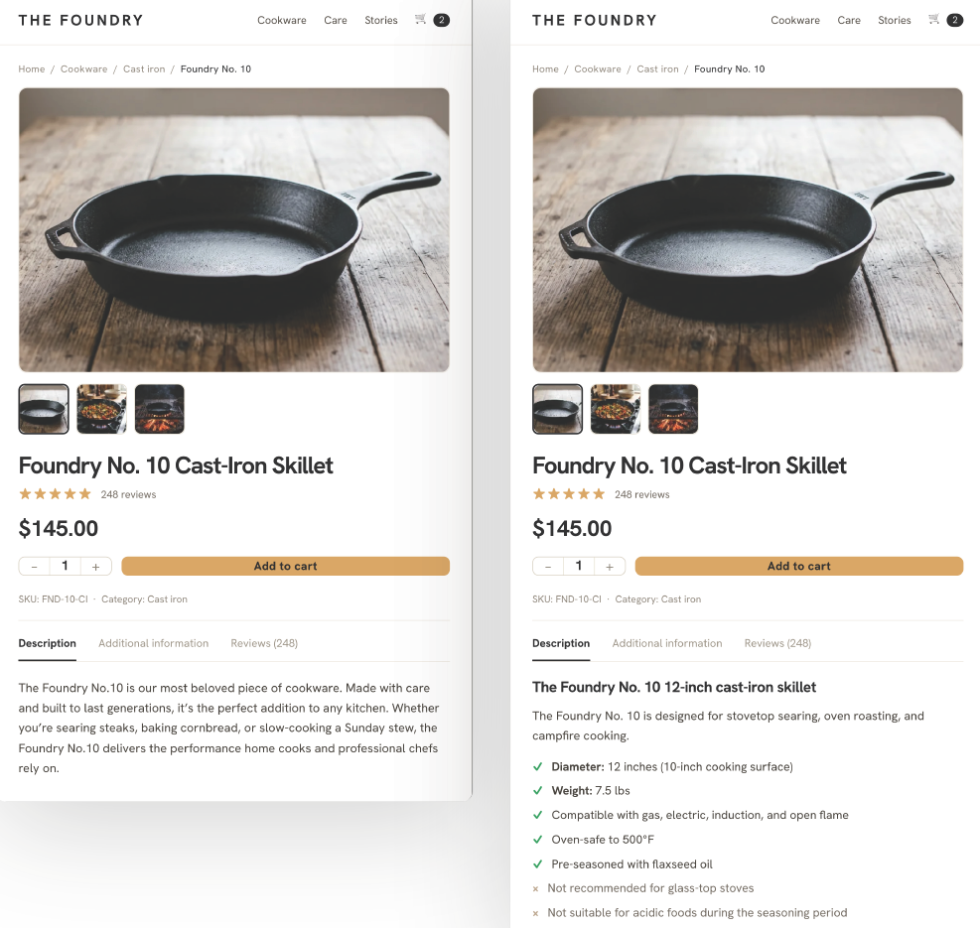
A primary example of this shift can be seen in product descriptions. A traditional description might read: "The Foundry No. 10 is our most beloved piece of cookware, built to last generations and perfect for any kitchen." While this appeals to human emotions, it provides zero matchable attributes for an AI agent. In contrast, an AEO-optimized description uses headers and bullet points to list specifications: a 12-inch diameter, 7.5-pound weight, compatibility with gas, electric, and induction stoves, and an oven-safe rating up to 500°F. If a shopper’s query includes any of those technical requirements, the AI has the "confidence" to recommend the Foundry No. 10. Without these details, the product remains invisible to the agent, regardless of the brand’s reputation or advertising budget.

Chronology of AI Integration in E-commerce
The transition toward AI-centric retail has moved rapidly over the last twenty-four months:
- Late 2022 – Early 2023: The public release of ChatGPT and other LLMs leads to an explosion in "conversational shopping" experiments.
- Mid-2023: Major search engines announce the integration of Generative AI into search results (e.g., Google’s Search Generative Experience).
- Early 2024: The emergence of "Agentic AI" begins, where bots are designed not just to suggest products but to eventually execute purchases on behalf of the user.
- 2025 and Beyond: Standardized protocols like
llms.txtbegin to see adoption, allowing webmasters to speak directly to AI crawlers through a dedicated file, much like therobots.txtfile of the early web.
Strategic Implementation: Optimizing the Storefront for Machines
To remain competitive, e-commerce managers are now implementing a multi-layered strategy that targets several key areas of the online store.
1. Enhanced Category Pages
Traditionally, category pages were mere grids of images. Under an AEO framework, these pages are being updated to include "Summary Content." By adding a short, factual paragraph at the top of a category—such as "Essential features of professional-grade cast iron cookware"—retailers provide the AI with a high-level overview of their inventory. This helps the agent understand the scope of the store’s expertise and the specific use cases the products serve.
2. FAQ Blocks as Data Repositories
Frequently Asked Questions (FAQ) sections are evolving from customer service tools into critical data nodes for AI. LLMs are trained to recognize the question-and-answer format. By including specific queries like "Is this skillet suitable for glass-top stoves?" or "What is the seasoning process for this pan?", retailers provide the exact "answers" that engines like Perplexity or Gemini are looking for when responding to user inquiries.
3. Standardizing Trust Signals on Policy Pages
AI agents are programmed to prioritize "trust signals." This includes clear information on shipping times, return policies, and warranties. Modern AEO involves moving away from dense legal jargon toward clear, numeric labels. An AI can easily process "30-day money-back guarantee" and "Ships within 48 hours," whereas it may struggle to extract those same facts from a five-page Terms of Service document.
4. The Adoption of the llms.txt Standard
A significant development in the AEO space is the introduction of the llms.txt file. This is a plain Markdown file placed in the root directory of a website (e.g., yourstore.com/llms.txt). It serves as a concise roadmap for AI agents, summarizing what the store sells and providing direct links to the most important pages. While currently supported by platforms like Anthropic and Perplexity, it represents a growing trend toward "machine-readable" web architecture. Major SEO plugins, including Yoast SEO and Rank Math, have already integrated automatic generation of these files, signaling their importance in the future of the web.
Supporting Data and Market Analysis
The urgency for these changes is backed by shifting consumer data. According to a 2024 retail report, nearly 40% of Gen Z consumers have used an AI tool to assist with a purchasing decision in the last six months. Furthermore, data from GA4 (Google Analytics 4) indicates a steady rise in referral traffic from sources like chat.openai.com and perplexity.ai. While these numbers currently represent a small fraction of total traffic compared to organic Google search, the growth rate is exponential.
Experts in the field of digital marketing suggest that the "first-mover advantage" in AEO is substantial. Stores that provide the most comprehensive, structured data now are being used as primary sources for AI training and real-time retrieval. This creates a feedback loop: as an AI agent successfully recommends a product and the user is satisfied, the AI’s internal "weights" for that source increase, leading to more frequent recommendations in the future.
Measuring Success in an AI-Driven Environment
Tracking the effectiveness of AEO is more complex than traditional SEO because AI "answers" are often generated in real-time and are personalized to the user. However, businesses are adopting three primary methods for validation:
- Referral Source Monitoring: Using analytics tools to filter traffic from AI domains. Even if the volume is low, the conversion rate from these sources is often higher because the AI has already "vetted" the product for the user.
- Self-Testing through LLMs: Retailers are increasingly performing "secret shopper" tests, asking various AI models for product recommendations in their niche to see if their store appears in the results and what justification the AI provides for its choice.
- Schema Validation: Using tools like Google’s Rich Results Test to ensure that the technical "underpinnings" of a page—the microdata that tells an engine what a price or a review rating is—are error-free.
Broader Impact and Industry Implications
The rise of AEO and AI shopping agents has profound implications for the competitive landscape. For smaller brands, AEO represents a "great equalizer." In the traditional SEO world, it was difficult to outrank massive marketplaces like Amazon or Walmart. However, an AI agent is looking for the best match, not necessarily the biggest brand. If a boutique cookware company provides more specific, high-quality data about a product’s compatibility and materials than a major retailer, the AI is more likely to recommend the boutique option for a specific, technical query.
Conversely, this shift places a higher burden of accuracy on retailers. If a store’s data is poorly structured or inaccurate, it will not only lose the immediate sale but may be "blacklisted" by the AI agent as an unreliable source of information. The transition to AEO is not merely a technical update; it is a shift toward a more transparent, data-driven era of commerce where the quality of information is as important as the quality of the product.
In conclusion, as AI agents become the new gatekeepers of the e-commerce world, retailers must adapt by prioritizing structured, factual, and machine-readable content. By embracing Answer Engine Optimization, category page summaries, and new standards like llms.txt, brands can ensure they remain visible in an era where the "searcher" is no longer a human with a mouse, but an algorithm with a mission. The brands that will thrive in the next decade are those that view their website not just as a visual storefront, but as a comprehensive, high-integrity database.
Related posts: