Streamlining Revenue Generation: An In-Depth Look at Sales Operations Platforms and Their Role in Modern Business

The modern sales landscape is characterized by increasing complexity, digital transformation, and an unrelenting pressure to achieve ambitious revenue targets. Despite these demands, a significant challenge persists: sales representatives, the front line of revenue generation, spend an average of only 30% of their time actively engaged in selling activities. The remaining 70% is often consumed by administrative overhead, manual data entry, navigating disparate systems, and tirelessly searching for crucial information that should be readily accessible. This pervasive inefficiency not only hampers individual productivity but also creates bottlenecks that undermine pipeline velocity, compromise forecast accuracy, and ultimately impede an organization’s growth trajectory.
The Evolution of Sales Challenges and Technology
For decades, sales processes were largely manual, relying on individual prowess, rolodexes, and rudimentary record-keeping. The advent of Customer Relationship Management (CRM) systems marked a pivotal shift, providing a structured database for managing contacts, accounts, and deal records. CRMs offered a centralized repository for customer interactions, enabling sales teams to track relationships and log activities. However, as sales processes grew more intricate and the volume of customer data exploded, CRMs, in their foundational form, proved insufficient to address the full spectrum of operational challenges.
Organizations began adopting a multitude of specialized "point tools" for specific sales functions: email automation, lead scoring, conversation intelligence, sales forecasting, and more. While each tool offered a solution to a particular problem, their disconnected nature led to a fragmented technology stack. Data silos emerged, requiring manual data transfer, complex integrations, or extensive custom development. This fragmented ecosystem reintroduced many of the inefficiencies CRMs initially aimed to solve, leading to data inconsistencies, disjointed workflows, and a lack of a single, reliable source of truth for sales performance. This critical juncture spurred the development and adoption of sales operations platforms – a strategic response to the demand for integrated, streamlined, and intelligent sales enablement.

Defining Sales Operations Platforms: Beyond the CRM
A sales operations platform is a sophisticated software solution designed to centralize and streamline the workflows for revenue teams. Unlike a standalone CRM, which primarily serves as a relationship-centric database for managing customer information, a sales operations platform is process-centric. It leverages CRM data to automate, optimize, and standardize sales tasks across the entire sales motion. Its core purpose is to enhance operational efficiency, enforce process consistency, and provide reliable, actionable analytics.
While many modern CRMs have expanded their feature sets to incorporate operational capabilities, and many sales operations platforms now include native CRM functionalities, their fundamental distinction lies in their primary focus. A CRM captures the history between reps and prospects; a sales operations platform uses that history to drive future actions and optimize the selling process. This includes automating lead routing, ensuring data quality standards, triggering follow-up sequences, and delivering predictive analytics that directly link sales activities to revenue outcomes. By reducing manual handoffs and eliminating spreadsheet-based reporting, these platforms empower sales operations leaders with the tools to build a robust, scalable sales engine.
Advanced platforms further layer in AI-driven insights, predictive analytics, and sophisticated automation to preemptively identify risks, highlight opportunities, and guide sales teams toward optimal strategies. The defining characteristic remains integration: sales operations platforms connect data and workflows that would otherwise reside in separate systems, offering a unified experience and a single source of truth for historical data and future growth predictions.
Key Features for Strategic Selection

When evaluating sales operations platforms, organizations should prioritize capabilities that directly impact pipeline health, rep efficiency, and overall revenue predictability.
1. Unified Data and Native CRM Integration
The foundation of any effective sales operations platform is a unified data model and seamless CRM integration. Data completeness and accurate activity capture are paramount for reliable forecasting and informed decision-making. A robust platform either includes a native CRM or offers deep, bidirectional, real-time integration with existing CRM systems. This ensures that data flows effortlessly between systems, creating a holistic view of the customer journey.
As Guido Tebano, Vice President of Sales and Marketing at Market My Market, aptly notes, "Early on, your biggest enemy is complexity. Your sales process isn’t even nailed down yet. It’s probably evolving every couple of weeks. The last thing you need is a product that takes three months to set up. Simple, fast, with CRM integration. Those are your MVP features.”
Beyond mere integration, effective data quality management is critical. Dirty data—rife with duplicates, missing fields, or stale records—is a primary driver of unreliable forecasts and wasted sales capacity. Platforms must offer built-in data hygiene tools such as duplicate detection, field validation, automated enrichment (adding missing attributes to CRM records), and data health scoring. Organizations that make data-backed decisions are significantly more likely to exceed revenue targets, provided the underlying data is trustworthy. A Gartner survey from 2023 indicated that poor data quality costs businesses an average of $15 million annually, underscoring the urgency of this feature.
2. Pipeline Management and Deal Visibility
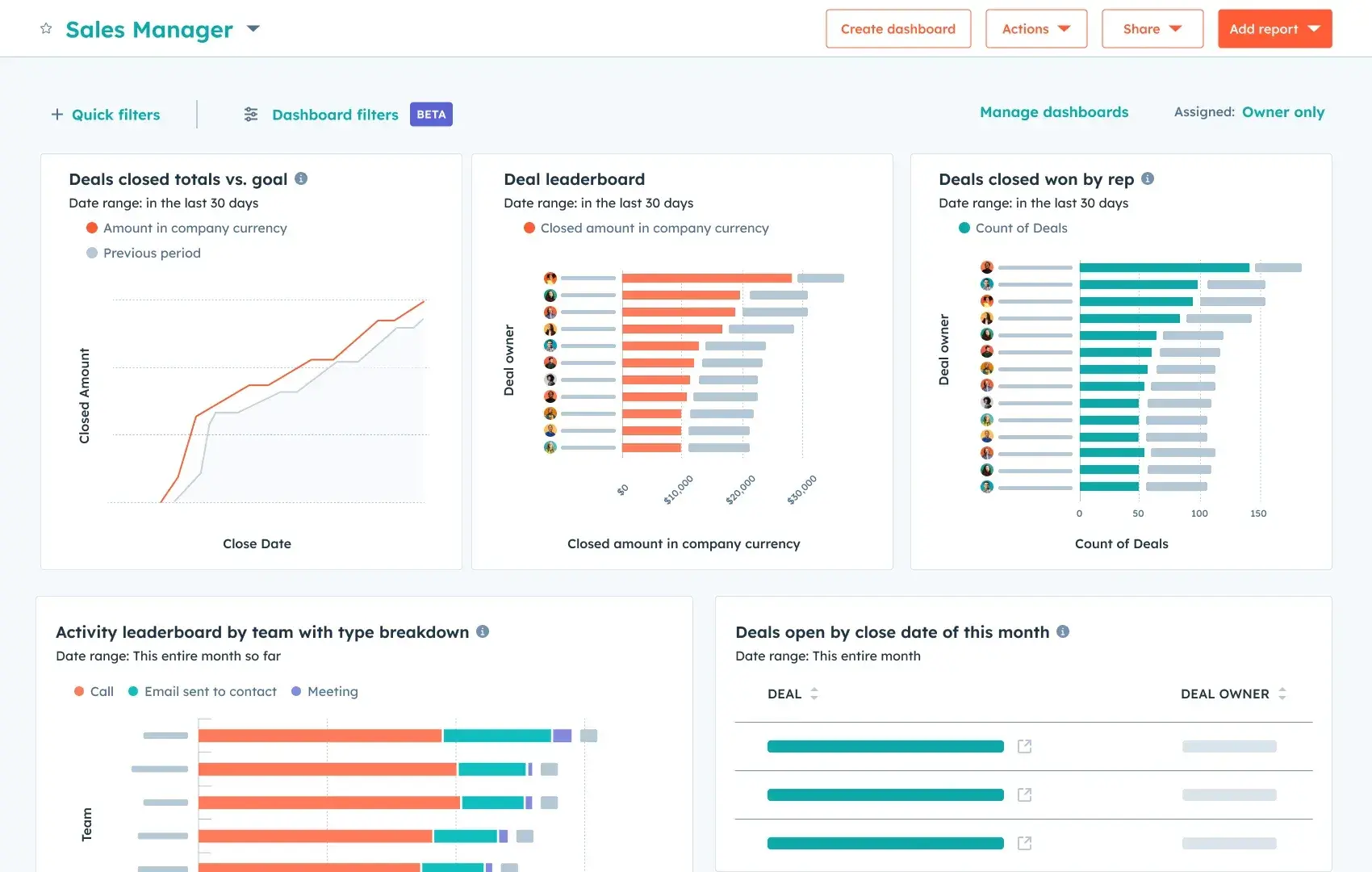
Effective pipeline visibility is indispensable for both accurate forecasting and targeted sales coaching. Leading platforms provide dynamic dashboards and detailed insights into deal health signals, such as engagement recency, duration in each sales stage, and comprehensive stakeholder management. These features enable operations leaders to proactively identify at-risk deals before they derail. Key questions to consider during evaluation include: Does the platform provide clear visibility into deal progression? Can it highlight potential roadblocks or stalled deals? Does it offer tools to analyze win/loss rates and identify common patterns?
3. Forecasting and Revenue Analytics
The perennial gap between forecasted and actual closed revenue represents one of the most significant and avoidable challenges in sales. A powerful sales operations platform replaces speculative spreadsheets with structured, data-driven forecasting models. Beyond basic forecasting, it offers advanced analytics that connect leading indicators (e.g., activity rates, pipeline coverage) with lagging outcomes (e.g., revenue attainment). This level of visibility empowers operations leaders to intervene early, implementing corrective actions well before the quarter concludes, thereby significantly improving the predictability of revenue generation. This shift from reactive to proactive management is a hallmark of high-performing sales organizations.
4. Workflow Automation and Lead Routing
Manual processes are inherently unscalable and prone to human error. A sales operations platform codifies critical processes—such as lead routing, approval workflows, and data management—into automated rules. This automation liberates sales representatives from tedious administrative tasks, allowing them to focus on core selling activities. Examples of powerful automation rules include: automatically assigning leads to the appropriate rep based on criteria like geography or industry; triggering follow-up sequences based on prospect engagement; updating deal stages when specific actions occur; and generating reports at predefined intervals. As Tebano emphasizes, "Follow-ups, task creation, and lead routing should not be based on whether or not the rep remembers to do it, because they won’t. They’re busy and distracted. If your entire process is relying on the rep doing the right next thing at the right time, your process is broken." Automation ensures process adherence and operational consistency, critical for scalable growth.
5. AI Insights That Drive Action
While "AI-powered" has become a ubiquitous marketing claim, the quality and effectiveness of AI implementation vary dramatically. True value from AI in sales operations comes from its deep integration into daily workflows, surfacing "next-best-action" recommendations contextually, rather than sequestered in separate analytics dashboards that reps rarely consult. Effective AI systems in sales operations should: analyze past interactions to suggest optimal outreach strategies; identify patterns in successful deals to guide new opportunities; predict deal outcomes with high accuracy; and automate content generation for personalized communications.
According to a 2024 Gartner survey, sellers who effectively partner with AI tools are 3.7 times more likely to meet their quota than those who do not. When evaluating AI capabilities, prospective buyers should demand live demonstrations of specific features within a production environment. Critical questions include: How does the AI output appear in the rep’s daily workflow? What data trains the model, and how long does it take to generate accurate predictions for new customers? What happens when underlying CRM data is incomplete? And crucially, what are the accuracy benchmarks grounded in customer outcomes? Metrics like "improved forecast accuracy by X% for customers with Y data maturity" are far more valuable than generic claims about model performance. Actionable AI is embedded AI.
Market Landscape: Leading Sales Operations Platforms
The market offers several robust sales operations platforms, each with distinct strengths and target audiences.
1. HubSpot Sales Hub
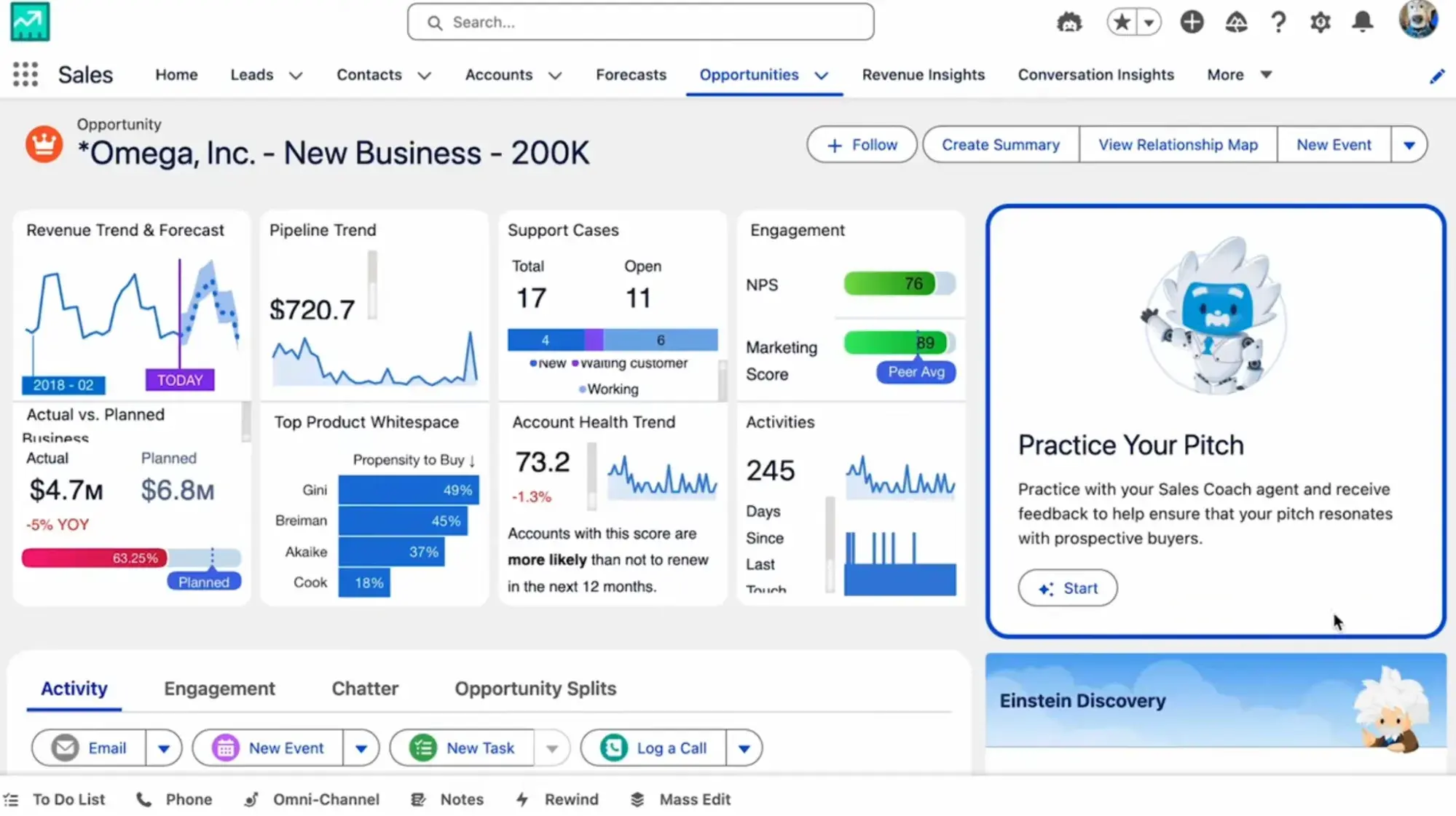
Built on HubSpot’s AI-powered CRM, Sales Hub stands out as one of the most complete and natively unified sales operations solutions available. Its strength lies in a single shared data layer where every prospect interaction, from initial touchpoint to closed-won, resides.
- Sales Engagement and Automation: Enables personalized outreach at scale using enriched CRM data, with multi-channel sequences orchestrating email, LinkedIn touchpoints, and calls. Real-time email engagement tracking provides immediate feedback. Activity capture is automatic when interactions occur within the platform, addressing a persistent CRM data quality challenge.
- HubSpot CRM Integration: Designed for AI outputs to be accessible across all hubs and workflows. Contact records, deal timelines, company data, and engagement history are available in real-time, allowing the CRM to function as an active revenue intelligence layer.
- AI Automation (Breeze): HubSpot’s proprietary AI system, Breeze, offers high-impact capabilities such as AI-driven prospecting, which uses company and contact data to identify and prioritize leads, and AI-powered forecasting, providing predictive insights into pipeline health and deal progression.
- Sales Automation: Covers the full revenue cycle, with routing rules and triggers responding to real-time record changes, eliminating sync delays and complex field mapping common in fragmented stacks.
- Strength: The compounding effect of unified CRM data and sales tasks. All rep activity feeds the same data model that powers forecasting, routing, and AI, eliminating integration complexities.
2. Agentforce Sales by Salesforce
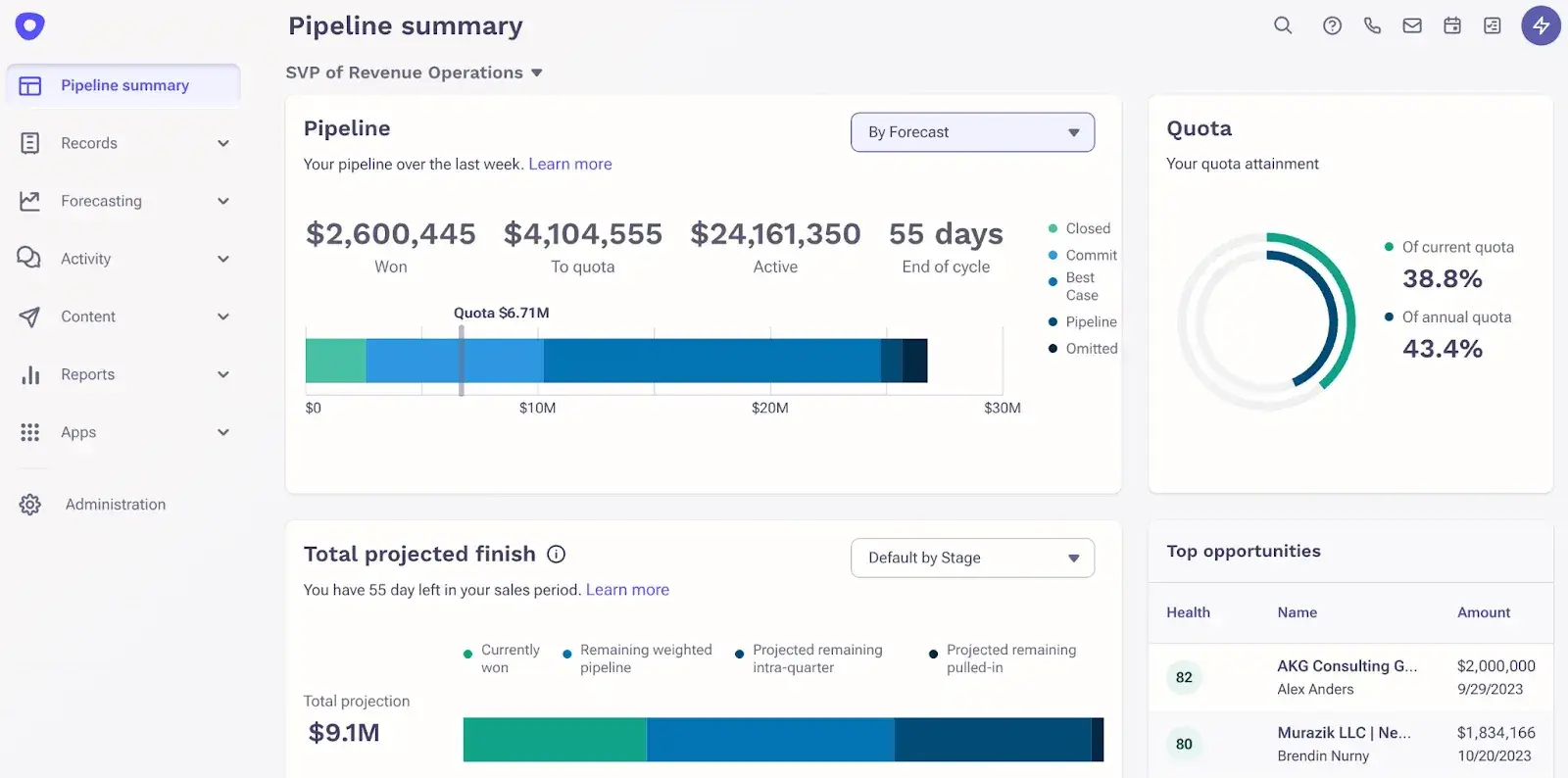
Formerly Sales Cloud, Agentforce Sales remains a robust choice for large enterprise sales organizations. Its configurability is a key strength, allowing customization of virtually every workflow to match complex organizational requirements. The extensive AppExchange ecosystem offers thousands of integrations.
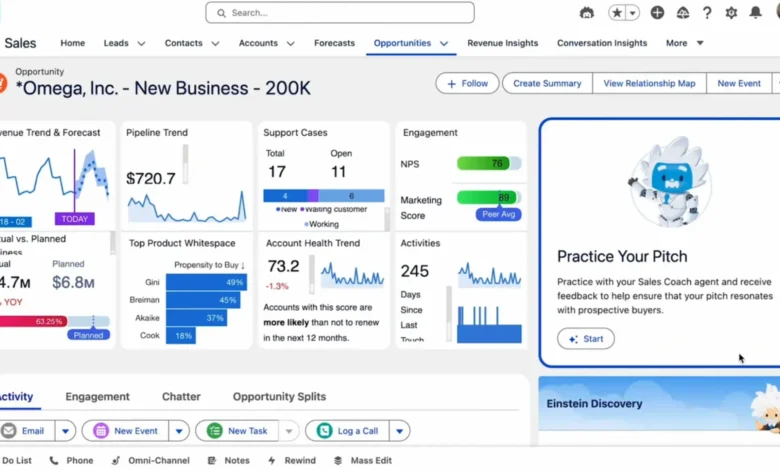
- Core Features: Lead and opportunity management, sales forecasting, mobile access, quote and order management, and Einstein AI for predictive scoring, opportunity health assessments, and automated activity capture.
- Pricing: Consumption-based, with advanced plans reaching up to $550 per user per month.
- Best for: Enterprise organizations with complex, multi-region sales hierarchies and the internal resources to configure and maintain an advanced platform.
3. Outreach
Outreach is a leading AI-powered sales execution platform, specifically designed for revenue teams managing high-volume outbound motions. Its sequence engine, conversation intelligence (Kaia), and deal health scoring are highly mature.
- Core Features: Sales engagement sequences, conversation intelligence (Kaia) for analyzing sales calls, deal health scoring, and AI-driven insights for optimizing outreach. Outreach’s 2025 sales data indicates that platform users closing deals within 50 days achieve double the average market win rate.
- Pricing: Custom pricing, typically positioned for mid-market and enterprise.
- Strength: Deeply embedded AI in reps’ daily activity, offering suggested deal updates, personalized talk tracks, and auto-generated voicemails. Highly credible for teams serious about AI in sales.
4. Clari
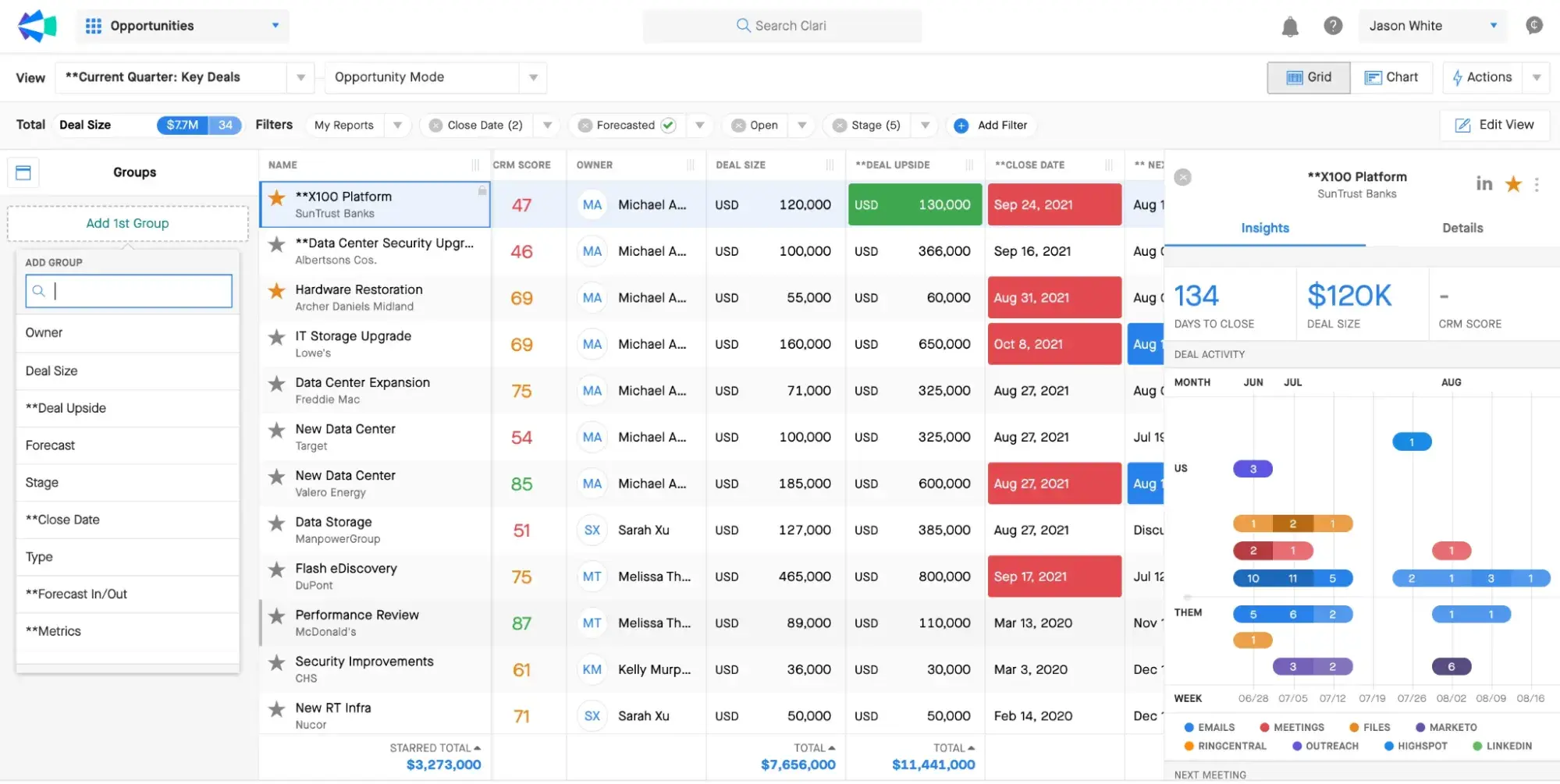
Clari is a revenue operations platform renowned for its AI-driven forecasting, pipeline inspection, and revenue leak identification. Where many platforms treat forecasting as a feature, Clari treats it as its core product.
- Core Features: Predictive forecasting, pipeline inspection, deal inspection and risk analysis, revenue leak detection, and guided selling. Its AI models ingest CRM data and engagement signals to generate highly accurate call-level forecasts.
- Pricing: Custom enterprise pricing, typically deployed alongside an existing CRM (Salesforce, HubSpot, Microsoft Dynamics).
- Best for: Revenue operations teams at mid-market to enterprise scale prioritizing forecast accuracy and revenue leak detection.
5. Gong
Gong is a market leader in revenue intelligence, with conversation analysis as its core strength. The platform records, transcribes, and analyzes every customer-facing interaction, mapping these signals to deal and pipeline data.
- Core Features: Conversation intelligence, deal and pipeline intelligence, coaching insights, and market intelligence. Gong’s AI models are trained on one of the largest datasets of B2B sales conversations, offering superior pattern recognition.
- Pricing: Custom enterprise pricing based on seat count and selected modules.
- Best for: Organizations aiming to bridge the gap between conversation reality and pipeline data, especially those investing heavily in rep coaching and proactive deal risk identification.
Strategic Implementation and Future Outlook
Adopting a unified sales operations platform requires strategic planning and careful execution.
Sales Operations vs. RevOps Platforms
The distinction between sales operations and Revenue Operations (RevOps) platforms is largely one of scope. Sales operations platforms focus specifically on tools and processes supporting sales functions. RevOps platforms, conversely, adopt a broader approach, aligning sales with marketing, customer success, and other business units through a unified data layer. In practice, this distinction is narrowing, as many sales ops platforms expand their capabilities, and RevOps platforms deepen their sales-specific tooling. For most growth-stage companies, a strong sales operations platform built on a unified CRM provides a solid foundation, allowing for a natural, non-disruptive expansion into a full RevOps architecture later.
Integration with Existing Tools
Most enterprise-grade sales operations platforms offer native integrations with common go-to-market tools. Platforms built on a native CRM, like HubSpot, often provide superior integration capabilities, with workflows living inside the platform rather than relying on external syncs. Typical integrations include email and calendar systems (Outlook, Gmail), communication tools (Slack, Teams), business intelligence platforms (Tableau, Power BI), and other specialized sales tools. When evaluating, inquire about specific integrations critical to your existing tech stack.
When to Transition from Point Tools to a Unified Platform
Teams should consider switching to a unified platform when they observe persistent discrepancies in forecast reliability, such as consistent quarter-end surprises, growing misalignment between sales leadership and operations, or an inability to articulate why deals are won or lost. Other clear signals include: diminishing returns from increased sales headcount due to operational inefficiencies; high administrative burden on reps; and disparate reporting across multiple systems, leading to conflicting data views. A unified platform consolidates these functions, fostering consistency and clarity.
Assessing AI Claims from Vendors
To stress-test vendor AI claims, always request a live, unscripted demonstration of a specific use case in a production environment. Observe where the AI output appears: Is it seamlessly integrated into the rep’s daily workflow, or does it require a deliberate detour to a separate analytics view? Ask about the data sources that train the model, the time required to produce accurate predictions for a new customer, and the system’s behavior when underlying CRM data is incomplete. Demand accuracy benchmarks grounded in actual customer outcomes, such as "improved forecast accuracy by X% for customers with Y data maturity," rather than vague assertions about model performance.
Key Performance Indicators (KPIs) Post-Launch
In the initial 30 to 60 days post-launch, prioritize KPIs that measure platform adoption and data quality, as revenue outcomes take longer to materialize. Track CRM field completion rates, sequence enrollment rates (as a proxy for rep adoption), and rates of duplicate or missing records (as a measure of data hygiene improvement). These operational KPIs indicate whether the platform is being correctly utilized, which is a necessary precondition for any downstream revenue impact. Monitoring these early indicators allows for rapid adjustments and ensures successful platform embedding within the sales culture.
Conclusion
The case for consolidating sales operations onto a unified platform has never been more compelling. In an era where efficiency and data-driven decision-making are paramount, these platforms offer a transformative solution to pervasive sales inefficiencies. By centralizing workflows, automating repetitive tasks, enhancing data quality, and leveraging advanced AI insights, sales operations platforms empower teams to move beyond mere record-keeping to proactive revenue generation. For organizations seeking to optimize their sales engine, improve forecast accuracy, and ultimately drive sustainable growth, investing in a unified sales operations platform is no longer an option, but a strategic imperative. The ability to gain rapid value while building a robust foundation for a sophisticated RevOps architecture provides a significant competitive advantage in today’s dynamic marketplace.