Salesforce to Acquire Braze in Strategic $5.66 Billion Deal to Revolutionize AI-Driven Customer Engagement

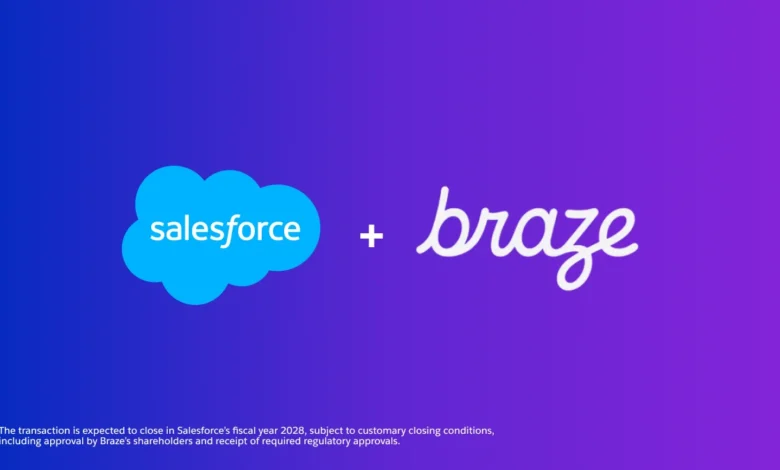
In a major consolidation move within the enterprise software sector, Salesforce (NYSE: CRM) has officially announced a definitive agreement to acquire Braze (NASDAQ: BRZE), a powerhouse in the customer engagement platform market, in an all-cash transaction valued at approximately $5.66 billion. Under the terms of the deal, Braze shareholders will receive $47.50 per share, marking a significant milestone in Salesforce’s ongoing strategy to cement its leadership in the artificial intelligence and CRM landscape. This acquisition is poised to reshape the digital marketing ecosystem, combining Salesforce’s vast data architecture with Braze’s specialized, high-volume, real-time engagement capabilities.
The transaction, which is subject to customary closing conditions including regulatory scrutiny and shareholder approval, is expected to close within Salesforce’s fiscal year 2028. For Salesforce, the move represents a calculated effort to deepen its integration of "agentic" AI, ensuring that its platform can not only store customer data but also make autonomous, real-time decisions that drive personalized interactions at scale.
The Strategic Rationale: Why Braze?
Braze has established itself as an industry leader by focusing on the "event-streaming" architecture necessary for modern, omnichannel marketing. Unlike legacy platforms that rely on batch processing, Braze’s cloud-native infrastructure is built to ingest and act upon customer behaviors—such as app clicks, website visits, or abandoned shopping carts—as they happen. This capability allows brands to orchestrate complex customer journeys across mobile applications, email, SMS, and messaging platforms like WhatsApp with millisecond-level responsiveness.
For Salesforce, integrating Braze is not merely a product add-on but a fundamental enhancement to its existing Customer 360 and Marketing Cloud offerings. By absorbing Braze’s technology, Salesforce aims to bridge the gap between static customer profiles and live, behavioral engagement. Industry analysts note that as consumer expectations for hyper-personalization grow, brands are increasingly struggling to connect disparate data points into a single, actionable narrative. Braze’s ability to "turn live customer behavior into personalized engagement" effectively solves this pain point, making it a critical asset for Salesforce’s goal of creating a more "agentic" enterprise environment.
A Chronology of Growth and Market Alignment
The road to this acquisition follows years of parallel growth for both companies. Braze, founded by Bill Magnuson and Jon Hyman, has grown from a boutique mobile engagement tool into a robust enterprise platform serving approximately 2,770 customers, including high-profile global brands like Canva, Instacart, Urban Outfitters, and Venmo.
- Foundation and Scaling: Throughout the early 2020s, Braze focused on the "composable" marketing stack, allowing brands to maintain flexibility in their data engineering.
- The AI Pivot: As generative and predictive AI gained mainstream adoption, Braze introduced BrazeAI, a suite of tools designed to optimize content, channel selection, and timing automatically.
- Salesforce’s M&A Evolution: Salesforce has maintained a disciplined M&A framework, focusing on acquisitions that advance its "Data 360" vision. The decision to pursue Braze aligns with its recent focus on Agentforce and SIForce, its proprietary architectures for AI agents and intelligent systems.
- The Agreement: Negotiations culminated in the current agreement, finalized after assessing the synergies between Salesforce’s massive global reach and Braze’s specialized technical prowess.
Data-Driven Marketing in the Era of AI
The sheer volume of data handled by Braze is a primary driver for this deal. Annually, the platform powers trillions of messages and journey actions. This scale is vital for enterprise clients who operate in high-frequency environments, such as food delivery, fintech, and fashion retail. When integrated into the Salesforce ecosystem, this high-volume capacity will allow users of the Salesforce Marketing Cloud to perform deep-funnel personalization that was previously computationally expensive or latency-prone.
The integration is expected to touch all four layers of the Salesforce architecture:
- Data 360: Enriching the unified customer profile with real-time behavioral event data.
- Customer 360: Improving cross-channel personalization logic.
- Agentforce: Providing the "eyes and ears" for AI agents to trigger actions based on live signals.
- SIForce: Integrating decisioning logic into the broader Salesforce intelligence framework.
Leadership Perspectives
Patrick Stokes, President of Applications and Marketing at Salesforce, emphasized that the acquisition is fundamentally about the customer experience. "Every interaction is an opportunity to wow your customers," Stokes stated. "Most of that wow comes from knowing your customer and responding at just the right moment. Braze was built to turn live customer behavior into personalized engagement at scale."
Bill Magnuson, CEO and Co-Founder of Braze, expressed confidence in the transition, noting that the company’s mission remains unchanged. "Braze was built on the conviction that marketers and their creativity are a brand’s ultimate competitive advantage," Magnuson said. He highlighted that the partnership will allow Braze to "innovate faster" while continuing to support the vast community of customers and partners that have grown alongside the platform.
Market Implications and Future Outlook
The acquisition of Braze is set to have a ripple effect across the marketing technology (MarTech) landscape. By absorbing a top-tier competitor in the real-time engagement space, Salesforce is signaling that it intends to dominate the "agentic" AI segment of CRM.
Analysts suggest that this deal may pressure other large-scale CRM providers to reconsider their own AI-engagement strategies. If Salesforce can successfully demonstrate that the integration of Braze leads to higher conversion rates and improved customer lifetime value (CLV) for its clients, it will set a new industry benchmark.
However, the path to completion is not without its hurdles. The transaction is subject to regulatory approval, a landscape that has become increasingly complex for large-cap tech acquisitions. Both Salesforce and Braze have acknowledged the risks associated with the deal, including potential delays in regulatory clearance and the inherent challenges of integrating disparate corporate cultures and technical stacks.
Despite these risks, the long-term strategic value is clear. As businesses move away from manual campaign management toward autonomous, AI-led journey orchestration, the infrastructure provided by Braze becomes an essential utility rather than a luxury. By bringing this capability in-house, Salesforce is positioning itself to be the primary operating system for the next generation of digital marketing.
Financial and Operational Impact
The deal is structured as an all-cash acquisition, a testament to Salesforce’s strong balance sheet and commitment to this specific vertical. Salesforce has clarified that it does not anticipate changes to its FY27 guidance as a result of the acquisition. Because the deal is expected to close in FY28, the company has not yet provided specific long-term targets regarding the financial impact, maintaining a cautious but optimistic stance.
For current Braze users, the message from leadership is one of continuity. The company’s commitment to an "open, composable approach" remains a core tenet, suggesting that Salesforce intends to maintain the platform’s flexibility rather than locking users into a rigid, closed-loop ecosystem. This "open" philosophy is designed to reassure existing partners that the acquisition will not disrupt their current data pipelines or tool integrations.
Conclusion: A New Chapter for Salesforce
The $5.66 billion acquisition of Braze marks a pivotal moment for Salesforce as it evolves into an AI-first company. By combining its massive CRM data repository with Braze’s real-time, event-streaming engagement engine, Salesforce is creating a formidable toolset that addresses the modern marketer’s most pressing challenge: delivering the right message at the right time to the right person, entirely at scale.
As the industry watches for regulatory developments and the eventual integration process, the move stands as a clear indicator of the direction in which enterprise software is heading. The future of the CRM is not just in storing data—it is in acting upon that data with the speed and intelligence that only autonomous AI agents can provide. With this acquisition, Salesforce is firmly establishing its intent to lead that charge.
Related posts: