Proving Causation in AI Search: seoClarity Webinar Reveals Definitive Strategies Amidst Google’s New Data

The intricate dance between content optimization and artificial intelligence visibility has long been shrouded in inference and correlation, but a recent webinar hosted by Search Engine Journal (SEJ) in collaboration with seoClarity has unveiled a groundbreaking methodology for establishing causation in AI search performance. A pivotal finding from seoClarity’s client tests demonstrated that adding FAQ sections to a set of test pages demonstrably lifted AI citations, and critically, removing those sections caused citations to drop back down. This reversion, a gold standard for proving causation over mere correlation, represents a significant leap forward in understanding and influencing AI search results – a feat few teams measuring AI search today can replicate.
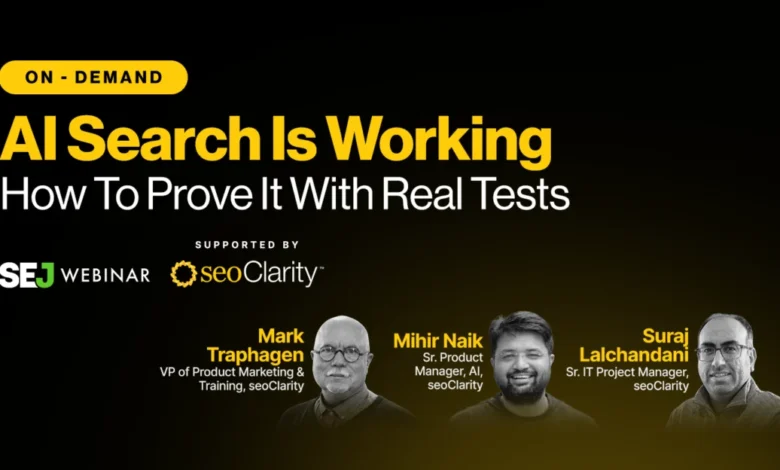
The webinar, titled "Beyond Correlation: Proving Causation in AI Search," featured seoClarity’s Mark Traphagen, VP of Product Marketing & Training; Mihir Naik, Senior Product Manager, AI; and Suraj Lalchandani, Sr. IT Project Manager. Their core message resonated clearly: "Visibility scores tell you if you showed up. Page-level performance and split testing tell you if what you did actually mattered." This emphasis on actionable, data-driven insights marks a crucial evolution in the field of search engine optimization (SEO), particularly as generative AI rapidly reshapes how users interact with information. The session meticulously outlined the split testing methodology seoClarity employs for its enterprise clients across leading AI surfaces like ChatGPT, Claude, Perplexity, Gemini, and Google’s AI features, providing a blueprint for building a funnel-spanning "golden set of prompts," constructing robust control groups despite LLM testing limitations, and integrating Google’s new first-party Search Console AI data.
The urgency for such a methodology stems from the dramatic proliferation of generative AI in search. In just the past year, large language models (LLMs) have moved from nascent technology to integral components of major search engines. Google’s introduction of AI Overviews (formerly Search Generative Experience or SGE) and similar AI-powered features across various platforms has fundamentally altered the search landscape, presenting both immense opportunities and complex challenges for digital marketers. Traditional SEO metrics and strategies often fall short in this new paradigm, where answers are synthesized, and direct traffic attribution becomes less straightforward. The seoClarity team’s work addresses this critical gap, providing a much-needed framework for proving the tangible impact of content changes on AI visibility.
A New Era of Measurement: Google Search Console’s AI Integration
One of the most significant developments discussed was Google’s recent launch of dedicated Search Console reports for AI Overviews and AI Mode, which began rolling out on June 3rd. For a specific subset of sites, this update finally provides page-by-page data on how often individual URLs appear within Google’s AI search features. Suraj Lalchandani hailed this as the "biggest measurement upgrade AI search testing has received," noting the industry’s previous reliance on sampling and inference. "Everyone was sampling. Everyone was inferring. But now Google is just giving it to you," he stated, underscoring the shift towards more reliable, first-party data.
This direct data from Google carries an unparalleled level of trust and accuracy, distinguishing it from any third-party tool. However, the seoClarity team was pragmatic about its limitations. The new reports, while invaluable, cover only a fraction of what a comprehensive AI search testing program requires. For visibility and performance tracking on other prominent LLMs such as ChatGPT, Claude, and Perplexity, businesses still need to rely on structured third-party tracking solutions. The webinar session detailed precisely which data gaps the new reports close, which remain open, and offered a platform-by-platform reference guide to what each AI engine can crawl and render. This nuanced understanding is crucial for marketers who might otherwise over-rely on Google’s data, neglecting the broader AI search ecosystem. The immediate action item for SEO professionals is to check their Search Console for these new AI reports and strategically integrate this first-party data into their existing or nascent AI testing programs, rather than building an entire strategy around it exclusively.
Strategic Prompt Selection: Targeting Easy Wins in the AI Funnel
In the complex world of AI search optimization, not all prompts are created equal. The seoClarity methodology advocates for a strategic approach to prompt selection, beginning with those queries where a brand is "almost winning." The team constructs a "golden set of prompts" designed to span the entire AI search funnel, from initial awareness to customer retention. Each prompt is meticulously tagged by its corresponding funnel stage, and then sorted into tiers based on the brand’s current standing within the AI’s response.
Tier 1 prompts are identified as "easy wins." Lalchandani explained these as scenarios where a brand is highly relevant to the query, but "AI just hasn’t been given a URL worth linking to." These represent low-hanging fruit, where minor content adjustments can yield significant citation improvements. Tier 2 prompts, conversely, represent a "heavier lift," requiring more substantial optimization efforts. Interestingly, the methodology advises dropping a specific bucket of prompts from immediate testing entirely – a decision that surprised many attendees. This sequencing is deliberate and strategic: securing early wins with Tier 1 prompts builds crucial "political capital" within an organization, making it easier to advocate for and fund more challenging tests later on. The webinar offered detailed guidance on how to build and tag this golden prompt set, define the tiers, and establish the precise tracking unit that pairs each prompt with its target page for citation. This structured approach ensures that optimization efforts are focused, efficient, and aligned with measurable business objectives.
The Rigor of Causal Testing: Split Testing LLMs
One of the most significant hurdles in AI search optimization is the inability to conduct traditional 50-50 A/B split tests on live LLM traffic. Unlike conventional web pages, LLMs do not allow for direct, simultaneous variations of content presentation to different user segments. To circumvent this, seoClarity has developed a robust control group methodology. This involves identifying a set of correlated pages that serve as a crucial "noise filter" against the inherent variability of model updates and algorithmic shifts. Lalchandani emphasized the indispensability of this approach: "Without a control group, every result would be guesswork. With one, you can tell a real win from the background noise." This controlled environment is paramount for isolating the impact of specific content changes.
Beyond establishing a control group, timing emerges as a critical, yet frequently overlooked, discipline in AI search testing. The seoClarity methodology prescribes a specific baseline period before any content change goes live, followed by a minimum test window after implementation. This structured timing is essential because AI search engines do not always respond to changes overnight, unlike some traditional SEO adjustments. Cutting the test window short can lead to misinterpretations, as Lalchandani warned, "you could be reading noise." By adhering to these defined windows, teams can gather sufficient data to confidently attribute performance changes to their interventions. Every test conducted within this framework yields one of three outcomes – a positive result, a negative result, or no significant change – each offering valuable insights into the validity of the initial hypothesis. The full webinar provided comprehensive guidance on constructing correlated control groups, defining precise baseline and test windows, and accurately interpreting all three potential outcomes, solidifying the framework for true causal analysis.
Real-World Validation: Client Tests and Unpredicted Outcomes
The practical application of seoClarity’s methodology across three distinct client scenarios yielded diverse, yet equally valuable, outcomes – precisely demonstrating the power of structured testing.
The most compelling demonstration of causation came from the FAQ test. Measuring approximately 1,000 prompts, the addition of well-structured FAQ sections to test pages led to a significant increase in AI citations compared to control pages. These elevated citation levels persisted throughout the period the change was live. Crucially, when the seoClarity team reverted the change and removed the FAQ sections, the citations demonstrably fell back down. "That’s the second half of proof," Lalchandani asserted. "Not that citations just went up when we added FAQs, but that they went back down when we took them away. That’s causation, not correlation." This conclusive finding provides a clear, actionable insight for content strategists: well-implemented FAQs can be a direct driver of AI visibility.
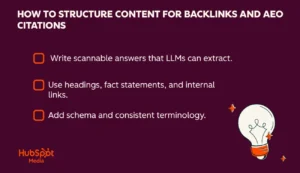
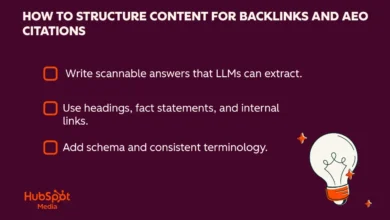
In contrast, two other client tests – one focusing on meta descriptions and another on listicle formatting – yielded very different results. While the webinar did not disclose the exact outcomes, it implied that these changes did not produce the anticipated positive shifts in AI citations. These "non-wins" are, in themselves, profound learning opportunities. They debunk common assumptions and prevent businesses from investing resources in tactics that may not be effective for AI search. Mihir Naik eloquently framed this perspective: "Every result is a win, because you have evidence instead of guesses. That is more than most teams in AI search have today." This philosophy underscores the value of testing, regardless of the immediate outcome, as it continuously refines understanding and guides future strategy. The session also laid out blueprints for future tests concerning schema and markdown optimization – two highly debated topics in AI Experience Optimization (AEO) – alongside a set of "fast structural tests" for high-value templates, capable of yielding insights within weeks.
Key Questions and Expert Answers from the Webinar Q&A
The webinar concluded with an insightful Q&A session, addressing pressing concerns from attendees.
Q: How do you measure AI authority when there is no clean authority metric?
Lalchandani acknowledged the absence of a single, definitive metric for "AI authority," which he defined as "how much the model trusts you as a source for this topic." Instead, he proposed a stackable approach using multiple signals. Foremost among these are citation share on top prompts and, significantly, cross-engine consistency. "Consistency across engines just means that you become the authoritative source in your category for specific kinds of questions," he explained. This multi-faceted approach helps build a comprehensive picture of a brand’s trustworthiness in the eyes of various AI models.
Q: Can AI bots read FAQ answers hidden behind collapsible toggles?
The answer, Lalchandani clarified, depends entirely on the implementation. "Collapsible can mean many different things. It’s how you are having it collapsible," he stated. Some common technical setups allow collapsed FAQs to remain fully readable to AI search engines and Google, while others render the content effectively invisible. This is because, as he noted, "even Google will not click around on your site." His standing advice for any uncertainty in implementation is pragmatic: "If you’re unsure of something, just test it out. It takes effort, but it’ll give you a sure answer."
Q: What is the ROI of an AI citation that does not drive referral traffic?
Mihir Naik provided a compelling argument that the value of an AI citation extends far beyond direct referral traffic. "You want to be cited because you are controlling the answer that is actually going to be showing up," he explained. Even without a click, a cited page significantly shapes the narrative presented in the AI’s response. This is particularly crucial in comparison queries, where citations play a heavy role in positioning brands, highlighting unique selling propositions (USPs), ensuring factual accuracy, and correcting any potential inaccuracies. Lalchandani reinforced this with a cautionary example from a real restaurant client, illustrating the negative consequences when AI cannot access relevant content – a scenario detailed fully in the recording. The ROI, therefore, lies in brand control, reputation management, and influencing user perception at the point of information synthesis.
Q: Is traditional SEO still a factor in moving the AI findability needle?
Unequivocally, the answer was "Absolutely. It is foundational. It is the foundation." Mark Traphagen highlighted that seoClarity’s longest-standing clients, those with well-optimized content and technically robust sites, are consistently the best performers in AI search. AI optimization, in this context, is an additional layer built upon a strong traditional SEO foundation. Lalchandani echoed this sentiment, adding, "When we run tests with our clients, we’ve rarely, if ever, found a situation where something works for SEO and does not work for AI search." This reaffirms that core SEO principles – technical health, high-quality content, clear structure, and user experience – remain paramount, serving as the bedrock upon which successful AI search strategies are built.
Broader Implications and The Future of AI Search Optimization
The insights from the seoClarity webinar signal a pivotal moment for digital marketing. The shift from anecdotal evidence and speculative best practices to a rigorous, causal testing methodology empowers businesses to make informed decisions and allocate resources effectively in the burgeoning AI search landscape. This data-driven approach is critical for maintaining competitive advantage as AI continues to evolve and integrate deeper into user information consumption habits.
The webinar’s emphasis on control groups, defined testing windows, and the nuanced interpretation of results sets a new standard for AI Experience Optimization (AEO). It provides a pathway for marketers to confidently articulate the ROI of their AI optimization efforts to stakeholders, moving beyond vague "visibility scores" to concrete evidence of impact. As AI models become more sophisticated, the ability to understand and influence their behavior through structured experimentation will be an indispensable skill for SEO professionals and digital strategists alike. The integration of Google’s new Search Console data further streamlines this process, though it underscores the need for a multi-platform approach to truly master AI search.
In essence, the future of AI search optimization is not about guessing but about methodical inquiry. It’s about asking specific questions, designing tests to answer them, and interpreting the results with scientific rigor. This webinar serves as a powerful call to action for organizations to embrace a culture of continuous testing and adaptation, ensuring their content not only shows up but also truly matters in the age of artificial intelligence.
Watch the Full Webinar
For those seeking to implement these advanced methodologies, the on-demand recording of the webinar offers comprehensive details. It includes a step-by-step guide to building the golden prompt set, defining the tier systems, constructing the correlated control group with exact baseline and test windows, a platform-by-platform crawler reference, the full results from the meta description and listicle tests, and the detailed blueprints for schema and markdown tests. Registration to watch the full session on demand is available for interested parties.