White House Media Relations and Global Broadcasting Shifts Define a Week of Institutional Transformation

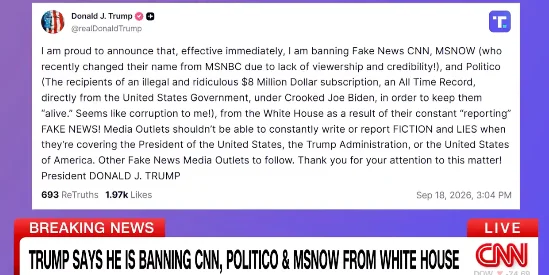
The landscape of American media is undergoing a period of profound volatility as the White House engages in a direct confrontation with prominent news organizations, while major broadcasting networks simultaneously restructure their weekend programming and international footprints. Tensions between the executive branch and the press reached a zenith this week following President Donald Trump’s public declaration that he intends to ban CNN, MS NOW, and Politico from reporting within the White House grounds, citing a cumulative history of coverage over the past two years as his primary justification. Despite the president’s assertion of an "effective immediately" ban, reporters from these outlets were observed continuing their coverage from the White House complex on Friday.
A Confrontation Over Press Access
The administrative threat to revoke press credentials marks a significant escalation in the ongoing friction between the Trump administration and the Fourth Estate. During an Oval Office question-and-answer session on Friday, the president remained vague when pressed for specific policy or ethical violations that necessitated such a ban. When asked by reporters to clarify the rationale, President Trump stated he had "no reason" beyond his general dissatisfaction with the tenor of reporting over the last two years.
CNN issued a formal, robust rebuttal to the administration’s posturing. In a statement released shortly after the president’s remarks, the network asserted its constitutional right to report on government activities without administrative interference. "Should the ban which President Trump threatened go ahead, it would be an illegal assault on that fundamental and constitutionally-protected right," the network stated. The legal consensus on this matter historically leans toward the protections afforded by the First Amendment. Former White House Correspondents’ Association (WHCA) president Weijia Jiang reinforced this stance by circulating the text of the First Amendment on social media, specifically highlighting the clause that prevents the government from abridging the freedom of the press. Legal experts suggest that any formal attempt to strip credentials would likely face immediate litigation, as federal courts have previously ruled that the White House is a public forum where the government cannot arbitrarily exclude news organizations.
Weekend Programming Overhauls at ABC News
While political tensions dominated the headlines, the broadcast industry saw significant personnel shifts, most notably at ABC News. The network’s flagship morning program, Good Morning America (GMA), debuted a revised anchor lineup for its weekend editions. Senior political correspondent Rachel Scott has been tapped to join Whit Johnson on the Saturday broadcast, while maintaining her existing role as the host of What You Need to Know on Disney+. The Sunday edition now features the pairing of correspondents Rhiannon Ally and Gio Benitez.
The changes extend to the network’s meteorological team as well. Leslie Lopez, formerly of KABC in Los Angeles, has been named the new weekend meteorologist for GMA. She succeeds Somara Theodore, who has transitioned to a full-time role on the weekday shift for ABC News Live. The network has also implemented a new rotation for its 24/7 digital platform, with Johnson, Scott, Benitez, and Ally sharing anchoring duties for ABC News Live Weekend, which airs at 10 a.m. ET. This strategic rotation is viewed by industry analysts as an effort to integrate streaming and linear broadcast talent more fluidly, catering to an audience that increasingly consumes news across multiple platforms.
Executive Restructuring at NBC News
NBC News is navigating a significant leadership transition following the departure of Janelle Rodriguez, who served as the executive vice president of NBC News programming for 12 years. Her exit, which she described in a memo to staff as the "right moment" to pursue new professional challenges, has prompted an immediate reorganization under the direction of NBC News president of editorial, Rebecca Blumenstein.
The new leadership structure elevates Catherine Kim to the position of executive vice president of editorial and content, granting her oversight of the growing NBC News Now platform and all network specials. Matt Carluccio’s portfolio has been expanded to include the supervision of core editorial units, such as business, health, investigations, and climate—sectors that have become increasingly vital for competitive audience engagement. Additionally, the elevation of Matt Frucci, the executive producer of NBC Nightly News, to report directly to Blumenstein, signals a tighter integration between the network’s flagship evening program and its editorial leadership team.
Strategic Retrenchment: The CNBC Hong Kong Closure
In the international sphere, CNBC has signaled a major contraction of its global operations, confirming the closure of its Hong Kong bureau. This decision follows a multi-month review of the network’s international programming, commercial viability, and resource allocation. The shutdown has resulted in the cancellation of several business-day programs, including Inside India, The China Connection, and Europe Early Edition. Feature series such as CNBC Meets and Built for Billions will conclude once their current production cycles wrap.
The network stated that a "small number of employees" were impacted by the restructuring. CNBC is pivoting its focus in the region, shifting editorial and technical resources to its Singapore and Beijing offices. These hubs, alongside existing operations in London and Abu Dhabi, are expected to serve as the primary pillars of the network’s future international strategy. Analysts note that this move reflects a broader trend among legacy financial news outlets to consolidate operations in cities with more favorable regulatory and business environments for regional broadcast production.
Evolution and Controversy at 60 Minutes
CBS News’ long-running investigative program 60 Minutes returned for its new season this week, marking the first under the leadership of Bari Weiss and Nick Bilton. While the network emphasized the show’s "tried-and-true formula" in a memo to staff, the transition has not been without internal friction. The debut episode, which the network described as a "powerful start," featured three major investigative pieces, yet the program’s editorial independence remains a subject of intense public and internal scrutiny.
The appointment of new producers, including Jordan Kronick—formerly of HBO’s Real Sports—and Wally Griffith, who arrives from CNBC, suggests a shift in the program’s production DNA. However, the tenure of the new leadership has been overshadowed by allegations of editorial interference. Guy Campanile, the former managing editor of 60 Minutes, recently addressed the state of the program in a private post that circulated widely. Campanile alleged that staff were being pressured to include "unverifiable notions" or specific political talking points, suggesting that his departure and that of his colleagues were tied to a refusal to compromise the show’s journalistic integrity. CBS leadership has denied these claims, maintaining that the program remains committed to the rigorous standards that have defined its history.
Digital Expansion and Future Debates
Finally, the media landscape is seeing a push toward direct-to-consumer models as MS NOW launched its "MS NOW Membership" on September 9. This platform offers an interactive layer to the network’s reporting, featuring twice-daily live Q&As that allow members to engage directly with hosts via video. This move underscores the industry’s pivot toward subscription-based engagement as a means of insulating news outlets from the fluctuations of the advertising market.
Looking toward the immediate political calendar, CNN has solidified its role as a key venue for political discourse, announcing a California Governor Debate scheduled for September 30. The hour-long event, moderated by Jake Tapper and Dana Bash, will feature candidates Xavier Becerra and Steve Hilton. The debate, which will be broadcast across CNN’s domestic and international platforms, is expected to draw significant attention, serving as a bellwether for the intensity of the upcoming electoral cycle.
As these events converge, the central theme remains the struggle for institutional autonomy. Whether through the direct pressure of White House rhetoric or the internal pressures of corporate restructuring and editorial debates, the American media is currently in a state of flux, balancing its commercial imperatives against the fundamental demands of public accountability and the protection of a free press.