The Definitive Guide to AEO Costs: From Monitoring Tools to Managed Agency Services

The landscape of search engine optimization (SEO) is undergoing a structural transformation as generative AI reshapes how information is discovered. As users increasingly turn to large language models (LLMs) like ChatGPT, Gemini, and Perplexity for direct answers rather than a list of blue links, businesses are pivoting toward Answer Engine Optimization (AEO). However, determining the financial commitment for this emerging discipline remains a challenge for marketing leaders. AEO costs span a vast spectrum, ranging from approximately $30 per month for self-managed monitoring software to upwards of $15,000 per month for comprehensive, full-service agency programs.
Understanding these costs requires an analysis of the scope, as the price is driven less by vendor margins and more by the specific volume of work being outsourced. At the entry level, businesses are paying for visibility tracking and automated reporting. At the high end, they are paying for specialized teams to handle content production, technical schema implementation, and off-site authority building.
The Evolution of the Search Ecosystem
To understand why businesses are suddenly allocating significant portions of their marketing budgets to AEO, one must look at the shift in user behavior over the last 24 months. Since early 2025, the proliferation of AI-driven search experiences has fundamentally altered the referral traffic landscape. Data from industry analysts suggests that while AI-driven referral traffic remains a relatively small percentage of total web traffic—often cited as less than 2%—it has tripled in volume between January 2025 and December 2025.
This transition has created a new urgency. CMOs and marketing directors are no longer just asking how to rank for keywords; they are asking how to ensure their brand is the primary source of truth within an AI-generated summary. This is a non-trivial shift. Traditional SEO focuses on maximizing click-through rates (CTR) by enticing a user to visit a website. AEO focuses on providing the information the AI needs to cite the brand directly in its response. Consequently, the "search" battleground has moved from the search engine results page (SERP) to the internal logic of the model itself.

A Comparative Analysis of AEO Pricing Models
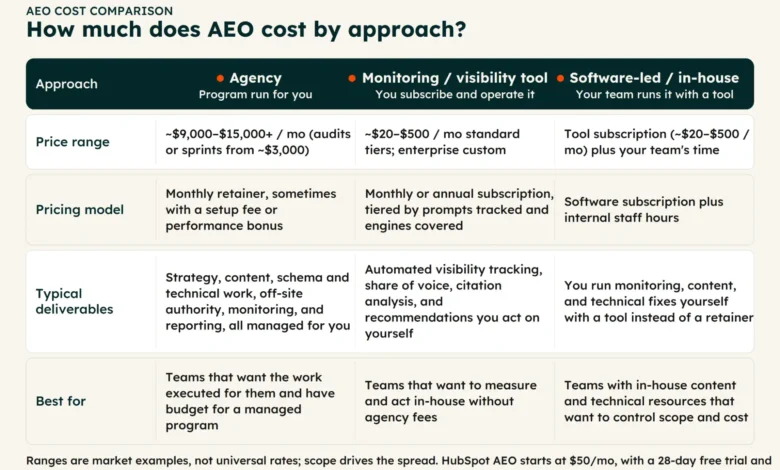
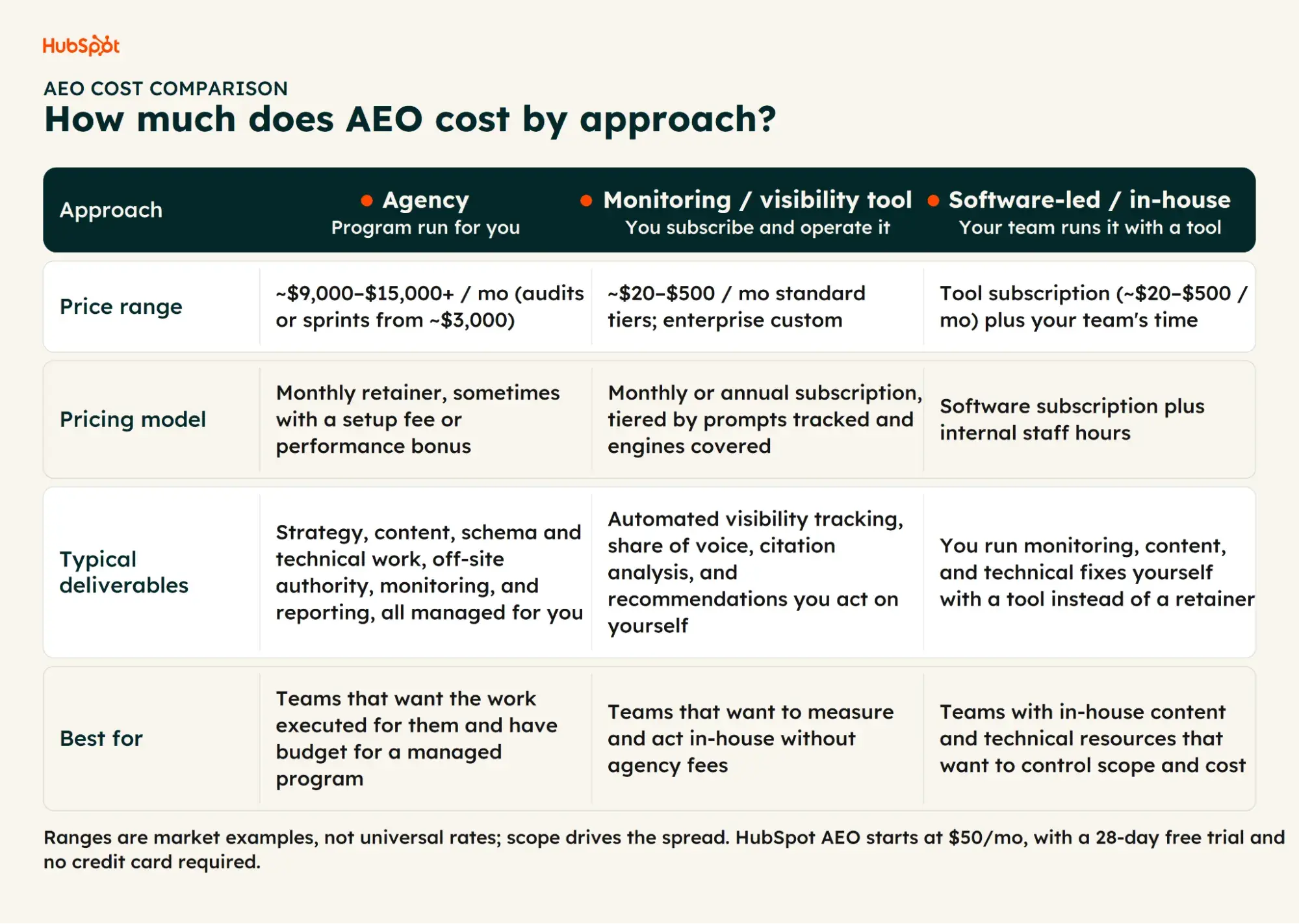
The cost of AEO is typically bifurcated into three distinct operational approaches: the software-led model, the hybrid in-house approach, and the full-service agency model.
The Software-Led Approach is designed for organizations that already possess strong internal SEO or content teams but lack the data infrastructure to monitor AI performance. Pricing for these tools generally falls between $30 and $500 per month, depending on the number of prompts tracked and the complexity of the analytics provided. For instance, platforms like HubSpot AEO offer entry-level solutions at approximately $50 per month, providing users with the ability to track brand mentions and competitor citations across major engines. These tools provide the "what" and the "where," leaving the "how" of optimization to the internal team.
The Hybrid or In-House Approach involves a higher investment of human capital. Here, the company pays for the software subscription mentioned above, but adds the cost of internal headcount—typically an SEO specialist or content strategist tasked with translating AI-derived insights into actionable content updates. This model provides the most control over brand messaging and technical implementation, though it requires a significant time investment from existing staff.
The Full-Service Agency Model represents the premium tier of the market. Agencies specializing in AEO often require monthly retainers starting at $9,000, with top-tier packages reaching $15,000 or more. This expenditure covers the entire lifecycle of AEO: the initial diagnostic audit, the strategic roadmap, the technical optimization of the website’s schema to be more "machine-readable," and the ongoing production of content designed to establish the brand as an authority on specific topics.
Factors Driving the Cost Gap
The wide variance in pricing is not merely a matter of vendor competition; it is a reflection of the resources required to satisfy the complex requirements of modern AI models. Several key factors dictate the cost:

- Volume of Prompts: Tracking 50 high-intent industry questions across three engines costs significantly less than monitoring 5,000 queries across a global market.
- Technical Debt: If a website’s underlying architecture is not optimized for AI ingestion, the cost of technical remediation—ensuring that data is structured correctly for LLMs—can significantly inflate the upfront audit costs.
- Content Velocity: AI models prioritize fresh, authoritative information. If a brand needs to produce 20 high-quality, AI-optimized articles per month to compete with industry rivals, the agency or internal costs will scale accordingly.
- Off-site Authority Building: Unlike traditional SEO, which relies heavily on backlinks, AEO is increasingly reliant on "brand mentions" and the overall reputation of a domain. Building this presence across third-party platforms requires sustained effort and investment.
Fact-Based Analysis: Implications for Marketing Strategy
The primary danger for organizations today is the conflation of SEO and AEO. While both disciplines share a foundation—a technically sound website and high-quality content—they are not interchangeable. A critical implication of this trend is the risk of "cannibalization." If a business cuts its traditional SEO budget to fund AEO, it may inadvertently destroy the very web pages that serve as the primary sources of information for AI models.
Data suggests that the most successful companies treat these as complementary efforts. A strong search ranking is often a prerequisite for being cited in an AI answer. Therefore, a strategic approach involves integrating AEO into existing search budgets rather than treating it as a separate, experimental silo.
Designing a 90-Day Pilot Program
For organizations skeptical of the ROI of AEO, industry experts recommend a 90-day pilot program. This limited-time engagement allows companies to gather data without committing to long-term retainers.
The first 30 days should be dedicated to establishing a baseline. By using an entry-level tool to track how the brand currently appears in responses for key industry queries, the marketing team can identify where they are missing out on citations. The next 30 days should focus on "low-hanging fruit"—making minor adjustments to existing content, ensuring schema markup is accurate, and updating the most frequently cited pages. The final 30 days are for measurement. Using the metrics established in the first month, the team can analyze shifts in brand mentions and share-of-voice against competitors.
It is essential to note that AEO results are rarely instantaneous. Because AI models are non-deterministic, they may provide different answers to the same prompt at different times. Therefore, success should be measured by tracking trends over the 90-day period rather than analyzing single data points.
Official Perspectives and Market Responses
Market participants, ranging from software developers like HubSpot to boutique digital agencies, emphasize the importance of transparency. A growing trend in the industry is the rejection of "black-box" AEO services. Agencies that promise guaranteed rankings in AI answers are increasingly viewed with skepticism by sophisticated buyers. Instead, industry standards are moving toward clear, outcome-based reporting: how many more times was the brand mentioned compared to the previous month? What is the percentage of competitor citations that have been displaced?
As businesses move toward 2026, the cost of entry is likely to stabilize as tools become more commoditized and agency processes become more streamlined. However, the cost of the work—the actual creation of high-quality content and the maintenance of a sophisticated digital presence—will likely rise as the competition for "AI real estate" intensifies.
Conclusion: Aligning Budget with Business Objectives
Choosing the right approach for AEO depends entirely on an organization’s internal capacity and strategic goals. For a small team with limited resources, a $50-per-month monitoring tool provides the necessary visibility to make informed, incremental improvements. For larger enterprises or those in highly competitive sectors where AI citations are a critical revenue driver, a full-service agency retainer is often the most efficient way to ensure the brand remains competitive.
Ultimately, the goal of AEO is not to "game" the algorithm, but to provide the most credible and accurate information to the user—the exact objective the LLMs themselves are trained to pursue. By aligning budget, technology, and content strategy, businesses can secure their position in the next generation of search, ensuring their brand remains visible even as the definition of "search" continues to evolve.