The transition from traditional, reactive supply chain management to the era of agentic AI represents one of the most significant shifts in industrial operations since the advent of enterprise resource planning (ERP) systems. In the current landscape, supply chains are often characterized by laborious manual monitoring, fragmented data silos, and a reliance on retrospective analysis. However, a new paradigm is emerging: the agentic supply chain. This model utilizes autonomous, goal-driven AI agents to orchestrate complex logistics, sourcing, and manufacturing processes, shifting the human role from constant oversight to strategic governance and exception management.
At its core, the agentic supply chain relies on the concept of a Minimum Viable Data Foundation (MVDF). This framework serves as the essential infrastructure required for AI agents to operate with precision, consistency, and safety. Without a harmonized master data set and a shared semantic model, these advanced systems are prone to failure. Rather than fixing operational weaknesses, agentic AI acts as a magnifying glass, exposing foundational data flaws at an accelerated pace.
The Evolution of Supply Chain Automation: A Chronology
To understand the shift toward agentic orchestration, one must look at the historical trajectory of supply chain technology. In the late 1990s and early 2000s, the focus was on the digitization of records—moving from paper-based systems to centralized databases. By the 2010s, the industry pivoted toward "visibility," with companies investing heavily in cloud-based dashboards to track shipments and inventory in near-real-time.
The current decade marks the transition into the "autonomous era." Following the widespread adoption of predictive analytics—which allowed companies to forecast demand—the industry is now moving toward prescriptive, agentic systems. Unlike earlier AI iterations that merely provided recommendations to human users, agentic systems are designed to initiate and execute actions across enterprise boundaries. This evolution is driven by the realization that humans can no longer process the sheer velocity of data generated by modern global trade networks.
The Anatomy of the Minimum Viable Data Foundation
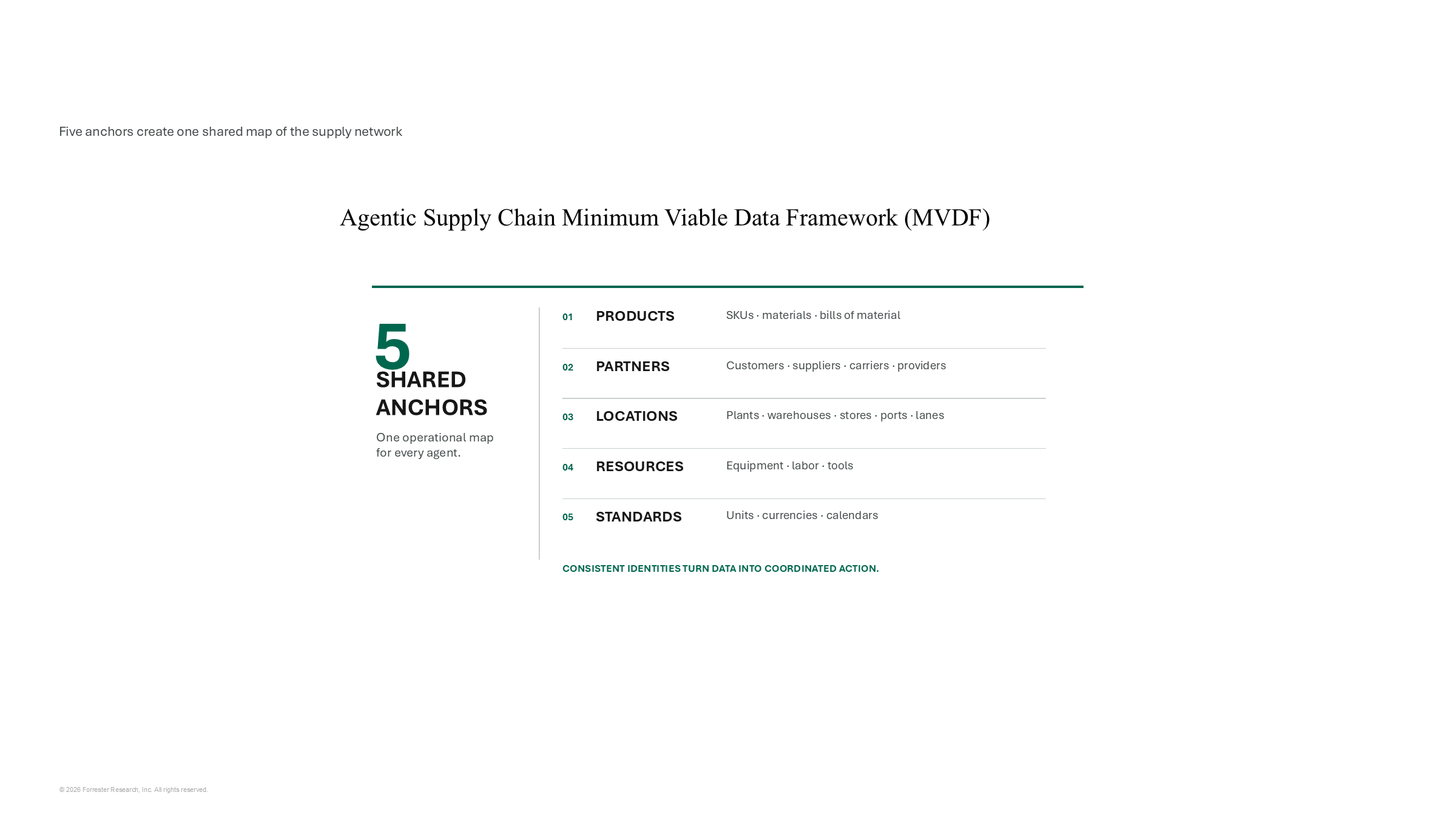
The MVDF is not merely a technical requirement; it is a strategic necessity. Technology leaders must standardize five "shared anchors" to enable agentic success: products, partners, locations, resources, and operating standards. Each of these anchors must be assigned a persistent identifier and a canonical definition that remains consistent across the entire enterprise.
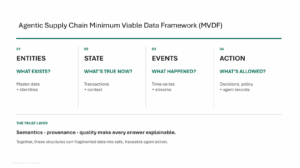
The integration process involves several critical layers:
- Entity Identification: Using harmonized master data to ensure that every agent recognizes a product or supplier identically, regardless of the source system.
- State Representation: Capturing the current transactional context, including real-time constraints and operational boundaries.
- Event Persistence: Maintaining a time-ordered ledger of changes, which allows agents to audit their own decision-making processes.
- Policy Governance: Establishing clear thresholds and permission sets that dictate what actions an agent is authorized to take.
- Metadata Enrichment: Attaching critical context—such as data freshness, version control, and lineage—to every data point.
By connecting these layers through a shared semantic model, organizations can move beyond fragmented point solutions. This connectivity is what enables the "orchestration" aspect of agentic AI; it allows multiple agents to collaborate on a single goal—such as optimizing a multi-modal shipment route—without conflicting with one another or violating corporate policy.
Data Weakness as an Impediment to Scalability
Industry data suggests that the primary barrier to AI deployment is not the sophistication of the models, but the state of the underlying data. According to recent industry benchmarks, more than 60% of supply chain leaders report that poor data quality is the single greatest obstacle to scaling automated workflows.
Agentic AI requires an authoritative "system of action." In a standard environment, data is often inconsistent: a product might have one SKU in the manufacturing database and a different identifier in the logistics portal. When an AI agent attempts to reconcile these, it hits a "semantic gap." If the data foundation is weak, the agentic system will either stall, require constant manual intervention, or, in the worst-case scenario, execute an incorrect action based on erroneous information. Consequently, the MVDF acts as a filter, ensuring that only trusted, validated data enters the agent’s decision-making loop.
Implications for Enterprise Governance and Explainability
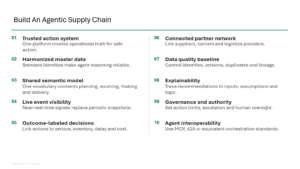
The shift to agentic supply chains necessitates a radical rethinking of governance. Because these agents operate autonomously, the traditional "human-in-the-loop" model must evolve into a "human-on-the-loop" model. In this setup, humans define the objectives and the "guardrails"—the policy thresholds and risk tolerances—while the agents manage the day-to-day tactical execution.
This shift has profound implications for corporate liability and operational transparency. If an agentic system makes an error, the organization must be able to trace that decision back through the data lineage to understand exactly why the action was taken. This requires that every agentic decision be logged with the same level of rigor as a financial transaction. Furthermore, explainability is a technical requirement for regulatory compliance, particularly in industries like pharmaceuticals or aerospace, where the provenance of every component must be documented.
Future Perspectives: The Role of Interoperability
Looking ahead, the success of the agentic supply chain will depend on interoperability standards. As companies begin to deploy specialized agents from different vendors, these systems must be able to communicate effectively. An agent managing inventory levels in a warehouse must be able to "speak" to an agent managing carrier procurement.
Current efforts in the industry are focusing on developing standardized communication protocols for AI agents. By establishing a shared semantic language, enterprises can ensure that their internal agent ecosystem can scale horizontally, incorporating new partners and logistics providers without requiring a complete overhaul of the IT architecture.
Strategic Recommendations for Technology Leaders
For those tasked with implementing agentic capabilities, the roadmap is clear: prioritize the foundation before the orchestration. Technology leaders should initiate a rigorous audit of their existing master data management (MDM) strategies. Are the identifiers persistent? Is the semantic model shared across the planning, sourcing, and fulfillment functions?
The move toward agentic maturity involves three distinct phases:
- Standardization: Resolving identity duplicates and establishing the five core anchors mentioned previously.
- Event-Driven Integration: Shifting from batch-processing data to real-time event streaming, allowing agents to respond to live operational conditions rather than stale planning snapshots.
- Policy-Driven Orchestration: Implementing the governance layer that enables agents to act safely within defined parameters.
As organizations prepare for the next generation of supply chain technology, the focus must remain on the data. The most successful implementations will be those that treat the data foundation not as a background utility, but as a primary competitive asset. By establishing a robust MVDF, enterprises can transform their supply chains from cost centers into highly responsive, autonomous engines capable of delivering superior business outcomes in an increasingly volatile global market.
The road to agentic maturity is incremental. By charting a course that balances technological innovation with disciplined data stewardship, firms can mitigate the risks of automation while capturing the significant efficiency gains promised by the agentic era. As research continues to evolve, engagement in industry forums and peer-to-peer discussions will remain critical for leaders seeking to navigate the complexities of AI-driven supply chain transformation.