The Rise of Answer Engine Optimization and the Essential Tools for Navigating the New Search Landscape

The paradigm of internet search has undergone a fundamental shift. For decades, the digital economy was built upon the "ten blue links" model, where users entered a query and received a list of websites to explore. Today, that model is being rapidly supplanted by generative AI-powered answer engines like ChatGPT, Perplexity, and Google’s AI Overviews. These systems synthesize information from across the web to provide direct, conversational answers, often resolving user queries without a single click-through to a source website. This transition has necessitated the birth of Answer Engine Optimization (AEO), a critical discipline for brands aiming to remain visible in an era where traditional organic rankings are no longer the sole arbiter of digital authority.
The Evolution of Search: From Links to Synthesis
The timeline of this transition accelerated significantly in May 2024, when Google integrated AI Overviews (AIO) into its core search results. This move followed the rapid adoption of large language model (LLM) interfaces that prioritized speed and synthesis over directory-style navigation. Unlike traditional Search Engine Optimization (SEO), which focuses on achieving high rankings in a static list of links, AEO focuses on securing "citations"—the specific mentions of a brand or the inclusion of a website as a verified source within an AI-generated response.
![AEO checker tools that measure answer engine visibility [2026]](https://53.fs1.hubspotusercontent-na1.net/hubfs/53/aeo-checker-1-20260903-3858273.webp)
The implications for digital marketing are profound. When an AI summarizes the "best project management software" or "top cybersecurity practices," it acts as a gatekeeper. If a brand is not cited in the answer, it effectively disappears from the user’s consideration set, regardless of how high that brand might rank on the traditional search results page (SERP). Consequently, businesses must now treat AI models as primary destinations rather than just referral traffic sources.
Understanding the Mechanics of AEO
At its core, AEO is about aligning content with the way LLMs consume, parse, and verify data. AI engines prioritize content that is highly structured, factually dense, and backed by primary sources. Because these engines "read" across thousands of pages to synthesize a single response, they rely on technical signals—such as schema markup, clear entity relationships, and direct answers to specific, long-tail questions—to build their confidence in a citation.
For marketers, the challenge is twofold: measuring visibility within these "black box" algorithms and identifying the gaps where competitors are gaining the upper hand. A manual check—searching for a term and reading the resulting AI summary—is the starting point for understanding this landscape. However, as query volumes grow, the volatility of AI results makes manual observation statistically unreliable. An AI response can change based on the user’s history, location, and the specific prompt used, creating a need for automated, enterprise-grade AEO checkers.
![AEO checker tools that measure answer engine visibility [2026]](https://no-cache.hubspot.com/cta/default/53/9dd5e54b-fbef-4dd0-bc44-1689feb1ea18.png)
Evaluating the AEO Tool Landscape
To manage this transition, the market has seen a surge in specialized software designed to track brand mentions and citations across multiple AI platforms. When selecting an AEO checker, organizations should prioritize tools that offer longitudinal data rather than static snapshots.
Tools with AI Overviews Tracking
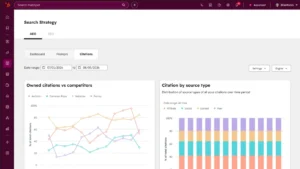
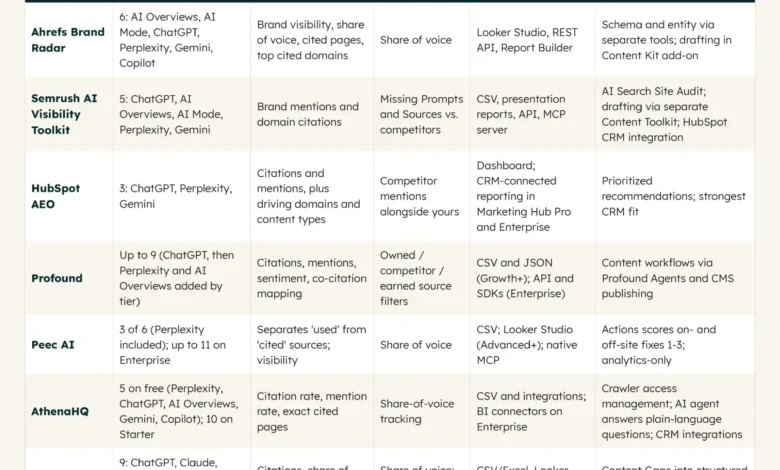
For companies heavily reliant on Google search traffic, tools like Ahrefs Brand Radar provide a necessary window into AIO behavior. By analyzing which keywords trigger AI summaries and which domains appear as citations, these tools allow marketers to bridge the gap between traditional SEO and AEO. Similarly, the Semrush AI Visibility Toolkit provides visibility into near-inclusion pages—content that is currently ranking in the top ten of standard results but failing to break through into the AI-generated snippet.
Citation Detection and Contextual Analysis
While tracking citations is essential, understanding the sentiment and context of those citations is the next frontier. HubSpot AEO, for instance, distinguishes between a citation (a link-back) and a mention (the brand name appearing without a link). This distinction is vital; being named as a market leader in an AI response provides brand authority even if a click does not occur. Furthermore, platforms like Profound offer deeper diagnostic data, such as sentiment scoring, which helps brands understand if the AI is positioning them negatively or inaccurately.
![AEO checker tools that measure answer engine visibility [2026]](https://53.fs1.hubspotusercontent-na1.net/hubfs/53/aeo-checker-2-20260903-852936.webp)
Technical Readiness: Schema and Entity Optimization
The foundation of any AEO strategy remains the technical health of the website. Tools like Scrunch AI and Conductor focus on the "crawlability" of a site, ensuring that AI agents can effectively render and interpret the brand’s pages. This includes verifying that schema markup is correctly implemented to define entities (such as products, people, or organizations) in a language the AI can parse. If an AI cannot identify a brand as a distinct entity, it is unlikely to cite that brand as an authority on a given topic.
Defining the Metrics of Success
In the traditional SEO world, success was measured by clicks, sessions, and conversion rates. In the AEO landscape, these metrics remain relevant but must be supplemented by "visibility scores." Key performance indicators (KPIs) for AEO include:
- Citation Share: The percentage of queries where your brand is cited as a source compared to competitors.
- Brand Mention Frequency: The number of times your brand is referenced within AI responses, even in the absence of a direct link.
- Competitor Gap Analysis: Tracking specific queries where competitors are receiving citations that you are not, serving as a roadmap for content updates.
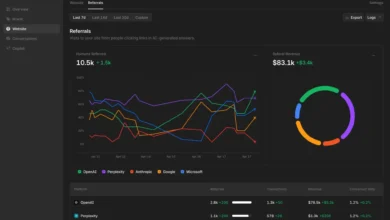
- AI-Referred Conversions: While many AI interactions are "zero-click," some platforms do drive traffic. Connecting these sessions back to the CRM—as some integrated platforms like HubSpot now do—allows businesses to quantify the ROI of their AEO efforts.
Strategic Implications and Future Outlook
The rise of AEO is not a temporary trend but a fundamental recalibration of how information is disseminated online. As AI engines grow more sophisticated, they will increasingly prioritize "verifiable truth" and "direct answers." This incentivizes brands to produce high-quality, long-form content that answers the "why" and "how" behind customer problems, rather than just optimizing for high-volume keywords.
![AEO checker tools that measure answer engine visibility [2026]](https://53.fs1.hubspotusercontent-na1.net/hubfs/53/aeo-checker-3-20260903-8904553.webp)
Industry analysts suggest that we are entering a "hybrid search" era. During this period, companies that ignore AEO will likely see a decline in organic traffic as "informational" searches move entirely into AI interfaces. Conversely, those that invest in early-stage AEO tools and adapt their content strategy to be "AI-friendly" stand to capture significant mindshare.
Furthermore, there is a clear institutional shift toward accountability. As Google and other tech giants begin rolling out dedicated generative AI performance reports, we can expect more granular data to become available. However, for the foreseeable future, the onus remains on the brand to monitor its own digital footprint. The transition from "managing for the link" to "managing for the answer" requires a shift in mindset: brands must stop viewing their content as a collection of pages and start viewing it as a comprehensive knowledge base designed to serve both human users and the AI models that represent them.
In conclusion, the adoption of an AEO checker is no longer an optional "nice-to-have" for digital marketing teams; it is a defensive and offensive necessity. By continuously monitoring the AI-generated landscape, prioritizing the remediation of content gaps, and ensuring that technical site signals are aligned with modern crawler requirements, businesses can maintain their authority in an increasingly automated, answer-driven digital world. The winners of this new era will be those who recognize that while the medium of search has changed, the value of being the authoritative source for your customer remains as vital as ever.
Related posts: