The shifting landscape of equal pay litigation: why market rate justifications are no longer legally sufficient

The legal landscape governing corporate compensation practices is undergoing a profound transformation as courts increasingly reject traditional justifications for pay disparities. For decades, human resources departments and organizational leadership have relied upon "market rates," business size, and job titles as the primary pillars for defending compensation structures. However, recent judicial rulings suggest that these metrics, when used in isolation, are no longer considered valid, gender-neutral defenses in the face of equal pay litigation. This shift marks a critical turning point for HR, reward, and legal teams, who must now navigate an environment defined by heightened pay transparency regulations and the rapid integration of artificial intelligence in workforce management.
The Erosion of Traditional Compensation Defenses
Historically, employers have utilized external benchmarking to set base salaries, arguing that the "market rate" for a specific role provided an objective, non-discriminatory basis for pay. This practice, while convenient for recruitment and retention, is increasingly failing to satisfy the legal requirements of equal pay legislation, such as the Equal Pay Act in the United Kingdom or Title VII of the Civil Rights Act in the United States.
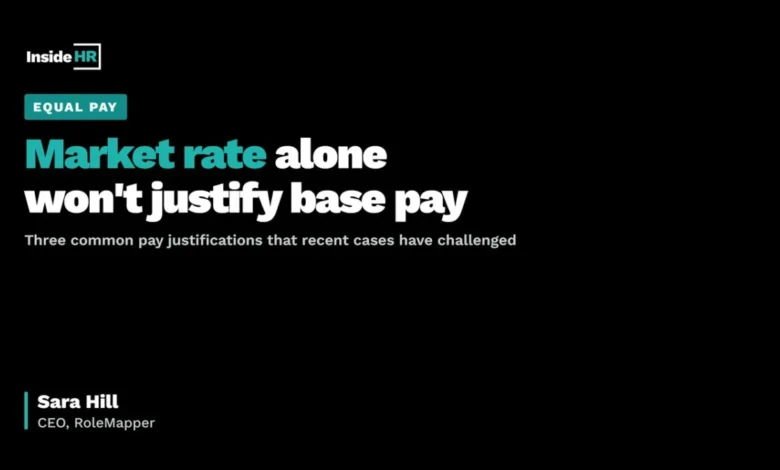
Sara Hill, CEO of RoleMapper, has emphasized that the bar for justifying pay differences has risen significantly. During a recent industry webinar hosted by InsideHR, Hill highlighted that courts are no longer accepting market pricing as a standalone justification. The core issue lies in the fact that market rates themselves are often a reflection of historical gender pay gaps. If an organization pays based on the market, it risks perpetuating the same systemic undervaluation of roles that historically impacted women or minority groups.
Furthermore, the judiciary has begun to dismantle other common defenses. Revenue and business size have been explicitly cited in recent case law as insufficient grounds for setting disparate base pay between employees performing work of equal value. Similarly, the reliance on formal job titles—which can often be inconsistent across departments or legacy systems—is no longer viewed as a reliable proxy for the actual value or complexity of the work being performed.
A Chronology of Legal Precedent and Regulatory Change
The movement toward more stringent pay equity standards is not an isolated event but rather the culmination of years of legislative and judicial evolution. The chronology of this shift can be traced back through several key milestones:
The early 2010s saw a surge in mandatory gender pay gap reporting requirements globally, starting with the UK’s Equality Act 2010. These regulations forced organizations to disclose aggregate data, shining a light on structural pay discrepancies that were previously hidden. As public and employee awareness grew, so did the number of collective litigation cases.
By 2017, the implementation of mandatory gender pay gap reporting in the UK created a massive influx of data. This transparency acted as a catalyst for legal challenges, as employees gained the ability to compare their earnings against broader organizational averages.
In the period between 2020 and 2024, the focus shifted from aggregate reporting to individual and class-action litigation. Courts began to examine the "why" behind the numbers. Judges increasingly demanded evidence of objective job evaluation systems rather than anecdotal or market-based justifications. This timeline reflects a transition from a "transparency-first" era to a "defensibility-first" era, where internal consistency and documented job architecture have become the primary legal shield for employers.
Supporting Data and the Cost of Non-Compliance
The financial and reputational stakes for organizations are higher than ever. According to data from the World Economic Forum’s Global Gender Gap Report, the time required to close the global gender pay gap has remained stubbornly high, with current projections suggesting that at the current rate of progress, it will take over a century to achieve parity.
For individual firms, the cost of failing to address these disparities is substantial. In the United Kingdom, for instance, equal pay claims can be filed up to six years after the cause of action, and the financial liability for back pay and potential legal costs can reach into the millions for larger enterprises. Beyond the financial impact, there is the "transparency penalty." With the rise of platforms like Glassdoor and the implementation of the EU Pay Transparency Directive, the reputational damage of a public pay equity scandal can lead to an immediate decline in talent acquisition and retention rates.

Data analytics firms have observed that organizations that proactively audit their compensation structures—using AI to identify hidden biases—are 40% less likely to face litigation than those that rely solely on annual market benchmarking exercises. This suggests that the solution to the legal challenge is not to abandon market data entirely, but to contextualize it within a rigorous, skill-based job architecture.
The Role of Artificial Intelligence in Compensation Defensibility
As organizations struggle to manually maintain equitable pay structures in increasingly complex global economies, many are turning to Artificial Intelligence (AI). When deployed correctly, AI can analyze thousands of data points—such as job responsibilities, required skills, and performance metrics—to identify whether a role is being compensated according to its objective value rather than its market title.
However, AI integration also introduces new risks. If an AI model is trained on historical data that includes biased pay practices, the algorithm may unintentionally automate and perpetuate those same biases. This has led to a growing consensus among HR leaders that AI must be used as a "decision support" tool rather than a "decision-making" engine.
The defensibility of pay, therefore, relies on "human-in-the-loop" systems. Organizations must be able to explain the logic behind their pay bands to regulators and employees alike. If an organization cannot articulate the objective criteria that led to a specific salary offer, the use of AI, however advanced, will not serve as a valid legal defense.
Implications for HR and Legal Strategy
The implications for human resources, reward teams, and in-house legal counsel are profound. The traditional "market rate" model is effectively obsolete as a standalone defense, necessitating a shift toward "Job Architecture."
Job Architecture involves mapping roles based on the actual skills, competencies, and value contribution required, rather than just market benchmarks or internal hierarchy. By standardizing these definitions across the organization, HR teams can ensure that pay is determined by a consistent, defensible methodology.
Key strategic recommendations for organizations include:
- Conducting Regular Pay Equity Audits: Moving beyond annual check-ins, firms should implement real-time monitoring of pay equity to identify gaps before they become systemic.
- Standardizing Job Descriptions: Eliminating "title inflation" and ensuring that job descriptions accurately reflect the scope and complexity of the work, regardless of the department.
- Transparency in Compensation Philosophy: Communicating clearly to employees how pay is determined. As transparency mandates expand, the ability to explain the "why" behind compensation is as important as the pay itself.
- Legal Review of Pay Data: Engaging with legal counsel to ensure that pay structures are not only equitable but also meet the evidentiary standards required by local courts.
Broader Impact and Future Outlook
The legal shift away from market-rate justifications signifies a broader societal movement toward the commoditization of labor based on objective value rather than historical precedent. As the workforce becomes more aware of pay transparency, the pressure on organizations will only intensify.
This evolution is fundamentally changing the role of the HR professional. It is no longer enough to be a steward of company policy; HR practitioners must now act as data analysts and legal strategists. The ability to build a defensible pay structure is rapidly becoming a core competency for any organization that wishes to avoid the mounting risks associated with equal pay litigation.
As courts continue to interpret the law in favor of transparency and fairness, the organizations that thrive will be those that have moved past the era of "market rate" reliance. By adopting robust, AI-supported job architectures and committing to continuous, transparent evaluation, companies can not only mitigate their legal risk but also foster a culture of trust and equity that is essential for long-term success in the modern, globalized labor market. The message from the judiciary is clear: the market is not an excuse for inequality, and the future of compensation lies in the ability to justify every dollar paid with evidence, logic, and fairness.