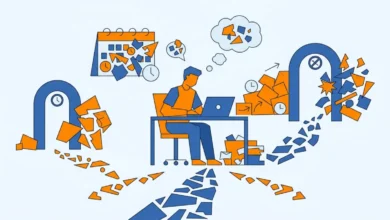
Mastering the Architecture of Deep Work: Strategies for Reclaiming Cognitive Autonomy in a Distracted Economy


In the modern knowledge-based economy, the ability to perform sustained, high-intensity cognitive work has become a critical competitive advantage. As digital connectivity continues to permeate every facet of the professional sphere, the fragmentation of time has emerged as a primary barrier to organizational and individual productivity. Productivity experts, including Brooks and proponents of the "Deep Work" philosophy, have identified a clear divergence between workers who operate via "emergency" reactive modes and those who employ structured, proactive scheduling to protect their cognitive resources.
The fundamental premise of deep work is the allocation of protected time blocks—ideally between 60 and 90 minutes—dedicated exclusively to high-value tasks that directly correlate with measurable success metrics. Research into cognitive load suggests that the human brain requires significant "warm-up" time to enter a flow state, a neurological phenomenon where an individual is fully immersed in a task. Constant task-switching, frequently triggered by synchronous communication tools like Slack or Microsoft Teams, prevents the brain from reaching this state, leading to a phenomenon known as "attention residue."
The Chronology of Cognitive Degradation
The erosion of deep work capability did not occur overnight; it is the byproduct of the shift toward the "always-on" culture that began accelerating in the late 2000s. The introduction of persistent mobile notifications and the rapid adoption of instant messaging platforms forced a fundamental change in how workers organize their days.
Historically, office work was structured around discrete, asynchronous tasks. By the mid-2010s, however, the "meeting-heavy" calendar had become the standard. This shift created a dependency on what practitioners now call "emergency deep work"—a reactive state where an individual only finds focus once the calendar collapses or a crisis demands immediate resolution. While this mode can temporarily produce results, it is inherently unsustainable and inefficient. It places the individual in a perpetual state of "fight or flight," preventing the long-term, strategic thinking required for high-level problem solving.
Supporting Data and the Cost of Interruption
Data from various workplace efficiency studies illustrate the steep cost of professional distraction. A study by the University of California, Irvine, found that it takes an average of 23 minutes and 15 seconds to return to deep focus after a significant interruption. When aggregated across an eight-hour workday, the cumulative impact of these "micro-interruptions" significantly reduces the volume of meaningful output.
Furthermore, industry analysts have noted that the "meeting-to-work ratio" in many corporations has become skewed. In some high-pressure sectors, managers report that up to 70% of their workday is consumed by synchronous meetings, leaving only the periphery of the day for the actual execution of tasks. This creates a structural deficit: employees are evaluated on the quality of their work output, yet the environment is optimized for communication rather than creation. The shift toward replacing non-essential meetings with AI-generated transcripts and summaries has emerged as a primary strategy for reclaiming this lost time. By auditing recurring meetings, organizations can identify instances where presence is merely performative, allowing for the substitution of these blocks with dedicated "DW" (Deep Work) sessions.
Implementation: The Mechanics of Structured Focus
To transition from an emergency-based workflow to a planned one, experts recommend a systemic approach to calendar management. This involves three distinct pillars: subtraction, ritualization, and tracking.
Subtraction is the first step. Before an individual can add deep work blocks to a saturated calendar, they must first identify and remove low-value activities. This requires an objective audit of one’s weekly agenda. If a meeting does not directly advance a key performance indicator (KPI) or a core project milestone, its necessity must be challenged.
Ritualization acts as the bridge between intent and action. Cognitive science suggests that environmental cues—such as a specific playlist, a dedicated workspace, or the physical removal of mobile devices—signal the brain to prepare for sustained concentration. The objective is to automate the transition into focus, reducing the "friction" that often leads to procrastination. By establishing a five-minute pre-work ritual, individuals can bypass the initial mental resistance to difficult tasks.
Tracking serves as the final, critical mechanism for accountability. Much like the use of continuous glucose monitors in health management, tracking the total number of deep work hours provides a feedback loop. When individuals log their "DW" sessions in a centralized system—such as a spreadsheet or an automated database—the data reveals patterns. If a specific time of day consistently yields poor focus, the worker can shift the block. If a specific day is prone to collapse due to high meeting volume, that day can be reorganized as a "meeting-heavy" day, thereby insulating the rest of the week from similar disruptions.
Official Perspectives on Digital Boundary Setting
Organizational psychologists have begun to formalize these practices into institutional policy. The consensus among productivity researchers is that "deep work" is not merely an individual responsibility but a corporate imperative. In environments where "always-on" communication is the norm, the quality of decision-making often suffers.
"The most effective organizations are those that treat attention as a finite, non-renewable resource," notes one organizational consultant. "When you permit constant interruptions, you are essentially taxing the cognitive capital of your workforce."
This sentiment is increasingly shared by firms that have begun to implement "No-Meeting Wednesdays" or "Focus Fridays." These policies are not just morale-boosting measures; they are evidence-based interventions designed to counteract the decline in long-form thinking. The implication is clear: the future of competitive advantage lies in the ability to protect the time and space required for complex cognitive labor.
The Broader Impact and Future Implications
The long-term implications of failing to cultivate deep work habits are significant. As generative AI continues to automate routine, low-level cognitive tasks, the market value of human labor will shift almost exclusively toward complex, creative, and strategic problem-solving. These tasks cannot be performed in 15-minute bursts between video calls.
If individuals and organizations do not intentionally carve out time for deep work, they risk becoming "commoditized" workers who provide high volumes of administrative output but low levels of intellectual value. The rise of "body-doubling"—the practice of working alongside others in a silent, virtual, or physical space—further underscores the growing recognition that focus is a social, as well as a solitary, endeavor.
To thrive in the coming decade, professionals must move beyond the "emergency mode" of the current era. This requires a transition toward a model where deep work is scheduled with the same rigor as an executive board meeting. It requires the courage to decline unnecessary meetings, the discipline to create environments free from digital noise, and the consistency to track performance against real-world metrics.
Ultimately, the most successful individuals will be those who view their calendar as a strategic tool for the allocation of attention, rather than a receptacle for the demands of others. By adopting the principles of deliberate planning, constant iteration, and ruthless prioritization, the modern knowledge worker can regain control over their cognitive landscape, ensuring that their limited hours are spent on the work that truly defines their career trajectory. The process begins with the commitment to a single, 30-to-60-minute block of time—an appointment with one’s own intellect that should be treated as inviolable.