Salesforce introduces new AI governance capabilities for Agent Fabric to enable enterprise-grade oversight and cost control

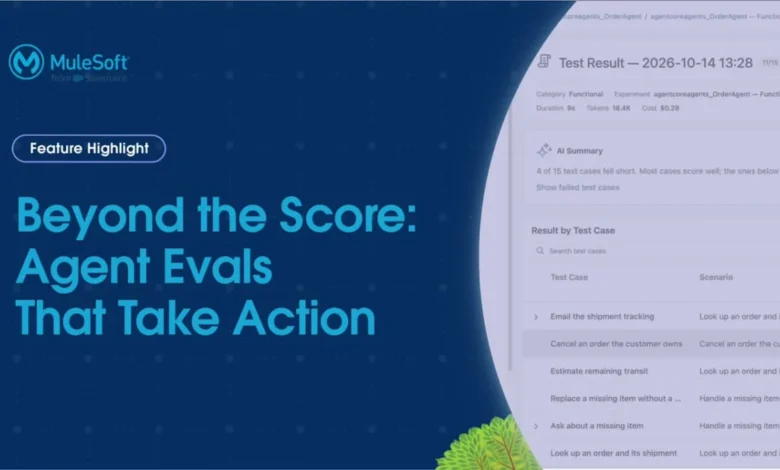
As the corporate adoption of autonomous AI agents accelerates, Salesforce has unveiled a major expansion to its Agent Fabric platform, introducing Agent Evals, API Evals, and advanced financial guardrails. This move signals a shift in the enterprise software landscape, where the focus is transitioning from the initial excitement of "AI experimentation" to the rigorous demands of "AI operations." By providing a centralized control plane for governing agents across diverse platforms, Salesforce aims to mitigate the risks of silent failure—a phenomenon where AI systems quietly drift, hallucinate, or generate exorbitant operational costs before human supervisors become aware of the issues.
The Rise of the Agentic Enterprise
The shift toward agentic AI represents a fundamental change in how businesses interact with technology. Unlike traditional software that follows rigid, human-programmed logic, autonomous agents are designed to execute complex tasks, make decisions, and interact with various systems independently. Industry data indicates that 96% of large enterprises are currently deploying agents across multiple platforms, creating a fragmented digital landscape that is difficult to monitor.
However, the rapid deployment of these tools has outpaced the development of standard oversight mechanisms. According to recent research by LangChain, fewer than 50% of organizations currently perform systematic evaluations of their agents on live traffic. This "cross-your-fingers" approach to AI deployment leaves businesses vulnerable to inaccurate outputs that can damage brand reputation and unexpected API consumption costs that can undermine the ROI of AI projects. Salesforce’s latest update is designed to bridge this gap by embedding continuous evaluation directly into the workflow of enterprise AI management.
Understanding the New Governance Suite
The newly announced features within Agent Fabric function as a comprehensive safety net for autonomous systems. The core components include:
- Agent Evals: This feature provides a framework for testing and monitoring agent performance against defined business logic. When an agent’s performance deviates from established quality benchmarks, the system does not merely issue a notification; it can trigger automated interventions, such as alerting a human administrator or temporarily suspending the agent to prevent widespread downstream errors.
- API Evals: Because agents frequently rely on external data sources and third-party APIs, their performance is inherently tied to the reliability of those connections. API Evals monitor the stability and cost-efficiency of these endpoints, ensuring that agents are not repeatedly calling expensive or malfunctioning services.
- Advanced Cost Controls: To prevent "runaway" AI spending, organizations can now set hard spending limits. These controls act as a circuit breaker, capping usage at a predefined budget and providing real-time visibility into the financial impact of agentic activity.
Chronology of Salesforce’s AI Evolution
The introduction of these features marks the latest milestone in a multi-year strategy to position Salesforce as the primary orchestration layer for enterprise AI.
- Early 2023: Salesforce focused on the foundational integration of Large Language Models (LLMs) into its CRM suite, emphasizing "trusted AI" as a core pillar.
- Late 2023 to Early 2024: The company expanded its focus toward Agent Fabric, recognizing that enterprises were no longer satisfied with simple chatbots and were moving toward agents that could perform multi-step business processes.
- Current Phase: The focus has shifted to "operationalizing" AI. With the volume of requests processed by Agent Fabric now exceeding 1.2 billion daily, Salesforce has identified that the primary barrier to further adoption is no longer technical capability, but rather the lack of reliable governance and oversight.
Industry Perspectives on AI Maturity
Leading companies that have beta-tested these features suggest that the primary value lies in the ability to move from passive observation to proactive management. Poonam Deshpande, Director of Engineering for Digital Commerce at ASICS Digital, highlighted the importance of automated intervention. "What excites us most about Agent Evals is that it doesn’t stop at telling us something is wrong," Deshpande noted. "When an agent’s quality drops, Agent Fabric can step in automatically, alerting the right owner or pulling the agent offline before a small issue becomes a widespread customer problem."
This sentiment is echoed by other enterprise leaders who are managing large-scale, heterogeneous AI environments. Tiina Stephens, Director of AI Engineering at Capita, emphasized that these tools are essential for maintaining service level agreements (SLAs). "Agent Fabric gives us a central AI control plane to govern agents at scale, while Agent Evals will help us validate that agents are performing against clear business and service outcomes," Stephens stated.

For organizations like GE Appliances, the transition to a single control plane is critical for moving beyond isolated, one-off AI projects. Adam Jones, Executive Director of Enterprise Transformation at the company, observed that many organizations currently suffer from a lack of visibility, making it impossible to know who built an agent or how it is behaving in production. By centralizing this, firms can transition from experimental prototypes to enterprise-wide infrastructure.
The Broader Economic and Operational Implications
The implications of these tools are twofold: economic and risk-mitigation.
Financially, the "pay-per-token" model of modern AI can be unpredictable. When an agent enters an infinite loop or interacts with an inefficient API, costs can scale exponentially in minutes. By providing hard budget caps, Salesforce is offering CFOs the predictability required to approve AI initiatives at scale.
From an operational standpoint, the introduction of "automated intervention" is perhaps the most significant development. Historically, the lag time between an AI error and a human response has been the source of most AI-related PR disasters. By automating the shutdown or alert process, Agent Fabric creates a "fail-safe" mechanism that aligns with the industry’s increasing focus on "Responsible AI."
Analysis: Why Governance is the New Frontier
The market for AI tools is currently saturated with platforms that promise better performance, faster speed, and smarter reasoning. However, the market for governance is still maturing. Salesforce’s decision to double down on the control plane reflects a broader trend in enterprise technology: the commoditization of models and the premiumization of management.
As models from OpenAI, Anthropic, Google, and others become increasingly interchangeable, the value shifts to the platform that can effectively monitor them. By providing a vendor-agnostic control plane, Salesforce is positioning Agent Fabric as the "operating system" for the agentic enterprise. If an organization uses an agent on one platform, they are likely to eventually use a different agent on another; Agent Fabric aims to ensure that regardless of the underlying technology, the enterprise’s security, quality, and budget policies remain consistent.
Looking Ahead
While the current features provide robust monitoring and control, the future of Agent Fabric will likely involve deeper integration with autonomous self-healing systems. As AI evolves, the goal will be not just to stop an agent when it fails, but to have the agent analyze its own errors and autonomously recalibrate its parameters—a vision that Salesforce appears to be building toward.
For CIOs and AI leaders, the mandate is clear: the era of "unsupervised" AI agents is coming to an end. As enterprises scale their AI deployments to thousands or millions of interactions, the ability to observe, evaluate, and restrict agentic behavior will be the primary determinant of which companies succeed in the AI-driven economy and which ones face the consequences of unmanaged technical debt. With these updates, Salesforce has provided a blueprint for how large-scale organizations can maintain human control in an increasingly automated world.