EEOC Lawsuit Against Kroger Highlights Legal Risks of Revoking Long-Standing Employee Accommodations

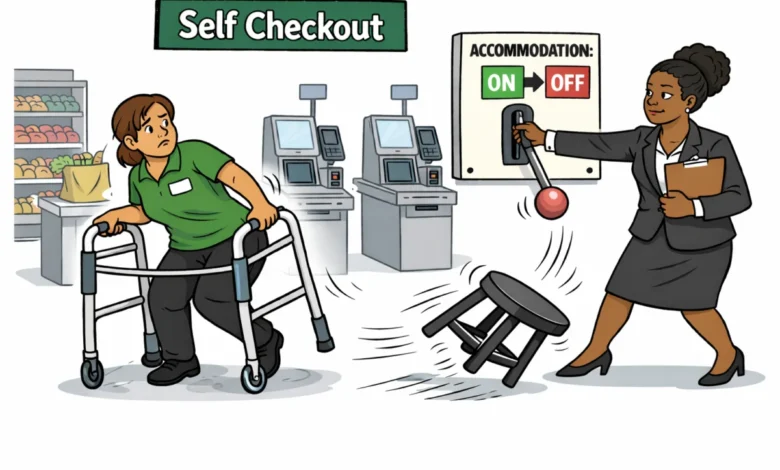
The United States Equal Employment Opportunity Commission (EEOC) has initiated a significant legal action against Kroger, one of the nation’s largest grocery retailers, alleging a violation of the Americans with Disabilities Act (ADA). The lawsuit, filed in the U.S. District Court for the Eastern District of Arkansas, centers on a veteran employee at a Jacksonville store whose long-standing disability accommodations were allegedly revoked following a change in store management. This case serves as a critical focal point for human resources professionals and legal experts, illustrating the legal hazards inherent in altering established workplace adjustments without a rigorous, documented interactive process.
According to the federal complaint, the litigation involves a female employee with a mobility impairment that significantly limited her ability to walk and stand for extended periods. To perform her duties effectively, she required the use of a walker and the opportunity to sit periodically. For more than three years, the employee worked in a self-checkout role with these specific accommodations in place. During this period, the EEOC asserts that her performance met all necessary standards, demonstrating that the accommodations were both reasonable and effective in allowing her to fulfill the essential functions of her position.
The stability of this arrangement was disrupted by a transition in store leadership. The EEOC alleges that a new store manager, supported by the company’s human resources department, unilaterally decided to discontinue the established accommodations. Despite the employee’s proven track record of successful performance over several years, the new management reportedly rejected her updated medical documentation and informed her that she could no longer use a seat while working. The lawsuit further claims that the manager issued an ultimatum: the employee could only continue working if she could do so "without restrictions," a policy that has frequently been flagged by the EEOC as a violation of federal law.
Chronology of the Dispute and Alleged Termination
The timeline of events outlined in the EEOC’s filing suggests a rapid breakdown of the employer-employee relationship following the leadership change. For approximately 36 months, the employee operated within the self-checkout area using her walker and a stool as needed. This period of stability ended when the new store leader assumed control and scrutinized the existing disability arrangements.
Upon the revocation of her accommodation, the employee reportedly attempted to engage with management to explain the necessity of the tools. However, the EEOC claims that the store manager refused to participate in the "interactive process"—a mandatory requirement under the ADA where employers and employees discuss potential accommodations in good faith. Instead of seeking a middle ground or evaluating whether the stool actually posed an "undue hardship" to the business, management allegedly directed the employee to go home and apply for a leave of absence.
When the employee attempted to follow these instructions, her request for leave was reportedly denied by the company. Having been barred from working with her walker and stool, and subsequently denied the very leave management suggested she take, the employee found herself in a professional limbo. The situation culminated in her termination, which the EEOC characterizes as a direct result of her disability and the company’s refusal to honor a proven accommodation.
Supporting Data and the Legal Framework of the ADA
This case highlights a recurring theme in federal employment litigation: the tension between new management’s desire for operational "standardization" and the legal protections afforded to disabled workers. Under the Americans with Disabilities Act of 1990, employers are required to provide "reasonable accommodations" to qualified individuals with disabilities unless doing so would cause significant difficulty or expense for the business, known as "undue hardship."
The "no restrictions" or "100% healed" policy allegedly invoked by the Kroger manager is a frequent target of EEOC enforcement. Legal precedent generally holds that such policies are per se violations of the ADA because they bypass the individualized assessment required by the law. By demanding that an employee work without any restrictions, an employer effectively refuses to consider any form of reasonable accommodation, regardless of whether it would allow the employee to perform the job.
Data from the EEOC’s recent fiscal years indicates that disability discrimination remains one of the most common types of charges filed with the agency. In 2023, ADA-related charges accounted for more than 34% of all private-sector discrimination complaints. Cases involving the revocation of existing accommodations are particularly high-risk for employers because the employee has already established a "baseline" of successful performance. When an employee has done a job successfully for three years with a stool, it becomes exceedingly difficult for an employer to prove in court that the stool suddenly constitutes an undue hardship.
Official Responses and Litigation Goals
The EEOC’s decision to litigate follows an unsuccessful attempt to reach a pre-litigation settlement through its voluntary conciliation process. In a public statement regarding the filing, EEOC representatives emphasized that the law does not allow an employer to simply "wipe the slate clean" regarding accommodations just because a new manager is hired.

"The ADA requires an employer to provide a reasonable accommodation to an employee with a disability unless it can show that doing so would be an undue hardship," stated Faye A. Williams, regional attorney for the EEOC’s Memphis District Office. "When an employee has been successfully performing her job with an accommodation for years, it is difficult for an employer to justify taking that accommodation away."
The lawsuit seeks back pay, compensatory damages, and punitive damages for the terminated employee. Additionally, the EEOC is seeking injunctive relief, which would require Kroger to implement training programs and policy changes to prevent future instances of disability discrimination and to ensure that management understands its obligations under the interactive process.
Kroger, as a matter of policy regarding pending litigation, generally does not comment on the specifics of active lawsuits. However, in similar cases, large retailers typically argue that the "essential functions" of a role have changed or that the specific accommodation requested interferes with safety or customer service standards. The challenge for the defense in this instance will be reconciling those arguments with the three-year history of the employee’s successful tenure in the same role.
Broader Impact and Implications for Corporate Policy
The Kroger case serves as a cautionary tale for organizations undergoing leadership transitions. It highlights the necessity of "institutional memory" regarding HR decisions. When a new manager takes over a department or a store, they often seek to implement their own vision of efficiency. However, this vision must remain compliant with existing legal obligations and the specific needs of the workforce.
The Danger of "New Manager Syndrome"
Legal experts often refer to the phenomenon where new supervisors inadvertently create liability by revoking flexible work arrangements or accommodations that were "grandfathered in" by their predecessors. This case suggests that HR departments must play a proactive role during management transitions to ensure that new leaders do not unilaterally dismantle ADA-compliant structures.
The Documentation Gap
A critical takeaway from this litigation is the importance of documentation. If a business truly needs to change an accommodation—perhaps due to a change in store layout, a shift in job duties, or new safety regulations—it must document those specific changes. The EEOC’s complaint suggests that the revocation in this case was based on a subjective preference for a "no restrictions" environment rather than a change in the employee’s ability or the store’s operational needs.
Redefining the Interactive Process
The "interactive process" is not a one-time event; it is an ongoing obligation. Even if an employer believes a current accommodation is no longer working, the legal requirement is to engage the employee in a dialogue to explore alternatives. Skipping this step and moving directly to termination or forced leave is frequently cited by courts as evidence of bad faith.
Conclusion and Strategic Takeaways
The EEOC vs. Kroger lawsuit serves as a reminder that an accommodation, once granted and proven effective, becomes a foundational element of the employment relationship. To undo such an arrangement requires more than a change in management; it requires a documented, legitimate business necessity that outweighs the employee’s right to a reasonable adjustment.
For employers, the strategic takeaways are clear:
- Consistency is Protective: Maintaining consistency across leadership changes prevents "shocks" to the system that trigger EEOC scrutiny.
- "No Restrictions" is a Liability: Policies that require employees to be 100% healthy before returning to work are legally indefensible under the ADA.
- Leave is the Last Resort: Forcing an employee onto leave when they are capable of working with an accommodation is often viewed as a discriminatory act.
- Interactive Dialogue is Mandatory: Even when management believes a change is necessary, they must sit down with the employee to discuss the "why" and the "how" of the transition.
As this case moves through the federal court system, it will likely reinforce the principle that the ADA is designed to keep people working. When an employer has a blueprint for how to keep a disabled employee productive—as Kroger allegedly did for three years—the law expects them to follow it. Ignoring that blueprint in favor of a "blanket policy" is a path that leads directly to the courtroom.