Unlocking Sales Potential: How Advanced Analytics Platforms Are Revolutionizing Revenue Generation by 2026

Sales organizations are grappling with an unprecedented volume of data, yet this abundance often hinders rather than helps strategic decision-making. Fragmented information, scattered across disparate spreadsheets and disconnected sales tools, creates a murky operational landscape, preventing sales leaders from accurately forecasting, effectively coaching their teams, and proactively identifying at-risk deals. This pervasive data fragmentation is precisely the challenge that modern sales analytics platforms are designed to address, offering a consolidated, real-time view essential for navigating the complexities of contemporary sales environments.
At its core, a sales analytics platform serves as a central intelligence hub, meticulously gathering and integrating sales data from Customer Relationship Management (CRM) systems and various connected tools. It then transforms this raw data into actionable insights, presented through intuitive dashboards, robust forecasts, and comprehensive performance metrics. For organizations already deeply embedded in the HubSpot ecosystem, solutions like Sales Hub seamlessly integrate sales reporting, pipeline tracking, and AI-powered forecasting capabilities, all underpinned by the cohesive HubSpot Smart CRM. This article delves into the definition and critical functionalities of these platforms, distinguishes them from traditional CRM reporting and broader Business Intelligence (BI) tools, and profiles five leading sales analytics solutions poised to dominate the market by 2026.
The Evolving Landscape of Sales Data Challenges
The journey of sales has dramatically shifted from an art reliant on intuition and personal relationships to a science driven by data and strategic insights. Historically, sales leaders operated with limited visibility, often relying on anecdotal evidence and end-of-quarter reports that were, by then, too late to influence outcomes. The advent of CRMs brought structure, but even with CRMs, the proliferation of specialized sales tools—for prospecting, engagement, conversation intelligence, and more—has inadvertently led to a new form of data siloing. A 2023 report by Salesforce indicated that sales teams spend an average of 20% of their time on administrative tasks, much of which involves manually consolidating data from various sources, underscoring the inefficiency born from disconnected systems.
This fragmentation has significant repercussions. Sales leaders struggle to piece together a coherent narrative of their pipeline, leading to "gut-feel" forecasts that often miss the mark. A lack of unified data impedes effective coaching, as managers cannot pinpoint specific areas where reps are faltering without spending hours on manual data extraction and analysis. Furthermore, the inability to quickly identify deals showing signs of stalling or disengagement means opportunities are often lost before they can be salvaged. The market for sales analytics software is projected to grow substantially, reflecting the urgent need for solutions that can synthesize this complex data environment into clear, actionable intelligence.
Defining a Sales Analytics Platform
While often conflated with CRM reporting or general BI tools, a sales analytics platform occupies a distinct and critical niche within the sales technology stack. CRM reporting typically provides insights derived exclusively from data residing within a single CRM, offering a snapshot but lacking a holistic view across the entire sales tech stack. General BI tools, on the other hand, are designed for broad data analysis across multiple business functions (finance, marketing, operations, etc.), requiring significant technical expertise to configure and maintain for sales-specific needs.
A dedicated sales analytics platform, however, is purpose-built to sit closer to the core sales motion. It aggregates data from the CRM, activity logs, engagement platforms, and even conversation intelligence tools. It then applies sophisticated analytical models to provide deep insights into pipeline health, forecasting accuracy, individual rep performance, and overall sales governance. For instance, consider a global software company launching a new product across multiple regions. Without a sales analytics platform, determining which region converts demos to closed-won deals most effectively might involve a RevOps analyst painstakingly exporting, cleaning, and manually aligning data from various spreadsheets and systems—a process that could take days. With a robust platform, the VP of Sales can access a single, dynamic dashboard displaying real-time conversion rates by region, enabling immediate, data-driven action.
Key Metrics Tracked by Sales Analytics Platforms:
A comprehensively configured sales analytics platform can monitor a wide array of vital sales metrics, including:
- Win Rate: The percentage of opportunities that result in a closed-won deal.
- Sales Cycle Length: The average time it takes for a deal to move from creation to close.
- Average Deal Size: The average revenue generated per closed-won deal.
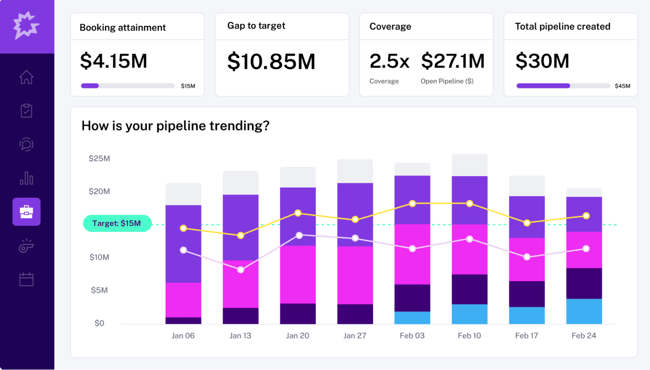
- Pipeline Coverage: The ratio of pipeline value to target revenue.
- Lead-to-Opportunity Conversion Rate: The effectiveness of converting leads into qualified opportunities.
- Opportunity-to-Win Conversion Rate (by stage): Identifying bottlenecks in the sales process.
- Rep Activity Metrics: Calls made, emails sent, meetings booked, demos conducted.
- Forecast Accuracy: The variance between predicted and actual revenue.
- Customer Acquisition Cost (CAC): The cost associated with acquiring a new customer.
- Customer Lifetime Value (CLTV): The total revenue a customer is expected to generate over their relationship with a company.
The specific metrics prioritized will naturally align with a team’s unique sales motion and overarching business objectives. The fundamental advantage is the platform’s ability to surface these metrics cohesively, eliminating the need for manual data stitching.
The Transformative Benefits of Sales Analytics Software
Beyond merely simplifying reporting, the strategic adoption of sales analytics software yields profound benefits that empower sales leaders to make more informed decisions, foster greater forecasting confidence, uncover new revenue streams, and provide highly targeted coaching. These advantages collectively drive significant improvements in sales efficiency and effectiveness.
-
Accelerated and Confident Decision-Making: When critical data—pipeline status, rep activities, and forecast projections—are consolidated and updated in real time within a single interface, sales leaders are liberated from the time-consuming chore of data hunting. This immediate access to reliable information allows for proactive intervention, particularly crucial when a deal signals distress. Instead of waiting for weekly reports or manually compiling data before pipeline reviews, the answers are readily available, enabling swift, impactful decisions.
-
Enhanced Forecasting Accuracy: Sales analytics software fundamentally shifts forecasting from subjective "gut-feel" estimations to data-backed projections. By analyzing historical deal performance, current pipeline health, and deal velocity, these platforms generate more realistic revenue figures. Over time, this iterative process helps leadership refine headcount planning, allocate budgets, and set revenue targets with substantially greater confidence, mitigating the risks associated with overly optimistic or pessimistic predictions.
-
Improved Pipeline Health and Visibility: A sales analytics platform provides a dynamic, live overview of the entire sales pipeline. This real-time visibility makes it effortless to identify stagnant deals, pinpoint stages where conversion rates are declining, or detect coverage gaps that could jeopardize future quarters. Dimi Baitanciuc, co-founder and CEO of Brizy, attests to this, stating, "Sales analytics tools are invaluable because they let you see patterns that aren’t obvious day-to-day. For example, I once noticed that deals initiated via webinars converted at a 30% higher rate than those initiated via cold email. Without tracking that data, we might have continued pouring effort into lower-performing channels." This direct insight allows for immediate strategic adjustments to optimize pipeline flow.

-
Uncovering New Revenue Opportunities: These platforms excel at revealing previously hidden revenue opportunities. By meticulously tracking patterns in pipeline data, teams can discern which lead sources, customer behaviors, or engagement signals consistently correlate with successful deal closures. This intelligence empowers them to strategically double down on effective channels and tactics. Kristiyan Yankov, founder of Above Apex, provides a compelling example: "Our sales analytics platform helped us realize that leads who interacted with our support content within the first 48 hours were much more likely to buy, so we started prioritizing outreach to them." Such targeted insights lead to more efficient resource allocation and increased revenue.
-
Optimized Rep Performance and Coaching: When managers have granular visibility into each rep’s performance—which deals they are advancing, where they encounter resistance, and specific loss patterns—coaching becomes significantly more effective. Instead of generic feedback based solely on quota attainment, managers can identify precise behavioral trends, such as deals consistently stalling at the proposal stage, and collaborate with reps on targeted strategies for improvement. This data-driven approach fosters continuous development and elevates overall team performance.
-
Consistent and Trustworthy Reporting: One of the often-underestimated costs of fragmented sales data is the time wasted in internal debates over conflicting numbers. A sales analytics platform equipped with robust governance features ensures that all stakeholders operate from a common set of definitions and a single source of truth. When a report indicates a 32% win rate, for example, there is no ambiguity about the methodology or the underlying data, fostering trust and enabling quicker progression from analysis to action.
Essential Features to Prioritize in a Sales Analytics Platform (2026 Outlook)
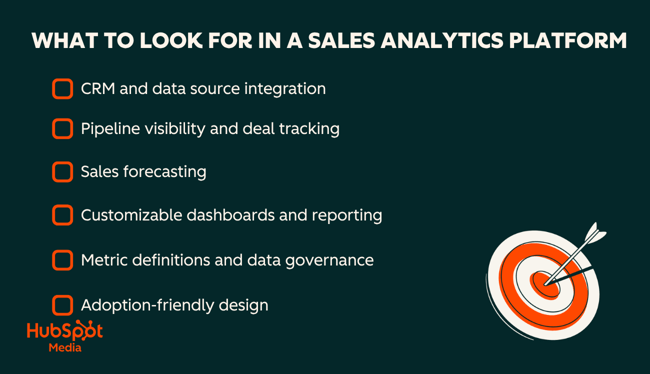
The effectiveness of a sales analytics platform hinges on its feature set. Choosing the wrong tool can perpetuate the very data fragmentation it aims to resolve. By 2026, the following features will be paramount for any sales organization seeking a competitive edge:
-
Seamless CRM and Data Source Integration: A platform’s utility is directly proportional to the quality and breadth of the data it receives. It must effortlessly connect with existing sales tools (e.g., Salesforce, HubSpot, Outreach, Gong) without necessitating extensive engineering resources for ongoing maintenance. Disconnected data sources are the primary culprits behind unreliable reporting; thus, the ability to centralize CRM data, call activities, and marketing pipeline information into one unified view is non-negotiable.
-
Real-time Pipeline Visibility and Intelligent Deal Tracking: Sales leaders require a dynamic, live view of their entire pipeline, not just static snapshots. A superior platform will offer a real-time overview of every deal, categorized by stage, representative, geographical region, and projected close date. Crucially, it should proactively flag at-risk deals based on predefined criteria such as inactivity, excessive age, or prolonged duration within a specific stage. For instance, if a rep has multiple deals projected to close "this month" but has logged no activity on them for several weeks, the platform should immediately alert the manager, preventing potential forecast misses.
-
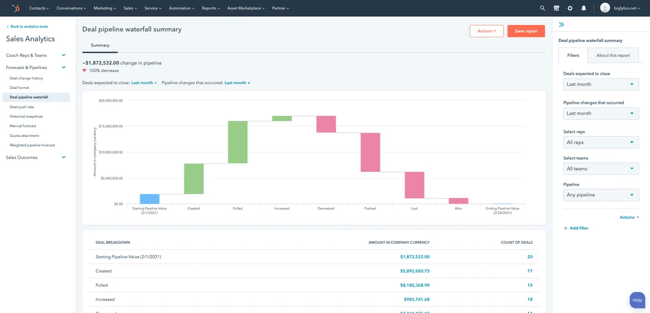
Advanced Sales Forecasting (including AI-powered capabilities): The ability to accurately predict revenue targets is fundamental. By 2026, sales analytics platforms with built-in, AI-powered forecasting will be standard. These systems analyze current pipeline deals, historical performance of similar deals, and deal velocity to generate highly accurate projected revenue figures. This moves beyond individual rep self-reporting, providing leadership with data-driven forecasts early enough to make necessary adjustments.
-
Customizable Dashboards and Flexible Reporting: Different stakeholders require tailored views of the same underlying data. A VP of Sales might need a high-level pipeline summary, while a frontline manager requires granular rep-level activity and quota attainment figures, and a RevOps analyst needs deep deal-level detail for trend analysis. The platform must facilitate the easy creation and sharing of customized dashboards for these diverse audiences, minimizing reliance on dedicated data analysts for every new report. While pre-built dashboards offer a starting point, the capacity for modification to reflect unique business operations (custom fields, non-standard stages, specific segments) is vital for long-term relevance.
-
Robust Metric Definitions and Data Governance: A frequently overlooked, yet critical, feature is the platform’s capacity to define and standardize metrics across the organization. Discrepancies in understanding terms like "pipeline" or "win rate" can lead to unproductive debates and undermine trust in reports. Platforms with strong governance capabilities empower RevOps teams to establish universal definitions that are automatically enforced across all reports and dashboards, ensuring consistent interpretation and reliable data.
-
Adoption-Friendly Design and User Experience: A sophisticated platform that only data analysts can navigate is effectively useless to the majority of its intended users. By 2026, sales analytics tools must prioritize intuitive design. Sales representatives and managers should be able to effortlessly access their performance data, monitor pipeline health, and identify actionable insights without requiring extensive training or submitting support tickets to a BI team. This translates to clean navigation, sensible default settings, mobile accessibility for field reps, and proactive alerts that push relevant insights directly to users.
Must-Have Sales Analytics Platform Features (2026):
- Real-time data synchronization
- AI-driven forecasting and risk analysis
- Customizable dashboards and reports
- Granular pipeline inspection
- Rep performance tracking
- Automated data capture (from calls, emails, calendar)
- Data governance and audit trails
Nice-to-Have Sales Analytics Platform Features (2026):
- Predictive analytics for deal closure
- Guided selling recommendations
- Integration with conversation intelligence
- Benchmarking against industry peers
- Natural Language Processing (NLP) for query interface
- Mobile-first design
Leading Sales Analytics Solutions for 2026
The market for sales analytics platforms is robust, with several key players offering distinct advantages. Here’s a look at five prominent solutions:
1. HubSpot Sales Hub
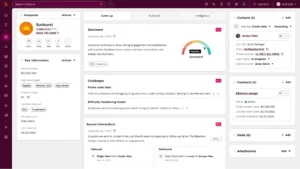
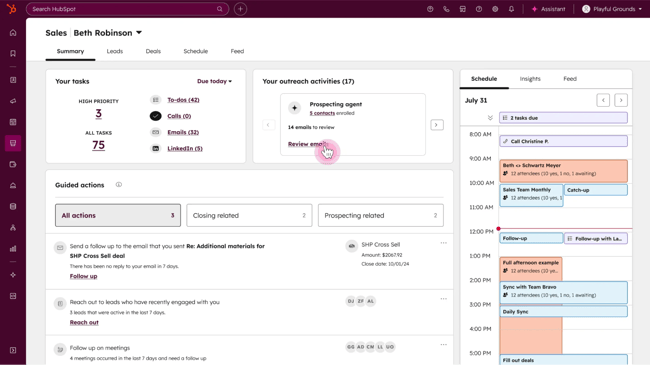
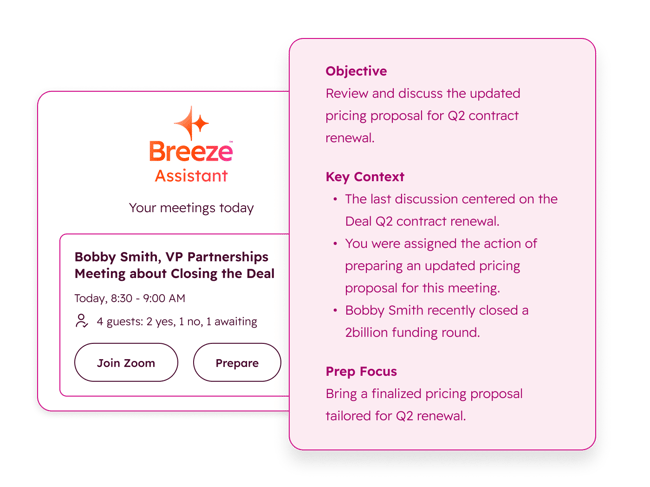
HubSpot Sales Hub is a comprehensive sales platform built natively on the HubSpot Smart CRM. It empowers teams to manage pipelines, automate repetitive tasks, execute forecasts, and ultimately close more deals. Its native integration with HubSpot’s marketing and service tools ensures that sales data is never isolated, providing a unified view of the entire customer journey. For analytics, Sales Hub offers sales leaders and RevOps managers a real-time perspective on pipeline health, rep performance, and forecasting without the need for data exports or rebuilding reports in external tools. All insights are drawn directly from CRM data, guaranteeing accuracy and immediacy.
Key Features:
- CRM-Native Reporting: Built directly within the HubSpot CRM for seamless data flow.
- AI-Powered Forecasting: Leverages AI to provide accurate revenue projections.
- Pipeline Management: Visual pipeline tracking with customizable stages.
- Sales Playbooks and Automation: Guides reps through best practices and automates routine tasks.
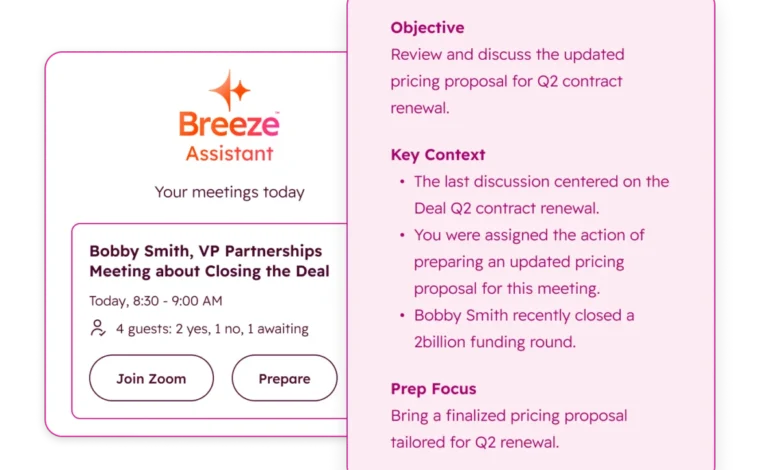
- Breeze Prospecting Agent: AI assistant for enhanced prospecting and insights.
- Customizable Dashboards: Tailor reporting to specific roles and needs.
Best for: Teams of all sizes seeking CRM-native analytics, AI-powered insights, and reporting that minimizes setup and maintenance, particularly those already utilizing or considering the broader HubSpot ecosystem.
Pricing: HubSpot offers a free plan with core sales tools. Paid Sales Hub plans currently start at $20/month per seat for Starter, $100/month per seat for Professional, and $150/month per seat for Enterprise (billed annually).
What stands out: HubSpot Sales Hub’s primary strength lies in its ability to provide immediate, practical sales analytics without requiring a separate BI stack. Its deep integration with the Smart CRM ensures dashboards reflect actual pipeline activity, while AI tools like Breeze proactively surface insights. For organizations prioritizing usability, automation, and deep reporting within a connected customer platform, Sales Hub offers a compelling solution.
2. Pipedrive
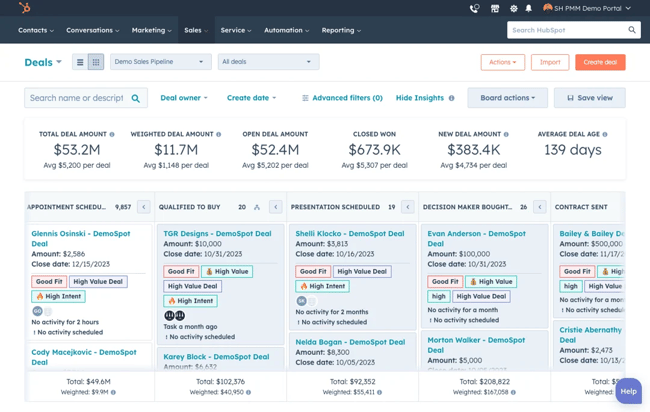
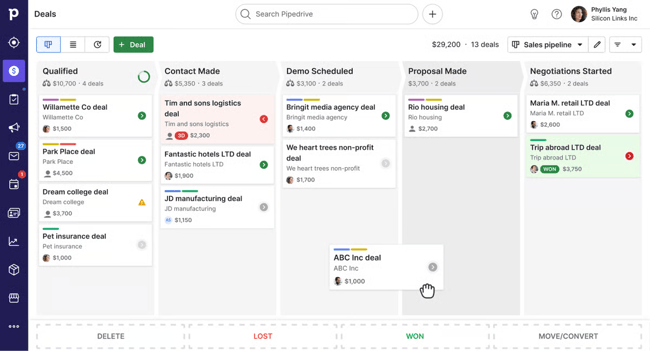
Pipedrive is a sales-focused CRM renowned for its highly visual interface, which helps sales reps track deals, manage leads, and automate administrative tasks. Its intuitive kanban-style pipeline view allows teams to easily visualize their sales funnel, advance deals through stages, and receive timely notifications for necessary follow-ups.
Key Features:
- Visual Pipeline Management: Drag-and-drop interface for easy deal progression.
- AI Sales Assistant: Provides recommended next actions and insights.
- Customizable Reports: Generate insights on sales activities and performance.
- Lead Management: Tools for organizing and prioritizing leads.
- Mobile App: Access and manage deals on the go.
Best for: Small-to-medium sales teams that prioritize CRM-native analytics, visual pipeline management, and AI-driven deal insights within an easy-to-use platform.
Pricing: Pipedrive offers a 14-day free trial. Paid plans start at $14 per seat per month (Lite), $39 per seat per month (Growth), $59 per seat per month (Premium), and $79 per seat per month (Ultimate), all billed annually.
What stands out: Pipedrive balances simplicity with powerful analytics. Its visual pipeline offers reps quick clarity on deal status, and the AI Sales Assistant proactively guides their actions. It delivers substantial value at a competitive price point for teams that don’t require enterprise-level complexity.
3. Clari
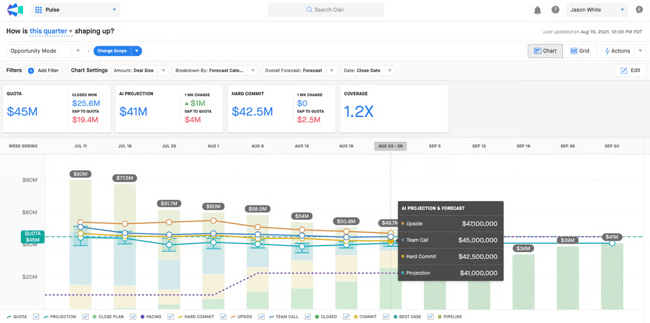
Clari is a revenue operations platform designed to consolidate data from various sources—CRM, email, calendar, calls, and sales engagement tools. It leverages advanced AI to enhance forecasting accuracy, identify deal risks early, and provide deep insights into where revenue is being won or lost.
Key Features:
- Revenue Operations Platform: Unifies data across the entire revenue process.
- AI-Powered Forecasting: Delivers highly accurate and auditable revenue predictions.
- Pipeline Inspection: Deep analysis of deal health and progression.
- Automatic Data Capture: Reduces manual data entry by reps.
- Revenue Insights: Identifies trends and patterns impacting revenue.
Best for: Mid-market and enterprise RevOps teams that demand AI-powered forecasting, extensive pipeline inspection capabilities, and automated data capture.
Pricing: Clari does not publish standard per-user pricing, requiring buyers to request a custom quote. They emphasize no platform fees for integrations or ongoing support and claim full implementation within eight weeks.
What stands out: Clari excels at performing significant analytical heavy lifting in the background. Its automatic data capture alleviates the burden on sales reps to update CRMs, while its AI forecasting provides leadership with reliable numbers for strategic planning. Clari is particularly valuable for organizations where forecast accuracy directly influences critical business decisions like headcount and expenditure.
4. Gong
Gong is a leading revenue intelligence platform that records and analyzes sales conversations (calls, emails, meetings), then links these insights directly to deal and pipeline data within the CRM. By rooting analytics in actual sales conversations, Gong provides sales leaders with invaluable context to understand the "why" behind deal movements and stalls.
Key Features:
- Conversation Intelligence: Records, transcribes, and analyzes sales interactions.
- Deal & Pipeline Visibility: Connects conversation data to CRM deal stages.
- Rep Coaching Insights: Identifies specific areas for individual rep improvement.
- Market Intelligence: Extracts trends from customer conversations.
- Risk Alerts: Flags deals based on conversational cues and engagement.
Best for: B2B sales teams that aim to directly link conversation data to pipeline outcomes, improve rep coaching, and enhance forecast accuracy through deeper qualitative insights.
Pricing: Gong does not publish standard pricing, offering a model based on per-user licenses and a platform fee tied to the number of supported users. Integrations are typically free. Custom proposals are required.
What stands out: Gong’s unique advantage lies in its focus on the conversation as the primary data source. While many tools report what stage a deal is in, Gong reveals what the buyer actually said, their level of engagement, and the underlying sentiment, providing a nuanced understanding of deal progression and risk.
5. Tableau
Tableau is a powerful business intelligence platform that allows teams to connect to virtually any data source, construct highly customized dashboards, and visualize complex sales data. Owned by Salesforce, it integrates effectively with Salesforce CRM but also supports a vast array of other data sources, making it ideal for organizations requiring cross-system analytics.
Key Features:
- Multi-Source Data Integration: Connects to a wide range of databases, cloud apps, and spreadsheets.
- Advanced Data Visualization: Offers extensive options for creating interactive charts and graphs.
- Customizable Dashboards: Build highly tailored reports for diverse stakeholders.
- Data Blending: Combines data from disparate sources into a unified view.
- Predictive Capabilities: Basic forecasting and trend analysis tools.
Best for: Sales and RevOps teams with diverse data sources that need a powerful, flexible BI platform to build highly customized sales analytics solutions, often requiring dedicated analytical resources.
Pricing: Tableau offers a free Desktop edition. Paid Tableau Standard plans start at $15/user per month (Viewer), $42/user per month (Explorer), and $75/user per month (Creator), billed annually. Tableau Enterprise Creator starts at $115/user per month, billed annually.
What stands out: Tableau’s strength is its unparalleled flexibility in data integration and visualization. It’s an excellent choice when reporting demands extend beyond the built-in capabilities of a single platform, such as integrating sales data with financial or product data. However, its optimal utilization often requires at least one dedicated data analyst for configuration and ongoing maintenance, making it more of an investment than a plug-and-play solution.
Strategic Selection: Choosing the Right Sales Analytics Platform
The optimal sales analytics platform is not a one-size-fits-all solution; it is deeply dependent on a team’s structure, existing data infrastructure, and the specific decisions they aim to expedite. A thoughtful approach to selection is paramount.
-
Prioritize the Problem, Not Just Features: Before evaluating any tool, clearly articulate the core issues. Is the problem inaccurate forecasting, inefficient coaching, poor pipeline visibility, or time wasted on manual reporting? Mike Dee, CEO of Playstack, advises, "Managers often spend money on software that has 50 features, whereas the team requires only four. Tools that take 30 hours to master cost a company thousands of dollars in lost work time as employees read manuals instead of making deals." Different platforms address different pain points; a clear problem statement streamlines the selection process, filtering out impressive but irrelevant features.
-
Assess Your Data Ecosystem: Consider where your sales data currently resides. Some organizations centralize all data within a single CRM. Others have it dispersed across a CRM, marketing automation platforms, data warehouses, and numerous spreadsheets. A CRM-native tool like Sales Hub or Pipedrive excels when the CRM is the primary source of truth. Conversely, teams with data spread across multiple systems may require a more robust BI platform like Tableau or a specialized revenue intelligence tool like Clari to consolidate and normalize data into a unified view. CRM-native analytics are generally best for faster pipeline visibility, forecasting, and rep performance within the CRM, while BI platforms are better suited for combining sales data with insights from finance, product, or marketing across diverse systems.
-
Consider the End-Users: A platform navigable only by data analysts will inevitably fail to be adopted by the sales professionals who need it most. Sales managers and reps must be able to independently access performance metrics, assess pipeline health, and understand actionable steps without needing to submit requests to a dedicated BI team. Usability and intuitive design are crucial for widespread adoption. Tom Bukevicius, CEO and co-founder of Scube Marketing, warns, "I’ve seen teams buy expensive platforms that no one adopted because it was too complex or didn’t integrate with their workflow. Always test a tool with a small group first, track measurable outcomes like response rates or deal velocity, and then scale. Tools should simplify the process, not complicate it – everything else is secondary."
-
Evaluate Setup and Maintenance Requirements: Platforms vary significantly in their implementation and ongoing maintenance demands. Some, like Sales Hub and Pipedrive, are relatively "plug-and-play." Others, such as Tableau and Clari, may necessitate substantial configuration, data modeling, or continuous administrative oversight to remain effective. A complex tool can still be a valuable investment, but organizations must ensure they have adequate RevOps or data engineering support to configure, maintain, and validate the reliability of reports.
-
Prioritize Metric Definitions and Governance: The ability to enforce consistent metric definitions across the organization is a cornerstone of trustworthy reporting. If sales leadership, managers, and individual reps operate with differing interpretations of terms like "pipeline value" or "win rate," reports quickly become unreliable. Seek platforms that empower RevOps teams to establish and consistently apply universal definitions across all dashboards and reports, eliminating ambiguity and fostering data integrity.
-
Focus on Ease of Adoption: A sales analytics tool’s value is directly tied to its actual usage by the team. Before committing, understand how reps and managers will interact with it daily. Does it integrate seamlessly into existing workflows? Does it proactively deliver insights, or does it require users to actively seek them out? Piloting a tool with a small group and measuring tangible outcomes is an effective way to gauge its real-world impact and potential for broader adoption.
Choosing by Business Size and Budget:
-
SMBs and Early-Stage Teams: For smaller organizations with constrained budgets and no dedicated data function, a CRM-native tool is typically the ideal starting point. HubSpot Sales Hub and Pipedrive both offer robust out-of-the-box analytics requiring minimal technical setup, and they scale effectively with growth. For businesses seeking a unified platform across marketing, sales, and customer support, HubSpot’s integrated Smart CRM offers a stronger comprehensive solution.
-
Mid-Market Teams: As teams mature, their reporting needs become more complex, often supported by a dedicated RevOps function. Tools like Clari and Gong become highly relevant, especially if forecasting accuracy, deep pipeline visibility, and conversation intelligence are top priorities. However, budgets must account for both platform costs and the resources required for proper configuration and team adoption.
-
Enterprise Teams: Large organizations with sophisticated data teams, intricate revenue models, and multi-system data environments often derive the most value from platforms like Tableau and Clari. While these tools offer unparalleled depth and flexibility, their adoption entails higher costs and greater complexity. Enterprise buyers must meticulously factor in implementation, training, and ongoing maintenance expenses, beyond just the per-seat licensing fees.
Frequently Asked Questions About Sales Analytics Platforms
Is a sales analytics platform the same as CRM reporting?
Not precisely. CRM reporting primarily displays data residing within the CRM, its accuracy dependent on manual input. A sales analytics platform extends this by integrating data from the CRM and other connected tools, applying consistent metric definitions, and generating deeper insights for forecasting, risk identification, and faster decision-making.
How long does implementation typically take for sales analytics tools?
Implementation timelines vary significantly. CRM-native tools like Sales Hub and Pipedrive can be operational in a matter of days. Purpose-built platforms like Clari generally require several weeks for proper configuration. Comprehensive BI tools such as Tableau, particularly when involving data modeling and extensive warehouse connections, can take several months.
What metrics should every sales team track?
At a minimum, every sales team should track win rate, sales cycle length, average deal size, and pipeline coverage. Beyond these core metrics, the most relevant indicators will depend on the specific sales motion. Product-led growth teams might emphasize conversion rates, while enterprise sales teams often focus on pipeline velocity and average contract value.
How do we estimate the total cost of ownership (TCO) of sales analytics software?
The TCO includes licensing fees, implementation costs, training expenses, and any ongoing administrative or data engineering resources required to maintain the platform. For highly flexible tools like Tableau, data preparation and infrastructure costs can be substantial. For CRM-native tools, the primary TCO components typically revolve around configuring reports and onboarding the team.
How do we measure the ROI of a sales analytics platform?
To measure ROI, compare the platform’s total cost against its quantifiable business impact. Start by tallying all expenses (licensing, implementation, training, admin time). Then, track improvements in forecast accuracy, win rates, sales cycle length, rep productivity, pipeline coverage, and the time saved on manual reporting. Crucially, also monitor whether the platform genuinely empowers managers to alter behaviors, rescue at-risk deals, coach effectively, or prioritize higher-converting channels, as these direct impacts generate the strongest business case.
How do we keep our data governed and secure?
Select platforms that offer robust role-based access controls, ensuring users only view data relevant to their specific roles. Look for features like audit logs, single sign-on (SSO) capabilities, and adherence to industry-specific compliance certifications (e.g., SOC 2, GDPR). On the governance front, establishing clear ownership of metric definitions and data pipelines early in the process is critical to prevent data quality issues from escalating into reporting problems.
Empowering Sales Decisions with Advanced Analytics
Sales organizations that continue to rely on disparate spreadsheets, inconsistent CRM data, and manual reporting are operating with a dangerously incomplete understanding of their pipeline. This fragmented view inevitably leads to suboptimal decisions, missed opportunities, and inefficient resource allocation. A sophisticated sales analytics platform rectifies this by providing every stakeholder, from frontline sales representatives to the Vice President of Sales, with a unified, trustworthy, and real-time perspective on pipeline health, individual and team performance, and forecast accuracy.
For growing sales teams seeking this level of visibility and control without the inherent complexity of building and maintaining a separate Business Intelligence stack, HubSpot Sales Hub stands out as an exemplary starting point. By integrating CRM-native reporting, dynamic pipeline tracking, advanced forecasting, and AI-powered insights within a single, connected platform, Sales Hub empowers teams to dedicate less time to data compilation and more time to the strategic activities that drive successful deal closures. The future of sales is data-driven, and robust analytics platforms are the indispensable engine of that transformation.