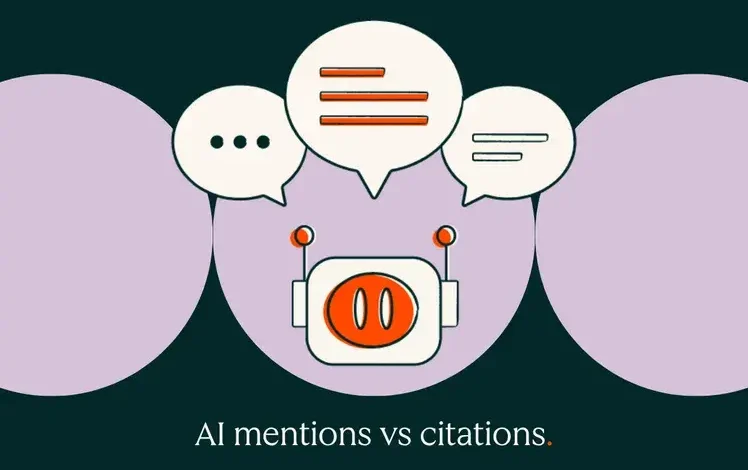
As generative AI reshapes the landscape of digital search, a disconnect has emerged for marketing teams and business leaders: the illusion of visibility. Many brands are finding their names frequently appearing within AI-generated responses from tools like ChatGPT, Google AI Overviews, and Perplexity, yet this presence is not translating into the expected surge in website traffic or lead generation. This phenomenon is rooted in the fundamental technical difference between an AEO (Answer Engine Optimization) mention and an AEO citation.
Understanding this distinction is now a mandatory requirement for any organization aiming to capture market share in the post-search era. While mentions bolster brand awareness and entity recognition, citations serve as the functional gateway to conversion. Without a clear strategy to bridge the gap between being recognized by an AI model and being verified as a source, companies are leaving significant revenue potential on the table.
The Evolution of Search and the AEO Paradigm
The transition from traditional link-based search to generative AI represents the most significant shift in consumer behavior since the inception of the search engine. Historically, search engine optimization (SEO) focused on ranking a domain within a list of ten blue links. Today, Answer Engine Optimization (AEO) operates on a different logic: synthesis. AI engines synthesize information from a vast pool of training data and live web crawls to provide a direct answer.
This evolution can be traced back to the introduction of Large Language Models (LLMs) into search interfaces in late 2022 and early 2023. By 2025, the industry reached a tipping point where AI-generated answers became the default starting point for complex queries. Research from The Digital Bloom indicates that by early 2026, the overlap between traditional organic search rankings and AI-generated citations had dropped significantly, reaching as low as 17% in some categories. This proves that high organic ranking is no longer a guaranteed passport to AI visibility; companies must now build a specialized, dual-layer strategy that targets both legacy search algorithms and the probabilistic reasoning engines of AI.
Defining the Visibility Gap
To navigate this new environment, organizations must distinguish between the two primary modes of AI output.
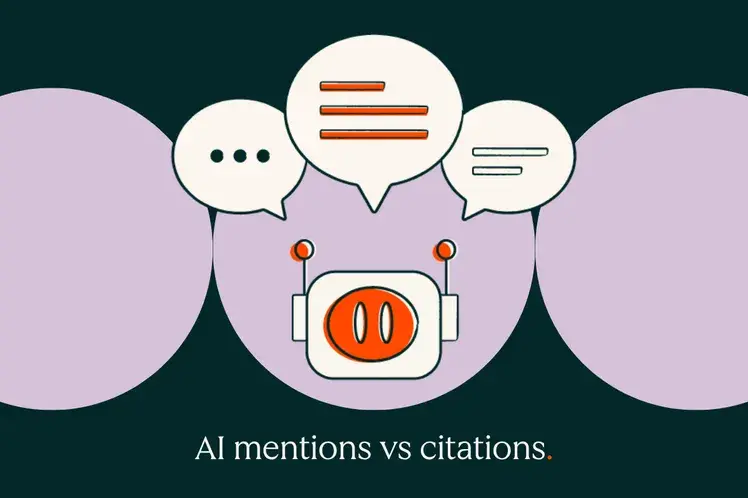
An AEO mention occurs when an AI engine references a brand, product, or service within the narrative of its response. This is a passive state; the engine acknowledges the existence of the brand, which is useful for entity recognition and brand recall. However, because there is no hyperlink or footnote, the user has no direct, frictionless path to visit the brand’s website.
An AEO citation, by contrast, is an active state. It occurs when the AI engine explicitly links to a specific URL, usually via a footnote, source card, or "learn more" link. This is the primary driver of referral traffic. Data shows that users arriving at a website via an AI citation possess higher purchase intent than those arriving through standard organic search, as they have already consumed a synthesized summary of the topic and are actively seeking deeper context.
Quantitative Analysis of AI Traffic
The financial implications of this gap are substantial. According to findings from MeasureU, roughly 22% of traffic originating from AI platforms is currently misclassified in Google Analytics 4 (GA4) as "direct" or "unassigned" traffic. This misattribution hides the true ROI of AEO efforts.
Furthermore, industry benchmarks suggest a stark correlation between domain authority and citation probability. Pages that rank first in traditional organic search have a roughly 33% probability of being cited in an AI overview, while that probability drops to approximately 13% for the tenth result. This suggests that while AI engines are autonomous, they remain heavily reliant on the same foundational signals—such as backlink profiles and content depth—that have defined search quality for decades.
Strategic Framework for Closing the Citation Gap
Transitioning from a mentioned brand to a cited source requires a systematic approach to content engineering. Experts suggest a five-pillar strategy:
- Entity Unification: AI models are probabilistic; they require clear, consistent signals to identify a brand. Inconsistent naming conventions across social media, press releases, and website metadata can confuse a model. Ensuring that the "brand entity" is defined identically across all digital touchpoints is the first step toward earning reliable citations.
- Answer-First Architecture: AI engines prioritize content that is easily extractable. By placing direct, declarative answers to specific queries at the very beginning of a page, rather than burying them in long-form narratives, creators increase the likelihood that their content will be selected for a summary.
- Structured Data Implementation: Utilizing Schema markup for articles, products, and FAQ pages allows AI crawlers to interpret the relationships between entities more effectively. Validated schema acts as a roadmap for the AI, confirming that a page is the definitive source for a specific question.
- E-E-A-T Signaling: The Google framework of Experience, Expertise, Authoritativeness, and Trustworthiness is now a critical factor for AI citation. Pages that feature named experts, verifiable citations, and current data are significantly more likely to be trusted by an AI engine than anonymous or outdated content.
- Continuous Benchmarking: Because AI models update their logic frequently, citations are not permanent. Brands must adopt a recurring audit cycle, ideally on a weekly basis, to monitor how their citation rate fluctuates in response to content updates or competitor activity.
The Role of Analytics in Measuring Success
To accurately track this progress, organizations must modernize their reporting infrastructure. This includes creating custom channel groups in GA4 to isolate traffic from platforms such as chatgpt.com, perplexity.ai, and gemini.google.com. By moving away from aggregate traffic reports and toward specific AI-referral attribution, companies can identify which queries are actually driving pipeline and revenue.
In a CRM environment like HubSpot, this involves tagging contacts based on their origin from AI-referral sources. By automating this, marketing teams can report on the specific contribution of AI search to the bottom line, moving the conversation from vanity metrics like "mentions" to business metrics like "AI-sourced leads."
Broader Implications and Future Outlook
The shift toward AI-mediated information retrieval is not a temporary trend; it is the new baseline for digital marketing. The "attribution gap" described by industry researchers is not merely a technical annoyance but a fundamental challenge to the current digital advertising model. As engines like Perplexity and ChatGPT continue to refine their interfaces to become more commercial, the competition for citation spots will intensify.
The long-term implication is a move toward a "zero-click" internet, where the platform provides the value and the brand provides the data. For companies, the goal is to ensure they are the primary source of that data. Those that fail to distinguish between mere mentions and measurable citations will find themselves increasingly invisible to the modern, AI-assisted consumer. By focusing on entity clarity, authoritative content, and precise attribution tracking, brands can secure their position as the preferred sources in an automated future. As the technology matures, the brands that win will be those that have successfully optimized their content not just for search engines, but for the machines that now interpret the world for the human user.
Related posts: