The Definitive Guide to Answer Engine Optimization and the Rise of AEO Checkers

The landscape of digital search is undergoing a structural transformation, shifting from a traditional index-based model to a synthesized, generative one. As users increasingly rely on AI-powered interfaces like ChatGPT, Perplexity, and Google’s AI Overviews to answer complex queries, the traditional "ten blue links" model of search engine optimization (SEO) is no longer sufficient. This shift has necessitated the emergence of Answer Engine Optimization (AEO)—the strategic practice of ensuring a brand is accurately cited and referenced within AI-generated responses. Unlike traditional SEO, which focuses on driving traffic to a specific URL, AEO aims to capture visibility within the "zero-click" environment where the AI summarizes information and resolves user queries without requiring a visit to an external website.
The pivot toward answer engines began in earnest during the first half of 2024, culminating in the widespread deployment of Google’s AI Overviews (AIOs). This change fundamentally altered how information is surfaced. Rather than acting as a directory of external links, modern search engines have evolved into research assistants that read, interpret, and synthesize data from across the web. For marketing departments and content strategists, this means that visibility once captured through organic search rankings can now vanish into an AI-generated paragraph that never directs a user to their site. Consequently, businesses must adopt AEO checkers—specialized tools designed to track, monitor, and improve a brand’s presence within these AI-generated responses.
![AEO checker tools that measure answer engine visibility [2026]](https://53.fs1.hubspotusercontent-na1.net/hubfs/53/aeo-checker-1-20260903-3858273.webp)
The Evolution of Search: From Crawling to Synthesizing
To understand the urgency of AEO, one must look at the timeline of the recent search revolution. Throughout the 2010s and early 2020s, SEO was defined by technical crawlability, backlink authority, and keyword density. However, the release of generative AI models shifted the user expectation toward immediate, summarized answers. By May 2024, Google fully integrated AI Overviews into its standard search results, marking a definitive departure from the traditional SERP (Search Engine Results Page).
During this period, platforms like Perplexity and ChatGPT gained significant market share by offering "citation-first" experiences. Perplexity, in particular, disrupted the market by providing a panel of sources alongside every answer, forcing brands to compete not just for relevance, but for the credibility afforded by an official citation. Data indicates that when an AI engine fails to mention a brand in a category-specific query, that brand effectively ceases to exist in the user’s research phase. This "omission risk" is the primary driver behind the adoption of AEO software.
Understanding the AEO Checker Ecosystem
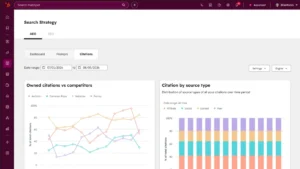
An AEO checker serves as the primary diagnostic tool for the post-link era. Unlike traditional SEO rank trackers that monitor position numbers (1 through 10), an AEO checker measures three distinct variables: brand mention, source citation, and sentiment context.
![AEO checker tools that measure answer engine visibility [2026]](https://no-cache.hubspot.com/cta/default/53/9dd5e54b-fbef-4dd0-bc44-1689feb1ea18.png)
A functional AEO tool performs a continuous loop of measurement:
- Diagnosis: Identifying which queries trigger an AI response and whether the brand is included.
- Gap Analysis: Pinpointing where a competitor is cited instead of the brand, effectively highlighting a content strategy failure.
- Prioritization: Ranking which pages require schema updates, technical content adjustments, or entity-based optimizations to increase the probability of being cited by the engine.
The technical requirements for these tools are demanding. Because AI responses are non-deterministic—meaning they change based on context, session history, and model updates—an effective AEO checker must perform high-frequency monitoring. A single snapshot is insufficient. As noted by industry experts, the volatility of AI responses necessitates daily or weekly tracking to establish a reliable baseline of performance.
Manual Assessment vs. Automated Intelligence
For organizations just beginning their journey into AEO, manual checks are a common starting point. This involves running priority queries in incognito sessions across multiple engines and recording the results. However, this method faces significant scalability issues. Manual checks often fail to account for regional differences, personalized search histories, or the subtle variations in how different LLMs (Large Language Models) interpret the same prompt.
![AEO checker tools that measure answer engine visibility [2026]](https://53.fs1.hubspotusercontent-na1.net/hubfs/53/aeo-checker-2-20260903-852936.webp)
Automated AEO software mitigates these risks by simulating hundreds of queries across diverse environments. These tools allow marketing teams to log results systematically, creating a "defensible record" of visibility. This is particularly important because, as of mid-2026, Google’s own search console data regarding AI performance remains limited in scope. While Google has introduced generative AI reporting, it provides an incomplete picture that often masks the nuance of which specific claims are being attributed to a brand.
Categorizing the Tools of the Trade
The market for AEO-specific software has fractured into several specialized niches, each catering to different aspects of the generative search experience.
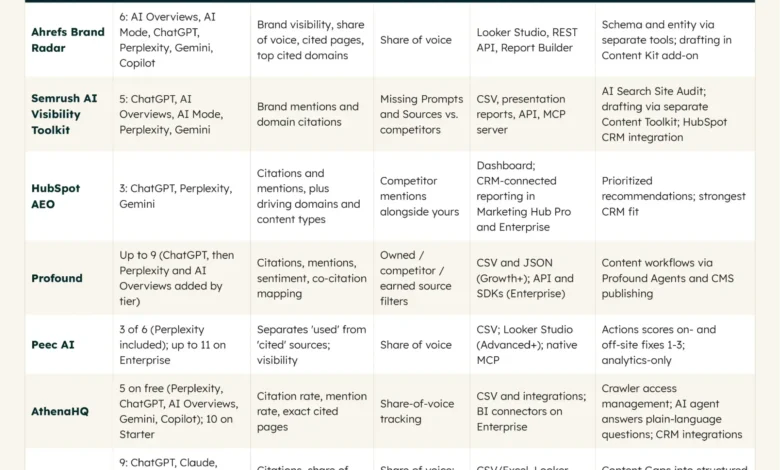
- Tools with AI Overviews Tracking: Platforms such as Ahrefs with its "Brand Radar" feature and Semrush’s "AI Visibility Toolkit" focus on the Google ecosystem. These tools are designed to flag which existing ranking keywords are now triggering AI Overviews, allowing teams to defend their current search real estate.
- Citation Detection Specialists: HubSpot’s AEO suite and Profound have emerged as leaders in monitoring the "mention versus citation" dynamic. These tools provide granular data on sentiment and context, helping brands understand not just that they were mentioned, but how the AI characterized their product or service.
- Perplexity-Focused Analytics: Tools like Peec AI and AthenaHQ have built their value proposition around the unique architecture of Perplexity, which heavily relies on clear, link-based citations. These are essential for brands operating in highly competitive research-heavy sectors like B2B software or financial services.
- Technical Readiness and Schema Tools: Scrunch AI and Conductor focus on the "under the hood" requirements—ensuring that a company’s web pages are structured in a way that AI crawlers can easily parse, render, and trust.
Implications for the Digital Marketing Funnel
The adoption of AEO tools has significant implications for how businesses calculate ROI. In a traditional funnel, a click is the primary success metric. In the AEO era, many interactions are "zero-click," meaning the user gains the information they need without ever leaving the search engine.
![AEO checker tools that measure answer engine visibility [2026]](https://53.fs1.hubspotusercontent-na1.net/hubfs/53/aeo-checker-3-20260903-8904553.webp)
This creates a new challenge: how to attribute value to a brand mention that does not result in a direct session. Advanced AEO platforms are now attempting to bridge this gap by integrating with Customer Relationship Management (CRM) systems. By connecting AI-referred traffic to actual sales data, these platforms aim to quantify the "influence" of a brand’s presence in AI answers. However, there is a clear distinction between visibility and conversion. Industry leaders emphasize that while AEO improves brand authority, it should be viewed as a complementary strategy to traditional SEO, not a replacement. Strong SEO provides the foundational authority signals—such as high-quality primary sources and clear, structured data—that answer engines require to trust and cite a brand in the first place.
The Future of Search Accountability
Looking forward, the integration of AEO into daily workflows will likely become standard for enterprise-level marketing. As AI models become more adept at synthesizing information, the "accuracy" of the answers they provide will become a primary competitive differentiator. Brands that proactively manage their representation through AEO tools will likely see higher trust scores from the algorithms, leading to more frequent citations.
Ultimately, the goal of AEO is not to "game" the algorithm, but to provide the most authoritative, clear, and relevant data to the engine. By focusing on entity-based optimization and the creation of high-value, research-backed content, organizations can ensure that when an AI is asked a question about their industry, their brand is not just mentioned, but becomes the primary source of truth. As manual checks become increasingly obsolete due to the sheer volume of search variation, the move toward automated, data-driven AEO solutions represents the next logical step in the maturity of digital marketing.
Related posts: