The Shadow of Nexus: How a Massive ID Scanning Breach Exposes Millions of Driver Licenses to Real-Time Theft

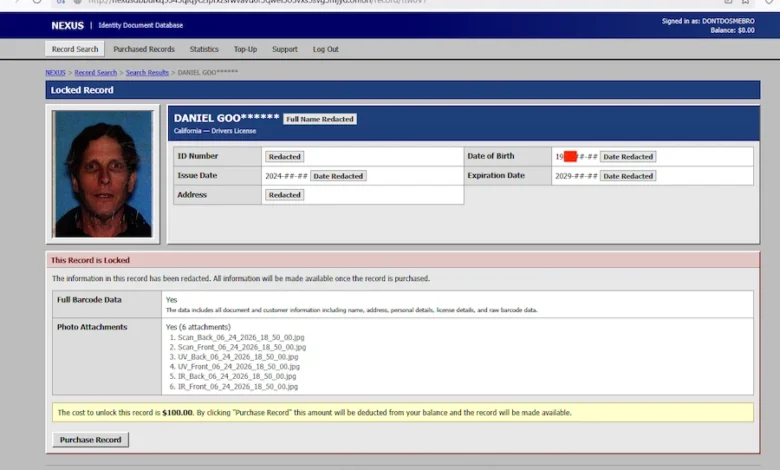
The landscape of digital identity security experienced a profound shock following revelations that a malicious data repository known as Nexus had achieved near real-time access to sensitive identification documents. Cybersecurity investigations spearheaded by industry experts exposed a sprawling underground operation capable of harvesting, cataloging, and monetizing driver licenses mere hours after individuals presented them to legitimate commercial entities such as car rental agencies and hospitality venues. The implications of this breach extend far beyond traditional data leaks, introducing sophisticated biometric and spectroscopic data points into the illicit cybercrime ecosystem.
The mechanism behind the Nexus repository highlights an unprecedented level of integration between physical point-of-sale verification systems and illicit data aggregation networks. According to investigative findings, newly submitted identity scans appeared on the illicit platform within a single day—and in some instances, within a matter of hours—of victims presenting their credentials at public-facing counters. This velocity indicates that the perpetrators maintained a continuous, automated ingestion pipeline, effectively siphoning data from the third-party verification services relied upon by everyday businesses.
Within a compressed 24-hour monitoring window, the volume of available driver licenses on the Nexus platform surged by nearly 400,000 records. This rapid expansion served as definitive proof that the underlying compromise was not a static, one-time historical dump, but an active, ongoing harvesting operation. Every time a consumer handed over their state-issued identification for routine authentication, the digital footprint of that interaction was seemingly mirrored and funneled directly into the hands of cybercriminals.
Tracing the Infrastructure: The IDScan.net Connection
As researchers dug deeper into the infrastructure supporting these commercial verification workflows, attention shifted toward third-party identity scanning providers. Publicly available corporate disclosures and press releases connected New Orleans-based IDScan.net to a network of high-profile commercial clients. The firm had previously publicized an exclusive partnership with cannabis enterprise Planet 13, alongside commercial relationships with major rental car giant Hertz and numerous other corporate entities across various sectors.
Crucially, technical literature published by IDScan.net emphasized the advanced nature of their scanning hardware and software architecture. The company’s promotional materials and annual fraud reports highlighted that their proprietary scanners capture authentication data across multiple spectrums, including both infrared and ultraviolet (UV) light. While these multi-spectral imaging techniques are designed to thwart counterfeiters by verifying security features embedded within modern driver licenses, their inclusion in harvested data sets transforms a standard identity leak into a far more dangerous commodity.
When cybercriminals gain access to raw infrared and ultraviolet scans alongside standard high-resolution color images, they acquire the precise blueprints necessary to manufacture physical counterfeits capable of bypassing advanced automated authentication gates. This elevates the Nexus breach from a conventional Personally Identifiable Information (PII) leak to a multi-layered identity cloning crisis.
Corporate Silence and Initial Industry Response
In the wake of these disclosures, public scrutiny intensified around the accountability of identity verification vendors and the commercial enterprises utilizing them. Inquiries sent via electronic mail to representatives of IDScan.net did not yield an immediate public statement, though a company spokesperson subsequently confirmed to investigative journalists that an internal inquiry had been initiated to determine the vector and scope of the compromise.
Similarly, inquiries directed toward major commercial partners, including car rental agencies that routinely scan customer credentials at check-in desks, went unanswered during the initial reporting cycle. The widespread corporate silence underscores a systemic vulnerability in how consumer data is delegated across third-party vendor chains. While companies routinely assure customers that identity scanning is conducted solely for fraud prevention and loss mitigation, the integration of these systems into compromised data pipelines demonstrates that the infrastructure itself may become the primary vector of exposure.
The Broader Context of Identity Theft and PII Fatigue
For the average consumer, the revelation that their driver license is actively circulating on a cybercrime marketplace compounds a deep-seated sense of digital fatigue. Decades of massive corporate breaches, government database compromises, and third-party vendor leaks have already exposed the foundational elements of modern identity. For millions of citizens across the globe, core demographic data—including current and historical residential addresses, full legal names, dates of birth, and Social Security numbers—have resided on underground forums for years.
However, security analysts emphasize that the Nexus repository represented a distinct escalation in data granularity. Standard data breaches typically leak static text fields and database entries. In contrast, the Nexus leak provided comprehensive digital replicas of physical cards, complete with multi-spectral security overlays, high-fidelity barcodes, and precise state-specific design layouts.
The psychological and financial toll of this exposure is severe. While traditional PII leaks enable remote financial fraud, synthetic identity creation, and account takeover attacks, access to authenticated driver license scans facilitates physical impersonation, fraudulent credit applications, and sophisticated perimeter bypass strategies. Victims face an uphill battle, as unlike a compromised password or credit card number, a state-issued driver license cannot be easily canceled or reissued without changing foundational identity numbers and enduring protracted bureaucratic hurdles.
Chronology of the Nexus Investigation
The public discovery and subsequent neutralization of the Nexus repository followed a rapid, high-stakes timeline characteristic of modern cyber threat intelligence operations.
- Initial Detection: Independent security researchers monitoring underground forums detected the sudden emergence of the Nexus database, noting an unprecedented influx of fresh identity records that matched recent real-world transactions.
- Correlation Analysis: Investigators conducted controlled tests by presenting physical identification documents to select commercial service providers, observing that corresponding digital scans appeared within the Nexus repository inside of 24 hours.
- Scale Assessment: Continued observation over a 24-hour monitoring window revealed explosive growth, with nearly 400,000 newly harvested driver licenses added to the marketplace, proving the automated nature of the compromise.
- Infrastructure Mapping: Researchers cross-referenced public corporate press releases and vendor disclosures to identify third-party scanning technologies, specifically highlighting multi-spectral capture capabilities utilized by major verification firms.
- Platform Shutdown: Within hours of public reporting and media inquiries by investigative journalist Brian Krebs, the Nexus platform abruptly went offline, effectively severing public access to the malicious data store.
- Federal Involvement: Law enforcement agencies, including the Federal Bureau of Investigation (FBI), initiated formal inquiries into the infrastructure, operators, and commercial touchpoints associated with the Nexus leak.
Implications and the Road Ahead for Digital Identity
The abrupt disappearance of the Nexus platform brought a temporary halt to the active exposure, but it left cybersecurity professionals and affected consumers in a difficult operational limbo. Because the portal went dark so quickly, individuals have no viable mechanism to query the database and determine whether their specific identification records were compromised during the operational window of the breach.
Nevertheless, the concurrent investigation by the Federal Bureau of Investigation provides a measure of institutional response, signaling that federal authorities are treating the infrastructure compromise as a significant threat to national identity security. Law enforcement agencies are expected to subpoena logs from third-party verification vendors, cloud hosting providers, and payment processors used to fund the Nexus operations.
From a structural perspective, the incident serves as a severe indictment of current data retention and handling practices within the commercial sector. Businesses that collect high-value biometric and spectroscopic identity data under the banner of security must now re-evaluate whether the collection practices themselves create an unacceptable liability. Storing or streaming sensitive credential scans through third-party networks without ironclad, end-to-end encryption and zero-trust verification creates lucrative honey pots for sophisticated threat actors.
As regulatory bodies examine the fallout, experts recommend that consumers remain vigilant, monitor credit reports closely, and question the necessity of physical ID scans in routine commercial transactions. The Nexus breach underscores a sobering reality in the digital age: until the foundational security of third-party data pipelines is fundamentally reinforced, the simple act of handing an ID to a trusted clerk will remain fraught with unseen cyber risks.