How WooCommerce is Overhauling its Security Infrastructure in the Era of AI-Driven Vulnerability Discovery

The landscape of web security has undergone a tectonic shift over the past eighteen months, driven primarily by the rapid democratization of Large Language Models (LLMs) and advanced automated scanning tools. For the WooCommerce ecosystem—a platform powering a significant portion of global e-commerce—this shift has necessitated a fundamental transformation in how security vulnerabilities are identified, triaged, and remediated. As malicious actors and security researchers alike deploy AI to probe codebases for weaknesses, WooCommerce has moved from a traditional, reactive security posture to an aggressive, proactive model. This transition reflects a broader trend in open-source software, where the transparency that once served as a primary strength is now being tested by the sheer volume of AI-generated bug reports.
The Rise of Automated Vulnerability Research
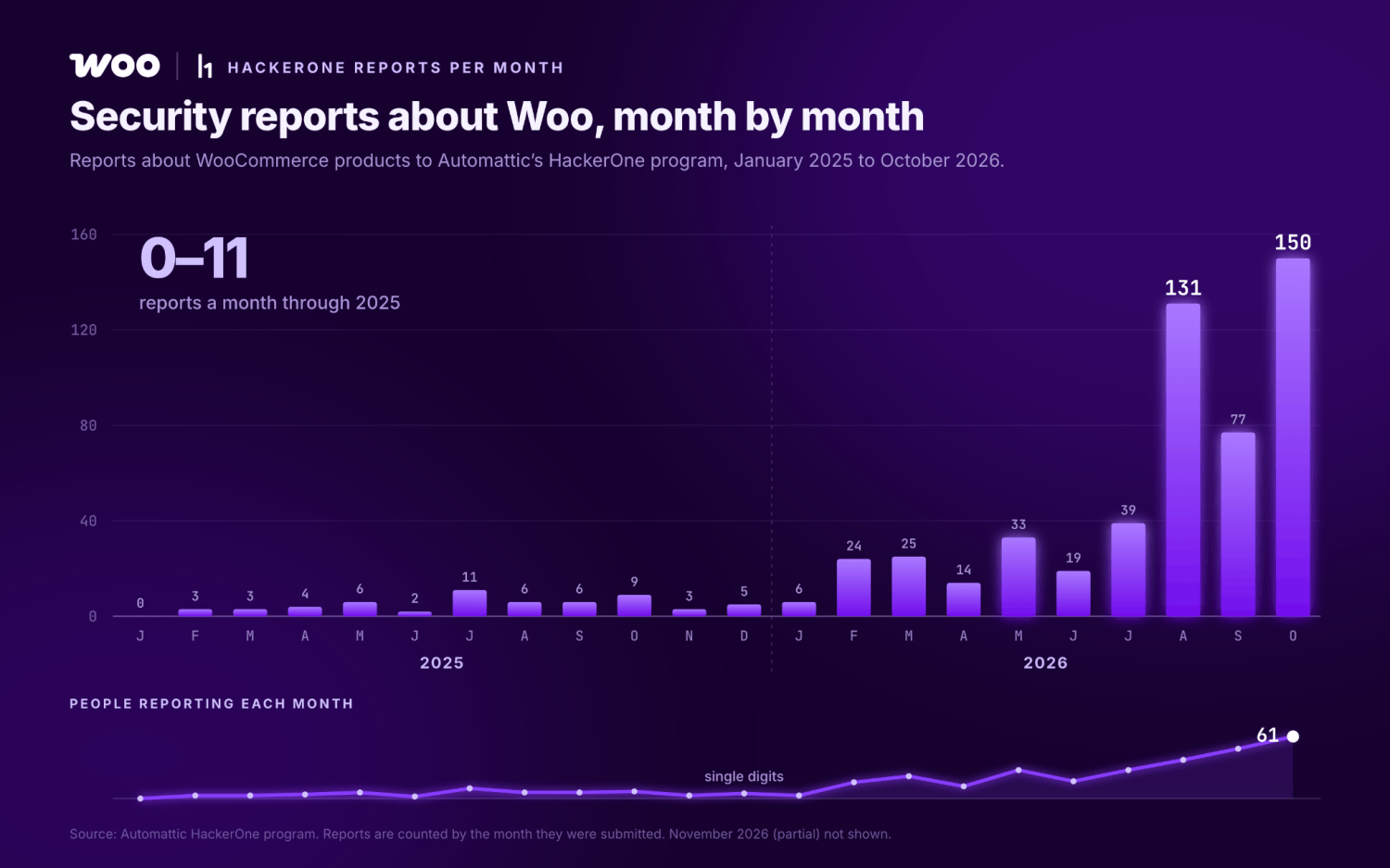
The catalyst for this shift began in earnest in late 2024 and accelerated throughout 2025. Data from Automattic’s HackerOne bounty program reveals a staggering ninefold increase in reports related to WooCommerce products compared to the previous year. This surge is not merely a result of more researchers focusing on the platform; it is a direct consequence of the tooling available to them.
When LLMs are tasked with analyzing public code, they can identify patterns and potential attack vectors at a scale previously reserved for top-tier security firms. The resulting influx of reports has created a "noise" problem, characterized by a high volume of duplicate findings. While this highlights the efficacy of AI in finding vulnerabilities, it places an unprecedented strain on the engineering teams responsible for maintaining platform integrity. In response, industry leaders, including the WordPress core team, launched the Core Security Initiative in August 2026, signaling a unified commitment to hardening the foundational layers of the internet against AI-assisted threats.
Chronology of a Security Evolution
The internal shift at WooCommerce toward a more robust, proactive security framework can be traced through several critical phases:
- June 2026: Acknowledging the rising tide of AI-driven reports, the engineering team began a complete audit of their internal triage processes.
- August 2026: A critical vulnerability in WooCommerce Subscriptions was identified via internal scanning. The incident served as a proof-of-concept for the necessity of mandatory, automated security updates, as the gap between patch creation and store-side implementation proved too wide.
- October 2026: A major PHP security advisory underscored the interdependency of the e-commerce stack. It became clear that while WooCommerce could harden its own code, it remained vulnerable to exploits in the underlying server environment, leading to a new policy on PHP version support.
- November 2026: Implementation of a new release cadence, specifically separating security patches from feature updates, went into effect with the rollout of WooCommerce 11.2.2.
Data-Driven Defense: The Role of Internal Scanning
One of the most significant metrics in the current security climate is the ratio of externally reported bugs versus internally discovered flaws. Historically, the majority of vulnerabilities were surfaced by the external community. However, since the adoption of proactive, automated scanning protocols in mid-2026, the WooCommerce engineering team has successfully identified more than twice as many valid core issues as those reported by external sources.
This proactive discovery is essential because it allows developers to ship patches before a vulnerability becomes public knowledge or is weaponized in the wild. The team utilizes a combination of static analysis tools, such as PHPCS and PHPStan, alongside proprietary AI-driven tools like "SentrySift." SentrySift serves as an initial filtering layer, analyzing incoming reports within minutes to assess severity and relevance, thereby allowing human engineers to focus on high-impact verification and remediation rather than administrative triage.
The New Release Strategy: Decoupling Security and Features
Prior to the recent policy overhaul, security fixes were often bundled into standard monthly feature releases. While efficient from a deployment perspective, this approach introduced significant risk. If a feature release contained an unrelated regression, the entire package would have to be rolled back, potentially leaving a site vulnerable to a known security exploit.
The new default is to issue security-specific updates as standalone releases. This allows for smaller, more predictable updates that can be applied rapidly by merchants without the potential disruption of new features or UI changes. While larger updates remain possible for major structural changes, the shift provides a clear path for critical patching.
Furthermore, WooCommerce has introduced a "required" status for security releases on the WooCommerce Marketplace. For stores connected to the official service with an active subscription, these security patches are now pushed automatically, bypassing the traditional wait time associated with manual store maintenance. This functionality aligns with the security practices seen on WordPress.org, ensuring that even store owners who have disabled auto-updates receive protection against critical vulnerabilities.
Broader Implications for the Open Source Ecosystem
The current security environment highlights the "double-edged sword" nature of open-source software. While the ability for anyone to inspect code is an inherent benefit of the open-source model, the democratization of powerful scanning tools means that bad actors can now uncover vulnerabilities with the same efficiency as the developers themselves.
Industry analysts suggest that this will likely lead to a "security arms race." Companies that maintain open-source projects will be forced to allocate significantly higher percentages of their engineering budgets to security research and automated defense. The cost of maintaining a "hard target" is rising, but as the WooCommerce team has noted, the trade-off is clear: delaying new features is a necessary price to pay for maintaining the trust and stability required for e-commerce.
The Road Ahead: PHP Compatibility and Compliance
Beyond the application layer, the platform is addressing the vulnerabilities inherent in legacy infrastructure. PHP versions older than 8.2 have reached their end-of-life, meaning they no longer receive security updates from the PHP project. WooCommerce has initiated a phased migration, with version 11.5 serving as the final release supporting legacy PHP versions 7.4 and 8.0. Starting in February 2027 with version 11.6, a minimum of PHP 8.1 will be required.
This transition is not merely a preference for modern code but a critical security requirement. Data indicates that approximately 9% of active stores are still operating on outdated PHP versions, posing a significant risk to the entire ecosystem. By mandating updates, WooCommerce is effectively forcing a baseline security standard across its entire user base.
What Merchants and Developers Should Do Now
To maintain a resilient security posture, the following actions are recommended for all store operators and developers:
- Enable Automatic Updates: Ensure that the "Automatic Updates" feature is enabled for both core WooCommerce and all extensions purchased through the official marketplace.
- Monitor PHP Versions: Check the current PHP environment via the WordPress Site Health tool. If the store is running on a version earlier than 8.1, coordinate with the hosting provider to upgrade immediately.
- Audit Extension Sources: Rely exclusively on the official WooCommerce Marketplace and WordPress.org plugin directory for extensions. These sources have built-in scanning protocols that ensure code meets current security standards.
- Regularly Review Security Logs: For larger stores or agencies managing multiple sites, utilize logging tools to monitor for unusual patterns or failed authentication attempts.
- Stay Informed: Subscribe to developer release notes. The shift to smaller, security-focused releases means that communication regarding patches will occur more frequently; staying informed is the first line of defense.
The transformation within WooCommerce represents a necessary evolution in how digital commerce platforms must operate in an era where AI is rapidly changing the rules of engagement. By integrating advanced automation into the development lifecycle and enforcing higher standards for server environments, the platform aims to stay ahead of an increasingly sophisticated threat landscape. For the merchant, the goal is a seamless experience where security is handled silently in the background, allowing them to focus on their core business operations without the looming threat of critical system vulnerabilities.