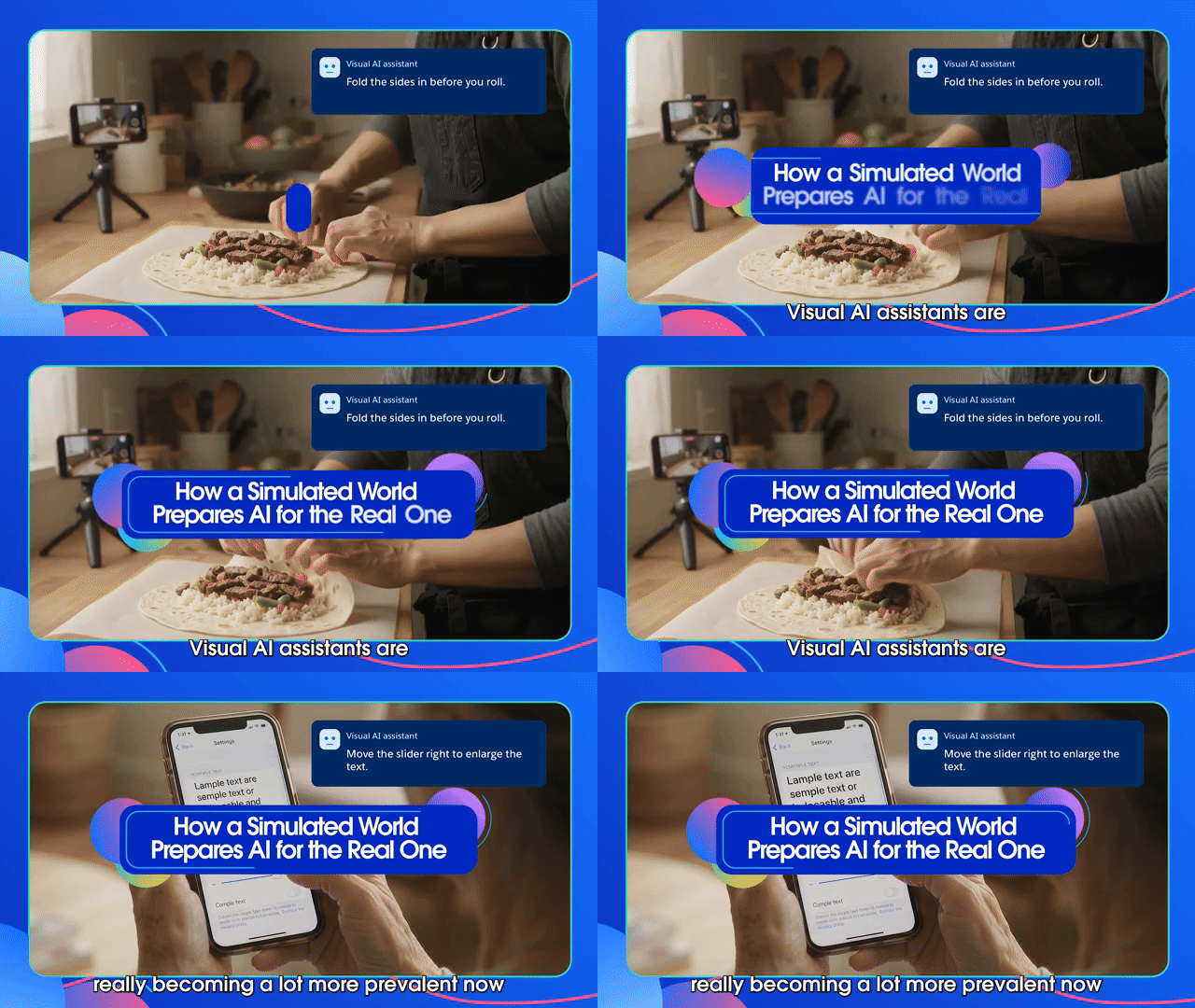
A technician kneels beside a commercial water heater, phone propped against a pipe, with an AI assistant observing the scene through the lens of a camera. As she reaches for a valve, the assistant interjects: "Stop, that is the supply line." This scenario represents the next frontier of artificial intelligence: transitioning from static text-based chatbots to real-time, physically aware guides that monitor human activity and provide corrective feedback in high-stakes environments. The effectiveness of such technology hinges on more than just the accuracy of the advice; it depends on timing, the user’s level of trust, and the assistant’s ability to guide a worker through complex, multi-step procedures without causing confusion or unnecessary delay.
As these tools migrate from the chat window to the physical workplace, the industry is grappling with a significant evaluation gap. Current testing methods for visual AI rely heavily on static, prerecorded video datasets, which fail to capture the reactive nature of a real-world task. To address this, researchers at Salesforce AI Research have introduced the Interactive Visual Gym (IVG), a simulated environment designed to stress-test how AI assistants interact with human agents in real-time.
The Evolution of Proactive Assistance: A 2024 Timeline
The rapid development of multimodal AI has compressed years of innovation into a single calendar year. The industry’s push toward "agentic" systems—AI that can perform tasks rather than just generating text—has moved with unprecedented speed.
In May 2024, the startup Thinking Machines unveiled new interaction models capable of continuous processing. By ingesting audio, video, and text streams simultaneously, these models moved away from the traditional turn-based structure of LLMs, allowing for a fluid, real-time conversation that doesn’t wait for a user to stop speaking before analyzing input.
By June 2024, Meta researchers pivoted toward the practical application of this technology by releasing a massive wearable video dataset. This dataset was specifically annotated to highlight "procedural deviations"—moments when a human worker drifts from a defined plan. By training models on how to identify these deviations and guide users back on track, Meta laid the groundwork for proactive, rather than reactive, assistance.
The momentum continued in September 2024, when Google introduced Gemini 3.8 Live. This iteration integrated advanced visual understanding with persistent background task processing, allowing the AI to keep track of a user’s physical surroundings while simultaneously managing digital administrative tasks.
The Evaluation Crisis: Why Static Benchmarks Fail
Despite these advancements, there remains a disconnect between the laboratory and the shop floor. Most existing AI benchmarks function like a traditional classroom exam: the model is shown a pre-recorded video of a task and asked to predict the next step or identify a mistake. While this verifies that the AI can "see" correctly, it ignores the dynamic nature of human-computer interaction.
In a real-world setting, advice is only useful if it is delivered within the "actionable window." If an AI identifies a mistake but processes the visual data with too much latency, the user may have already completed the incorrect action. Furthermore, a static test cannot measure how a user reacts to the AI’s voice. If an assistant provides an instruction that is misunderstood or ignored, the static test provides no data on the consequences of that interaction.
The Interactive Visual Gym (IVG) was created to solve this by placing AI assistants into a simulated, responsive environment. Within this "proving ground," the AI is not observing a passive recording; it is observing a simulated human who is actively performing a task. If the AI gives an instruction, the simulated worker reacts. This creates a closed-loop system where researchers can quantify the impact of the AI’s guidance on the success or failure of the project.

Methodology and Design: Crafting the Simulated Worker
The design of the IVG environment focuses on three core pillars that distinguish it from standard robotics simulators. First, the interaction is grounded in natural language. Rather than requiring the AI to communicate in complex mathematical coordinates or robotic joint velocities, the simulator facilitates natural human-to-human style instructions, such as "pick up the wrench" or "turn the red dial."
Second, the system is designed to introduce "out-of-plan" variables at precise intervals. These variables include sudden mistakes, mid-task shifts in priority, or requests for clarification. This allows researchers to test how an AI handles the ambiguity of human behavior.
Third, the simulator accounts for the psychological variance of the user. Simulated workers are programmed along four distinct axes:
- Skill Level: Varying from novices who require granular, step-by-step instructions to experts who need only periodic reminders.
- Trust in AI: A critical factor that dictates whether a user will actually follow a correction or ignore it.
- Execution Speed: How quickly the user processes information and completes physical actions.
- Interruption Tolerance: Whether the user prefers constant guidance or minimal interference during the task.
By modulating these variables, developers can observe how an AI assistant performs when it is pushed to its limits—for example, when a low-trust, high-speed novice worker makes a mistake under pressure.
Performance Analysis: IVG-Bench Findings
The implementation of IVG-Bench, which encompasses 315 distinct scenarios across three simulated environments, has provided a sobering look at the current state of visual AI. When evaluating 15 different models, even the top-performing model—running on the Gemini 4 Argon architecture—achieved a success rate of only 53.4% within specified time constraints.
The analysis revealed several systemic weaknesses in modern AI agents:
- Interaction Quality vs. Task Success: A model might successfully guide a user to complete a task, but the "clumsiness" of its guidance—such as constant, repetitive instructions or delayed alerts—can lead to user fatigue.
- Latency Stale-mate: The dynamic testing confirmed that latency is a primary failure point. When an AI tells a user to "approach the table" after the user has already arrived, the advice is not only useless but potentially distracting.
- Instruction Degradation: Many open-weight models showed a measurable drop in performance as the task progressed. In longer, multi-step operations, these models tended to lose "context," providing repetitive or irrelevant advice that didn’t account for steps already completed.
To validate these findings, researchers conducted human-in-the-loop tests. When human participants were tasked with navigating the simulator, their preference for specific assistants correlated with the IVG’s automated "interaction-quality" score 78.5% of the time. This suggests that the simulator is a highly accurate proxy for human satisfaction.
Implications for Industry Leaders and Future Deployment
For organizations considering the deployment of visual AI in industrial or frontline roles, the shift from static testing to dynamic simulation is not merely an academic exercise; it is a prerequisite for safety and efficiency.
The implications for leadership are clear: before integrating these systems, decision-makers must demand proof that the AI can function in an unpredictable environment. The key performance indicators for these tools should be:
- Outcome Impact: Does the presence of the AI statistically increase the success rate of the task?
- Temporal Precision: Is the guidance provided within the specific window of time where it can actually influence the outcome?
- Robustness: Does the AI maintain performance integrity during long-duration, high-complexity tasks, or when the user deviates from the standard operating procedure?
As AI continues to transition into the physical world, the focus of the industry will likely shift from "can the AI see?" to "can the AI effectively collaborate?" The work done by researchers at Salesforce and the broader AI community underscores a fundamental truth: in a physical workspace, an assistant that provides the wrong information at the wrong time is not just unhelpful—it is a liability. By utilizing tools like the Interactive Visual Gym, developers are finally creating the feedback loops necessary to build assistants that are as reliable as they are intelligent.