The Art of Strategic Calendar Management: Balancing High-Volume Commitments Through Hierarchical Planning

Effective time management remains one of the most significant challenges for professionals operating in high-demand environments. As organizational responsibilities, personal obligations, and travel requirements intersect, the traditional "to-do list" often fails to account for the hidden friction of transitions, recovery periods, and unforeseen logistical hurdles. Recent studies into workplace productivity suggest that the average professional underestimates the time required for secondary tasks—such as travel, preparation, and follow-up—by as much as 40 percent. This phenomenon, often termed "planning fallacy," leads to chronic overcommitment and the subsequent degradation of output quality.
To address this, high-performance strategists are increasingly adopting a three-tiered planning framework that reconciles long-term aspirations with the practical constraints of a 24-hour day. By treating the calendar as a finite resource rather than a flexible vessel, individuals can move from reactive task management to proactive outcome realization.
The Mathematics of Temporal Overcommitment
A three-day project rarely occupies only three days of a calendar. When accounting for the "invisible" requirements—pre-event research, transit time, post-event debriefing, and the inevitable catch-up on routine communications—a single commitment can effectively consume a full work week. Ignoring these ancillary demands is the primary driver of schedule collapse.
In October 2024, a notable shift in personal productivity modeling highlighted the necessity of imposing strict capacity ceilings. By limiting a single month to a maximum of three core outcomes, individuals can insulate themselves against the dilution of focus. In this specific case study, the subject constrained their output to two primary goals: launching an online curriculum and executing an overseas travel itinerary. This restriction serves a functional purpose: it forces a clear distinction between an "outcome" and a "task."
An outcome is defined by a binary, yes-or-no conclusion (e.g., "Taxes filed"), whereas a task is a continuous action (e.g., "Researching tax regulations"). By limiting the month to three outcomes, professionals ensure that they possess the bandwidth to actually finalize their stated goals rather than merely progressing through an endless queue of administrative chores.
A Three-Box Framework for Monthly Planning
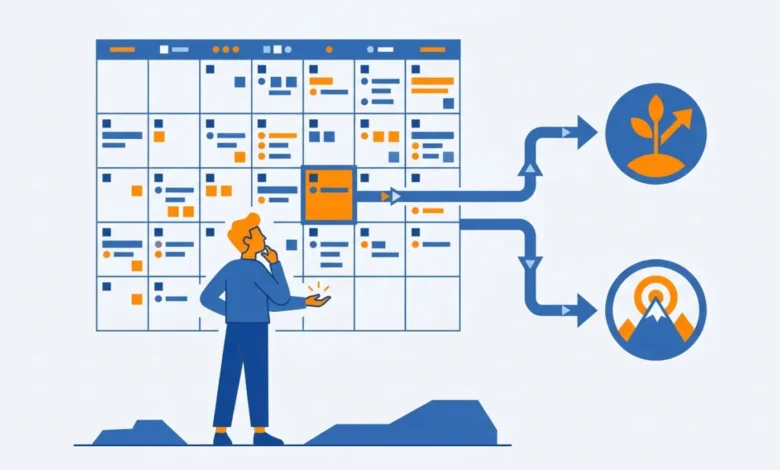
To manage these competing demands, experts recommend a standardized monthly template structured into three distinct categories: Anchor Events, Outcomes, and Key Tasks.
The chronology of planning begins with the "Anchor Events." These are non-negotiable commitments that occupy a full day or longer, including conferences, international travel, and pre-planned vacations. By placing these into the calendar first, the remaining available capacity becomes immediately apparent, preventing the dangerous assumption that every workday is an open canvas.
Once the anchor events are established, the next phase involves the selection of outcomes. These are limited to a maximum of three per month. By prioritizing these before assigning any granular tasks, one ensures that the month is driven by objective success metrics rather than the simple accumulation of busy work.
Finally, the "Key Tasks" are identified. These are the actionable steps necessary to realize the outcomes. This approach transforms a vague monthly ambition into a series of predictable, manageable weekly objectives. The efficacy of this model relies on the timing of the planning session itself; by scheduling the monthly review one week prior to the start of the month, individuals provide themselves with a buffer to finalize logistical details and set realistic expectations.
Shifting from Annual Planning to 90-Day Cycles
While corporate structures often demand annual projections, research indicates that these long-term targets frequently lose their psychological urgency within the first quarter. Data suggests that objectives set for a 12-month horizon often suffer from a lack of immediate accountability, leading to a "scramble phase" in the final weeks of the year.

Industry standards are shifting toward the 90-day (quarterly) planning cycle. This duration is long enough to permit substantial progress on complex projects but short enough to maintain the pressure of an impending deadline. Under this model, annual themes serve as a guiding "North Star," while specific, actionable outcomes are distilled into 90-day increments. This allows for iterative improvement and prevents the paralysis that often accompanies overly broad, long-term goals.
The Feedback Loop: Weekly and Daily Reviews
The most common point of failure in productivity systems is the absence of a retrospective review. Without a formal assessment of the previous week, individuals are prone to repeating the same planning errors. A robust review process requires answering three critical questions: What was successfully completed? What served as a primary obstacle? What must be modified for the next cycle?
This review process informs the subsequent week’s planning. Much like the monthly model, the weekly plan should be capped at three core outcomes. This prevents the "overload effect," where an excessive number of priorities results in the completion of none.
Daily planning acts as the final guardrail. Whether performed at the close of the previous day or the start of the current one, the goal is to identify the next steps for each key task and to identify potential "blockers." A common failure in this area is failing to verify the prerequisites for a task—for example, scheduling a meeting without confirming the availability of a participant or the necessary technology. By performing a "prerequisite check," one can resolve potential conflicts before they manifest as failed schedule blocks.
Managing Volatility and Administrative Friction
Modern work environments are characterized by high-velocity change. When meetings run long or new, urgent requests enter the queue, rigid schedules often fracture. Historical data on time-blocking suggests that the most resilient schedules are those that incorporate "buffer zones."
Rather than packing a day into 15-minute increments—which creates immense administrative overhead if even one item is delayed—planners are advised to leave visible margins between commitments. These open pockets provide the necessary "landing strip" for delays, ensuring that a single disruption does not cascade into a total loss of daily productivity.
Furthermore, the prioritization process must be dynamic. The "first-come, first-served" approach to tasks is inherently flawed, as it ignores the weight of strategic importance. When a new request arrives, it should be weighed against the predetermined monthly outcomes. While genuine emergencies and service-level commitments may warrant a deviation from the plan, they should be the exception rather than the rule.
Building a Foundation for Long-Term Execution
For individuals feeling overwhelmed by their current workload, the initial step is not to add more complexity, but to return to "neutral." This concept involves clearing the backlog—processing inboxes, organizing active project lists, and resolving immediate, low-level stressors. Just as an investor cannot effectively manage a portfolio while drowning in debt, a professional cannot engage in high-level strategic planning while the tactical, daily landscape remains in disarray.
The hierarchy of planning is absolute:
- The Monthly Template: Defines the strategic direction and identifies project milestones.
- The Weekly Plan: Converts project goals into actionable, time-bound commitments.
- The Daily Schedule: Ensures that today’s actions are directly aligned with the broader mission.
By strictly adhering to this hierarchy, individuals can maintain a clear view of their priorities while remaining agile enough to pivot when reality departs from the plan. As demonstrated by recent productivity systems like the 25X framework, the most successful individuals are those who have mastered the ability to define what matters, clear the space to achieve it, and maintain the discipline to recalibrate when the unexpected occurs. This transition from passive participation in one’s schedule to active management of one’s time is the fundamental requirement for sustained professional and personal output.