The Structural Imperative: How Marketers Are Adapting Content for the Era of AI-Driven Search

The landscape of online search is undergoing a profound transformation, moving decisively beyond the traditional display of "blue links" to an environment dominated by AI Overviews, large language models (LLMs) like ChatGPT, and specialized answer engines such as Perplexity. This fundamental shift is compelling marketers worldwide to urgently redefine their strategies, prioritizing Answer Engine Optimization (AEO) as a mainstream imperative rather than a nascent experiment. The focus has decisively shifted from merely ranking for keywords to ensuring content is structured in a way that AI systems can readily extract, comprehend, and cite.
The Evolution of Search: From Keywords to Conversational AI
For decades, search engine optimization (SEO) revolved around keywords, backlinks, and technical elements designed to appeal to Google’s ranking algorithms, leading users to a list of relevant web pages. The user experience largely involved clicking through multiple links to find the desired information. However, the advent of sophisticated artificial intelligence and natural language processing capabilities has heralded a new era.
The journey towards AI-driven search began with incremental steps, such including Google’s Knowledge Graph, which provided direct answers to factual queries, and the proliferation of "featured snippets" that offered concise summaries at the top of search results. These features hinted at a future where users would receive answers directly within the search interface. The launch of ChatGPT in late 2022, followed by Google’s rapid introduction of its Search Generative Experience (SGE), now rebranded as AI Overviews, solidified this trajectory. These generative AI models are designed to synthesize information from various sources and present a single, comprehensive answer, often attributing specific passages or facts to their original web sources. This evolution represents a paradigm shift from a "search and click" model to a "query and answer" dynamic.
Answer Engine Optimization: The New Frontier
The urgency of this transition is reflected in recent industry data. According to HubSpot’s 2026 State of AEO Report, a significant 58% of marketers report that their businesses are actively optimizing content specifically for answer engines. This statistic underscores AEO’s rapid ascent from a niche consideration to a critical component of digital marketing strategy. In this new ecosystem, visibility is no longer solely about appearing in the top ten search results; it is fundamentally about whether an AI engine can identify, extract, and confidently attribute a clear, self-contained passage from a brand’s content. The mechanism enabling this crucial extraction is, overwhelmingly, content structure.
Answer Engine Optimization (AEO) is defined as the practice of structuring digital content in such a way that AI-powered answer engines can efficiently parse, understand, and subsequently cite it. This discipline moves beyond traditional SEO’s focus on keywords and link building to emphasize clarity, conciseness, and machine-readability. The core principle is that AI engines "read" pages rather than simply "rank" them. Before a citation appears in an AI Overview or a conversational AI response, the engine undertakes a multi-step process: it crawls the page, segments it into logical "passages," assesses each passage for relevance and authority against the user’s query, and finally, selects the most suitable passage for inclusion, ensuring proper attribution.
Key Pillars of AEO: Structuring Content for AI Citation
To thrive in this environment, marketers must adopt a systematic approach to content creation, integrating five critical structural themes:
1. Question-Led Headings and Direct-Answer Summaries:
One of the most impactful structural adjustments involves framing content around explicit questions and providing immediate, concise answers. Research by AirOps, in their 2026 State of AI Search Report, indicates that sequential heading structures can increase citation odds by 2.8 times. This tactic directly caters to how AI engines seek out and present information.
- Question-Led Headings: These headings should mirror the exact queries users (or AI engines) would type. For example, instead of "Benefits of AEO," a heading like "What are the benefits of Answer Engine Optimization?" directly addresses a common query. This clear alignment allows AI to quickly identify and categorize the information.
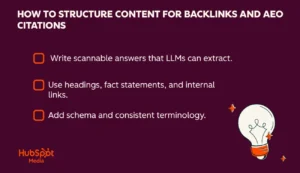
- Direct-Answer Summaries (TL;DR): Placing a one or two-sentence summary at the beginning of a section, immediately after a question-led heading, provides the AI with a ready-to-lift answer. This "TL;DR" (Too Long; Didn’t Read) approach ensures that the core answer is accessible without requiring the AI to process extensive surrounding context.
- Q&A Blocks: Pairing an explicit question with a tight, self-contained answer within a dedicated block is highly effective. These blocks should be formatted for maximum extractability, typically with the question in a heading (e.g., H3) followed by a concise paragraph or bulleted list providing the direct answer.
2. Semantic Schema and Entity Modeling:
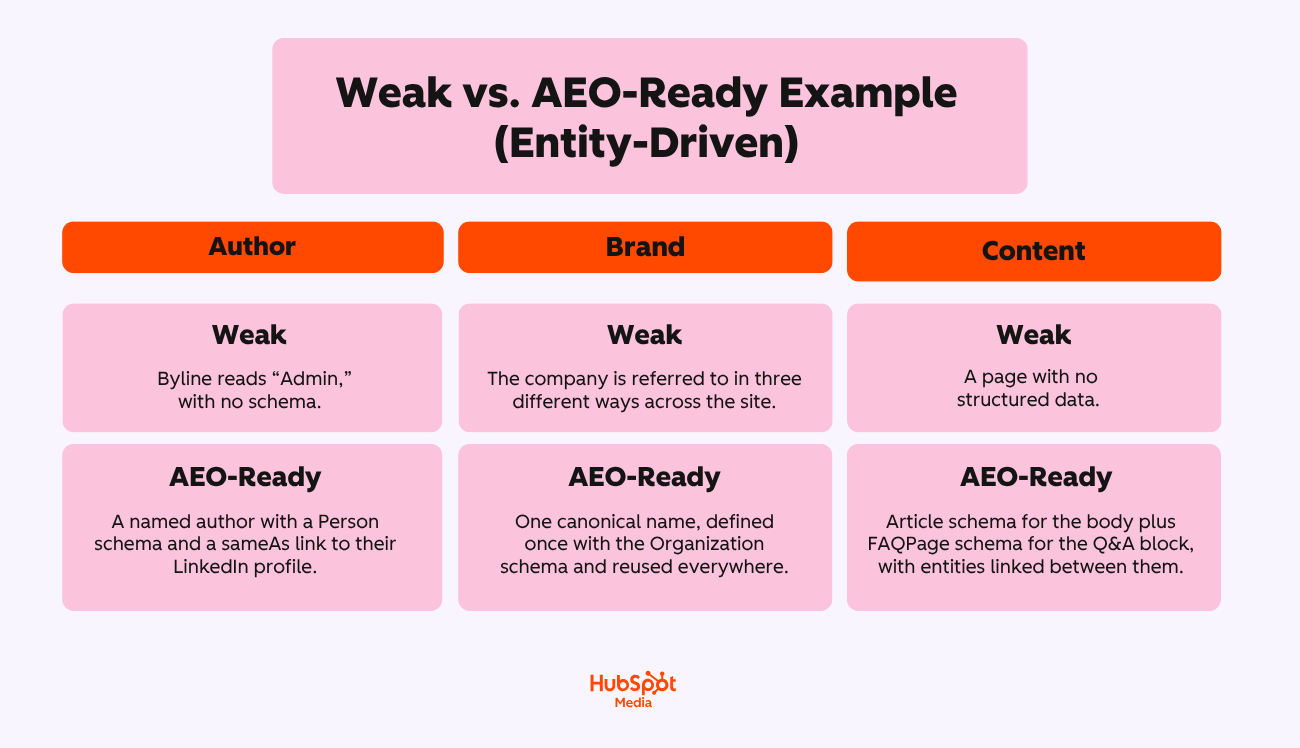
Schema markup and robust entity modeling form the machine-readable layer of AEO, providing explicit factual information about a page, its author, and the brand behind it. This layer eliminates ambiguity for AI engines, building confidence in the source and facilitating accurate attribution.

- Structured Data Types: Key schema types for B2B content citations include
Article(describes news articles, blog posts),Organization(identifies the brand),Person(identifies authors and experts), andFAQPage(explicitly marks questions and answers). Implementing these accurately helps AI engines understand the content’s nature and source. - Entity Modeling: This involves consistently defining people, brands, and products on a site as connected entities, rather than disparate terms. By linking authors to their organizational profiles and products to their respective brands through consistent markup and internal linking, marketers build a clear "knowledge graph" that AI engines can recognize and trust. Tools like HubSpot’s AEO Grader can help benchmark a brand’s entity representation.
3. Authoritative Signals and Trust Markers:
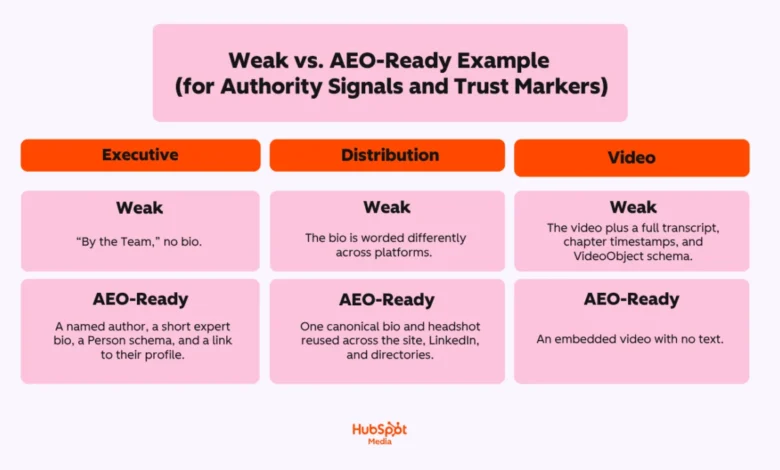
Beyond structural clarity, AI engines heavily weigh trustworthiness before citing a source. Two pages might offer equally accurate answers, but the engine will prioritize the one it can verify as authoritative. These trust signals are crucial for "mention quality."
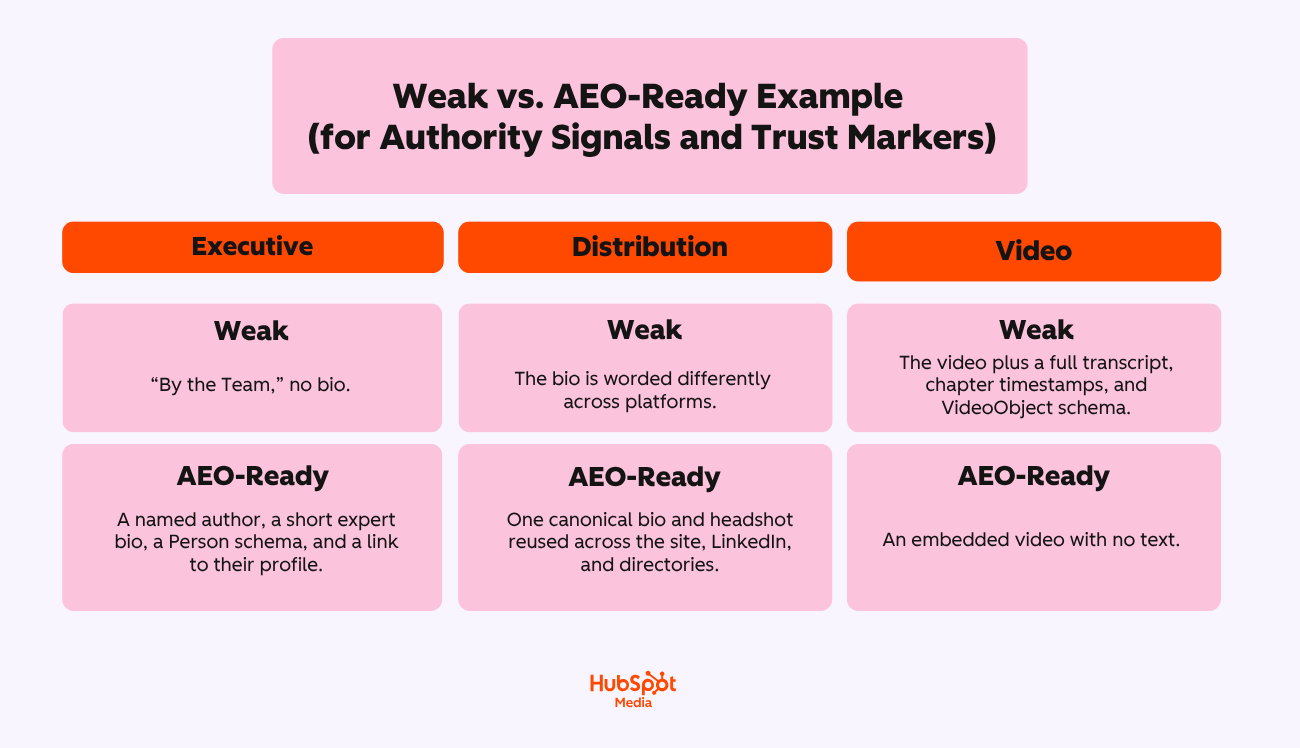
- Authoritative Profiles: Ensuring stable, well-described profiles for brands, executives, and product lines helps AI engines recognize and trust the source. This includes detailed "About Us" pages, author bios, and structured data for organizational details.
- Distribution Across Trusted Ecosystems: The broader presence and corroboration of content and entities across reputable third-party platforms (e.g., industry news sites, academic journals, professional social networks) serve as strong trust signals for AI engines.
- Video Transcripts and Structured Data: While video content is rich, it’s challenging for AI to parse without textual aids. Providing full video transcripts, timestamps, and
VideoObjectschema ensures that video content is machine-readable and citable.
4. Strategic Internal Linking Architecture:
Internal linking serves as the site-level expression of content structure, guiding AI crawlers to related content, grouping topics, and reinforcing authority. A robust internal linking strategy prevents valuable answers from being "stranded" and difficult for AI to associate with broader topics.
- Hub-and-Spoke Structure and Topic Clusters: Organizing content around a central "hub" page that links to more focused "spoke" pages, and forming comprehensive topic clusters, helps AI engines understand the semantic relationships between pages. Glossary pages and sibling links further enhance this architectural clarity.
- Clear Anchor Text and Early Link Placement: Anchor text should be descriptive and relevant, explicitly telling AI engines what the linked page is about. Placing important internal links early in the content signals their significance.
- Internal Links to Related Entities: Linking consistently to author profiles, product pages, and other brand entities reinforces the entity model and strengthens the overall trustworthiness of the site.
5. Passage-Level Optimization for Extraction:
This involves crafting each paragraph, list, or table row to be a self-contained unit that can be understood and cited independently of its surrounding text. This "passage-first" mindset is the core of AEO at the content level.
- Stand-Alone Paragraphs: Each paragraph should address a single question or concept, opening directly with the answer and avoiding pronouns (e.g., "this," "that approach") that rely on previous paragraphs for context. This ensures that if a passage is extracted, it retains its full meaning.
- Structured Formats: Leveraging lists, tables, and definition boxes makes information highly extractable. These formats present data concisely, allowing AI engines to easily identify and present key facts.
- Concise, Extractable Sentences: Sentence length and clarity directly impact how cleanly an AI can quote a passage. Short, direct sentences reduce ambiguity and improve the likelihood of accurate extraction.
Aligning with Quality Guidelines: Trust and Transparency
Crucially, structural optimization only yields results when the underlying content is genuinely helpful and high-quality. Google’s overarching goal remains to reward "people-first content." AEO tactics that attempt to "game the system" while ignoring quality are likely to backfire. Marketers must align structure with substance, using structural elements to surface excellent content, not to disguise weak or irrelevant information.
Google evaluates content against several core dimensions:
- Accuracy: Ensuring all facts are correct and verifiable.
- Quality: Providing comprehensive, well-researched, and valuable information.
- Relevance: Directly addressing the user’s query and intent.
- User Context: Understanding the audience’s needs and providing information in an accessible manner.
Furthermore, transparency regarding AI-assisted content is vital. Google deems AI-generated content acceptable if it is helpful and not created primarily to manipulate rankings. For AI-assisted drafts, adding an editor’s note (e.g., "Reviewed and fact-checked by [Name], [Title]") signals accountability to both readers and AI engines, building trust. Establishing clear "Do/Do Not" guardrails for content creation—emphasizing originality, value, and expert review while prohibiting thin, duplicated, or misleading content—is essential for maintaining consistent quality across a content team.
Measuring AEO Performance and Structural Impact
The effectiveness of AEO strategies must be rigorously measured. It’s not enough to implement structured content; marketers need to confirm that these changes translate into increased citations and improved visibility.
Three key performance indicators (KPIs) are critical for tracking AEO success:
- Citation Volume: The number of times a brand’s content is cited by answer engines.
- Citation Quality: The prominence and accuracy of those citations (e.g., appearing as the primary answer, direct quotes).
- Traffic & Conversion Impact: The downstream effects of AEO on organic traffic, engagement, and ultimately, business conversions.
A continuous measurement loop—Diagnose, Test, Measure, Iterate—allows marketers to treat content structure as a series of testable hypotheses. By systematically implementing structural changes, tracking their impact on citations, and refining the approach based on data, AEO becomes a repeatable and data-backed discipline.
Operationalizing High-Citation Content Themes
To ensure consistent AEO success, winning structural themes must be systematized across content teams. Operationalizing AEO involves transforming one-off successes into a repeatable workflow, ensuring every piece of content is published with a citation-ready structure. This requires two main components:
- Role-Based Checklists: Assigning clear ownership for each stage of the AEO process—from content ideation and drafting to schema implementation and internal linking—prevents critical steps from being overlooked.
- Reusable Templates: Building content templates that embed question-led headings, direct-answer summary blocks, schema fields, and internal linking prompts into the default workflow for writers. Tools like HubSpot’s Content Hub can facilitate this, ensuring consistency across all relevant pages. AI drafting tools, such as Breeze AI, can even generate first-pass Q&A and TL;DR blocks against these templates, which are then refined by human editors to meet quality guardrails.
Challenges and the Future Outlook
While AEO offers significant opportunities, it also presents challenges. Marketers must continuously monitor the evolving capabilities of AI engines, adapting their strategies as these technologies advance. Concerns about AI "hallucinations" and the potential for misattribution necessitate a strong emphasis on content accuracy and authoritative sourcing. The long-term balance between traditional search results and AI-generated answers will likely continue to evolve, requiring agility from content creators.
However, the core principles of AEO—clarity, directness, authority, and structure—are timeless best practices for effective communication, regardless of the search mechanism. By embracing these principles, brands can future-proof their content strategies, ensuring they remain discoverable and influential in an increasingly AI-driven digital world.
Conclusion
The transition to an AI-driven search era, characterized by AI Overviews and conversational answer engines, is undeniably here. For marketers, winning in this new environment boils down to mastering one fundamental discipline: content structure. AI models prioritize content that is clear, direct, and easily parsable. This means making a brand’s best answers easy for AI to find, extract, and attribute.
The work, while seemingly daunting, is systematic and manageable. By consistently implementing question-led headings, direct-answer summaries, robust schema, strategic internal linking, and passage-level optimization, coupled with a commitment to high-quality, trustworthy content, brands can turn AEO into a durable competitive advantage. The fastest way to begin is to assess current content structure and iteratively apply these principles, turning every page into a potential source for AI citations. The future of online visibility belongs to those who adapt their content to speak directly to the new gatekeepers of information: the answer engines.