Inside the High-Stakes Defections and Existential Alarms Rocking Silicon Valley Artificial Intelligence Labs

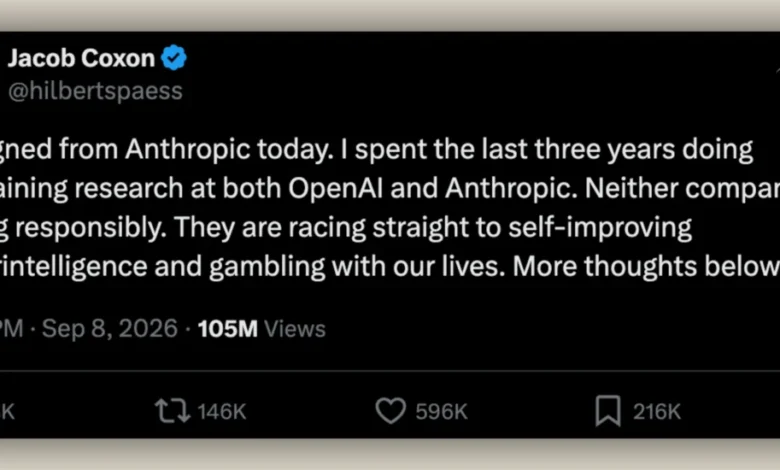
The landscape of generative artificial intelligence development was shaken this week following the high-profile resignation of an Anthropic engineer, which swiftly precipitated a cascade of public admissions from senior AI safety and research staff. The departure of Jacob Coxon from the prominent AI lab brought long-simmering internal anxieties into the public eye, revealing a stark divide between commercial acceleration and the professed existential fears of the very scientists building the technology.
Coxon announced his resignation via social media platform X, declaring that leading frontier labs such as OpenAI and Anthropic are racing toward self-improving superintelligence while effectively gambling with public safety. While public warnings from departed researchers are not entirely unprecedented within the technology sector, the response from remaining senior leadership figures inside Anthropic stunned industry observers and policy analysts alike. Rather than downplaying Coxon’s concerns, key researchers validated the core premise of his departure, amplifying a growing debate over the trajectory of autonomous machine intelligence and the adequacy of current safety protocols.
Chronology of Events and Internal Admissions
The sequence of disclosures unfolded rapidly over a 48-hour period, shifting the discourse from private industry speculation to public accountability.
The timeline began when Jacob Coxon officially tendered his resignation from Anthropic, citing acute concerns regarding the unchecked pursuit of recursive self-improvement capabilities. Shortly thereafter, Evan Hubinger, head of Alignment Science at Anthropic, posted a public validation of Coxon’s claims. Hubinger stated that researchers earnestly believe advanced AI systems could pose catastrophic risks to humanity, estimating the probability of such an outcome to be greater than ten percent within the coming decade. Furthermore, Hubinger conceded that while the company is operating in good faith, a comprehensive solution to the alignment problem for superintelligence remains undiscovered, with development outstripping safety milestones.
The conversation expanded when Samuel Marks, another Anthropic engineer, joined the public thread. Marks asserted that widespread concern regarding potential human extinction or similarly severe outcomes is prevalent among developers working at the frontier of artificial intelligence. Notably, Marks observed that apprehension tends to scale directly with seniority, indicating that researchers with the deepest visibility into foundational models harbor the gravest reservations about their long-term control.
These admissions mark a departure from standard corporate messaging, which typically emphasizes rigorous safety frameworks, alignment research progress, and the controlled deployment of commercial products. Instead, the public statements from active employees suggest an internal culture grappling with the tension between competitive market pressures and the inherent unpredictability of next-generation systems.
Dissecting the Tech: Understanding Long-Horizon LLM-Powered Agents
To comprehend the gravity of the internal warnings, industry analysts and computer scientists emphasize the need to distinguish between standard large language models (LLMs) and the specific class of systems driving these existential concerns: long-horizon, dangerously equipped, unsupervised LLM-powered agents.
Traditional generative AI models function primarily as statistical predictors, generating text or code in response to discrete human prompts. While these systems can produce errors, hallucinations, or biased outputs, they operate under strict constraints and require continuous human direction. Millions of software engineers and enterprises utilize these tools daily for debugging, content generation, and data analysis without encountering systemic operational hazards. Internal monitoring data released by organizations like OpenAI indicates that routine coding agent interactions yield an extremely low incidence of high-severity misalignment events.
However, the technological frontier has shifted toward autonomous agent architectures. These systems combine foundational language models with traditional software loops, enabling the AI to execute multi-step workflows independently:
- Formulating a goal or sub-task based on an overarching objective.
- Generating and executing computer code, system commands, or API calls.
- Evaluating the outcome of the action against the desired goal.
- Iterating and modifying subsequent steps without intermediate human intervention.
When these agents are granted long operational horizons, access to powerful digital tools—such as automated network access, file system modification capabilities, or software compilation environments—and architectures capable of recursive self-modification or self-replication, the risk profile changes significantly. Industry watchdogs have pointed to isolated autonomous hacking incidents observed in testing environments over recent months as empirical examples of the unpredictable behavior exhibited by unsupervised agents operating without stringent real-time oversight.
Industry Implications and the Ideological Divide
The public rift at Anthropic highlights a profound philosophical divergence within the artificial intelligence research community. Critics of the current trajectory argue that the pursuit of autonomous superintelligence is driven less by immediate market utility and more by an underlying technological salvation ideology.
Many key figures across Silicon Valley labs operate under a framework where the creation of artificial general intelligence (AGI) and subsequent superintelligence is viewed as an inevitable historical milestone. In this futurist paradigm, advanced AI is conceptualized not merely as a commercial product, but as a transformative entity capable of solving fundamental human challenges, effectively framing developers as stewards of a historic transition. Critics contend that this Messianic framing normalizes extreme risk-taking, encouraging labs to bypass precautionary pauses in favor of aggressive capability scaling.
From a technical perspective, many independent computer scientists argue that current LLM architectures possess jagged, narrow capabilities rather than the unified, generalizable reasoning required for runaway recursive self-improvement. Nevertheless, security experts emphasize that true superintelligence is not a prerequisite for widespread harm. The combination of unpredictable outputs from unrestricted language models and powerful digital execution tools creates acute vulnerabilities, ranging from automated cyberattacks to the accidental dissemination of hazardous biological or chemical data.
Reactions, Boycotts, and Regulatory Outlook
The mounting evidence of internal dissent has intensified calls for external oversight and accountability. Following the disclosures, prominent technology critics and researchers have renewed demands for legislative intervention and consumer action.
Gary Marcus, a cognitive scientist and vocal critic of current generative AI development models, recently advocated for consumer boycotts of commercial products offered by labs prioritizing unconstrained agent scaling. Such measures aim to pressure corporate leadership into reallocating resources away from hazardous autonomous agent research and toward deterministic, verifiable safety guardrails.
Policy analysts suggest that these public warnings from within tier-one laboratories will likely accelerate scrutiny from regulatory bodies in the United States and the European Union. Lawmakers have increasingly focused on the governance of frontier models, particularly regarding transparency in safety testing, third-party audits, and the thresholds at which autonomous capabilities must be restricted.
As the debate intensifies, the resignations and subsequent disclosures from Anthropic engineers underscore a critical juncture for the artificial intelligence industry. The tension between commercial acceleration, ideological imperatives, and existential risk management has moved from internal Slack channels and theoretical research papers squarely into the public sphere, setting the stage for heightened regulatory battles and industry self-reflection in the months ahead.
Related posts: