Sales is undergoing an undeniable transformation, a perpetual evolution that, while often stated, remains profoundly true. The paradigm shift is particularly evident in the way data is harnessed, fundamentally reshaping how businesses interact and build experiences. This change is not merely incremental but a structural re-engineering of the sales process, driven by an increasingly sophisticated and self-sufficient buyer.
The advent of smartphones irrevocably altered the dynamic between consumers and brands. Consumers gained unprecedented access to information, leading to a significant increase in self-service capabilities and a reduced reliance on direct human intervention. Brands, in turn, began consuming vast quantities of data to comprehend buyer behaviors, personalize suggestions, and tailor experiences. This consumer-centric shift has now fully permeated the business-to-business (B2B) landscape, fundamentally redefining B2B purchasing.
The Evolving B2B Buyer Landscape
Today’s B2B buyers are unequivocally digital natives in their purchasing habits. They initiate their own research, often crafting their criteria and engaging with their professional networks long before a vendor is ever contacted. Vendors are frequently brought into the process at its concluding stages, facing larger buying committees and a multitude of engagement channels. This complex, multi-touch journey makes these elusive buyers significantly harder to identify and engage effectively if traditional sales methodologies are still employed.
The consequence for many sales organizations is a reliance on conjecture. Sales representatives, operating without adequate insights, frequently make "guesses at scale," leading to missed quotas and an inefficient allocation of effort. The common organizational response—demanding more activity from reps under the guise of increased "productivity"—often exacerbates the problem, creating a cycle of high effort and low return. This era demands a departure from such unproductive practices, advocating for a shift towards actions guided by provable recommendations and intelligent automation.
Consumer technologies have long mastered this blend of intelligence and automation, meticulously crafting buyer-centric experiences behind the scenes. In the B2B sphere, platforms like XANT’s Playbooks aim to replicate this guided experience, offering unique sales engagement solutions that are tailored to the complexities of modern selling. While basic sales engagement tools, or "cadences," have become table stakes, true differentiation now lies in sophisticated automation, a robust and compliant system, and actionable intelligence derived from buyer behaviors. Playbooks positions itself precisely at this intersection, moving beyond generalized activity to enable truly guided selling.
Foundational Pillars of Guided Sales Experiences
XANT’s Playbooks differentiates itself through several foundational architectural pieces designed to empower sellers and optimize the sales cycle. These pillars — deep CRM integration, intelligent automation, reliable telephony, stringent compliance, advanced buyer intelligence, comprehensive reporting, and unparalleled speed-to-lead — collectively create a cohesive, buyer-centric selling environment.
1. Seamless and Deep CRM Integration
At the core of Playbooks’ effectiveness is its approach to integration, specifically designed to amplify existing CRM investments rather than duplicate CRM functionalities. A critical challenge for many sales organizations is the proliferation of siloed data, leading to fragmented insights and operational inefficiencies. Playbooks addresses this by working natively with customized CRM setups, particularly Salesforce, ensuring robust and reliable connections between sales tools and the CRM. This significantly reduces the time and cost associated with maintenance, data silos, duplicate records, and manual data entry.
Unlike many solutions that require extensive, ongoing mapping to CRM—often marketed as "flexibility" but leading to constant maintenance whenever CRM changes occur—Playbooks aims for a "plug-and-play" model. Once integrated, the system largely operates without further manual intervention for integration management. This prevents the common scenario where data quality degrades, leading to sales operating outside CRM and marketing creating duplicates, culminating in the "eternal revenue tug-of-war" between departments.
Furthermore, Playbooks avoids arbitrary caps on CRM fields, a common limitation in sub-par integrations that hinders comprehensive reporting. With over 15 years of dedicated investment in security and reliability, including proprietary diagnostic tools, Playbooks automatically monitors and updates a multitude of cadence-level and outcome-level fields within the CRM. For instance, when a rep makes a call via Playbooks on a Salesforce task object, detailed metrics such as call duration, ring count, and campaign origin are accurately reported back to Salesforce, providing granular visibility that is often lacking in other platforms which merely append disparate details to subject lines. This rich, integrated data forms the bedrock for superior analytics and strategic decision-making.
2. Intelligent Automation for Enhanced Productivity
The sheer volume of data, systems, and processes sellers are expected to navigate often results in significant waste and guesswork. Without clear processes, reps improvise; without buyer insights, they waste time researching; without proper data sync, manual logging creates silos; without CRM monitoring, key events are missed; and without automated lead assignment, opportunities go cold. The ultimate goal is to free sellers to spend the majority of their time engaging and selling to actual buyers, a feat impossible without robust automation. This isn’t about enabling email spam; it’s about building guardrails with intelligent robots to facilitate effective selling and minimize distractions.
Playbooks’ automation capabilities include:
- Accurate Data Entry: Automatic capture and recording of data to and from any CRM field, without arbitrary caps or complex mapping. This ensures data integrity and provides richer reporting, as exemplified by the 25+ additional fields updated for every interaction.
- Seamless Engagement Across Any Object: Supporting workflows across all CRM objects (Leads, Contacts, Opportunities, Accounts, Cases), aligning with specific business processes. For example, Customer Success Managers (CSMs) can auto-enroll customers approaching renewal into dedicated "Plays" to proactively manage contracts.
- Deal Progression Automation: Facilitating deal movement through the sales funnel. Playbooks can automatically trigger opportunities to advance through stages based on status changes and even prioritize those most likely to close, optimizing an Account Executive’s (AE’s) focus.
- Auto Record Enrollment: Automatically enrolling records (Accounts, Leads, Contacts, Cases, Opportunities) into relevant Plays based on customizable criteria. This enables the system to learn from successful Plays and automatically apply them to similar records, creating repeatable and scalable motions.
- Flexible Shared and Personal Records: A unique feature allowing for automatic assignment of records to individual reps or to shared pools. This dynamic assignment system, combined with round-robin capabilities and time-based rules, ensures that no lead goes unworked, especially during high influx periods or when reps are unavailable.
- Alerts and Activity Triggers: Monitoring all CRM fields to provide real-time alerts for key events and trigger subsequent actions. This prevents opportunities from falling through the cracks, such as alerting reps to engage with an opportunity if no activity has been recorded for several days.
- Buyer Behavior Insights and Predictions (Smart Email Send): Beyond basic automation, Playbooks incorporates buyer-specific algorithms to predict behaviors. The Smart Email Send feature, for instance, recommends optimal sending times based on actual open rates, demonstrating a proven average 23% lift in contact rates for customers.
3. Robust and Flexible Telephony Solutions

Despite common misconceptions about its demise, calling remains a highly effective channel for high-performing sales professionals. The key is to employ a multi-channel approach, and reliable telephony is an indispensable component. XANT’s deep roots in dialing technology, dating back to its pioneering work in 2004 that contributed to core digital sales tech IP (like click-to-call), grant it a unique position. By building its own telephony backbone, XANT offers unparalleled flexibility and reliability, mitigating risks associated with outages, poor call quality, and system incompatibilities that can lead to missed revenue opportunities.
Playbooks provides three distinct telephony options:
- Direct Carrier Connections: Utilizing direct connections to traditional global carriers through existing phone systems. This ensures superior call quality, faster issue resolution, and avoids the "global backlog" common with third-party discount providers.
- SIP Integration: Connecting Playbooks’ telephony to local networks and Private Branch Exchange (PBX) systems. This offers significant cost savings as XANT does not charge for these calls, but it typically requires a more technical integration suited for larger, complex organizations.
- Computer-Based Dialing: A convenient, low-cost option for remote teams, allowing reps to make outbound calls directly from their computers. While dependent on internet speeds, it provides a viable alternative to inconsistent mobile phone calls, addressing the modern reality of distributed sales forces.
4. Comprehensive Compliance Framework
In an increasingly regulated global business environment, compliance is no longer a peripheral concern but a foundational requirement. Sales representatives cannot realistically be expected to navigate the intricate web of compliance standards across different cities, states, and countries. Playbooks is architected to provide a robust compliance framework, protecting businesses from legal issues, fines, and reputational damage.
Compliance extends beyond legal statutes to encompass internal process adherence, message consistency, best practice adoption (e.g., persistency, immediacy), and accurate activity logging in CRM. The platform accounts for regulatory nuances, such as local holidays (e.g., Utah’s Pioneer Day), and helps avoid insensitive outreach (e.g., prospecting into disaster zones).
Playbooks’ compliance capabilities span multiple critical areas:
- Call Compliance: Ensuring adherence to Do Not Call (DNC) lists, consent requirements, and local dialing regulations.
- Email Compliance: Managing opt-outs, CAN-SPAM, GDPR, and other regional email marketing regulations.
- Data Compliance: Safeguarding data privacy, security, and governance, including anonymization and encryption protocols.
- Workflow Compliance: Enforcing consistent sales processes, engagement sequences, and opportunity progression rules.
- CRM Compliance: Maintaining accurate and complete activity logs within the CRM, preventing data decay and ensuring a single source of truth.
This comprehensive approach fosters a consistent and compliant sales culture, leading to more predictable results and peace of mind for both sellers and their customers.
5. Actionable Buyer Intelligence
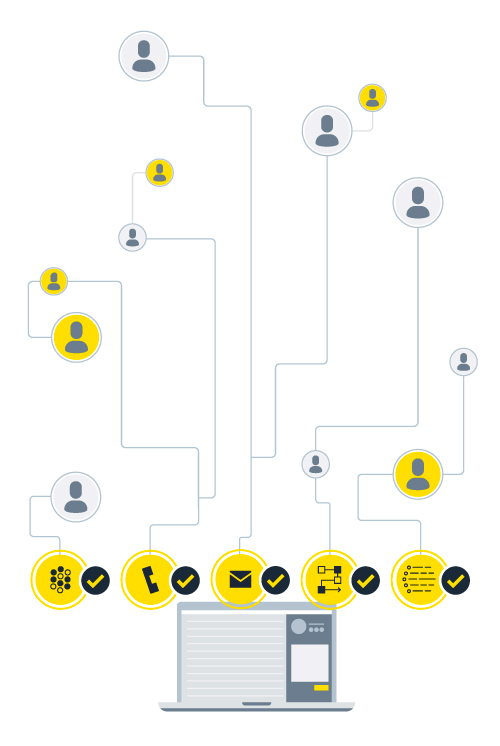
Selling without buyer intelligence is akin to navigating a boat through dense fog at night without a lighthouse. Buyers, as the "lighthouse," constantly shift their positions and behaviors, making it imperative to capture their signals. Playbooks’ Buyer Intelligence is a sophisticated mechanism for achieving this.
The process involves:
- Data Collection: Gathering data from every interaction and outcome across the platform—thousands of sellers, millions of buyers, billions of actions, all linked to closed-won or closed-lost deals.
- AI-Powered Signal Mining: Employing artificial intelligence to extract relevant behavioral signals: identifying influencers, decision-makers, preferred channels, optimal engagement times, and buying group dynamics.
- Anonymization, Encryption, and Validation: Processing these signals, anonymizing and encrypting them, then validating them against third-party data sources to ensure accuracy and privacy.
- Actionable Recommendations: Serving these verified insights and scores directly to reps within Playbooks, guiding their actions.
Key Buyer Intelligence features integrated into the Playbooks user experience include:
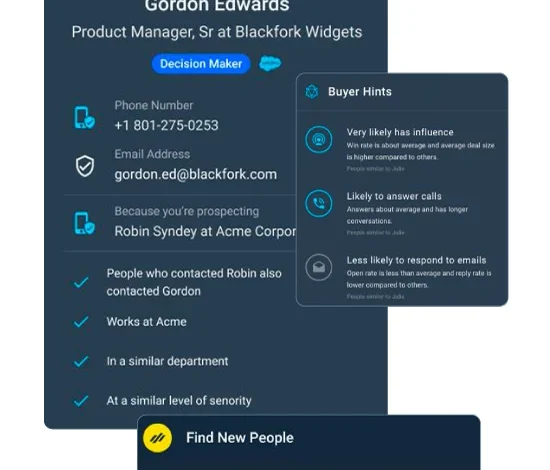
- PeopleFinder: Identifying additional members of the buying group, their roles, influence levels, contact information, and engagement patterns.
- Buyer Hints: Providing profiles, purchasing behaviors, influence at the account level, and engagement recommendations.
- Verified Contact Data: Supplying validated email and phone contact information, complete with timestamps of last successful use.
- Data Append: Automatically enriching individual CRM records with additional contact information.
- Mobile Recommend: Detecting and recommending verified mobile phone numbers.
- Smart Email Send: Predicting the best time to send emails based on historical open rates.
- Scoring: Quantifying the likelihood of leads and contacts to engage, and accounts and opportunities to close, enabling prioritization.
This intelligence, combined with Playbooks’ automation, provides the flexibility to prioritize workflows, optimize lead routing, and personalize engagement, giving sales teams a distinct advantage in a competitive market.
6. Insightful Reporting and Performance Scorecards
Effective sales management hinges on understanding what works and what doesn’t. Yet, many sales leaders grapple with the arduous task of manually building reports and chasing down incomplete data to measure performance and align sales and marketing. The proliferation of "shadow CRMs" that allow actions and store data outside the primary CRM system exacerbates this, leading to data integrity issues and unreliable reporting.
Playbooks directly addresses this by integrating natively with the CRM, pushing data updates to all relevant fields without caps or downtime. It leverages the CRM as the single source of truth, avoiding the creation of separate, often inconsistent, data silos. The platform deploys custom reporting packages pre-loaded into the CRM, offering performance insights readily accessible to all stakeholders.
Beyond native CRM reporting, Playbooks provides in-app dashboards, scorecards, and leaderboards for quick views into rep activity and team performance. These dashboards are harmonized with CRM data, serving as a simplified control center. Gamification features, such as customizable KPIs for scorecards and personal leaderboards, motivate reps and foster a culture of continuous improvement. Sample reports include task and event reports, strategy reports, inbound call metrics, email reports, account penetration analysis, and activity dashboards, providing comprehensive visibility into every facet of the sales process.

7. Unmatched Speed-to-Lead
The adage "half of buyers still choose the vendor that responds first" holds more weight than ever in the digital age. Research consistently demonstrates the critical importance of speed-to-lead: conversion rates are 8X higher within five minutes, contact rates 2.5X higher within the first two hours, and win rates 7.5X higher when engagement occurs within hours versus days. This highlights an incredibly narrow window for sellers to respond to buyer signals.
Despite this, a significant proportion—an estimated 79%—of inbound leads are never touched, and only 9% receive engagement within the crucial first two hours. This represents a colossal amount of "cheddar left on the table." Bottlenecks caused by manual lead assignment, leads going cold due to rep unavailability (sick leave, vacation), and a lack of visibility into these failures are common operational inefficiencies.
Playbooks leverages its Automation Robots to revolutionize speed-to-lead:
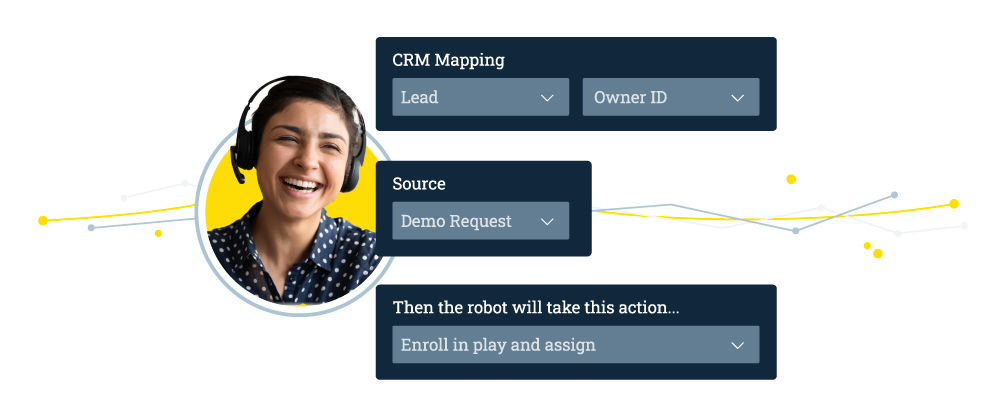
- Automated Lead Assignment: Eliminating manual lead assignment, robots query CRM fields in real-time or every ten minutes (by default) to instantly enroll urgent inbound leads (e.g., demo requests) into Plays and assign them to reps.
- Shared Records and Auto Round-Robin: A hallmark feature that allows leads and contacts to be assigned to individual reps (Personal Records) or placed in shared pools for any rep to work. Urgent tasks on shared records are automatically round-robin assigned until taken. Crucially, time-based rules can pull personal records back into a shared pool if an assigned rep fails to act promptly, preventing leads from languishing in a "digital vault."
This sophisticated automation bypasses bottlenecks, eliminates manual delays, and ensures that urgent leads receive immediate attention, drastically increasing the chances of connection and conversion. The atrophy of high-velocity selling muscles in recent years necessitates a retooling, and Playbooks provides the instruments for this revitalization.
Conclusion
The modern sales landscape, characterized by digital-first B2B buyers and an abundance of data, demands a sophisticated, guided approach. XANT’s Playbooks stands as a comprehensive solution built for this new era, guiding sellers to engage with modern buyers effectively. By eliminating guesswork and backing actions with robust data, Playbooks enables more efficient connections with the right people, leading to highly predictable and improved results. The platform’s foundational pillars—deep CRM integration, intelligent automation, reliable telephony, stringent compliance, actionable buyer intelligence, insightful reporting, and unparalleled speed-to-lead—collectively empower sales organizations to navigate the complexities of the digital sales revolution and thrive in a buyer-centric world.
Related posts: