Elevated Brands Group Enhances Customer Experience and Sales Conversions with the Launch of AI Shopping Assistant Ask Cleo

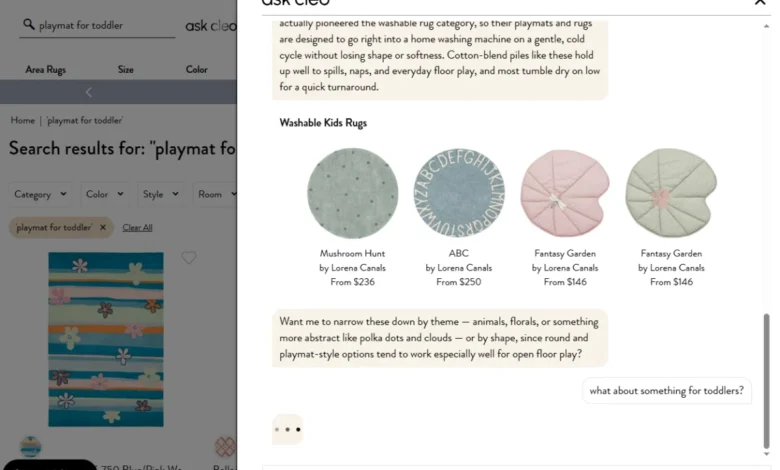
Elevated Brands Group, the parent company behind home decor and lighting retailers Rugs Direct and Lightopia, has successfully integrated an advanced, agentic AI-powered conversational assistant known as Ask Cleo. This strategic deployment marks a significant shift in how the company approaches digital discovery, moving away from traditional, rigid search parameters toward a fluid, natural language interaction model. Since the phased rollout began in May 2026, the tool has demonstrated a profound impact on key performance indicators, most notably by driving add-to-cart rates that significantly outpace those of users relying on legacy search functions.
The Strategic Rollout and Operational Timeline
The implementation of Ask Cleo was designed as a bespoke experience tailored to the specific product categories of each retailer within the Elevated Brands Group portfolio. Lightopia, which specializes in complex technical lighting solutions, served as the initial proving ground, debuting the assistant on its website in May 2026. Encouraged by early performance metrics and consumer feedback, the company expanded the initiative to Rugs Direct in early June 2026.
This two-pronged launch allowed the company to refine the AI’s behavior based on distinct product needs. While the core engine remains consistent, the application of the agent reflects the fundamental differences between the two retail environments. For Rugs Direct, the assistant is frequently queried regarding physical attributes such as material composition, pile thickness, and spatial dimensions. Conversely, at Lightopia, the dialogue is inherently more technical, with shoppers seeking guidance on dimmability, bulb compatibility, color temperature, and complex architectural requirements, such as selecting fixtures suitable for vaulted ceilings.
Performance Metrics and Consumer Engagement
The quantitative success of Ask Cleo has been notable within the initial months of operation. Sharon Gautschi, chief merchandising officer of Elevated Brands Group, reports that shoppers who interact with the AI agent exhibit add-to-cart rates eight to nine times higher than those utilizing traditional search methods. This dramatic delta suggests that the conversational nature of the assistant effectively reduces the friction typically associated with finding high-consideration items online.
Despite these impressive ratios, Gautschi remains grounded in her assessment of the tool’s current footprint. While the conversion efficiency of the AI interface is superior, it currently serves a smaller segment of the total user base. A significant majority of shoppers continue to favor classic, keyword-based search. Consequently, the company is actively focusing on strategies to increase user engagement and encourage customers to trial the conversational interface as a more intuitive alternative to legacy search bars.
The relationship between engagement and conversion appears to be linear. Data analyzed by Elevated Brands Group indicates that the more questions a user asks during a single session, the higher the likelihood of a purchase. This correlation suggests that the AI is not merely acting as a search filter, but as a consultative agent that builds shopper confidence, thereby validating the company’s decision to prioritize "agentic" capabilities—the ability for the AI to perform multi-step reasoning and ask clarifying questions—over simple chatbot functionality.
Data Integrity and Training Methodology
The efficacy of Ask Cleo is largely attributed to the company’s disciplined approach to data management and training. The training phase, which spanned approximately four to six weeks, involved the ingestion of a comprehensive library of internal assets. This included extensive SEO-driven blog posts, PR materials, and, critically, granular product specifications.
Elevated Brands Group leveraged the expertise of Constructor, a platform specializing in AI-powered search and discovery, to develop the agent. However, the quality of the output remains heavily dependent on the "well-informed friend" persona that the company has curated. Gautschi emphasized that the goal is not merely to provide a link to a product, but to offer stylistic advice and contextual considerations that reflect the brand’s identity.
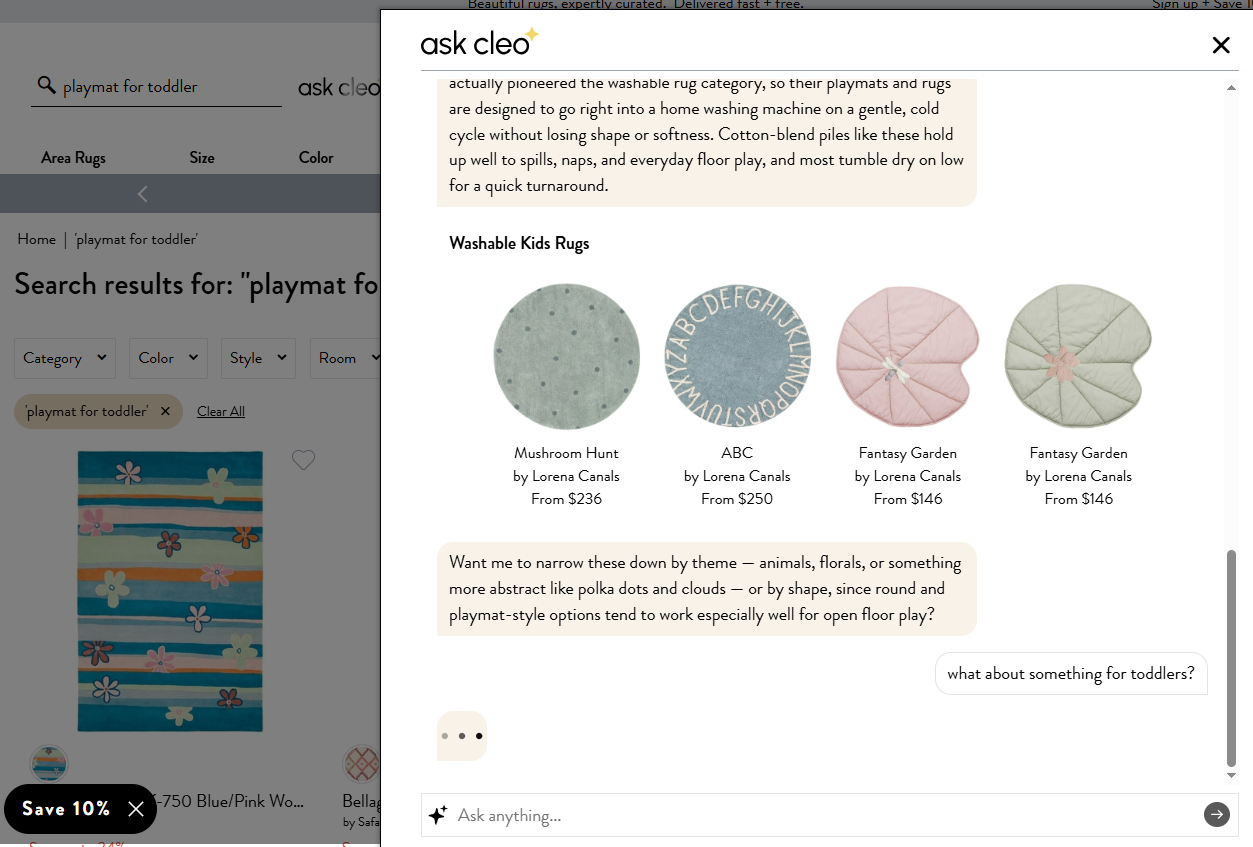
A rigorous testing cycle ensures that the AI’s responses align with brand standards. If an interaction falls short of expectations or requires optimization, the team provides specific examples to the third-party developers for iterative improvement. This commitment to "data integrity" serves as a competitive advantage; in a retail landscape where product information is often fragmented or incomplete, Elevated Brands Group’s ability to keep its assortment data accurate and centralized allows the agent to function with a higher degree of reliability.
The Role of Off-site AI Traffic
Beyond the immediate success of on-site tools, Elevated Brands Group is closely monitoring the evolving landscape of off-site AI referrals. Platforms such as OpenAI’s ChatGPT, Anthropic’s Claude, and Perplexity are becoming increasingly influential in the consumer journey. Currently, these AI platforms account for less than 10% of total site traffic to Rugs Direct and Lightopia.
While this represents a relatively small share of total volume, the company views this as a critical growth vector. As these AI platforms become more sophisticated, the quality of traffic they direct is expected to increase. Gautschi notes that the company is effectively competing with massive, well-capitalized retailers, and securing a foothold in the AI referral ecosystem is essential for long-term scalability. The expectation is that if traffic sourced from these platforms proves more "qualified"—meaning users have already performed deep research within the AI environment before reaching the site—the return on ad spend and overall marketing ROI will surpass that of traditional digital marketing channels.
Broader Industry Implications and Future Outlook
The adoption of Ask Cleo by Elevated Brands Group mirrors a broader trend across the retail sector, where merchants are pivoting from reactive search to proactive, conversational commerce. According to data from the Digital Commerce 360 Top 1000 database, Rugs Direct currently ranks No. 622 among North America’s largest online retailers. Furthermore, the company’s inclusion at No. 492 in the specialized AI Rankings underscores its early-mover status in the application of generative technology.
The success of these tools suggests that the future of ecommerce lies in the reduction of "decision fatigue." By acting as a concierge rather than a database, retailers can shorten the sales cycle and increase customer lifetime value. As consumers grow more accustomed to conversational interfaces for daily tasks, the expectation for similar experiences within the retail environment will only intensify.
For Elevated Brands Group, the challenge moving forward is twofold: maintaining the high quality of data that fuels these agents while scaling the technology to reach a broader segment of its customer base. As the technology matures, the distinction between a "search" and a "conversation" will likely blur entirely, potentially rendering the traditional search box a legacy feature of the early internet era.
The company’s focus on maintaining a consistent brand voice, combined with a technical architecture that prioritizes transparency and utility, positions it well within the competitive landscape. As traffic from off-site AI platforms grows and the internal adoption of Ask Cleo rises, Elevated Brands Group stands as a pertinent case study in how mid-sized retailers can leverage artificial intelligence to compete with, and in some areas outperform, larger market players by focusing on the quality of the customer’s digital journey.
This evolution in retail technology represents a fundamental shift toward hyper-personalized shopping experiences. By synthesizing complex product specifications with natural language processing, companies like Elevated Brands Group are setting a new standard for how home furnishings and specialized equipment are discovered, evaluated, and ultimately purchased in an increasingly digital-first economy. The coming quarters will be critical in determining whether these early performance gains can be sustained at scale, but the initial evidence suggests that the era of the conversational shopping assistant has firmly arrived.