The landscape of digital visibility is undergoing a seismic shift as search behavior migrates from traditional blue-link results to the synthesized, conversational responses provided by Artificial Intelligence (AI). As this transition accelerates, organizations are scrambling to define Answer Engine Optimization (AEO)—the practice of ensuring a brand is cited, referenced, or recommended within AI-generated answers. Unlike traditional Search Engine Optimization (SEO), which has matured over two decades into a predictable budgetary line item, AEO is currently in a "Wild West" phase, with costs varying drastically based on service scope, technical complexity, and the level of managed support.
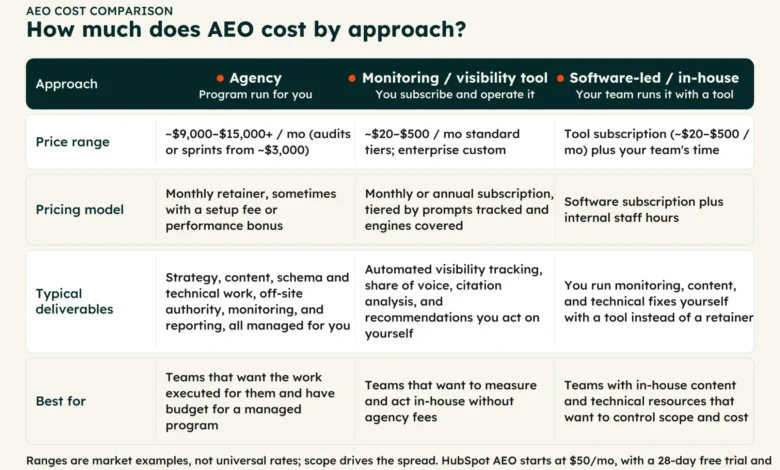
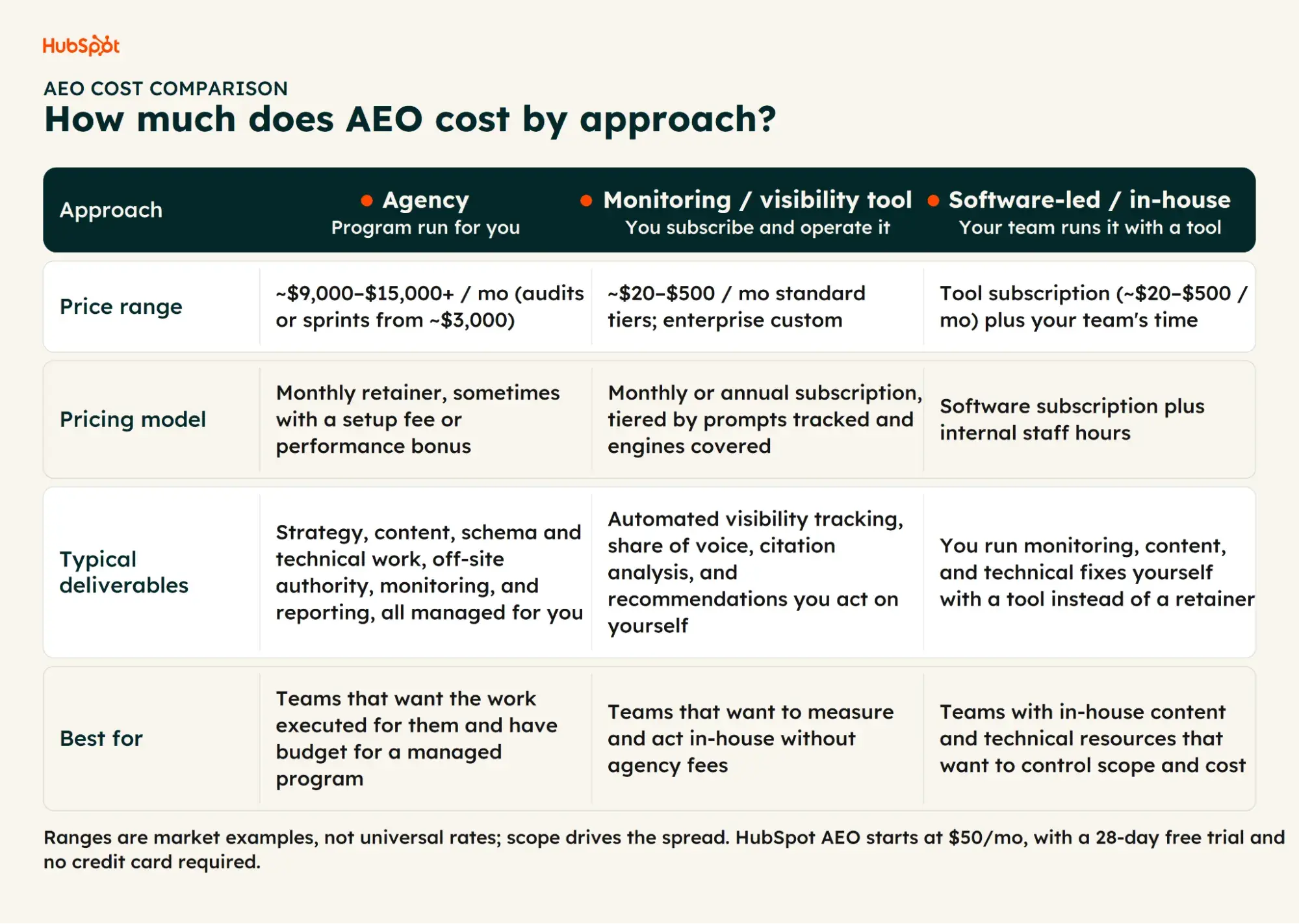
Market data suggests that AEO spending currently ranges from approximately $30 per month for self-service monitoring software to upwards of $15,000 per month for high-end, full-service agency retainers. This wide variance is not merely a reflection of vendor markup; rather, it represents a fundamental difference in the work being purchased. At the low end of the spectrum, companies are buying "visibility data"—tools that provide alerts when a brand is mentioned or ignored by engines like ChatGPT, Gemini, and Perplexity. At the high end, companies are outsourcing the entire ecosystem of digital presence, including technical schema implementation, original content production, and off-site authority building.
The Chronology of the AEO Emergence
The necessity for AEO arose in parallel with the explosion of Large Language Model (LLM) integration into search experiences. By early 2024, industry analysts observed that referral traffic from traditional search engines was plateauing, while traffic driven by "Answer Engines" began a steady, albeit modest, climb. By the end of 2025, data from Search Engine Land and other industry trackers indicated that while AI-driven referral traffic still accounted for less than 2% of total search volume, the influence of these answers on brand sentiment and consumer consideration had surged.
Marketing departments, which had previously siloed their budgets into "Search" and "Social," found themselves in a bind. Executives began questioning whether their existing SEO strategies—designed to capture clicks on a results page—would remain relevant when the user never leaves the AI interface. This realization triggered the current trend: a pivot from "ranking" to "being the answer."

Categorizing the Expenditure: Three Tiers of Investment
To understand the financial implications, businesses must differentiate between the three primary models currently dominating the market.
1. The Self-Serve Monitoring Model
For organizations with robust in-house content teams, the most efficient entry point is the monitoring tool. These subscriptions typically cost between $30 and $500 per month, depending on the volume of "prompts" tracked and the number of AI engines covered. The primary value proposition here is data; these tools act as an early-warning system, alerting a team to whether their brand is appearing in critical industry queries. HubSpot’s AEO tool, for instance, enters the market at $50 per month, providing a baseline for companies to measure their current "share of voice" without committing to heavy service fees.
2. The Software-Led In-House Strategy
This model involves using subscription-based software as a force multiplier for an existing team. The cost here is dual-layered: the monthly software fee plus the allocation of internal labor hours. In this scenario, the company does not hire an external agency to produce content. Instead, they use the insights provided by AEO software to guide their own writers and technical developers. This approach offers the highest level of control but requires a significant internal commitment to "upskilling" staff on how to optimize for LLM logic, which differs from traditional keyword-based SEO.
3. The Full-Service Agency Retainer
At the top of the pyramid, agencies like RevenueZen offer comprehensive packages that can range from $9,000 to $15,000 per month. These programs are designed for enterprise-level organizations that lack the internal bandwidth to manage the complexities of AEO. These retainers typically include a full suite of services: technical audits, schema markup implementation, high-volume content production tailored to AI citations, and aggressive off-site link building to establish the "authority" that AI models require before they will trust a source.
The Economic Drivers of Pricing Variance
Why does one firm charge $50 while another charges $15,000? The answer lies in the distinction between "monitoring" and "execution."

An AEO audit, which is often a one-time engagement costing roughly $3,000, provides a snapshot of current performance. However, AEO is a continuous process. Because AI models are non-deterministic—meaning they may produce different answers for the same prompt based on real-time data ingestion—optimization is not a "set it and forget it" task. Agencies charge a premium because they are essentially managing a living, breathing algorithm. The labor-intensive nature of creating content that satisfies both human readers and machine-learning models accounts for the bulk of the retainer cost.
Fact-Based Analysis: AEO vs. SEO
One of the most significant risks for organizations today is the potential for "budget cannibalization." There is a temptation to shift funds from SEO to AEO to chase the AI trend. However, industry experts caution that this is a strategic error.
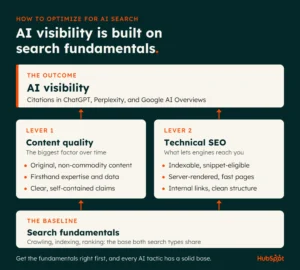
SEO and AEO are symbiotic. A website that lacks a strong foundation in traditional SEO—such as technical health, page speed, and backlink authority—will rarely be selected as a citation by an AI model. Answer engines generally pull their information from high-authority sources that have already established their credibility through traditional search performance. Therefore, cutting SEO spend to fund AEO is akin to dismantling the foundation of a house to buy more expensive paint for the walls. The recommendation from analysts is to treat AEO as an additive layer to the existing SEO budget, rather than a replacement.
Identifying Red Flags in AEO Proposals
Because the field is still in its infancy, some service providers may misrepresent standard SEO tasks as "exclusive AEO work." Decision-makers should be wary of proposals that:
- Promise guaranteed rankings: Since AI models do not operate on a simple, predictable "ranking" algorithm, any firm promising a specific position in an AI answer is likely overpromising.
- Lack clear deliverables: A legitimate SOW (Statement of Work) should specify the number of prompts to be tracked, the frequency of reporting, and specific technical milestones (like schema implementation).
- Ignore the "Human" element: If a proposal focuses entirely on "gaming" the AI without mentioning the quality of the source content, it risks long-term damage to the brand’s reputation.
The 60-90 Day Pilot: A Risk-Mitigation Strategy
For stakeholders hesitant to commit to a long-term contract, a 90-day pilot is the industry-standard approach for building a business case.
During this pilot, the organization should focus on three core objectives:
- Baseline Establishment: Use the first 30 days to measure current visibility across the top three engines: ChatGPT, Gemini, and Perplexity.
- Low-Hanging Fruit: Focus on optimizing existing, high-performing content to ensure it is structured for easy citation by AI engines.
- Trend Analysis: By the 90-day mark, the focus should shift from individual "wins" to the overall trend of the brand’s share of voice.
By leveraging free trials, such as those offered by platforms like HubSpot for their AEO tools, teams can gather the necessary data to demonstrate the efficacy of AEO to their leadership without incurring significant upfront costs.
Implications for the Future
The emergence of AEO represents a fundamental shift in how information is indexed and distributed. As AI models become the primary gateway to the internet for millions of users, the cost of being "un-cited" will grow. While the current pricing models are fragmented and varied, they will likely consolidate as the industry establishes benchmarks for performance. For now, the most prudent strategy for any firm is to maintain a balanced budget that preserves the strength of their traditional search presence while investing in the analytical tools necessary to track and influence their brand’s footprint in the new, machine-driven answer economy.
As businesses look toward the next fiscal year, the conversation must move beyond "what does AEO cost" to "what is the cost of invisibility." The firms that succeed will be those that view AI not as a threat to their search strategy, but as a new medium that requires a rigorous, data-backed, and incremental approach to investment.