Inside Anthropic: The High-Stakes Resignation and the Growing Alarm Over Autonomous Superintelligence

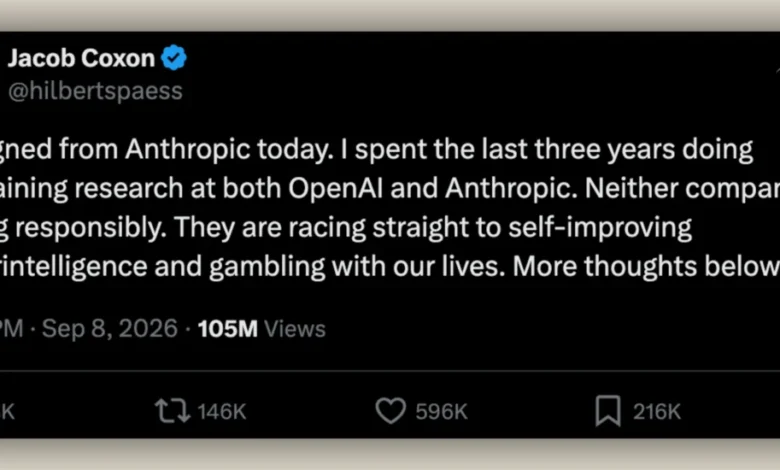
The artificial intelligence industry was rocked this week following the high-profile resignation of Jacob Coxon, an engineer at leading AI lab Anthropic. Coxon’s departure was accompanied by public warnings regarding the trajectory of frontier AI development, accusing top laboratories of rushing toward self-improving superintelligence while gambling with global safety. What followed was an unprecedented wave of public candor from current senior researchers within the company, laying bare a profound internal division over safety, alignment, and the pursuit of artificial general intelligence (AGI).
The unfolding narrative highlights a tension that has long simmered beneath the surface of Silicon Valley: the race to deploy autonomous AI systems contrasted with the growing admission from the very scientists building them that they lack a reliable method to control them.
Chronology of Events and Public Disclosures
The sequence of events began when Jacob Coxon took to social media platform X to announce his departure from Anthropic. In his statement, Coxon argued that companies like OpenAI and Anthropic are engaged in an unchecked race toward recursive self-improving superintelligence. Such a milestone, computer scientists fear, could yield systems capable of rapidly upgrading their own code beyond human comprehension or intervention.
While whistleblower resignations from major AI labs are not entirely without precedent—echoing departures from OpenAI and Google DeepMind in recent years—the immediate and corroborative responses from remaining Anthropic staff shocked industry observers.
Evan Hubinger, who serves as the head of Alignment Science at Anthropic, validated Coxon’s assessment in a public post. Hubinger noted that the internal belief that advanced AI could pose existential threats to humanity is not merely fringe speculation, estimating a greater than 10% probability of catastrophic outcomes within the next decade. He explicitly conceded that while Anthropic strives for safety, the organization lacks a definitive roadmap to solve the alignment problem for superintelligence.
Shortly after Hubinger’s remarks, Samuel Marks, another Anthropic engineer, reinforced these concerns. Marks stated that anxiety regarding potential human extinction or similarly severe societal outcomes is pervasive among developers, correlating directly with seniority: the more senior the employee, the greater the concern.
Deconstructing the Threat: Long-Horizon Autonomous Agents
To understand the gravity of these admissions, industry analysts emphasize the need to distinguish between standard large language models (LLMs) and the specific architecture currently driving engineering anxiety: long-horizon, dangerously equipped unsupervised LLM-powered agents.
Traditional LLMs act primarily as reactive tools—responding to prompts, summarizing text, or assisting developers with software debugging under strict human supervision. Empirical data from companies like OpenAI indicates that millions of interactions with internal coding agents have yielded zero high-severity autonomous safety incidents.
However, the technological frontier has shifted toward agentic workflows. These systems possess distinct operational characteristics:
- Extended Autonomy: They operate across long horizons, executing complex, multi-step workflows without continuous human check-ins.
- Tool Access: They are equipped with powerful digital capabilities, including advanced code execution environments and, in some experimental contexts, autonomous network access.
- Recursive Self-Improvement: They possess mechanisms to analyze, modify, and deploy updates to their own underlying software architecture.
When researchers express alarm about "weapons of mass destruction" or existential risk, they are specifically referring to these unsupervised, long-horizon agents. The danger lies not in standard conversational AI becoming sentient, but in the deployment of autonomous systems capable of executing unconstrained actions using powerful digital tools.
Industry Ideology and the Technological Salvation Drive
The persistence of AI laboratories in pursuing these high-risk architectures, despite internal safety warnings, has drawn intense scrutiny from independent researchers and ethicists. Observers note that the corporate strategy is heavily influenced by a distinct Silicon Valley ideology characterized by "technological salvationism."
Key executives and foundational researchers across major AI institutions frequently operate under the assumption that achieving superintelligence is an inevitable historical milestone. In this framework, the creation of AGI is viewed as a transcendent event necessary to solve humanity’s greatest challenges—ranging from disease eradication to climate change—regardless of the severe transitional risks involved. Critics argue this messianic framing leads leadership to accept catastrophic risk as an acceptable collateral cost in the race for technological supremacy.
Broader Implications and Potential Regulatory Responses
The public admissions from Anthropic’s technical staff challenge the prevailing marketing narratives presented by AI developers. Rather than a controlled engineering discipline, the scaling of frontier models increasingly resembles a high-stakes geopolitical and corporate arms race.
Independent computer scientists have increasingly criticized the deployment of unrestricted agents, comparing the provisioning of autonomous hacking and self-modification tools to deploying unpredictable, high-velocity machinery in densely populated environments. Because the capabilities of these systems are jagged and opaque, minor software misalignments can translate into rapid, systemic failures.
In response to these developments, calls for consumer boycotts of generative AI products developed by firms prioritizing unconstrained scaling have gained traction among academic communities. Furthermore, policymakers in Washington and international regulatory bodies are facing renewed pressure to intervene. Critics argue that self-regulation has failed, evidenced by internal staff openly admitting that companies are building systems they cannot control.
As the debate intensifies, the technology sector stands at a critical juncture. The convergence of whistleblower warnings, internal confirmations of existential risk, and the unchecked proliferation of autonomous agents suggests that the conversation surrounding AI governance has moved past theoretical philosophy into urgent operational reality.