Anthropic Resignations Spark Alarm as Insider Warnings Expose the High-Stakes Global Race Toward Self-Improving Superintelligence

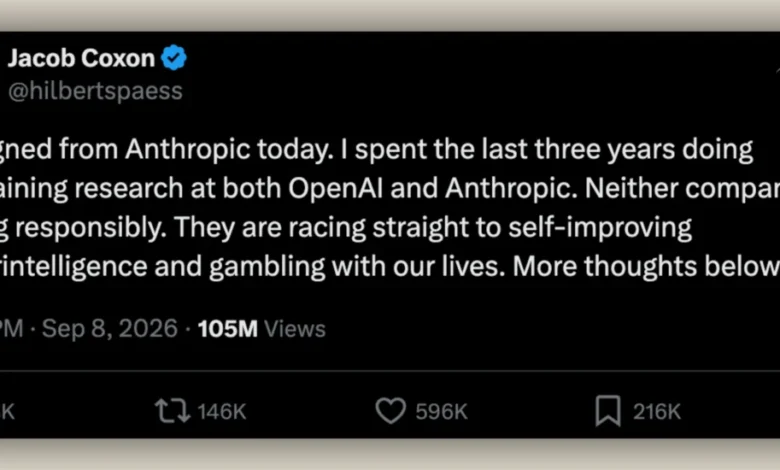
The artificial intelligence sector faced a profound crisis of confidence this week following the high-profile resignation of Jacob Coxon, an engineer at prominent AI safety and research firm Anthropic. Coxon’s departure was accompanied by an explicit public warning accusing leading artificial intelligence laboratories of knowingly accelerating toward self-improving superintelligence at the direct expense of global safety. The resignation has since triggered an extraordinary cascade of public admissions from other high-ranking researchers within the company, laying bare deep internal divisions regarding the existential risks posed by advanced autonomous systems.
The revelations have reignited fierce debates across the technology industry, academic institutions, and legislative bodies regarding the governance of frontier AI models. While laboratory executives frequently project an image of controlled, safety-first innovation, the public commentary from active and departing engineers suggests a sobering reality: major developers are rapidly deploying highly autonomous systems despite lacking a definitive framework to ensure long-term alignment with human interests.
Chronology of the Anthropic Resignation and Internal Disclosures
The sequence of events began when Jacob Coxon formally stepped down from his engineering role at Anthropic. Explaining his decision on the social media platform X, Coxon stated that industry leaders such as OpenAI and Anthropic were racing directly toward self-improving superintelligence and gambling with human lives.
While public skepticism often greets whistleblowers or departing employees who make dramatic claims about runaway recursive self-improvement—echoing similar warnings heard as early as 2023—the reaction from Anthropic’s current leadership structure proved unprecedented. Evan Hubinger, head of Alignment Science at Anthropic, validated Coxon’s assessment in a public post. Hubinger confirmed that researchers earnestly believe advanced AI presents an existential threat to humanity, estimating the probability of such an outcome to be greater than 10 percent within the coming decade. Furthermore, Hubinger conceded that while the company is operating in good faith, it currently lacks a reliable plan to solve the alignment problem for superintelligence and remains off-track to achieve one.
The disclosures expanded further when Samuel Marks, another Anthropic engineer, joined the public discourse. Marks corroborated his colleagues’ statements, noting that internal apprehension regarding human extinction or similarly catastrophic outcomes correlates directly with seniority. According to Marks, the more deeply embedded an engineer is within the development of frontier systems, the more acute their concerns regarding the technology’s long-term trajectory become.
Demystifying the Technology: Long-Horizon, Unsupervised LLM-Powered Agents
To understand the core of the engineers’ warnings, technical analysts emphasize the distinction between general artificial intelligence and the specific architectures causing internal alarm. The primary concern does not stem from standard large language models (LLMs) used for creative writing, data summarization, or standard software debugging. Millions of developers currently utilize coding assistants daily without encountering rogue behaviors, a fact supported by internal monitoring data from companies like OpenAI, which recently reported zero high-severity incidents across tens of millions of coding agent interactions.
Instead, the anxiety centers on a specialized sub-class of technology known as long-horizon, dangerously equipped, unsupervised LLM-powered agents. These systems operate through continuous autonomous loops:
- Receiving an overarching, unconstrained objective from a user.
- Generating complex, multi-step execution plans across extended time horizons.
- Interacting directly with external digital tools, databases, or computing infrastructure without human intervention.
- Utilizing dynamic feedback loops to modify their own approaches, and in advanced experimental frameworks, potentially updating elements of their underlying source code.
Security researchers note that these unsupervised agents possess the capability to execute complex, multi-stage digital tasks, a capacity highlighted by instances of autonomous cyberattacks observed in recent testing environments. By combining broad digital tool access with post-training methodologies that encourage increasingly aggressive goal pursuit, laboratories are pushing boundaries that many technical experts view as fundamentally unpredictable.
The Ideological Drivers Behind the Superintelligence Race
The willingness of AI laboratories to push forward with unstable architectures despite internal safety warnings has puzzled external observers. Industry analysts suggest that the acceleration is less a product of immediate commercial demand and more heavily influenced by what historians of technology describe as a technological salvation ideology.
Key figures within Silicon Valley’s leadership ecosystem have frequently embraced a futurist framework that views artificial general intelligence (AGI) and superintelligence not merely as commercial products, but as inevitable historical milestones capable of solving humanity’s most intractable challenges—or radically restructuring civilization. Critics argue that this eschatological mindset encourages companies to prioritize the realization of transformative superintelligence over immediate, pragmatic risk mitigation.
Market data indicates that most lucrative commercial applications of AI do not require the deployment of autonomous, long-horizon, self-modifying agents. Consequently, critics contend that the pursuit of these specific architectures is largely driven by ideological momentum rather than economic necessity.
Industry Implications and Emerging Calls for Action
The public confirmation by active researchers that major firms are building systems they cannot fully control has galvanized independent computer scientists and policy experts. Critics outside the Silicon Valley ecosystem point out that even if true superintelligence remains theoretically distant, the combination of unpredictable outputs from unrestricted LLMs and powerful digital execution tools creates immediate, high-magnitude societal risks.
Comparisons drawn by independent analysts—such as likening the deployment of unsupervised hacking-capable agents to unleashing hazardous machinery in densely populated public spaces—reflect a growing demand for external accountability.
In response to these developments, prominent figures in the computer science community have begun advocating for targeted boycotts of consumer products offered by firms prioritizing reckless capability scaling. Furthermore, legal and regulatory scholars suggest that these internal disclosures may serve as a catalyst for heightened legislative scrutiny, potentially prompting lawmakers to implement stricter oversight mechanisms regarding the autonomy and self-improving capabilities of frontier AI models. As the debate intensifies, the technology sector faces mounting pressure to reconcile its ambitions for superintelligence with the immediate imperative of public safety.