Religious Accommodation Claims Require Deference Rather Than Theological Scrutiny

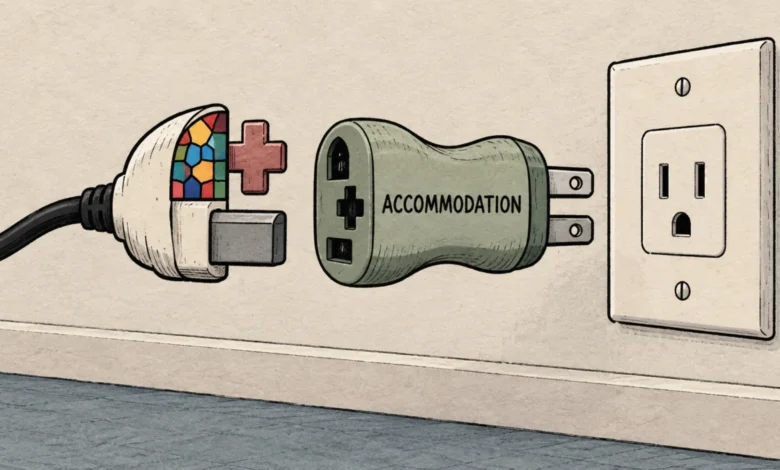
A recent ruling by the United States Court of Appeals for the Fourth Circuit has significantly clarified the boundaries between legitimate employer inquiry and unlawful religious discrimination. The appellate court’s decision to revive a religious-accommodation claim—originally dismissed at the summary judgment stage—underscores a critical legal standard: employers must be exceptionally cautious when evaluating an employee’s request for a religious exemption. When an employee cites spiritual motivations for refusing a workplace requirement, even if those motivations are intertwined with personal, medical, or ethical concerns, the employer’s obligation is to move toward the accommodation process rather than acting as an arbiter of theological doctrine.
The Case Background and Procedural History
The case centers on a former employee who sought a religious exemption from her employer’s mandatory vaccination policy during the height of the COVID-19 pandemic. In her formal request, the employee articulated that her physical body was a "temple of God," invoking the concept of "God’s law" and noting that her decision was guided by scripture and the Holy Spirit.
Despite these explicit religious references, the employer determined that the employee’s objections were primarily secular in nature, citing her inclusion of concerns regarding vaccine ingredients, general medical safety, and broader ethical questions. Relying on this assessment, the employer denied the accommodation request and subsequently terminated the employee’s employment.
The employee filed suit, alleging religious discrimination under Title VII of the Civil Rights Act of 1964. The district court initially granted summary judgment in favor of the employer, concluding that the objections were not truly religious in character. However, the Fourth Circuit reversed this decision, holding that the lower court had overstepped its bounds by essentially attempting to grade the employee’s theology. The appellate court emphasized that under Title VII, a belief is religious if it is held with the strength of religious conviction and relates to a person’s "own scheme of things," regardless of whether that belief is shared by a larger religious denomination or whether it is expressed with theological precision.
Chronology of Religious Accommodation Litigation
The landscape of religious accommodation has evolved significantly since the early days of the pandemic.
- 2020–2021: As employers across the United States implemented mandatory vaccination policies, thousands of employees filed religious exemption requests. Many employers struggled to differentiate between sincerely held religious beliefs and secular personal preferences.
- 2022–2023: A wave of litigation followed as employers denied requests, often based on the assertion that the employee’s stated reasons were "philosophical" rather than "religious."
- 2023 (Groff v. DeJoy): The Supreme Court of the United States issued a landmark decision in Groff v. DeJoy, which heightened the standard for what constitutes "undue hardship" for employers. The Court clarified that an employer must show that the burden of granting an accommodation would result in substantial increased costs in relation to the conduct of its particular business.
- 2026: The Fourth Circuit’s recent decision builds upon this momentum, reinforcing that the initial threshold for establishing a religious belief is relatively low and that employers should prioritize the accommodation analysis over questioning the validity of the belief itself.
Analysis of the Legal Standard: "Sincerity" vs. "Theology"
The core issue addressed by the Fourth Circuit is the distinction between assessing the sincerity of a belief and assessing the theology of a belief. Title VII protections do not require that a belief be logical, consistent, or accepted by a formal church hierarchy. Courts have long held that individuals may have their own unique religious frameworks.

When an employee mentions religious tenets alongside secular concerns—such as health or politics—employers often make the strategic error of dismissing the entire request as "not religious." The Fourth Circuit clarified that the presence of secular concerns does not "cancel out" the religious components of a request. Because the employee linked her refusal to her relationship with God and the Bible, she met the threshold for a prima facie case. By deciding that her request was secular, the employer prematurely cut off the interactive process required by federal law.
Data and Trends in Employment Litigation
According to data from the Equal Employment Opportunity Commission (EEOC), religious discrimination charges have remained a consistent portion of the agency’s workload. In recent fiscal years, religious discrimination claims have often accounted for roughly 3% to 4% of total charges filed annually, though the nature of these claims shifted dramatically during the pandemic.
Employers who adopt a rigid, overly skeptical approach to these requests face significant financial and reputational risks. The cost of defending a federal lawsuit, even one that is ultimately won by the employer, can reach hundreds of thousands of dollars in legal fees. Furthermore, as the Groff standard makes it more difficult for employers to prove "undue hardship," the most cost-effective path for HR departments is to focus on finding reasonable accommodations rather than engaging in adversarial fact-finding regarding the employee’s faith.
Implications for Human Resources Policy
The Fourth Circuit’s decision serves as a masterclass for HR professionals on how to handle requests involving sensitive personal and religious topics. To mitigate risk, organizations should implement a three-tiered approach:
- Presume Sincerity: The EEOC’s guidance is clear: employers should assume that an employee’s stated religious belief is sincere unless there is a specific, objective reason to doubt it. "Objective reasons" do not include an employee’s lack of membership in a specific church or the presence of secular reasoning.
- Focus on the Accommodation, Not the Doctrine: Instead of debating whether a belief is "religious enough," HR should focus immediately on the potential for accommodation. Can the employee work in a different role? Can the task be performed remotely? Is there an alternative shift that avoids the conflict?
- Document the Undue Hardship: If an accommodation is denied, the denial must be based on a documented analysis of undue hardship. This means identifying specific, measurable costs or operational disruptions. Generic statements about "company policy" or "safety" are rarely sufficient to withstand judicial scrutiny.
Broader Impact on Workplace Requirements
While the Fourth Circuit case arose in the context of vaccination, the principles established have wide-ranging applications. Religious accommodation requests can involve:
- Scheduling: Requests for time off for religious observances or Sabbath requirements.
- Dress and Grooming: Requests for accommodations related to hijabs, turbans, or other religious attire that may conflict with safety gear or company uniforms.
- Job Duties: Requests to opt out of specific tasks, such as handling certain materials or interacting with certain products, that conflict with personal religious tenets.
In all these instances, the "lower-risk approach" is to treat the employee’s statement as a starting point for dialogue. When HR departments attempt to act as judges of religious sincerity, they often expose the organization to claims that they have misapplied the law.
Conclusion
The Fourth Circuit’s reversal serves as a reminder that the law requires a high degree of sensitivity to the nuances of individual belief. By ruling that an employee’s characterization of vaccination as a "personal decision" does not invalidate her concurrent religious objections, the court has effectively narrowed the window for employers to dismiss requests based on the perceived "impurity" of the employee’s logic. In the modern workplace, the most successful employers will be those who move past the impulse to scrutinize the theology of their workforce and instead focus their efforts on the practical, fact-based search for reasonable workplace accommodations. Failure to do so not only risks litigation but also undermines the trust between the employer and the employee, potentially leading to long-term cultural degradation within the company.
Related posts: