The Essential Guide to Answer Engine Optimization and Selecting the Right AEO Checker for Your Business

The rise of generative AI has fundamentally altered the digital discovery landscape, shifting user behavior from traditional link-based search results to synthesized, conversational answers. As platforms like ChatGPT, Perplexity, and Gemini—alongside Google’s own AI Overviews—become the primary interface for information retrieval, the traditional SEO playbook is no longer sufficient. Businesses now face a "zero-click" reality where visibility is increasingly captured within an AI-generated summary, often without the user ever clicking through to a website. This transition has necessitated a new discipline: Answer Engine Optimization (AEO).
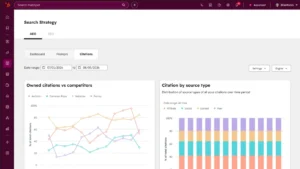
An AEO checker is a specialized tool designed to monitor how frequently and accurately a brand is cited, mentioned, or ignored by AI-powered search interfaces. By analyzing whether a brand’s content is being leveraged as a primary source, these tools provide the diagnostic data necessary to remain visible in an era where the "blue link" is increasingly secondary.
![AEO checker tools that measure answer engine visibility [2026]](https://53.fs1.hubspotusercontent-na1.net/hubfs/53/aeo-checker-1-20260903-3858273.webp)
The Evolution of Search: From Links to Synthesis
The shift toward generative search represents the most significant disruption in the search engine industry since the inception of Google. In May 2024, Google officially rolled out AI Overviews, a feature that prioritizes AI-synthesized responses at the top of the search results page. This move followed the rapid adoption of standalone answer engines like Perplexity, which has positioned itself as an "answer engine" rather than a search index, and the integration of web-searching capabilities into ChatGPT and Gemini.
For years, SEO was defined by the quest for the "top three" ranking spots. Today, that hierarchy is contested by an AI layer that reads, summarizes, and extracts information from dozens of sources before presenting a final answer. If a brand’s content is not structured in a way that allows these engines to parse it as an authoritative, direct answer, that brand effectively ceases to exist for a growing segment of search users.
Understanding the Mechanics of AEO
AEO and SEO are not opposing forces; rather, they are symbiotic. SEO focuses on technical crawlability, backlink authority, and keyword relevance—the very signals that AI models use to determine which sources are "trustworthy" enough to cite. AEO builds upon this foundation by optimizing content for clarity, directness, and structure.
![AEO checker tools that measure answer engine visibility [2026]](https://no-cache.hubspot.com/cta/default/53/9dd5e54b-fbef-4dd0-bc44-1689feb1ea18.png)
Answer engines operate on a logic of efficiency. When a user asks a specific question, the AI evaluates potential sources for "entity relevance." If a webpage provides a concise, structured answer—such as a list, a table, or a clearly defined paragraph—that matches the user’s intent, it is significantly more likely to be cited. AEO checkers provide the visibility into this process, identifying which queries trigger AI responses, which sources are being cited, and where a competitor is successfully displacing your brand in the narrative.
Manual Auditing vs. Automated Intelligence
While businesses can conduct manual audits, the dynamic nature of AI models makes this approach increasingly unsustainable. An AI Overview on Google may change based on a user’s history, location, or even the specific phrasing of a query.
To conduct a manual audit, marketing teams must define a set of "priority queries"—a mix of brand-specific terms and informational long-tail questions. For example, a software company might track "best CRM for small businesses." By performing these searches in incognito mode, teams can document:
![AEO checker tools that measure answer engine visibility [2026]](https://53.fs1.hubspotusercontent-na1.net/hubfs/53/aeo-checker-2-20260903-852936.webp)
- Whether an AI summary is triggered.
- Which domains are cited as sources.
- Whether the brand is explicitly mentioned in the text.
However, as the volume of queries grows, manual tracking becomes prone to error and lacks the longitudinal data necessary to identify trends. Automated AEO checkers bridge this gap by continuously monitoring these queries across multiple engines, logging results in real-time, and alerting teams to shifts in visibility.
Key Capabilities of Modern AEO Software
When selecting an AEO tool, organizations must prioritize platforms that offer more than just basic reporting. A robust solution should provide the following:
- Multi-Engine Tracking: It is not enough to monitor Google. Tools must provide visibility into Perplexity, ChatGPT, and Gemini, as each engine employs different weighting for citations.
- Citation vs. Mention Detection: A critical distinction in AEO is whether the AI links to your site (a citation) or merely mentions your brand name (a mention). Both contribute to brand authority, but citations are the lifeblood of traffic.
- Competitor Benchmarking: A checker should flag when a competitor is cited for a query that you are currently losing. This allows teams to analyze the competitor’s content structure to determine why the AI preferred their answer over yours.
- Actionable Recommendations: The most advanced tools don’t just diagnose the problem; they suggest content updates, such as rewriting an introduction to be more concise or adding schema markup to help the engine understand your page’s data.
Market Landscape: Tools and Technologies
The market for AEO tools is currently bifurcated between established SEO platforms that have integrated AI-tracking features and emerging, specialized startups.
![AEO checker tools that measure answer engine visibility [2026]](https://53.fs1.hubspotusercontent-na1.net/hubfs/53/aeo-checker-3-20260903-8904553.webp)
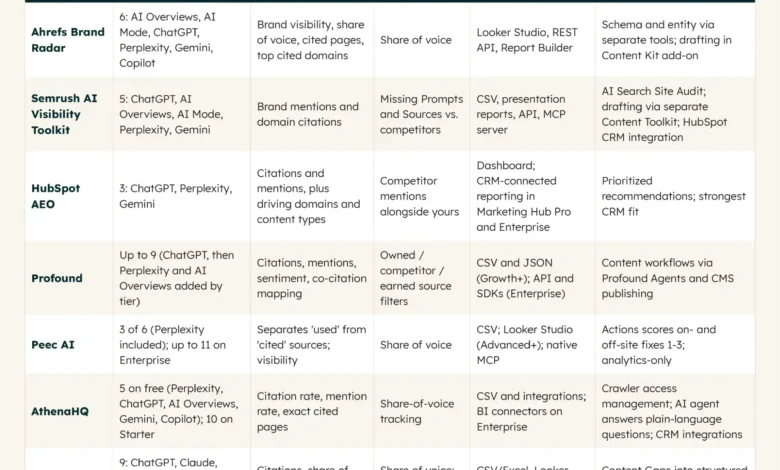
Leading the pack in general visibility tracking, platforms like Ahrefs (through its Brand Radar feature) and the Semrush AI Visibility Toolkit leverage their massive existing datasets to show how organic rankings correlate with AI presence. These tools are ideal for teams already embedded in those ecosystems who need to understand how their existing keyword strategy translates to the generative AI space.
On the other hand, specialized tools like HubSpot AEO, Profound, and Peec AI focus on the nuanced requirements of answer engines. HubSpot’s AEO tool, for instance, provides a direct link between AI visibility and CRM data, allowing businesses to see not just which AI queries they appear in, but which of those appearances actually resulted in high-intent leads. Profound offers deeper sentiment and context analysis, while Peec AI and AthenaHQ provide specialized, high-frequency monitoring for platforms like Perplexity.
The Role of Technical Readiness
Beyond content, technical readiness remains a prerequisite. Tools like Scrunch AI and Conductor focus on the "back-end" of AI optimization, ensuring that AI crawlers can effectively access, render, and interpret the structured data on a website. If a page cannot be parsed, no amount of high-quality writing will earn a citation. This emphasizes the importance of maintaining clean, semantic HTML and utilizing Schema.org structured data to provide clear "signals" to AI agents.
![AEO checker tools that measure answer engine visibility [2026]](https://53.fs1.hubspotusercontent-na1.net/hubfs/53/aeo-checker-4-20260903-6212698.webp)
Metrics that Define Success
In the era of zero-click search, traditional metrics like "click-through rate" (CTR) and "organic sessions" are no longer the sole indicators of success. Instead, brands must track:
- Citation Share of Voice: The percentage of total AI answers for your target queries that cite your domain.
- Brand Mention Frequency: How often your brand is included in the narrative of an AI response, even if a link is not provided.
- AI-Referral Traffic: While limited, this represents the "high-intent" users who chose to click through despite the presence of an AI summary.
- Visibility Velocity: The trend of your presence in AI answers over time. A single snapshot is rarely indicative of success; consistent, upward trends in citation frequency are the primary goal.
Future Implications for Digital Marketing
The integration of AEO into the marketing stack represents a permanent shift in how companies approach digital presence. As AI models become more sophisticated, the "middle-man" role of search engines will continue to evolve. Businesses that treat AEO as an afterthought risk losing their direct connection to the consumer, as the AI becomes the gatekeeper of information.
The immediate implication for marketing departments is the need for a unified strategy that combines technical SEO, content authority, and data-driven AEO. By treating answer engines as a primary channel—distinct from, yet related to, traditional search—brands can ensure that they remain part of the conversation, regardless of whether that conversation happens on a results page or within an AI chat window. As the technology matures, the ability to audit, analyze, and optimize for these engines will define the next generation of digital winners.
Related posts: