AI, Earnings, and Geopolitical Crosscurrents: Big Tech Faces a Week of Scrutiny

As the financial world braces for a deluge of quarterly earnings reports from the titans of Big Tech in the coming week, market participants are attempting to strike a delicate balance. The prevailing sentiment on Monday was a desire to pivot focus towards the intricacies of artificial intelligence (AI) advancements, robust corporate earnings, and forward-looking guidance. This strategic shift aims to overshadow persistent anxieties surrounding Middle Eastern geopolitical tensions, the ever-present specter of inflation, and the trajectory of interest rates. The major equity indexes on Monday mirrored this complex equilibrium, reflecting a market grappling with competing forces.
By the close of trading, the tech-centric Nasdaq Composite registered a marginal dip of 0.05%, settling at 25,508. The broader S&P 500 index experienced a more pronounced decline of 0.2%, closing at 7,443. Meanwhile, the venerable Dow Jones Industrial Average, representing a more traditional segment of the market, shed 0.6% to finish the day at 51,841. This mixed performance underscores the market’s ongoing navigation between the speculative allure of technology and the more fundamental concerns of macroeconomic stability.
In commodity markets, the front-month West Texas Intermediate (WTI) crude oil futures contract demonstrated resilience, adding 0.9% to trade at $82.49 per barrel. This uptick suggests continued demand or supply-side considerations influencing energy prices. Simultaneously, the 2-year Treasury yield saw a modest increase, ticking up to 4.208% from its Friday close of 4.172%. This movement in yields can be interpreted as a subtle signal of evolving expectations regarding monetary policy and inflation.
The iShares Semiconductor ETF (SOXX), a bellwether for the crucial semiconductor industry, managed a recovery of 0.5% on Monday. This rebound followed a significant 10.2% slide in the preceding week, which was largely attributed to renewed apprehension regarding hyperscalers’ capital expenditures on AI infrastructure. Additionally, the emergence of a new Chinese AI model had injected a fresh layer of competitive concern into the sector.
"Despite the recent pullback," observed LPL Financial Chief Technical Strategist Adam Turnquist, referencing the S&P 500’s 1.6% decline last week, "market breadth continues to improve." Turnquist’s analysis highlights a key indicator of underlying market health: the percentage of S&P 500 stocks trading above their 200-day moving average. This metric has climbed to nearly 70%, a notable improvement from just above 50% in May. This upward trend signals that participation and positive momentum are extending beyond a select few large-cap stocks, suggesting a more generalized strength within the broader market, a critical factor for sustainable rallies.
However, the market’s path forward remains subject to volatility, largely influenced by the fluctuating geopolitical landscape. Escalating and de-escalating tensions between the United States and Iran continue to cast a shadow, creating an environment of uncertainty that can quickly impact investor sentiment and risk appetite. These geopolitical developments can have ripple effects across various asset classes, from energy prices to the perceived safety of global markets.
Apple Falls From High Branches Amidst Profit-Taking
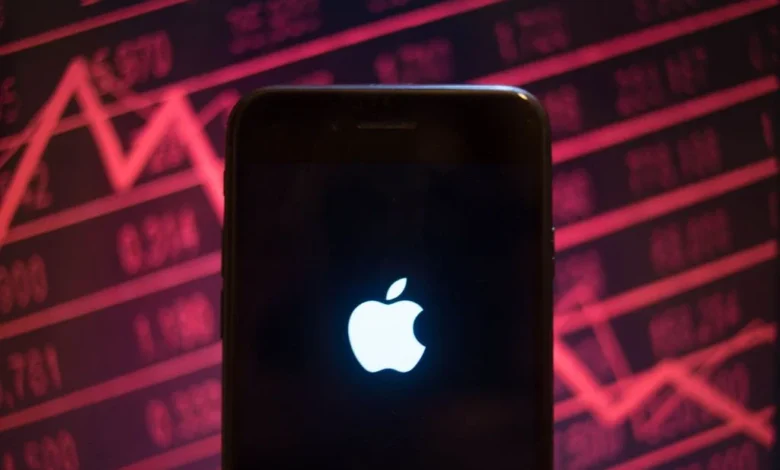
Apple (AAPL), a perennial leader and a cornerstone of the "Magnificent 7" group of mega-cap technology stocks, found itself among the decliners on Monday, shedding 2.1%. The iPhone maker’s share price retreated after reaching new all-time highs on Friday, a move widely interpreted as a natural consequence of profit-taking by investors who had benefited from the stock’s impressive run.
AAPL had achieved a fresh intraday peak of $334.99 and a closing record of $333.74 on July 17. In a significant market development, this surge briefly propelled Apple past Nvidia (NVDA) as the world’s largest company by market capitalization. Nvidia, which had itself experienced an extraordinary ascent driven by the AI boom, saw its shares gain 0.2% on Monday. The temporary dethroning of Nvidia underscored the intense competition and shifting dynamics within the tech sector, where market leadership can be fluid, especially in periods of rapid innovation and significant earnings expectations.
Tesla Faces Earnings Ahead, SpaceX IPO Lingers
Tesla (TSLA), the electric vehicle (EV) giant, experienced a notable sell-off, dropping 3.0% ahead of its upcoming second-quarter earnings report, scheduled for release after the closing bell on Wednesday. This pre-earnings dip comes despite Tesla’s recent announcement of a 25% increase in EV deliveries during the second quarter, a figure that generally signals positive operational momentum. Investors are likely scrutinizing the company’s profitability margins, production costs, and future demand projections in anticipation of the detailed financial results.
The performance of TSLA has also been indirectly influenced by its relationship with SpaceX (SPCX), whose own market trajectory has been a subject of intense interest. SpaceX, having recently completed what is being described as the biggest IPO in stock market history, has seen its consumer discretionary stock drift lower in the aftermath of this monumental event. While not directly tied to Tesla’s operations, the performance and valuation of closely associated ventures can sometimes create a halo effect or a sense of broader sector sentiment that impacts investor perception.
Tech Giants Show Divergent Fortunes: Alphabet, Amazon, Microsoft Lead Gains
In contrast to Apple’s retreat, other technology behemoths demonstrated stronger performance on Monday. Alphabet (GOOGL), the parent company of Google, was a standout performer among the Dow Jones components, climbing 1.5%. This positive momentum comes as Alphabet prepares to unveil its second-quarter earnings results on Wednesday. Investors are keenly awaiting updates on its advertising business, cloud computing growth, and its strategic investments in AI, a key area of focus for the company.
Amazon (AMZN) and Microsoft (MSFT) also posted solid gains, rising 1.1% and 2.2%, respectively. Both companies are scheduled to report their second-quarter earnings later in the week, with Amazon slated for July 30 and Microsoft on July 29. The anticipation surrounding these reports is palpable, as these tech giants are critical indicators of consumer spending, enterprise technology adoption, and the broader digital economy.
Meta Platforms (META), the parent company of Facebook, closed marginally lower by 0.02% on Monday. The social media giant is also on the earnings calendar, with its report due on July 29. Nvidia, the semiconductor titan whose stock has been a primary driver of market gains, is scheduled to report its earnings on Wednesday, August 26. The staggered reporting schedule means that market sentiment can be influenced by the performance and outlook of these key players throughout the week.
AMC Entertainment Soars on Record Revenue and Optimistic Outlook
In a remarkable turn of events, AMC Entertainment (AMC), a company that has become synonymous with the meme stock phenomenon, surged by as much as 27.8% on Monday. This dramatic rise was fueled by management’s announcement of the highest revenue in the movie theater operator’s more than 100-year history. The company’s financial performance for the quarter significantly surpassed Wall Street expectations, showcasing a robust recovery in the theatrical exhibition industry.
AMC reported earnings per share of 14 cents, a stark contrast to analysts’ consensus forecast of a 4-cent loss. Revenue climbed by an impressive 14.2% to $1.59 billion, exceeding the $1.5 billion estimate. Furthermore, adjusted EBITDA (earnings before interest, taxes, depreciation, and amortization) saw a substantial increase of 69.6%, reaching a company record of $321.4 million. This marked the first time AMC has surpassed $300 million in adjusted EBITDA for a single quarter. The company also generated a healthy $190.1 million in free cash flow.
CEO Adam Aron expressed significant optimism regarding the current state and future prospects of the theatrical marketplace. He pointed to the strong debut of films like "THE ODYSSEY" as evidence of the industry’s resilience and appeal. Aron highlighted that six different movies achieved domestic opening weekend box office totals exceeding $75 million in the second quarter alone. This trend, coupled with the strong performance of recent blockbusters, leads Aron to predict that 2026 will be the strongest post-pandemic year for movie theaters, both domestically and globally. The company’s year-to-date total return of almost 25%, significantly outperforming the S&P 500’s less than 10% return, suggests that investors are indeed finding value and optimism in AMC’s turnaround narrative, beyond just the potential for shareholder perks. This performance underscores a broader narrative of recovery in the entertainment sector, driven by compelling content and a renewed desire for shared experiences.