Revolutionizing Sales: The Ascent of Meeting Management Software in Driving Revenue

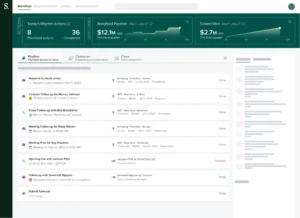
Meetings are an indispensable component of every sales process, serving as critical touchpoints that can either propel a deal forward or cause it to stagnate. The landscape of sales has increasingly recognized the pivotal role of efficient meeting management, transitioning from a peripheral administrative task to a strategic imperative. This shift is underscored by robust market growth: according to Cognitive Market Research, the global revenue for meeting management software is projected to reach an impressive $2.7 billion by 2025. This significant figure not only highlights the expanding adoption of these tools but also their undeniable importance for modern sales organizations striving for optimized performance and sustained revenue growth.
This article delves into the transformative impact of meeting management software on sales teams, dissecting the essential attributes that define an effective solution, outlining the various types of tools available, and spotlighting leading platforms such as HubSpot Sales Hub, Calendly, Chili Piper, and Acuity Scheduling.
The Evolving Sales Landscape and the Imperative for Efficiency

The contemporary sales environment is characterized by increased competition, sophisticated buyers, and a globalized, often remote or hybrid, workforce. In this complex ecosystem, the traditional, fragmented approach to managing sales meetings—where scheduling, note-taking, and follow-ups are disparate activities—has become a significant bottleneck. Sales professionals frequently find themselves mired in administrative tasks, such as endless email chains to coordinate availability or manually transcribing meeting notes, diverting precious time and energy away from core selling activities. This friction not only slows down the sales cycle but also introduces opportunities for critical information to be lost, leading to missed action items, inconsistent customer experiences, and ultimately, stalled deals.
Industry experts widely agree that for sales teams, meetings are not mere conversations; they are pivotal moments of engagement where relationships are built, needs are uncovered, and value is communicated. When these moments are poorly managed or disconnected from the broader sales strategy, their potential impact diminishes. Meeting management software emerges as a comprehensive solution, integrating the entire meeting lifecycle—from planning and scheduling to execution and post-meeting follow-up—into a cohesive, connected workflow. By doing so, it tackles head-on the inefficiencies that plague traditional sales processes, ensuring every interaction contributes meaningfully to pipeline progression and revenue generation.
Core Pillars of Effective Sales Meeting Management Software
An efficient meeting management software solution tailored for sales teams must possess a suite of features designed to enhance productivity, streamline operations, and provide actionable insights. These include:

-
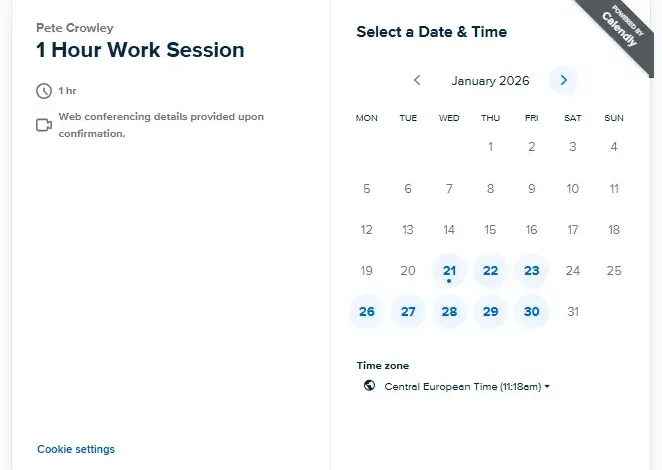
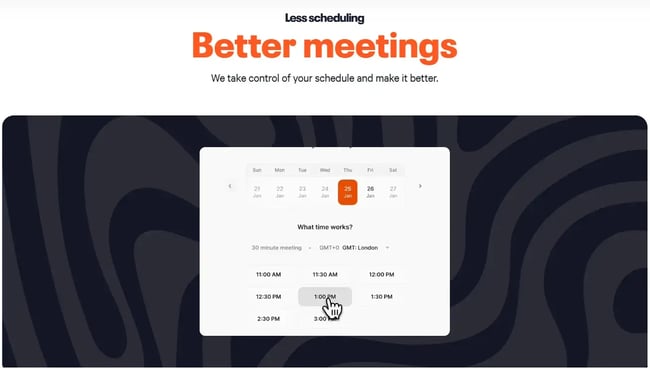
Easy and Flexible Scheduling: The cornerstone of any good meeting management tool is its ability to simplify the scheduling process. This means offering intuitive interfaces where prospects and internal team members can effortlessly find and book available times. Key functionalities include seamless calendar synchronization (e.g., Google Calendar, Office 365), automated time-zone adjustments, flexible meeting duration options, and the ability to set buffers between meetings. The goal is to eliminate the tedious back-and-forth communication that often precedes a confirmed meeting, thereby reducing friction and improving conversion rates at the initial contact stage.
-
Smart Routing and Assignment: For scaling sales organizations, simply scheduling a meeting isn’t enough; it must be assigned to the right person. Effective software incorporates intelligent routing logic that automatically directs booked meetings to the appropriate sales representative based on predefined criteria such as territory, product expertise, current workload, or a round-robin distribution model. This automation prevents delays, ensures workload balance, and guarantees that high-potential leads are connected with the most suitable sales professional, thereby accelerating the sales process and maintaining consistency.
-
Automated Notifications and Reminders: A significant challenge in sales is the prevalence of no-shows or late arrivals, which waste valuable time and resources. A robust meeting management system mitigates this by automatically sending personalized confirmations, timely reminders, and updates (e.g., rescheduling or cancellation notifications) to all participants. This proactive communication significantly improves attendance rates and ensures that all parties are well-informed, contributing to a more professional and reliable interaction.
-
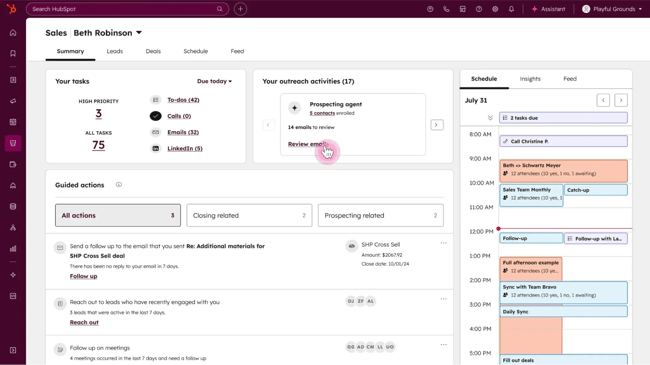
Integrated CRM Context and Activity Tracking: The true power of meeting management software for sales lies in its deep integration with a Customer Relationship Management (CRM) system. This integration ensures that every interaction, including scheduling details, meeting agendas, notes, and outcomes, is automatically logged and stored within the relevant contact or deal record. Providing sales representatives with immediate access to a prospect’s complete history and current deal stage during a meeting equips them to have more informed and impactful conversations. Without this seamless flow of data, meetings risk becoming isolated events, disconnected from the continuous customer journey and making it challenging to track progress and measure true revenue impact.
-
Personalization and Follow-Up Automation: To maintain momentum and foster engagement, sales communications must be tailored. The best meeting management tools facilitate personalization, allowing reps to craft custom meeting descriptions, agendas, and even automated follow-up sequences based on meeting outcomes. This level of customization enhances the prospect’s experience, reinforces key discussion points, and ensures that critical next steps, such as sending additional resources or triggering new email campaigns, are initiated promptly and automatically, preventing opportunities from falling through the cracks.
Diverse Tools for Diverse Sales Needs
The market offers a variety of meeting management tools, each specializing in different aspects of the meeting lifecycle:
-
Scheduling and Routing Tools: These are foundational tools that automate the initial stages of meeting setup. They excel at finding mutually agreeable times, coordinating participant availability across multiple calendars, and intelligently routing meeting invites or links. By providing shared availability views, buffer times, and robust time-zone handling, they drastically reduce administrative overhead and accelerate the lead contact process, significantly contributing to a reduction in no-shows and speeding up lead qualification.
-
Video Conferencing Platforms: Beyond simple audio/video calls, modern video conferencing platforms have evolved into sophisticated collaboration hubs. They offer real-time screen sharing, interactive chat, virtual whiteboards, and robust security features. Their value in sales extends to conducting product demonstrations, virtual presentations, and remote client consultations, enabling rich, face-to-face interactions regardless of geographical location. Integrations with recording and transcription services further enhance their utility for sales teams.
-
Agenda and Collaboration Tools: These tools are designed to maximize meeting effectiveness by fostering focus and accountability. They allow teams to create structured agendas, share relevant documents in advance, capture detailed notes, and assign action items directly to owners during the meeting. Features like templates, voting mechanisms, and integrations with project management tools ensure that meetings are outcome-driven, leading to shorter, more productive discussions and clear follow-up responsibilities, which significantly reduces post-meeting friction.
-
AI Meeting Assistants and Note Takers: Representing the cutting edge of meeting technology, AI meeting assistants utilize advanced speech-to-text transcription and natural language processing (NLP) to automate the documentation process. These tools drastically lower the cognitive load on sales professionals by automatically transcribing entire conversations, generating concise summaries, extracting key discussion points, and identifying actionable follow-ups. Advanced assistants can even surface sentiment analysis and seamlessly integrate all this data directly into the CRM. While they do not fully replace the human element of note-taking—as sales reps still add personal context, strategic insights, or nuances that AI might miss—they act as an invaluable "second brain," handling the heavy lifting of documentation and making meeting content easily discoverable and actionable. For sales leaders, conversation intelligence (a subset of AI meeting assistants) provides data-driven insights, helping to understand not just what was said but what it means for the deal, facilitating better coaching and pipeline visibility.
Spotlight on Leading Meeting Management Solutions for Sales Teams
HubSpot Sales Hub: The Integrated Powerhouse
HubSpot Sales Hub is a comprehensive platform engineered to manage the entire meeting lifecycle within a unified CRM ecosystem, making it ideal for sales teams seeking deeply integrated revenue workflows.
-
Meeting Scheduler: HubSpot’s Meeting Scheduler is a standout feature, allowing prospects to book time directly on a rep’s calendar via shareable links. It syncs seamlessly with Google Calendar and Office 365, displaying real-time availability. Advanced capabilities include round-robin routing to distribute meetings equitably across a team and robust group scheduling for multi-attendee sessions. The system also automates meeting changes, sending rescheduling and cancellation links, which helps sales teams avoid unproductive waiting times and focus on confirmed, relevant engagements.
-
Meeting-Based Workflows: This feature enables marketers and sales leaders to automate critical post-meeting actions. For instance, a task can be automatically generated and assigned to the meeting scheduler or associated company owner whenever a specific type of meeting is scheduled or after its completion. This functionality ensures timely follow-ups, consistent lead nurturing, and proper task delegation, especially valuable for recurring meetings or specific sales stages.
-
Click to Call: HubSpot Sales Hub empowers sales professionals to initiate phone calls directly from within the CRM interface. Phone numbers become interactive call links, allowing reps to launch calls instantly through their browser or a registered outbound number. Crucially, each call is automatically logged against the associated contact record, ensuring complete and up-to-date activity logs, which are vital for accurate reporting and continuity.
-
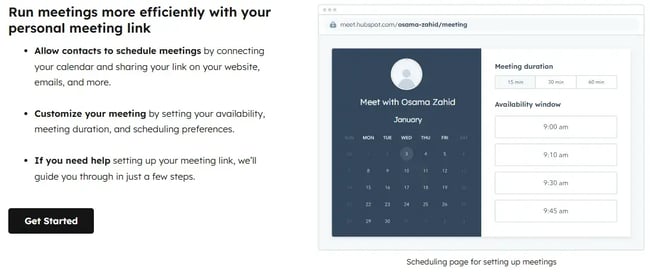
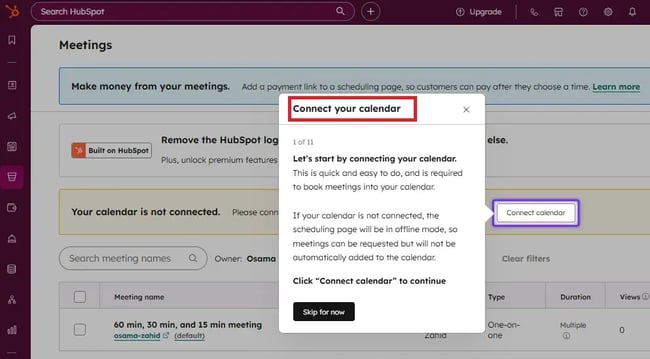
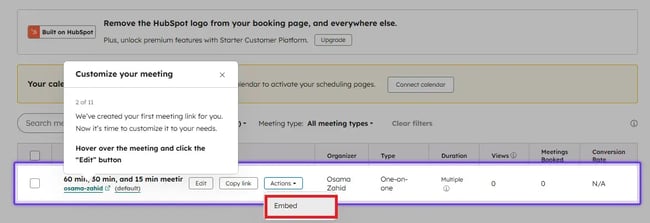
Effortless Meeting Setup & Embedding: Connecting a calendar and setting up meeting options in HubSpot is a streamlined, guided process. Users can easily define multiple time-slot options (e.g., 15-, 30-, or 60-minute sessions) and embed meeting links directly into websites, landing pages, and email signatures. This simplicity allows clients to book appointments without leaving the current page, enhancing the user experience and reducing abandonment.
-
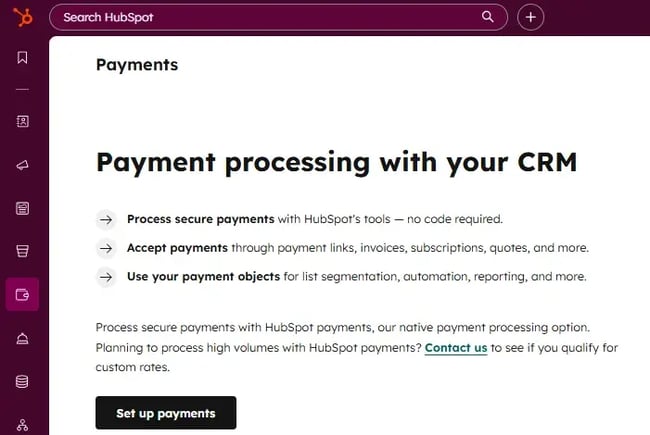
Monetizing Meetings: A unique capability, HubSpot simplifies the process of attaching payment links to scheduling pages. This is particularly valuable for sales reps operating on a contract or performance-based model, allowing meetings to be tracked and billed based on scheduled or completed sessions, creating a clear and transparent link between activity and compensation.
-
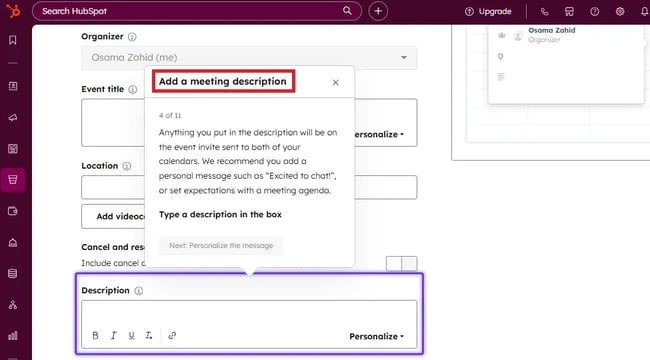
Meeting Agenda Personalization: HubSpot facilitates defining a clear agenda upfront, which clarifies the meeting’s purpose and sets expectations for all participants. This ensures conversations start with shared context and focus, making them more relevant and intentional. Agendas can be dynamically personalized with contact-specific details like name, company, and email, ensuring each invitee receives a tailored description.
-
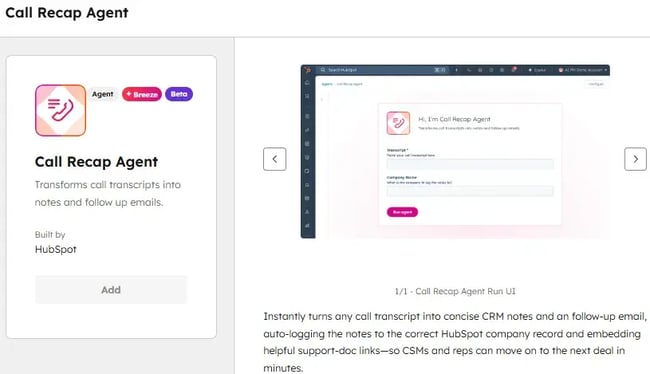
Meetings Assistant (AI): For Professional and Enterprise plans, HubSpot’s Breeze AI agents significantly enhance post-meeting follow-up. These agents leverage AI call transcription to record and analyze conversations, automatically generating concise summaries, identifying key discussion points, and extracting actionable next steps. This drastically reduces the need for manual note-taking, allowing reps to remain fully engaged with the buyer during the call. The AI can also surface sentiment, identify recurring themes, and suggest personalized follow-up emails, ensuring no opportunity is missed and freeing up sales reps for higher-value activities.
-
Pricing: Free Plan, Starter – $9 per user/month, Professional – $90 per user/month, Enterprise – $150 per user/month.
Calendly: The Scheduling Specialist
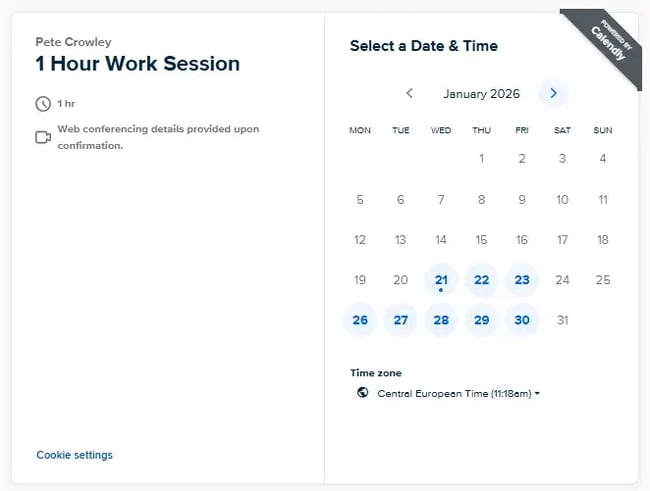
Calendly has become a widely adopted tool for simplifying the scheduling process. It eliminates the cumbersome back-and-forth by providing shareable booking links that sync in real-time with users’ calendars. Invitees can choose an available slot that works for them, and Calendly handles automated confirmations, reminders, and updates.
- Core Features: Automated scheduling, calendar integrations (Google, Outlook, iCloud), customizable meeting types, team scheduling features (round-robin, collective), and integrations with popular tools like Zoom and Salesforce.
- Pricing: Free for personal use; standard plans start at $10 per seat/month.
- Strengths: Known for its straightforward interface and ease of use, making it highly effective for individuals and teams primarily focused on streamlining scheduling logistics.
Chili Piper: Real-time Lead Qualification & Routing
Chili Piper specializes in automating real-time lead routing and instant meeting scheduling, particularly for inbound leads. It focuses on connecting high-intent prospects with the right sales rep immediately.
- Core Features: Instant booking from web forms, intelligent lead routing based on CRM data, one-click scheduling, automated reminders and follow-ups, and comprehensive utilization reports for team performance visibility.
- Pricing: Plans start at $30 per seat/month, plus a platform fee based on inbound lead volume.
- Strengths: Its robust routing logic and immediate booking capabilities are critical for reducing response times and preventing high-intent leads from going cold, making it a powerful tool for accelerating the sales cycle for qualified leads.
Acuity Scheduling: The Service-Oriented Scheduler
Acuity Scheduling is tailored for appointment-based meeting management, making it easy for businesses to manage bookings, collect client information, and process payments within a single platform.
- Core Features: Customizable booking pages, client intake forms, automatic reminders and confirmations, payment processing integration, and management of multiple calendars/staff.
- Pricing: Starting price is $20/month.
- Strengths: Highly suited for service-based small businesses, freelancers, or sales models where appointments involve client intake and upfront payments, offering robust customization for booking flows.
Transforming Sales Operations: Broader Implications
The strategic adoption of meeting management software represents a significant leap forward for sales organizations. By automating tedious administrative tasks, these tools liberate sales professionals to concentrate on high-value activities: building relationships, understanding client needs, and closing deals. The implications extend beyond individual productivity, fostering faster sales cycles, improving lead conversion rates, and enhancing the overall customer experience through seamless, professional interactions.
Furthermore, the integrated nature of these platforms provides sales leaders with unprecedented visibility into their team’s activities and pipeline health. Data on meeting effectiveness, conversion rates, and follow-up adherence becomes readily available, enabling more informed decision-making, targeted coaching, and accurate forecasting. In an increasingly competitive market, the ability to operate with such precision and efficiency translates directly into a sustainable competitive advantage.
Ensuring Ethical and Effective Meeting Practices
As sales teams leverage these powerful tools, particularly those with recording and AI capabilities, adherence to best practices for consent and data management is paramount.
-
Handling Consent for Recorded Meetings: Transparency is key. Participants should be clearly informed at the outset of a meeting that the call is being recorded, with a brief explanation of the purpose (e.g., "to ensure accurate notes," "capture action items," or "share context with internal teams"). Many regions consider verbal consent at the beginning of the call sufficient, but organizations must always comply with local recording laws and internal company compliance policies. Including a disclaimer in the calendar invite is also a good practice, building trust by ensuring buyers understand the purpose and are comfortable with the recording.
-
Which Meetings to Record: Sales teams should prioritize recording meetings where critical deal context, decision-making discussions, or definitive next steps are involved. This typically includes discovery calls, product demonstrations, proposal walkthroughs, negotiation calls, and account review meetings. These conversations are rich in buyer signals, objections, and commitments that are crucial for advancing deals and maintaining continuity across the sales cycle. Internal syncs or informal check-ins, which may not require deep analysis, might be better left unrecorded to respect privacy and foster open dialogue.
Conclusion
The choice of meeting management software can profoundly influence a sales team’s operational efficiency and its ability to drive revenue. The most effective tools streamline scheduling, eliminate friction, automate follow-ups, and seamlessly integrate meetings into the broader sales process. HubSpot Sales Hub, with its comprehensive suite of features—from its intuitive Meeting Scheduler and AI-powered Meetings Assistant to robust CRM integration and automated workflows—stands out as an end-to-end solution for high-performing sales organizations. By enabling sales professionals to create free booking pages, schedule meetings faster, and connect every interaction directly to reporting and forecasting, HubSpot transforms isolated events into structured, trackable steps in the sales process. This strategic shift is precisely what modern sales teams need to thrive in today’s dynamic market, ensuring that every meeting serves as a valuable catalyst for pipeline progress and sustained growth.
Related posts: