Streamlining Operations: How Advanced Answering Services Are Revolutionizing the Trades Industry


In the demanding world of plumbing, HVAC, electrical work, and general contracting, the adage "time is money" holds profound truth. For professionals often perched precariously on a ladder, deep within a crawlspace, or navigating traffic between urgent job sites, every incoming phone call represents a potential booking, a critical emergency, or a lost opportunity. The daily reality for many small to medium-sized trades businesses is a delicate balance: maximizing billable hours on a job versus ensuring that new leads are captured and existing clients are serviced promptly. This inherent conflict has historically led to a significant drain on potential revenue, as missed calls frequently translate into immediate lost business, a challenge now being addressed by sophisticated answering services, particularly those leveraging artificial intelligence.
The Unseen Cost of Missed Connections
For contractors, a missed call is often more detrimental than a negative online review, which, while stinging, can often be addressed and recovered from. A homeowner facing a burst pipe, a malfunctioning furnace in winter, or a non-operational air conditioning unit in peak summer does not typically leave a voicemail and patiently await a callback. The immediacy of their need dictates a rapid response. Industry data consistently underscores this urgency. Research from call analytics firms, such as Invoca, highlights that a stark minority—fewer than 3%—of callers directed to a service business’s voicemail actually leave a message. This lack of engagement means no message, no lead, and critically, no awareness that a potential job was even on the table. The caller, driven by necessity, simply moves to the next name on their search results, a process that can take mere seconds in today’s digitally connected marketplace.
This rapid customer decision-making is further compounded by the nature of trade services. Many calls are inherently time-sensitive, from emergency repairs to urgent maintenance requests. The tolerance for delayed responses, or the conventional "we’ll call you back" message, is considerably lower than in less critical industries. Speed, therefore, is not merely a convenience but a fundamental differentiator that separates a booked job from a vanished opportunity. The competitive landscape for contractors is fierce, with online directories and review sites empowering consumers to quickly compare and select providers based on availability and responsiveness.
The Evolution of Call Management in the Trades
Historically, call management for contractors was rudimentary. Many operated solely with a personal cell phone, relying on voicemail or the occasional ability to pull over and answer. Larger operations might employ a dedicated dispatcher or a small administrative team to field calls during business hours. However, this model struggled with scalability, after-hours emergencies, and the inherent cost of staffing. The early 2000s saw the rise of basic answering services, typically staffed by human operators who would take messages or follow simple scripts. While an improvement, these services often lacked deep integration with a contractor’s operations and could still be overwhelmed by sudden spikes in call volume.
The late 2010s marked a significant shift with the advent of more sophisticated Interactive Voice Response (IVR) systems and, more recently, the integration of artificial intelligence (AI) and natural language processing (NLP). This technological leap has transformed the potential of answering services from simple message-takers to intelligent virtual receptionists capable of understanding context, triaging emergencies, and even scheduling appointments. This evolution reflects a broader trend across industries where AI is increasingly deployed to enhance customer service, automate routine tasks, and free up human resources for more complex interactions. For the trades, this means the possibility of a "front desk" that never sleeps, never takes a break, and handles every call with consistent efficiency.
Tailored Solutions for Unique Demands
Unlike office-based businesses with predictable rhythms and front-desk staff, contractors operate in dynamic environments. Calls can come in from diverse locations and under varying circumstances, demanding an answering solution specifically designed for the trades. An effective contractor answering service must adeptly sort and manage three distinct categories of calls without causing delays or misdirection:
-
Emergency and Same-Day Repair Requests: These are often the most critical and time-sensitive. A "no-heat" call in the dead of winter, a "burst pipe" flooding a basement, or a "no power" situation requires immediate recognition and rapid action. An answering service must be capable of identifying urgency from the initial moments of the conversation, often through keywords or tone, and swiftly routing the call to the appropriate on-call technician or emergency contact. Treating an emergency as a routine scheduling request can lead to immediate job loss and severely damage the trust that underpins client referrals in the trades.

-
Routine Scheduling and Estimates: Not every call is a crisis. Many involve homeowners seeking quotes for remodeling projects, scheduling routine maintenance, or confirming existing appointments. These calls require meticulous information capture, including the caller’s name, contact details, service address, a clear description of the required work, and preferred scheduling times. Crucially, this information must be logged accurately and efficiently to prevent the customer from having to repeat details during a callback, which can be frustrating and convey a lack of professionalism. Basic answering services often falter here, with rushed intakes leading to incorrect addresses or missing callback numbers, turning a potential booking into a missed opportunity.
-
Vendor and Supplier Calls: A significant portion of incoming calls may not even be from customers. Suppliers confirming delivery windows, subcontractors checking on schedule changes, or municipal permit offices following up on inspections all compete for the same communication channels. An intelligent answering setup must be able to differentiate these non-customer calls from urgent client leads. Incorrect routing can either unnecessarily interrupt a busy crew or, worse, bury a critical customer call under lower-priority traffic. Efficient sorting ensures that crews remain focused on their primary tasks while essential operational communications are handled appropriately.
The Three Pillars of Modern Answering Services: Live, AI, and Hybrid Models
Contractors exploring modern answering solutions typically choose from three primary categories, each offering distinct advantages and trade-offs:
-
Live Answering Services: These services rely on trained human agents to answer calls, often following detailed scripts for common scenarios.
- Benefits: Live agents excel at handling nuance, empathy, and improvisation. They can comfort a panicked homeowner during a gas leak, skillfully negotiate a same-day appointment for a high-value client, or discern a hidden emergency through subtle cues in a caller’s tone, even if the explicit words don’t indicate urgency. Experienced agents, familiar with a contractor’s business, can accurately quote prices, upsell maintenance plans, or recognize repeat customers without needing to access extensive digital records, fostering a more personalized touch.
- Trade-offs: The primary drawback is cost; live agents are generally more expensive per call or per minute than automated options. Quality can also be inconsistent, varying by individual agent’s experience, training, and familiarity with a specific contractor’s services, service area, and pricing. High turnover rates at answering services mean contractors may frequently pay for new agents to get up to speed. Furthermore, live services can be overwhelmed during peak periods, such as storm seasons or extreme weather events, leading to longer hold times and callers being routed to queues precisely when rapid assistance is most needed.
-
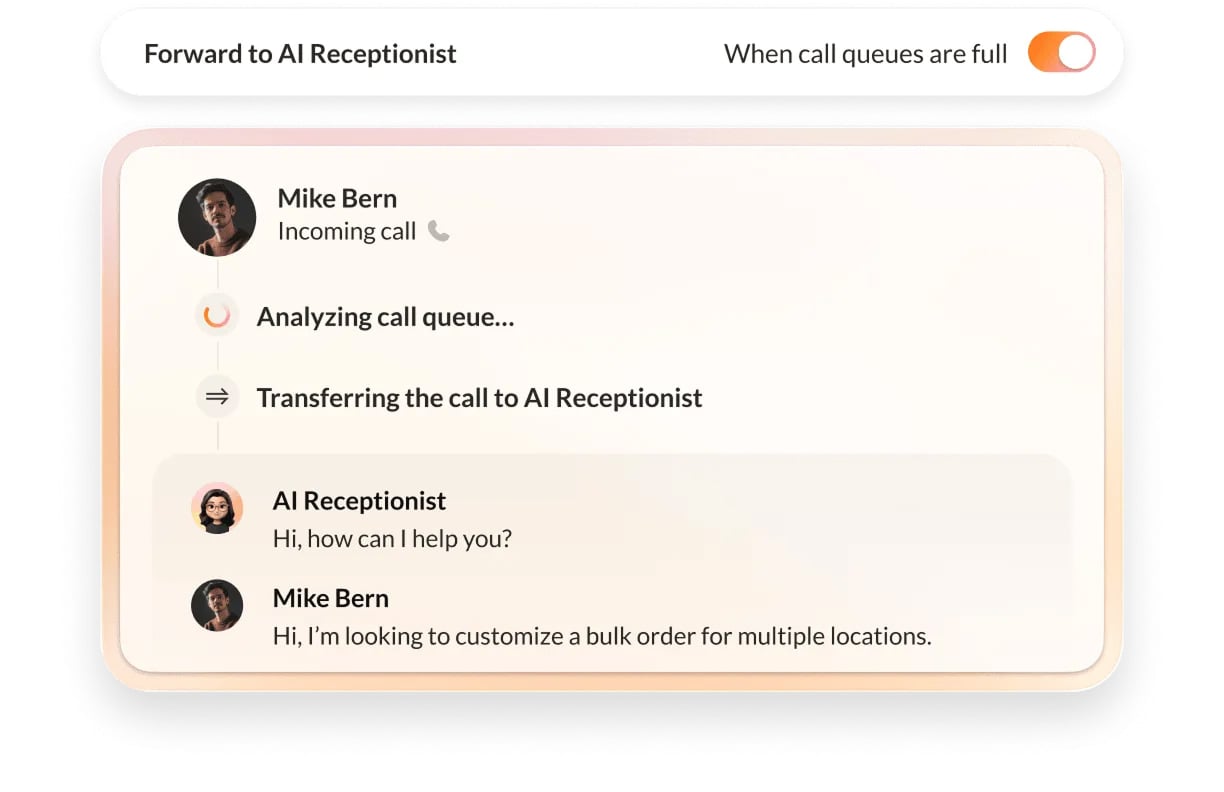
AI Answering Services: These services utilize artificial intelligence to answer and process calls automatically, offering a consistent experience regardless of time or call volume.
- Benefits: AI answering services provide significantly lower and more predictable costs per call, as there are no staffing costs, overtime for after-hours calls, or ramp-up times for new hires. Their consistency is unparalleled; every call is answered uniformly, without hold times or agent variability. Modern AI systems are context-aware, moving beyond rigid phone trees to understand natural language. They can pull information from extensive knowledge bases to answer service-area or pricing questions, schedule appointments directly into digital calendars, and intelligently flag urgent jobs (like a burst pipe or a heating failure in freezing temperatures) for immediate human callback rather than placing them in a generic queue. This level of automation ensures consistent lead capture and triage, even during off-hours or unexpected call surges.
- Trade-offs: While highly effective for structured scenarios like booking appointments, triaging emergencies, or capturing lead details, AI systems may struggle with highly unusual, emotionally charged, or multi-part complex problems. A caller attempting to negotiate a quote, describe an intricate repair issue, or vent frustration about a previous service may push the system beyond its current capabilities, necessitating a human handover. Contractors relying solely on AI must implement robust fallback mechanisms, such as a live transfer option or a guaranteed same-day callback promise, to prevent these complex calls from reaching a dead end.
-
Hybrid Models: These innovative solutions combine the strengths of AI for initial contact and routine tasks with the flexibility and empathy of live agents for complex or high-stakes interactions.
- Benefits: The hybrid approach offers the best of both worlds. AI systems provide immediate answers and efficiently capture essential information—caller name, job type, address, urgency—ensuring no critical detail is missed during off-hours or intense call spikes. Live agents then step in precisely when human judgment, empathy, or negotiation skills are required: handling an irate customer, discussing intricate pricing, or addressing a unique job request that doesn’t fit standard categories. This model provides contractors with consistent, around-the-clock intake while preserving the crucial human touch for interactions where it matters most, optimizing both efficiency and customer satisfaction.
- Trade-offs: Hybrid models can be the most expensive option, as they layer the costs of live agents onto an AI system. Effective implementation requires meticulously defined escalation rules. Contractors must clearly articulate which call types trigger a handover to a live agent. Vague rules can lead to either an excessive number of unnecessary human transfers (driving up costs) or too few (leaving complex calls stuck with the AI bot). The initial setup and ongoing coordination for a hybrid system also demand more effort and integration than either standalone option. The optimal choice among these three models ultimately depends on a contractor’s specific call volume, crew size, budget, and the proportion of their business that involves emergency versus routine work.
Beyond the Ring: The Art of Job Capture and Follow-Up
Answering the phone is merely the first step. The true measure of an effective answering service lies in its ability to transform that initial contact into a confirmed job on the schedule. This is where many basic services, whether human or automated, often fall short. The critical gap typically manifests in three areas:
-
Accuracy of Information Capture: Transcribing an address incorrectly, omitting a crucial callback number, or logging a job description that is too vague to act upon can render an answered call as unproductive as a missed one. Such mishandling doesn’t appear in "call answer rate" metrics, but contractors who diligently track lead quality often find it just as costly as outright missed calls.
-
Speed of Follow-Up and Actionability: Even perfectly captured job details lose their value if they are not acted upon swiftly. Logging a job request accurately but delaying its transmission to the relevant crew or dispatcher for several hours is almost as detrimental as a call that went to voicemail, given how quickly homeowners move on to the next available option. Effective services must ensure real-time or near real-time delivery of actionable information.
-
Consistency Across Operations: For contractors with multiple crews, varied shifts, or different service locations, consistency is paramount. A system that works efficiently for one crew’s schedule but creates confusion or delays for another is not a scalable solution. A truly effective answering setup ensures that job information is captured and routed consistently, regardless of who is on duty or which truck is handling service at a given moment.
This holistic view—from initial answer to accurate, timely, and actionable job information—serves as the real benchmark for evaluating any answering service for a trades business. It’s not just about picking up the phone, but reliably turning every call into a tangible opportunity.
Industry Perspectives and Expert Insights
The shift towards advanced answering solutions is being recognized across the trades. "For years, contractors have been leaving money on the table simply because they couldn’t be in two places at once," comments Sarah Chen, a market analyst specializing in small business technology. "The integration of AI into call management is not just a technological upgrade; it’s a fundamental business strategy. It levels the playing field, allowing smaller, agile operations to compete effectively with larger companies that have dedicated call centers."
Hypothetical contractor testimonials further illustrate this impact. "Before we implemented a hybrid answering system, I’d estimate we were losing three to four potential jobs a week, especially after hours," says Mike Rodriguez, owner of "Reliable Plumbing Solutions." "Now, every call gets handled, whether it’s 2 PM or 2 AM. The AI handles the routine stuff, and if someone’s really distressed, a live agent steps in. It’s transformed our lead capture and customer satisfaction." Another contractor, Emily Vance of "Vance Electrical Services," notes, "The consistency is what truly stands out. My teams know exactly how leads will be processed and dispatched, no matter who answers the initial call. It’s practically another dispatcher on staff, without the overhead."
The Road Ahead: Future of Contractor Communications
The trajectory of answering services for the trades points towards even deeper integration and intelligence. Future trends are likely to include:
- Proactive Customer Outreach: AI systems could not only answer incoming calls but also initiate follow-ups or offer preventive maintenance reminders based on service history and predictive analytics.
- IoT Integration: As smart homes become more prevalent, AI answering systems could potentially receive direct alerts from IoT devices (e.g., a smart water sensor detecting a leak) and proactively schedule service without human intervention.
- Enhanced CRM Integration: Seamless, bidirectional integration with Customer Relationship Management (CRM) platforms will allow for richer customer profiles, personalized interactions, and streamlined service delivery, from initial contact to invoicing.
- Multilingual Support: As demographics shift, AI systems will increasingly offer robust multilingual support, expanding a contractor’s potential customer base.
However, challenges remain. Data privacy and security will become increasingly important as more sensitive customer information is handled by automated systems. The initial investment in sophisticated AI or hybrid systems, while offering long-term ROI, can be a barrier for some smaller businesses. Furthermore, ensuring that AI systems maintain a human-like level of empathy and problem-solving for highly complex or emotional situations will be an ongoing development focus.
In conclusion, for contractors navigating a competitive and time-sensitive industry, effective call management is no longer a mere administrative task but a cornerstone of business growth and customer retention. The choice between live, AI, or hybrid answering services depends on individual business needs, but the overarching imperative is clear: every call must be answered, and every potential job must be efficiently captured and acted upon. The contractors poised for continued success are those who embrace these advanced communication strategies, ensuring their phone never goes unanswered, and transforming every ring into a tangible opportunity.
Originally published May 15, 2024
Related posts: