The Great AI Schism: Nvidia and Anthropic Clash Over the Future of Artificial Intelligence at Dreamforce

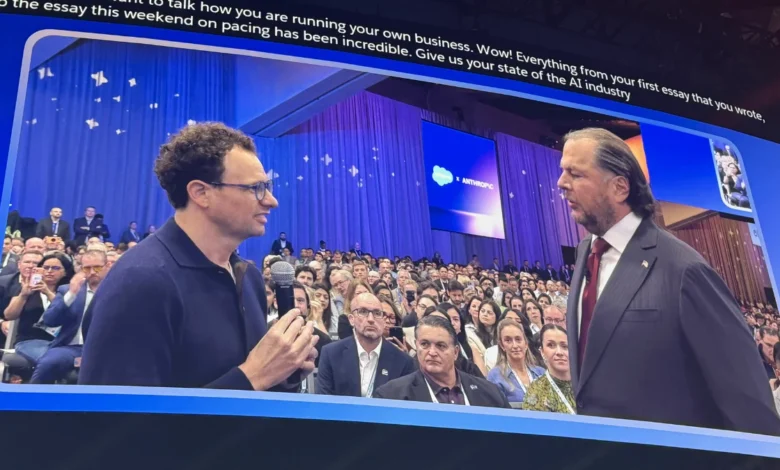
The annual Dreamforce conference in San Francisco, Salesforce’s flagship event, served as the unlikely backdrop for the most consequential ideological divide currently shaping the global technology sector. As 12,000 industry professionals and enthusiasts gathered at the Moscone Center on Tuesday, the stage hosted a stark, public confrontation between two of the most influential figures in the artificial intelligence ecosystem. Nvidia CEO Jensen Huang and Anthropic CEO Dario Amodei presented diametrically opposed visions for the future of the industry, highlighting a growing tension between the drive for rapid innovation and the calls for existential caution.
The debate, which has simmered in private boardrooms and academic circles for months, reached a boiling point when Amodei, fresh from publishing a comprehensive manifesto on AI safety, advocated for a deliberate deceleration of model development. Moments later, Huang, whose company is the primary architect of the hardware infrastructure fueling the AI boom, doubled down on the necessity of aggressive, unabated expansion. This divergence reflects a deepening schism in Silicon Valley regarding how—and how quickly—humanity should proceed with the development of artificial general intelligence (AGI).
The Chronology of the Debate
The friction between these two perspectives did not materialize overnight. The current conversation is the culmination of a year defined by unprecedented investment and equally significant regulatory scrutiny.
In early 2024, the rapid release of multimodal models from companies like OpenAI, Google, and Anthropic triggered a global discussion about safety guardrails. On September 12, 2024, Dario Amodei escalated this discourse by releasing a 3,800-word essay titled "We Must Pace the Frontier." In this document, Amodei argued that current development trajectories are unsustainable from a safety perspective. He suggested that as AI systems move toward capabilities that could surpass human intelligence, the industry must adopt a more cautious, measured pace to ensure that technical safety research keeps stride with model scaling.
The industry response was swift. High-profile figures, including OpenAI CEO Sam Altman and X owner Elon Musk, have previously echoed sentiments regarding the dangers of unchecked development. However, the Dreamforce keynote provided the first major public forum where these competing philosophies were articulated in back-to-back presentations, forcing the audience to weigh the merits of technological acceleration against the warnings of potential systemic risk.
Supporting Data and Market Context
To understand the intensity of this debate, one must look at the capital expenditure currently flooding the market. According to recent financial disclosures, the global AI infrastructure market is expected to grow at a compound annual growth rate (CAGR) exceeding 30% through 2030. Nvidia, which holds an estimated 80% to 90% market share in the high-end AI chip market, reported record-breaking revenue in its most recent fiscal quarter, driven primarily by demand for its H100 and Blackwell GPU series.
The economic pressure is immense. Large-scale language models require thousands of GPUs running for months to train, with training costs for "frontier" models now surpassing $100 million and expected to reach $1 billion by 2025. Huang’s stance—that full-speed development is the only way to realize the potential of these machines—is rooted in the reality that stalling development creates significant financial liability for companies that have invested billions into massive data centers and energy infrastructure.
Conversely, data from the AI Index Report suggests that while investment is increasing, public sentiment and research into AI safety have not seen a commensurate surge in funding. Proponents of Amodei’s "pace" strategy argue that the current ratio of compute power to safety research is skewed dangerously toward growth, leaving the world vulnerable to emergent, unintended behaviors in large models.
Differing Philosophies: Accelerationism vs. Controlled Growth
The disagreement at Dreamforce centers on the philosophy of "AI accelerationism" (often referred to as "e/acc") versus "AI alignment."
Jensen Huang’s position is that AI is a transformative economic force capable of solving the world’s most intractable problems, from climate modeling to drug discovery. From this perspective, the risks of AI are manageable through iterative engineering, and any attempt to slow progress would be a dereliction of duty, as it would cede technological leadership to global competitors who may not share Western standards for ethical development. For Huang, the bottleneck is not capability, but hardware throughput; therefore, the industry’s mission is to remove those bottlenecks as quickly as possible.
Dario Amodei’s position, while not anti-AI, is one of systemic caution. Amodei, a former researcher at OpenAI, emphasizes that the risks associated with advanced AI—ranging from biological weapon creation to disinformation campaigns—are not merely theoretical. His proposal for a paced development model involves stricter oversight of compute clusters, transparency in safety testing, and a shift in incentives for researchers. He argues that by slowing down, firms can dedicate the necessary time to build "constitutional" guardrails that prevent the model from deviating from human-aligned objectives.
Implications for the Tech Industry and Global Policy
The implications of this divide extend far beyond the boardroom. Policymakers in Washington, Brussels, and Beijing are currently drafting comprehensive AI legislation, and the public disagreement between titans like Huang and Amodei complicates the task of crafting balanced regulations.
If the industry follows the "accelerationist" path, the world could see a rapid influx of AI-integrated products that drastically change labor markets, education, and healthcare within the next five years. However, this path carries the risk of "black box" scenarios where AI systems act in ways that their creators do not fully understand.
If the industry adopts a "paced" approach, it could theoretically lead to a safer integration of AI into society, but it risks "innovation stagnation." Critics of a slower pace argue that AI development is a race, and that a self-imposed pause by American companies could lead to a scenario where geopolitical adversaries develop superior, less-regulated systems, thereby undermining global stability.
The Reaction from Industry Observers
Financial analysts and ethicists remain divided on the outcome of this ideological standoff. Some market observers note that Nvidia’s hardware dominance makes them the "arms dealer" of the AI revolution, making it structurally impossible for them to advocate for anything other than high-speed growth. Others suggest that Anthropic, by taking a stand for safety, is positioning itself as the "responsible choice" for enterprise clients and governments, which could serve as a unique market differentiator as regulations inevitably tighten.
Ultimately, the confrontation at Dreamforce underscores the reality that the development of artificial intelligence is no longer just a technical endeavor; it is a social and political process. As the industry moves forward, the question of whether to "step on the gas" or "apply the brakes" will likely determine the character of the next century. Whether the solution lies in the radical innovation championed by Nvidia or the prudent stewardship advocated by Anthropic remains the central question of the modern digital age. The debate, far from being settled on that San Francisco stage, has only just begun.
Related posts: