AEO Audit Tools: The New Strategic Essential for Modern Brand Visibility in the Era of AI Search

The digital marketing landscape has undergone a seismic shift as the traditional "blue link" paradigm of search engine results pages (SERPs) gives way to the era of generative AI. Today, consumers are increasingly bypassing traditional search engines in favor of direct recommendations from platforms like ChatGPT, Perplexity, and Gemini. For brand managers, SEO specialists, and growth marketers, this transition represents a fundamental change in how visibility is earned and measured. As these answer engines become the primary interface for buyer research, the implementation of Answer Engine Optimization (AEO) audit tools has evolved from a competitive advantage into an existential necessity for maintaining market relevance.
Understanding the shift toward answer-driven discovery requires recognizing that modern AI models do not merely rank websites; they synthesize information to provide curated, concise responses. Unlike traditional SEO, which prioritizes crawl health and keyword density to earn a top-ranking position, AEO focuses on "citation health." The critical question for 2026 and beyond is not whether a brand ranks for a keyword, but whether an AI model chooses to cite the brand as a credible, authoritative source when a potential customer asks a specific question.
The Evolution of Search: From Crawling to Synthesis
The timeline of this transition began in late 2022 with the public launch of generative AI, which fundamentally altered user behavior. By 2024, industry data suggested that nearly 40% of complex queries were being directed to AI-native interfaces rather than legacy search engines. This shift necessitates a new measurement layer. While traditional SEO audits remain vital for technical site health, they are insufficient for tracking brand presence within the "black box" of LLM-generated responses.
AEO audit tools serve as the diagnostic bridge in this new environment. They provide the necessary visibility into whether a brand is being surfaced by AI, whether the information provided is accurate, and whether the brand is winning the "citation war" against competitors. Without these tools, companies are effectively flying blind, unable to discern why a competitor might be receiving a recommendation while their own, potentially superior, product goes unmentioned.
Baseline Visibility and the Diagnostic Framework
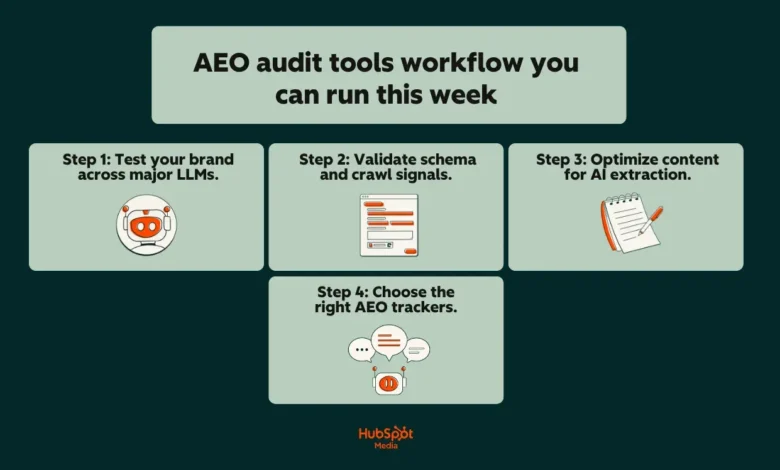
The initial step for any organization is to establish a baseline. Before investing in expensive enterprise software, teams should utilize diagnostic tools such as HubSpot’s AI Search Grader to conduct a gap analysis. This process involves identifying exactly where a brand appears—or is notably absent—across major platforms like ChatGPT, Perplexity, and Google’s Gemini.
This baseline check is not a one-time task but a recurring requirement. Because AI models are subject to continuous retraining and updates, a brand’s visibility can fluctuate significantly month-over-month. A competitor’s newly published, highly authoritative content can displace an established brand within an AI citation almost overnight. Therefore, effective AEO strategy treats visibility tracking as a dynamic, ongoing process rather than a static annual report.
Content Engineering: Preparing for AI Extraction
Visibility in an AI-driven search environment is heavily dependent on content structure. AI models operate by extracting and synthesizing discrete "chunks" of information. Consequently, content that is optimized for human readability but poorly structured for machine extraction will consistently fail to earn citations.
To improve "extraction readiness," marketing teams must prioritize several key structural changes:
- Answer-First Intros: The most critical information must appear at the beginning of a document. AI models are programmed to pull the most relevant, concise answers first.
- Semantic Q&A Blocks: Incorporating structured FAQ sections allows AI to easily map user queries to specific, high-quality answers provided by the brand.
- Comparative Tables: Data-rich comparison tables are highly favored by LLMs because they provide structured, clean, and easily digestible information, making them ideal for citation-heavy answers.
Analysis of this structural shift suggests that the teams most successful in the next two years will be those that view their content libraries not as collections of articles, but as structured data sets designed for machine consumption.
The Strategic Stack: Matching Tools to Team Maturity
The complexity of AEO requires a tiered approach to tooling, depending on the scale and maturity of the organization.
For startups and SMBs, the primary focus is validation. These organizations should prioritize low-cost or free baseline tests to determine if AI search is a viable channel for their specific industry. If the data shows zero visibility, the focus must remain on foundational content reformatting rather than complex software procurement.

Mid-market organizations require a more integrated approach. At this stage, manual spot-checks become unsustainable. The most effective tools for this tier are those that layer citation tracking onto existing SEO and CRM workflows. By integrating AEO data into existing marketing dashboards, mid-market teams can monitor performance without the overhead of managing fragmented, siloed platforms.
For enterprise-level organizations, the challenge is governance and scale. These teams must manage visibility across diverse product lines, global regions, and various business units. The most successful enterprise strategies involve consolidating citation tracking into existing marketing stacks, such as HubSpot’s Marketing Hub, which allows for the synchronization of AEO data with broader campaign attribution. When evaluating vendors, enterprise leaders should prioritize pricing models based on data volume—such as the number of queries and engines monitored—rather than simple user-seat counts, which can become prohibitively expensive at scale.
Implementing a Recurring AEO Workflow
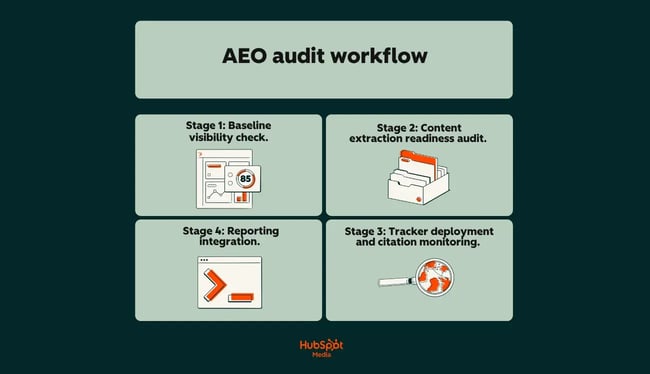
A sustainable AEO strategy relies on a disciplined reporting cadence. A three-tier workflow is recommended for most marketing departments:
Weekly: Automated monitoring of citation accuracy. This is the "firewall" stage, where teams catch misinformation or outdated product details before they circulate widely. If an AI misrepresents pricing or features, the damage can be significant; weekly alerts ensure rapid remediation.
Monthly: Strategic analysis of citation share and content performance. This stage moves beyond simple visibility to analyze the quality and context of citations. Are the brand’s primary product pages being cited, or are lower-value resources being prioritized?
Quarterly: Comprehensive engine testing and stack evaluation. This involves a top-down review of the brand’s entire search presence, assessing whether the current tools and strategies are still aligned with the latest AI model updates.
Common Pitfalls and Strategic Corrections
Despite the urgency of the situation, many organizations fall into predictable traps. One of the most prevalent is "tool-first buying," where companies purchase expensive enterprise software before they have optimized their content for AI extraction. No tool can improve visibility if the underlying content is not structured correctly.
Another common mistake is the "single-engine bias." Relying solely on ChatGPT for testing creates massive blind spots, as different engines utilize different data sources and citation logic. A brand may perform exceptionally well in one ecosystem while being entirely invisible in another.
Finally, the lack of a clear measurement framework remains a significant barrier. Without defining what success looks like—whether it is "share of voice" in citations or specific conversion metrics linked to AI referrals—teams will struggle to justify the investment in AEO.
The Future of Search-Driven Growth
The rise of AI-driven search is not a temporary trend but a fundamental shift in the digital economy. As buyers increasingly rely on AI to perform their research and make purchasing decisions, the ability to appear within these synthesized responses will become the primary driver of brand awareness and lead generation.
By prioritizing content structure, implementing consistent diagnostic cadences, and integrating AEO tracking into the broader marketing stack, companies can ensure they remain visible in the new AI-powered search landscape. The tools are available, the methodology is clear, and the imperative is absolute: brands that fail to optimize for answer engines risk being written out of the narrative of their own industries. To remain competitive, marketing leaders must act now to baseline their current presence and build the technical foundation necessary for the next generation of search.