The Strategic Evolution of Referral Marketing Building Sustainable Growth Through Customer Advocacy and Economic Incentives


Referral marketing has emerged as one of the most resilient and high-yield customer acquisition strategies in the modern digital economy, formalizing organic word-of-mouth into a structured program defined by unique tracking codes, incentivized rewards, and granular conversion data. At its core, the strategy leverages the "trust transfer" that occurs when an existing customer recommends a brand to a peer, a phenomenon that market researchers have found to be structurally more potent than traditional advertising. According to longitudinal data from the University of Pennsylvania’s Wharton School, referred customers are approximately 16% more valuable over their lifetime than those acquired through other channels. As businesses face rising costs in paid media and decreasing efficacy in cookie-based targeting, the shift toward customer-led growth represents a significant pivot in demand marketing.
The Economic Foundation of Referral Programs
The efficacy of referral marketing is supported by three primary economic pillars: enhanced lifetime value (LTV), reduced customer acquisition costs (CAC), and the "referral loop" effect. A 2024 study published in the Journal of Marketing Research, which tracked 10,000 customers over a six-year period, revealed that referred customers are not only more loyal but also more active as advocates. The study found that referred individuals make 31% to 57% more referrals of their own compared to customers acquired via traditional marketing. Furthermore, ignoring these downstream referrals often leads firms to undervalue the original referral by as much as 20% to 36%.

From a cost perspective, referral channels typically yield a CAC that is 25% to 50% lower than paid social or search channels. While vendor benchmarks vary, the consensus among demand generation experts is that referral marketing serves as a "blended CAC" stabilizer. By incentivizing existing users to act as a decentralized sales force, companies can reallocate capital from ad platforms directly into the hands of their customers, fostering a cycle of reciprocity that strengthens brand affinity.
Psychological Drivers and the Principle of Reciprocity
The success of these programs is rooted in deep-seated psychological triggers, most notably the principle of reciprocity popularized by social psychologist Robert Cialdini. In a referral context, "double-sided" programs—where both the referrer and the referee receive a reward—consistently outperform single-sided incentives. This structure ensures the existing customer feels the transaction is fair and socially acceptable, rather than exploitative.
The trust factor remains the most significant hurdle in modern commerce. Nielsen’s 2021 Trust in Advertising Study indicated that 88% of global consumers trust recommendations from people they know more than any other form of marketing. This high level of baseline trust leads to higher conversion rates at the "top of the funnel," as the referee enters the brand ecosystem with a pre-validated sense of the product’s utility.

Differentiating Referral from Affiliate and Influencer Channels
A common point of confusion for many organizations is the distinction between referral marketing and its neighboring disciplines: affiliate and influencer marketing. While all three utilize third-party advocacy, their incentive structures and intended audiences differ significantly.
Word-of-mouth is entirely organic and untracked, representing the "purest" form of advocacy but the hardest to scale. Referral marketing focuses on one-to-one shares among existing customers, rewarding them for personal introductions. Affiliate marketing, by contrast, is publisher-led; it pays commissions to third-party entities like bloggers or deal sites for driving public traffic. Influencer marketing is creator-led, often involving flat fees for reach and brand alignment. Understanding these distinctions is critical for budgetary allocation and regulatory compliance, as each channel carries different disclosure obligations under federal law.
Structural Frameworks: The Eight Models of Referral Programs
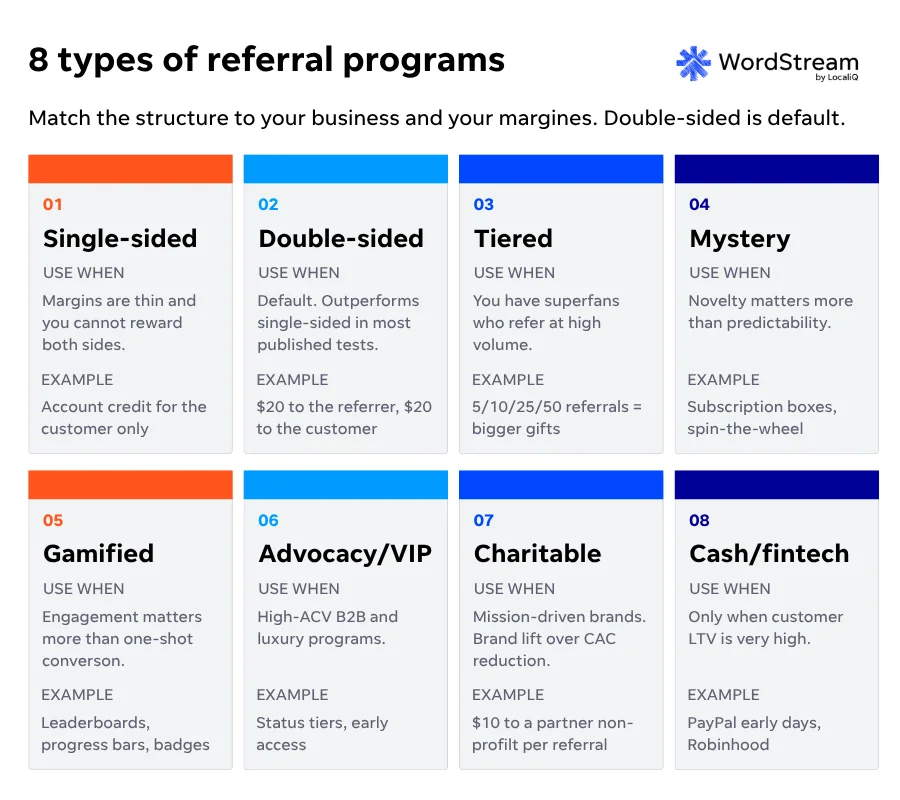
Not all referral programs are created equal. The architecture of a program must align with the product’s lifecycle and the customer’s purchase frequency. Industry experts generally categorize successful programs into eight distinct types:

- Double-Sided: The industry standard, rewarding both parties to maximize social capital.
- Single-Sided: Rewarding only one party, often used when the social incentive of "giving a gift" is stronger than the desire for a personal rebate.
- Tiered/Milestone: Rewards that scale as the customer refers more people (e.g., refer 5 friends for a t-shirt, 10 for a jacket).
- Gamified: Incorporating leaderboards and badges to appeal to competitive social drives.
- Advocacy/VIP: Offering exclusive status or early access rather than monetary rewards.
- Charitable: Donating to a cause in the name of the referrer, effective for mission-driven brands.
- Mystery: Using randomized rewards to create "variable ratio reinforcement," a powerful psychological motivator.
- Cash: Direct monetary payouts, most common in high-LTV sectors like fintech and insurance.
Strategic Implementation: A Chronology for Launch
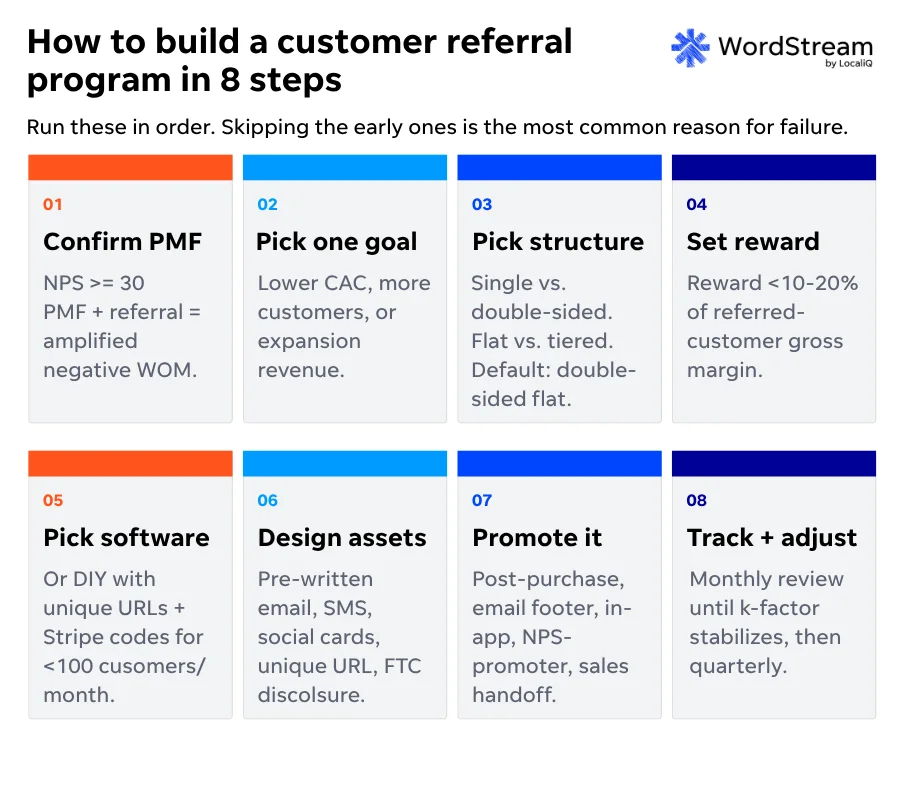
Building a sustainable referral engine requires a sequential approach to ensure the program amplifies success rather than subsidizing failure. The first and most critical step is confirming product-market fit. Marketing experts warn that launching a referral program for a subpar product will only accelerate negative word-of-mouth. A positive Net Promoter Score (NPS) is generally considered a prerequisite for launch.
Once fit is established, the organization must define a singular goal—whether it be lowering CAC, increasing customer volume, or driving expansion revenue. This goal dictates the reward structure, which should typically not exceed 10% to 20% of the referred customer’s gross margin. Following the design phase, the selection of software (such as ReferralCandy for e-commerce or GrowSurf for SaaS) allows for the automation of unique link generation and reward fulfillment.
The final phases involve promoting the program across high-trust touchpoints, such as post-purchase confirmation pages, shipping notifications, and customer support resolutions. Continuous review of metrics—specifically the "K-factor" or viral coefficient—is necessary to optimize the program over time.
Historical Case Studies: Mechanics as the Lesson
The history of digital growth is paved with referral successes that provide blueprints for modern operators. Dropbox remains the gold standard for "product-led" rewards; by offering extra storage space instead of cash, they tied the reward directly to the product’s core value, creating a virtuous cycle of usage.
PayPal’s early-stage growth was fueled by direct cash payouts ($10 to both parties), a high-burn strategy that was only sustainable because the lifetime value of a fintech user justified the upfront cost. In the automotive sector, Tesla utilized milestone rewards to offer "status" as a prize, including invitations to unveiling events and even free vehicles for top-tier referrers. These examples demonstrate that the most effective rewards are those that match the customer’s existing emotional connection to the brand.
Regulatory Compliance and the 2024 FTC Mandates
As referral marketing has scaled, so has regulatory oversight. The Federal Trade Commission (FTC) in the United States has significantly tightened its Endorsement Guides. As of the 2023 and 2024 updates, the FTC requires "clear and conspicuous" disclosure of any material connection between a brand and an endorser. This includes referral rewards such as store credit or discounts.
If a customer shares a referral link, the accompanying text must state that they receive a benefit from the purchase. Failure to include these disclosures can result in civil penalties reaching into the five-figure range per violation. Modern referral programs must now build "built-in disclosure" into their share templates to ensure that every automated message sent by a customer remains compliant with federal law.
Industry-Specific Nuances: B2B vs. B2C
While the underlying psychology remains consistent, the execution of referral marketing differs vastly between B2C and B2B sectors. B2C programs are characterized by short cycles and low-friction, often utilizing "refer-a-friend" widgets on mobile apps. B2B programs, however, are more akin to partner programs. They require integration with CRM systems like Salesforce or HubSpot to track multi-step sales cycles and often involve manual "sales handoffs."
In the B2B world, the reward is often more substantial, reflecting the higher annual contract values (ACV) of the industry. However, the "ask" must be timed more carefully, typically occurring after a successful implementation or a positive quarterly business review.
Broader Implications for the Future of Acquisition
Looking toward the end of the decade, referral marketing is positioned to become the primary counterweight to the "walled gardens" of big tech advertising. As privacy regulations like GDPR and CCPA limit the ability of brands to target new customers through third-party data, the "first-party" data generated by a referral program becomes an invaluable asset.
Referral marketing is no longer a "set-it-and-forget-it" tactic hidden in a settings menu; it is a sophisticated, data-driven discipline that requires ongoing management. For brands that can successfully navigate the economics, psychology, and legalities of the space, it offers a path to compounding growth that is both cost-effective and deeply rooted in customer satisfaction. The ultimate goal of any such program is to turn the customer base into a community of advocates, ensuring that the brand’s best users become its most effective growth engine.