The landscape of professional networking has undergone a significant transformation over the last twelve months, according to a comprehensive study of 4.8 million LinkedIn posts. Data released by social media management platform Buffer reveals a major shift in user behavior, indicating that the traditional "working hours" window for engagement is no longer the dominant force in professional social media. While 2025 data suggested that engagement plummeted after 5 p.m., the 2026 findings show that peak windows are moving increasingly into the late afternoon and evening hours, suggesting that professionals are now consuming industry content during their personal time and commutes.
The study, led by data scientist Julian Winternheimer, underscores a pivotal moment for digital marketers and personal brands. As the boundaries between professional development and personal leisure continue to blur, the timing of content distribution has become a critical variable in navigating the LinkedIn algorithm. With engagement—defined as reactions, comments, and reposts—serving as the primary signal for content reach, the shift toward evening activity requires a fundamental reassessment of B2B and professional communication strategies.
Evolution of the LinkedIn Engagement Window: A Two-Year Chronology
To understand the 2026 shift, it is necessary to examine the trajectory of user behavior since 2024. In the post-pandemic era, LinkedIn engagement was largely tethered to the traditional 9-to-5 desk-bound environment. Users typically checked their feeds during the "morning coffee" window (8 a.m. to 10 a.m.) or during lunch breaks. By 2025, data showed a sharp drop-off in activity immediately following the end of the workday, as users sought to disconnect from professional environments.
However, the 2026 data indicates a reversal of this trend. The current peak engagement window now sits between 3 p.m. and 8 p.m. on weekdays. This evolution mirrors patterns previously seen on entertainment-centric platforms like Instagram and TikTok, suggesting that LinkedIn is successfully transitioning from a utility-based job board to a content-rich social destination. This shift is likely driven by the increased quality of professional storytelling and the proliferation of mobile usage during evening hours, where users scroll through industry insights as a form of "productive relaxation."
Detailed Findings: The Best Times to Post by Day
The 2026 analysis provides a granular look at how engagement fluctuates throughout the week. While the general recommendation focuses on late afternoon, specific days exhibit unique "micro-peaks" that savvy creators can leverage.
Monday: The Late Night Catch-Up
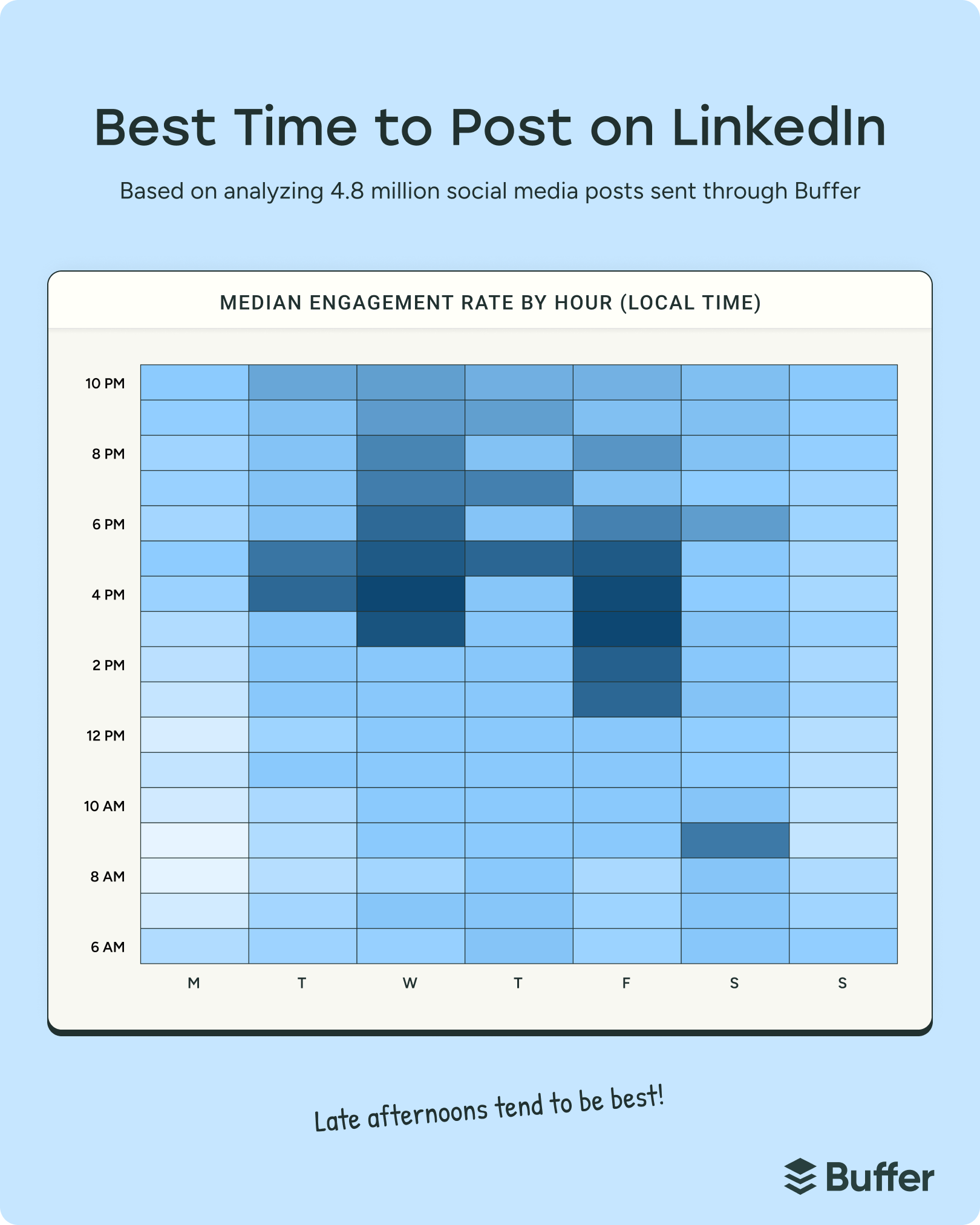
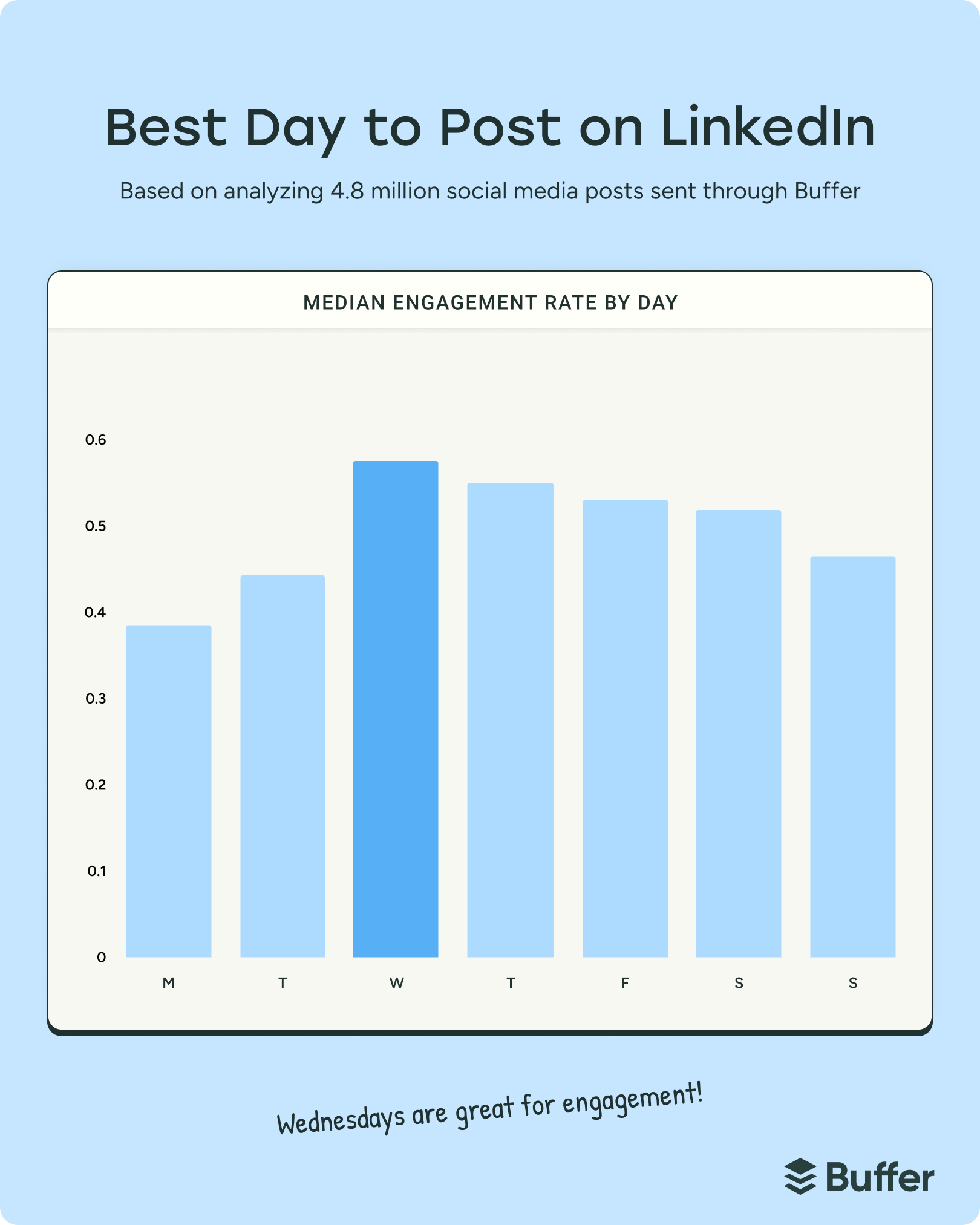
Counter-intuitively, the highest engagement on Monday occurs at 10 p.m. This suggests that professionals use the end of the first day of the workweek to catch up on missed content. Other strong slots include 5 p.m. and 9 p.m. Overall, Monday remains one of the lower-engagement days of the week, as users are often overwhelmed with task-setting and meetings.
Tuesday: The Transition Period
Tuesday begins to see an uptick in activity, with 4 p.m. emerging as the primary peak. This is followed closely by 5 p.m. and 10 p.m. While more active than Monday, Tuesday is still considered a secondary day for high-priority announcements.
Wednesday: The Mid-Week Peak
Wednesday is officially the best day of the week to post on LinkedIn. The 4 p.m. slot on Wednesday represents one of the highest engagement points in the entire dataset. Additional high-performing windows include 3 p.m. and 5 p.m. By mid-week, professionals are fully immersed in their industry’s discourse and are most likely to interact with long-form content and carousels.
Thursday: Sustained Evening Momentum
Thursday continues the mid-week strength with a peak at 5 p.m. Engagement remains high throughout the evening, with notable spikes at 7 p.m. and 9 p.m. This day is ideal for "thought leadership" pieces that require more reflective engagement.
Friday: The Early Weekend Wind-Down
The Friday peak occurs earlier than other weekdays, hitting its stride at 3 p.m. as professionals begin to wrap up their tasks. The window remains strong until 5 p.m., making it a prime time for lighter, culture-focused content or weekly recaps.
Weekends: Strategic Niche Windows
While weekend engagement is significantly lower than weekday averages, Saturday at 9 a.m. and Sunday at 10 p.m. offer opportunities for reaching users who use their time off for professional development. Sunday night, in particular, serves as a "pre-workweek" ritual for many executives.
The LinkedIn Algorithm: Why Timing Influences Reach
The importance of timing is directly linked to how LinkedIn’s ranking algorithm functions. Although LinkedIn utilizes a "velocity" check—often referred to as the "golden hour"—to determine how a post should be distributed, the platform’s official stance is that engagement signals are the most reliable indicators of value. When a post receives immediate reactions and comments, the algorithm views it as relevant to a wider audience, thereby increasing its visibility in the "Home" feed.
By posting during late-afternoon windows when more users are active, creators maximize the probability of receiving these early signals. However, researchers caution that timing is not a substitute for quality. A post shared at the "perfect" time of 4 p.m. on a Wednesday will still fail to gain traction if it lacks professional value or fails to spark conversation. The data suggests that timing acts as a multiplier: it helps good content reach its maximum potential, but it cannot rescue poor content.
Supporting Data on Posting Frequency and Format
Beyond timing, the 2026 report highlights two other critical factors for LinkedIn success: frequency and content format.
Frequency Impact
The study analyzed over 2 million posts to determine the "sweet spot" for activity. The findings suggest a tiered benefit system:
- 2 to 5 posts per week: This is the baseline for growth, resulting in approximately 1,182 more impressions per post compared to those who post once a week.
- 6 to 10 posts per week: This frequency sees a jump of over 5,000 impressions per post.
- 11+ posts per week: The most active users see a dramatic lift, gaining nearly 17,000 more impressions per post.
The Power of Carousels
The 2026 data identifies "document posts" (often used as swipeable carousels) as the most effective format on the platform. These posts generate up to 596% more engagement than text-only updates. This is attributed to "dwell time"—the amount of time a user spends looking at a post—which the LinkedIn algorithm uses to measure content depth.
Professional Reactions and Strategic Implications
Industry experts have noted that these findings signal a shift in the "psychology of the professional user." Digital marketing strategist Julian Winternheimer noted that the shift toward evening hours suggests that LinkedIn is no longer just a tool for the office, but a destination for the individual.
"People are still showing up for professional content; they’re just doing it after they’ve closed their laptops for the day," the report states. This has profound implications for B2B companies. Traditionally, B2B marketing was designed to reach a "worker" during "work hours." The 2026 data suggests that B2B brands must now compete for attention in the same evening windows where users are also exposed to entertainment and personal social media.
Furthermore, the normalization of time zones in this study provides a new level of ease for global teams. The data scientist confirmed that these recommended times are applicable to the user’s local time zone. A 4 p.m. recommendation holds true whether the target audience is in New York, London, or Singapore, simplifying the scheduling process for international campaigns.
Broader Impact on Digital Marketing Strategy
The 2026 LinkedIn data serves as a reminder that social media is a fluid environment. The shift from morning-centric to evening-centric engagement reflects broader societal changes, including the rise of flexible work arrangements and the increasing importance of personal branding for career longevity.
For businesses and individual creators, the implications are clear:
- Re-evaluate Automation: If your social media tools are still set to post at 9 a.m. on Mondays, you are likely missing the current peak of the audience.
- Focus on Mid-Week: Prioritize high-value white papers, product launches, and major announcements for the Wednesday-to-Friday window.
- Invest in Visual Storytelling: Given the 596% engagement lift for carousels, the "text-only" status update is no longer sufficient for brands seeking high reach.
- Monitor Individual Analytics: While the 4.8 million post sample provides a robust benchmark, individual niche audiences may behave differently. A developer audience might engage later at night than a human resources audience.
As LinkedIn continues to evolve, the ability to interpret and act on data-driven insights will separate successful communicators from those shouting into an empty digital room. The 2026 report proves that the "professional" world is no longer confined to the daylight hours; it is a 24/7 ecosystem where timing, format, and frequency converge to create influence.