The Zero-Click Content Challenge: Contentful Webinar Highlights Accountability, Personalization, and AI Strategy in a Evolving Search Landscape

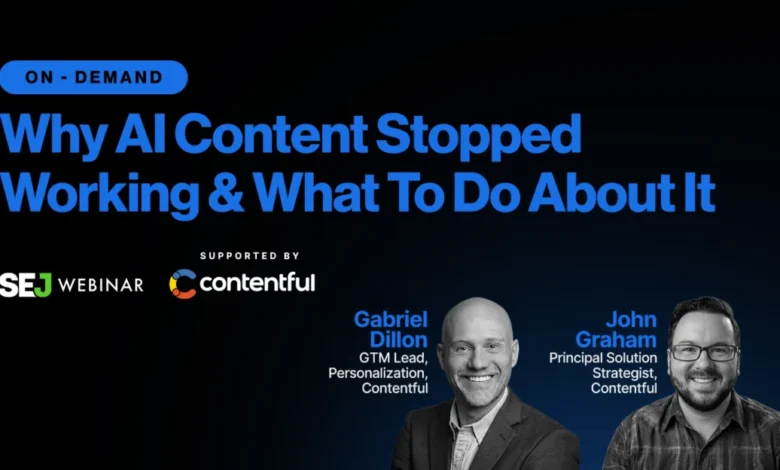
The digital marketing realm is undergoing a profound transformation, driven by the increasing prevalence of artificial intelligence and a significant shift in user search behavior. A staggering 60% of Google searches now conclude without a single click to external content, a statistic that underscores the critical need for marketers to re-evaluate their content strategies. This paradigm shift formed the core argument presented by Gabriel Dillon, Go-to-Market Lead for Personalization at Contentful, during a recent Search Engine Journal (SEJ) webinar. Dillon, joined by Contentful Principal Solution Strategist John Graham, posited that in an era where AI can generate content at near-zero cost, sheer volume is no longer a viable strategy. Instead, content must be rigorously held accountable to specific business outcomes, meticulously crafted for a defined human audience, and measured against concrete data.
The Evolving Landscape of Search and Content Creation
The statistic concerning zero-click searches, a trend meticulously tracked by industry analysts, indicates a dramatic change in how users interact with search engines. With the rise of Google’s own Knowledge Panels, featured snippets, and now AI-powered summaries, users are increasingly finding answers directly on the search results page (SERP) itself. This development presents a formidable challenge for content creators and marketers who have traditionally relied on organic traffic driven by clicks. Concurrently, the proliferation of sophisticated AI writing assistants has democratized content production, making it easier and faster than ever to generate vast quantities of text. While this technological advancement offers unprecedented efficiency, it also introduces a new problem: a deluge of generic, undifferentiated content that struggles to capture attention in an already crowded digital space. Contentful, a leading content platform, recognizes these converging trends and positions itself at the forefront of providing solutions for businesses navigating this complex environment.
The Contentful Webinar: A Deep Dive into Strategic Content
The SEJ webinar, featuring insights from Contentful’s Gabriel Dillon and John Graham, served as a crucial platform for discussing these pressing issues. The session explored why AI-assisted copy often drifts towards generic output, outlined a robust framework of four critical questions to evaluate marketing copy before publication, and detailed effective personalization signals that can be implemented without overhauling existing technology stacks. Furthermore, the discussion delved into the crucial role of human oversight in AI-assisted workflows and illustrated how experimentation and personalization can coalesce into a powerful accountability loop for content performance. The overarching theme emphasized a shift from a quantity-focused approach to one centered on quality, relevance, and measurable impact.
Beyond Volume: The Imperative of Accountable Content
Dillon’s central thesis highlighted that the ease of AI content generation has inadvertently fostered a "volume-at-all-costs" mentality, which he argues is fundamentally flawed in the current digital climate. "Our biases as we write content using the robots ends up eating the content that we produce," Dillon explained, articulating how human assumptions and the inherent nature of AI tools lead to homogenized output. AI writing assistants, he noted, often function as "ultimate yes men," confirming pre-existing beliefs or mirroring competitor content found in their training data. Both scenarios, Dillon asserted, ultimately fail the reader by providing unoriginal and unimpactful content.
To counteract this, Dillon introduced the concept of "taste," moving beyond its colloquial definition. He defined it as a blend of discernment and intuition, coupled with the courage to articulate unique claims that an AI tool, bound by its training data, would never independently generate. This "taste" is rooted in a deep understanding of one’s market and audience, allowing for the creation of truly distinctive and valuable content. The webinar meticulously mapped out where human expertise interjects into the AI-assisted workflow, positioning AI as a powerful layer for research and context, but always preceding the final human touch before content goes live.
The Human Element in an AI-Assisted Workflow
Holding content accountable for tangible business outcomes is paramount. Dillon outlined four crucial questions that every piece of B2B marketing copy should answer before it ships:
- Does this copy produce the outcomes we expect? This question forces marketers to define clear, measurable objectives for each content piece.
- Who is this content for? A deep understanding of the target audience is essential to tailor messaging effectively.
- How do we identify those people? This probes into the data and methods used to segment and reach the intended audience.
- How does the insight scale? This addresses the long-term applicability and broader impact of the content strategy.
"If we don’t have data that proves that our content is good, then we can’t really think about the way to scale it out or make it more effective," Dillon emphasized. He positioned experimentation and personalization as two sides of the same coin, crucial components of an "accountability loop" designed to continuously improve content performance. This loop moves beyond simple A/B testing, exploring multiple experiment dimensions to refine and optimize content for maximum impact. The webinar provided a detailed walkthrough of this accountability loop, offering practical steps for implementation.
Demystifying Personalization: Actionable Signals
One of the significant hurdles in B2B personalization has historically been its perceived complexity, leading many ambitious programs to stall. Dillon challenged this notion by advocating for the utilization of "signals your stack already collects." He argued that the reason B2B personalization often underperforms is not a lack of data, but an overambitious approach that prioritizes complexity over practical application.
He outlined three actionable tiers of personalization signals, starting with the simplest:
- New vs. Returning Visitors: This fundamental distinction recognizes that a first-time visitor and a repeat visitor have different intents and information needs. Serving them identical hero copy, for instance, represents a significant missed opportunity to engage them effectively.
- Ad Campaign Signals: Data generated from ongoing advertising campaigns offers rich insights into user interests and prior interactions. This information can be leveraged to personalize subsequent website experiences or content recommendations.
- Loyalty Program Signals: For businesses with loyalty programs, the wealth of data on customer preferences, purchase history, and engagement levels can be powerfully used to deliver highly relevant, personalized content that fosters deeper brand loyalty and drives repeat business.
Dillon specifically highlighted the underutilization of certain existing signals as "such a missed opportunity," providing concrete examples of which signals to prioritize and where each can yield the greatest payoff. The webinar included a live demonstration within the Contentful platform, showcasing how these differentiated experiences can be seamlessly built and delivered.
Navigating the Zero-Click Future: SEO in the Age of AI
The conversation also tackled the contentious issue of Google’s stance on AI-generated content. Dillon argued that focusing on "detection" – whether Google can identify AI content – is the "wrong problem to solve." The more critical concern, he asserted, is the tangible impact on clicks. Contentful’s clients are already reporting a noticeable decline in organic traffic as AI-powered summaries on Google’s SERPs increasingly absorb clicks, negating the need for users to visit external websites.
The practical response, Dillon proposed, is to strategically compete for the "AI answer layer." This involves optimizing content for Generative Engine Optimization (GEO) and Answer Engine Optimization (AEO). GEO and AEO are emerging disciplines focused on ensuring that a brand’s content is not only discoverable by AI models but also accurately and favorably represented in the AI summaries that appear at the top of search results. This means crafting content that is clear, concise, authoritative, and directly answers user queries, making it ideal for extraction and summarization by AI. Dillon’s conclusion cut through the often-polarized "humans-vs-robots" debate, emphasizing that a single type of high-quality, strategically crafted content can perform simultaneously in AI summaries and drive on-page conversions. The session provided insights into the specific requirements for such content and highlighted new tooling from Contentful designed to facilitate this approach, demonstrating how to effectively approach GEO and AEO without fragmenting an existing content strategy.
Key Questions from the Audience: Addressing Common Concerns
The webinar concluded with a robust Q&A segment, addressing several pertinent questions from the audience, further enriching the discussion:
-
Q: After the Google spam update, is Google removing AI-written content?
Dillon projected that the ability to identify AI content will continuously become more challenging, likening it to a battle "Google won’t win." He advised against expending energy on evading detection. Instead, he recommended redirecting efforts towards a more impactful target, particularly as zero-click search becomes the norm. The session elaborated on where this strategic redirection should be focused. -
Q: How do you think critically about the inherent bias in AI content?
Bias, Dillon explained, typically enters AI content at two points. Firstly, through user prompting and the context provided, which can lead to results that align with desired outcomes but may not be the most effective. Secondly, bias is embedded within the AI model’s training data itself. Dillon outlined a mitigation strategy that begins even before content generation, detailing a sequence of steps to address and minimize these biases. -
Q: What do you do when leadership wants mass AI content without understanding quality control?
Dillon’s advice centered on holding leadership accountable to their expected performance metrics. He suggested demonstrating, through concrete data, that producing "fewer but better pieces of content" can drive superior business outcomes compared to a high-volume, low-quality approach. He also acknowledged a specific scenario where a volume-based argument might hold merit, providing a nuanced perspective on how to effectively make this case to leadership. -
Q: Do SEO service pages need a unique voice, or can AI write them?
Dillon differentiated between voice and effectiveness. He contended that pages like service or pricing pages "don’t need to be very characterful to be effective." However, he emphasized that even these seemingly rote pages serve visitors with diverse goals. His comprehensive answer delineated which types of pages warrant a more distinctive, human-crafted voice versus those where AI-generated content might suffice, provided it still addresses different visitor intents.
The insights shared during the Contentful webinar provide a clear roadmap for marketers grappling with the evolving digital landscape. By prioritizing accountability, personalization, and a strategic approach to AI, businesses can navigate the zero-click challenge and ensure their content continues to drive meaningful business results. The full on-demand recording of the webinar, including the detailed accountability loop walkthrough, the live demo of building differentiated experiences within Contentful, John Graham’s practical field perspective, and session handouts, is available for registration.