The Erosion of Standardized Roles
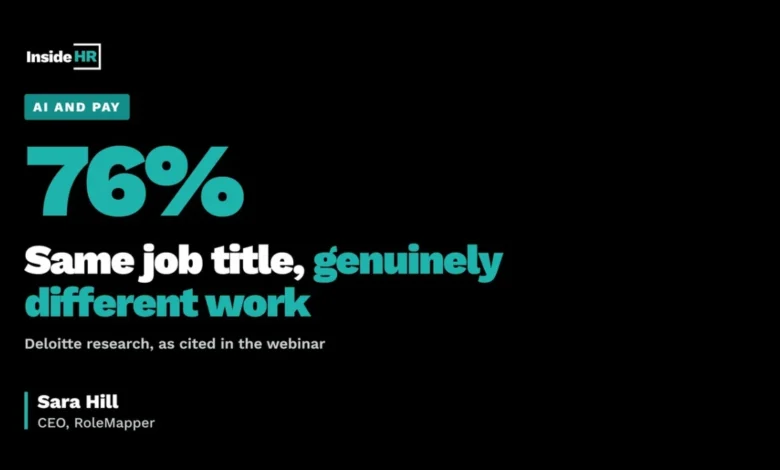
The concept of a job title, once a reliable indicator of an employee’s scope, authority, and compensation, is undergoing a profound transformation. Historically, job architecture was built on rigid hierarchies where titles corresponded to standardized duties and fixed salary bands. However, the Deloitte research cited in the recent InsideHR webinar, led by Sara Hill, CEO of RoleMapper, indicates that these legacy systems are no longer fit for purpose.
The finding that 76 percent of individuals with identical job titles perform fundamentally different work suggests that organizations are operating under a false sense of internal parity. When employees are leveled according to outdated descriptions, the resulting pay scales may be inherently inequitable, even if they appear "fair" on paper. This phenomenon is not merely an administrative oversight; it represents a fundamental shift in how work is being organized in the 21st century.
Chronology of the Shift: From Static to Dynamic
The transition toward role fluidity has been accelerated by several global events over the past decade.
- Pre-2020: Organizations primarily relied on static job descriptions updated annually, if at all. These descriptions focused on inputs—tasks performed—rather than outputs or outcomes.
- 2020–2022 (The Pandemic Catalyst): The rapid shift to remote and hybrid work models forced a move toward "work-based" rather than "presence-based" management. Managers began prioritizing project completion over strict adherence to traditional job scopes, leading to a proliferation of ad-hoc responsibilities.
- 2023–2024 (The AI Integration Era): The emergence of generative AI and automated agents has further disrupted standard roles. As AI tools handle repetitive administrative tasks, human roles have shifted toward oversight, strategy, and complex problem-solving. This has created a "skills-first" environment where an employee’s value is increasingly tied to their ability to leverage technology rather than their tenure or official job title.
Supporting Data and the "Skills-First" Imperative
The data from Deloitte aligns with broader trends observed by global labor analysts. According to the World Economic Forum’s "Future of Jobs Report," the shift toward skills-based hiring is no longer an optional strategy but a necessity for survival in an AI-driven economy.
The disconnect between title and task creates a "transparency gap." When regulators, unions, or internal employees demand proof of pay equity, companies relying on 20th-century job architecture find themselves unable to provide a "defensible" rationale. If an employee discovers that a colleague with the same title is earning more while performing different tasks, the lack of a clear, skills-based justification can lead to litigation, internal discord, and high attrition rates.
Furthermore, research indicates that when job architecture is decoupled from actual work, the "hidden" responsibilities—often termed "invisible work"—fall disproportionately on certain demographics, potentially exacerbating existing gender and racial pay gaps.
The Role of Artificial Intelligence in Reshaping Work
Sara Hill’s analysis emphasizes that we are entering an era where AI will reinvent nearly every job description. The trend toward "AI-first" operating models is creating flatter organizational structures. In these environments, the traditional pyramid—defined by many junior roles and a few managers—is being replaced by a model featuring individual contributors who work alongside AI agents.
In this context, a job title becomes an increasingly arbitrary label. An "Analyst" in an AI-first organization might spend 80% of their time managing large language models (LLMs) to generate predictive data, while an "Analyst" in a legacy department might still be manually reconciling spreadsheets. The titles remain identical, but the competency requirements, the intensity of the work, and the value generated are vastly different.

Implications for HR and People Analytics
For HR departments, the implication is clear: the manual, periodic "levelling" processes of the past are now obsolete. Organizations must transition toward a "dynamic job architecture" that is capable of being updated in real-time as the nature of work changes.
- Defensible Pay Structures: As pay transparency legislation continues to gain momentum globally, organizations must be able to justify compensation based on objective, measurable data rather than subjective title-based assumptions.
- Strategic Resource Allocation: Understanding exactly what work is being done by whom allows companies to identify talent gaps. If 76% of staff are working outside their descriptions, the company likely possesses latent skills it is not currently utilizing.
- Governance and Compliance: Transparent, audit-ready data is the best defense against claims of pay discrimination. By mapping skills to outcomes rather than just roles, HR can demonstrate that compensation is linked to actual business contribution.
Official Perspectives and Industry Reactions
While the data from Deloitte serves as a warning, industry experts suggest that the solution lies in a hybrid approach to talent management. Technology providers like RoleMapper are advocating for platforms that use AI to monitor and update job profiles continuously, rather than waiting for annual performance reviews.
"We are seeing a trend where companies are moving away from the ‘role’ as the central unit of work," says one industry consultant who reviewed the findings. "Instead, they are moving toward ‘work units’ or ‘projects.’ The title is becoming a secondary identifier, whereas the ‘skills portfolio’ of the individual is becoming the primary driver of value."
However, this shift also brings challenges. Employees often find comfort and professional identity in their titles. If titles are devalued, companies must find new ways to provide career paths and internal mobility markers that satisfy the human need for status and progression.
Broader Impact on Global Labor Markets
The findings regarding job title inaccuracy are not limited to one industry or geography; they are a global phenomenon. As the global economy becomes increasingly digitized, the standard "Job Description" is becoming a relic of the industrial age.
This transformation has profound implications for:
- Recruitment: Prospective employees are increasingly prioritizing "skill growth" over "title prestige." Companies that can provide transparency about the actual work they offer will have a competitive advantage in the war for talent.
- Compensation Policy: Total rewards packages will need to be more flexible, reflecting the high value of specific, AI-augmented skill sets that may not fit neatly into traditional "grade" or "level" structures.
- Organizational Design: The move toward flatter, AI-augmented structures necessitates a culture of continuous learning. If work is changing, the workforce must be supported with constant upskilling, making the "Learning and Development" function an inextricable partner to the "Compensation and Benefits" function.
Conclusion: Navigating the Transparency Age
The evidence presented by Deloitte and analyzed by experts like Sara Hill serves as a definitive wake-up call for organizational leaders. The "same title, different work" reality is a structural risk that can no longer be ignored.
As transparency rules tighten, organizations that fail to align their compensation structures with the reality of the work being performed will find themselves at a significant disadvantage—both in terms of legal risk and their ability to attract and retain the best talent. The future of effective HR management lies in the ability to bridge the gap between legacy titles and the dynamic, AI-influenced nature of modern output. By adopting a more fluid, data-driven approach to job architecture, companies can build the transparency, fairness, and agility required to thrive in the years ahead.
The path forward is not to abandon titles entirely, but to ensure they are supported by a robust, living framework that reflects the actual contributions of the workforce. Only by acknowledging that the "job description" is a fluid, not a static, entity can organizations hope to maintain a defensible and equitable pay strategy in an increasingly complex professional landscape.
Related posts: