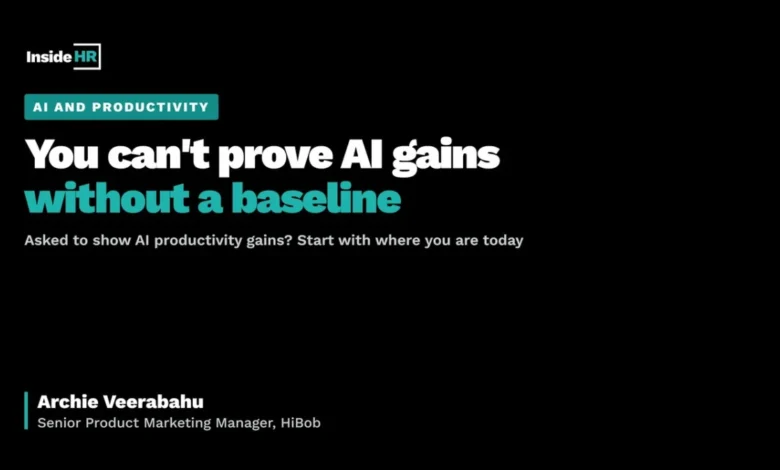
The rapid integration of Artificial Intelligence (AI) into the modern workplace has created a significant pressure point for Human Resources, finance, and operations departments: the mandate to prove Return on Investment (ROI). As organizations rush to adopt generative AI tools to streamline workflows and automate administrative tasks, many leaders are discovering that their existing data infrastructure is ill-equipped to quantify these supposed gains. According to recent expert insights from Archie Veerabahu, Senior Product Marketing Manager at HiBob, the fundamental failure in most corporate AI strategies is the absence of a verified performance baseline, rendering current productivity metrics largely anecdotal rather than empirical.
The Measurement Paradox in Modern HR
For years, HR departments have operated under the assumption that technology-driven efficiency would naturally manifest in quarterly reports. However, the introduction of AI presents a unique challenge: unlike legacy software, which often digitized existing manual processes, AI fundamentally alters the nature of workflows. When stakeholders demand to know how much time or capital an AI tool has saved, HR teams are frequently left without a frame of reference.
The core of the issue, as highlighted during the InsideHR webinar series titled "Designing for Change: A Modern Operating Model for HR," is a systemic lack of foundational data. If a company does not know the baseline duration of a specific task—such as onboarding a new hire, drafting a performance review, or reconciling payroll data—it is mathematically impossible to claim a percentage increase in productivity. Without a clear "before" snapshot, any post-AI implementation data is simply a measurement of current state, not a measurement of improvement.
Chronology of the AI Productivity Hype Cycle
To understand the current measurement crisis, one must look at the rapid acceleration of AI adoption in the corporate sector over the past 24 months.
- Late 2022: The public release of generative AI tools triggers a "fear of missing out" (FOMO) phenomenon among enterprise leaders. Many organizations initiate "pilot projects" with little to no formal tracking framework.
- Early 2023: HR departments focus on policy and ethics, struggling to catch up with employees who are already utilizing unauthorized AI tools for daily tasks.
- Late 2023: CFOs and board members begin requesting concrete data regarding the financial impact of these AI tools. HR teams, having prioritized adoption over analytics, struggle to provide evidence of ROI.
- 2024: The current phase, characterized by a pivot toward "Operational AI." The focus has shifted from mere adoption to the rigorous integration of AI into HR Information Systems (HRIS), with an urgent push to standardize data collection to prove long-term value.
The Data Gap: Why Standard Metrics Fail
Traditional KPIs, such as "hours worked" or "tasks completed," are proving insufficient in an AI-driven environment. AI tools often compress task time from hours to minutes, but they also change the quality and complexity of the output. If an employee uses AI to write a report, they may spend less time typing but more time editing and fact-checking.
Research from the World Economic Forum and various human capital analysts suggests that organizations attempting to measure AI productivity are failing because they rely on vanity metrics. A vanity metric might be the number of prompts an employee submits to a chatbot; a meaningful metric would be the reduction in time-to-competency for a new employee supported by an AI-driven training module.
The lack of "trusted people context"—a term used by Veerabahu to describe clean, integrated, and longitudinal HR data—means that even when a productivity jump is observed, companies cannot definitively attribute it to AI versus seasonal trends, improved management, or changes in external market conditions.

Strategic Implications for Finance and HR Collaboration
The disconnect between Finance and HR has historically been a hurdle, but the AI era has made this friction a critical business risk. Finance teams are trained to look for cost displacement or revenue generation, while HR teams often view productivity through the lens of employee engagement and well-being.
When HR fails to provide a baseline, Finance often defaults to cutting budgets for software licenses or stalling investments in new AI infrastructure. The solution, according to industry best practices, is the creation of a "Modern Operating Model." This involves:
- Defining the Workflow: Before deploying AI, HR must map the existing process, noting every touchpoint and the time required for each.
- Establishing the Baseline: Collecting at least one quarter of data on the manual process to create a stable benchmark.
- Controlled Deployment: Implementing AI tools in specific departments to allow for A/B testing against the established baseline.
- Feedback Loops: Integrating qualitative feedback from employees to ensure that productivity gains are not coming at the expense of burnout or work quality.
Broader Impact on Organizational Structure
The inability to measure AI productivity is not just a technical oversight; it is an organizational one. When companies fail to establish a baseline, they risk "AI-washing" their results, where management assumes success based on the novelty of the tool rather than its actual impact. This leads to the erosion of trust between employees and leadership. If employees are told that AI will make their lives easier, but the metrics show no improvement in their actual workload, morale declines.
Furthermore, the "people data" required to build these baselines must be treated as a strategic asset. Many companies currently have fragmented data across disparate systems—a payroll system here, a performance management tool there, and an AI chatbot in another corner. The push for a unified HR operating model is, at its heart, a push for data integrity. Without it, HR remains a reactive department, constantly defending its technological spending rather than proactively driving organizational strategy.
Addressing the Skills Gap in People Analytics
A significant barrier to establishing these baselines is the current skills gap within HR teams. Traditionally, HR roles focused on policy, recruitment, and employee relations. The transition to a data-centric function requires expertise in data science, analytics, and systems architecture. Organizations that are successfully navigating this transition are increasingly hiring "People Data Analysts" who sit at the intersection of IT and Human Resources.
These professionals are responsible for ensuring that the data being collected is clean and that the baseline is representative. They must also be able to communicate these findings to the C-suite, translating technical metrics into language that aligns with corporate financial goals. As Archie Veerabahu noted, the first step is building the foundation of trusted context; without this, all subsequent AI reporting is merely speculation.
Conclusion: The Path Forward
The mandate for HR in the coming years is clear: the era of "AI experimentation" is ending, and the era of "AI optimization" has begun. To survive this shift, HR must move beyond the excitement of new tools and return to the fundamentals of performance management.
Organizations must begin by pausing to audit their current processes. They must document how work is performed today, define what "success" looks like in measurable terms, and establish a rigorous baseline before scaling any AI initiatives. Only through this disciplined approach can HR prove its value as a strategic partner, ensuring that AI investments deliver genuine, measurable, and sustainable gains in productivity. The challenge is not the AI itself, but the human systems designed to measure it. Without a baseline, HR is flying blind—and in the current economic climate, that is a risk few organizations can afford to take.