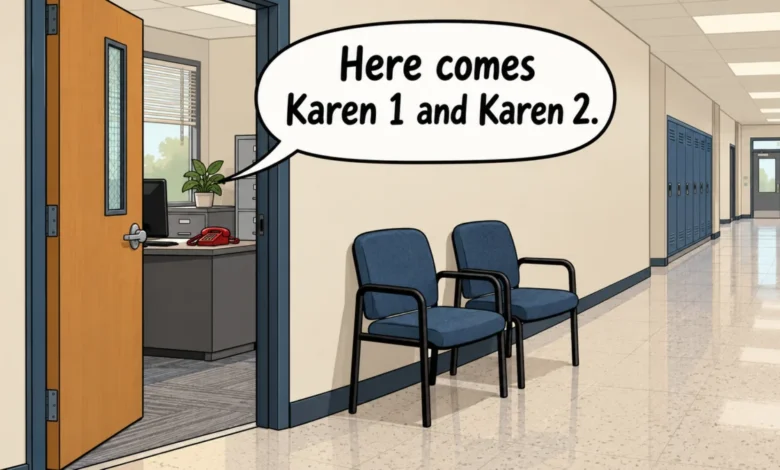
The case originated within a school setting, involving a school psychologist and a guidance counselor who were referred to as “Karen 1 and Karen 2” by an administrative secretary. The term, which has evolved in contemporary lexicon to denote a specific archetype of entitled, often white, middle-aged women, became the catalyst for a series of events that escalated from a minor office slight to a federal lawsuit.
A Chronology of Escalation
The sequence of events began when the psychologist and her colleague entered an assistant principal’s office. Upon their arrival, the secretary made the aforementioned remark. Although the psychologist did not hear the comment in real-time, she was informed of it shortly thereafter by her colleague. Given the derogatory nature of the term, both employees sought a formal resolution through the school’s administrative channels.
The school administration arranged a meeting to address the grievance. According to court records, the meeting began with a contentious exchange. The psychologist alleged that the secretary, rather than immediately de-escalating, began mocking her speech and physical mannerisms. The psychologist interpreted this as a direct attack on her hearing impairment. While the secretary eventually offered an apology for the “Karen” remark and exited the room, the meeting did not conclude there.
The focus of the discussion shifted toward a debate regarding whether the term “Karen” constitutes a racial slur. The assistant principal, who held credentials as a professional in diversity, equity, and inclusion (DEI), vehemently disputed the characterization. The situation deteriorated rapidly; witnesses reported that the administrator became visibly agitated, raised his voice, pounded his chest, and positioned his face within inches of the guidance counselor. This display of aggression became a central component of the psychologist’s subsequent litigation, as she argued that the school’s leadership failed to foster a safe and professional environment.
The Legal Threshold for Hostile Work Environment
In the ensuing lawsuit, the plaintiff alleged that the school created a hostile work environment, engaged in unlawful discrimination, and retaliated against her for raising the complaint. To prevail on a hostile work environment claim under Title VII of the Civil Rights Act of 1964, a plaintiff must demonstrate that the workplace is permeated with discriminatory intimidation, ridicule, and insult that is sufficiently severe or pervasive to alter the conditions of the victim’s employment and create an abusive working environment.
The federal court’s decision focused on whether the "Karen" comment and the subsequent meeting behavior met this high legal bar. In its ruling, the court assumed, for the sake of argument, that the comments were related to race. However, it concluded that the isolated nature of the remarks, combined with the secretary’s subsequent apology and limited ongoing interaction, did not constitute a "pervasive" pattern of harassment. The court further noted that the psychologist’s claims regarding broader, systemic mistreatment were not supported by specific, documented evidence.
Crucially, the court did not offer a definitive ruling on whether the term “Karen” should be legally classified as a racial slur. By sidestepping this definition, the court avoided setting a blanket precedent. Instead, it reaffirmed that employers possess the authority—and indeed the responsibility—to intervene in unprofessional conduct long before it crosses the threshold into actionable federal harassment.
Data and Context: The Rise of Workplace Incivility
This case takes place against a backdrop of increasing workplace incivility. According to data from the Society for Human Resource Management (SHRM), reports of workplace conflict have risen steadily over the last decade, with "incivility" often cited as a primary driver of turnover and decreased productivity. Research indicates that when employees feel that management handles complaints poorly, their perception of organizational justice declines, leading to higher rates of absenteeism and, in more severe cases, litigation.

The inclusion of the assistant principal’s conduct is particularly notable. In the modern workplace, administrators tasked with DEI responsibilities are held to a higher standard of behavioral compliance. When a supervisor—or a DEI-trained professional—resorts to physical intimidation, such as chest-pounding or invading an employee’s personal space, it effectively undermines the institution’s credibility. The school’s subsequent decision to issue a counseling memorandum to the assistant principal suggests that the institution recognized the professional lapse, even if the court found it insufficient to support a federal discrimination claim.
Implications for Management and HR
The outcome of this case offers three critical lessons for employers attempting to navigate the complexities of modern workplace grievances:
1. Separate the Rhetoric from the Remediation
Employers should not allow debates over the "definition" of a specific term or label to stall an investigation. Whether a term is legally classified as a "slur" is less important than whether the conduct violates company policy regarding respect and professional communication. HR departments should focus on the impact of the language rather than the intent, ensuring that all employees adhere to a standard of conduct that prevents the normalization of name-calling.
2. Standardize the Complaint Meeting Process
The meeting in question was intended to resolve a grievance but ultimately served to generate new ones. This underscores the necessity of structured, neutral procedures for handling complaints. Organizations should consider using neutral facilitators for meetings involving high-tension disputes. When tempers rise, the meeting should be paused or rescheduled. Allowing a supervisor to engage in shouting or physical intimidation during a mediation session is a failure of internal protocol that invites legal scrutiny.
3. Move Beyond the "Check-the-Box" Apology
An apology is a starting point, not an end goal. While the court noted the secretary’s apology as a mitigating factor, employers should not assume that a single interaction resolves a long-term cultural issue. Management must actively monitor the workplace to ensure that the conduct has actually ceased. Documenting follow-up interactions is essential for building a robust defense, as it demonstrates that the organization took the complaint seriously and monitored the situation for recurrence.
Broader Institutional Impact
The decision to remand the state-law claims back to state court indicates that while the federal claims were dismissed, the controversy is not entirely over. The plaintiff may still find relief in state-level litigation, where the standards for harassment or intentional infliction of emotional distress may differ from federal mandates.
For the employer, the primary takeaway is that legal victory does not equate to a successful management strategy. The school’s reputation, the morale of its staff, and the professional standing of its leadership were all compromised by the initial remark and the subsequent, poorly managed meeting. The incident serves as a reminder that the "hostile work environment" standard is a floor, not a ceiling. Organizations that aim only to stay above the legal threshold of litigation often find themselves in the courtroom anyway, defending their culture and their leadership practices.
Ultimately, the case confirms that while the term "Karen" may not currently trigger a federal finding of discrimination in isolation, the context in which it is used—and the way management responds to that usage—remains a high-risk area. In an era of heightened sensitivity and increased emphasis on professional conduct, the best defense against litigation remains proactive, de-escalating, and impartial management. By fostering a culture that prioritizes professional boundaries over ideological debate, employers can avoid the pitfalls that led this particular school into a protracted legal battle.
Related posts: