Inside the Growing Alarm at Anthropic: Engineers Sound the Alarm on Unchecked Superintelligence Goals

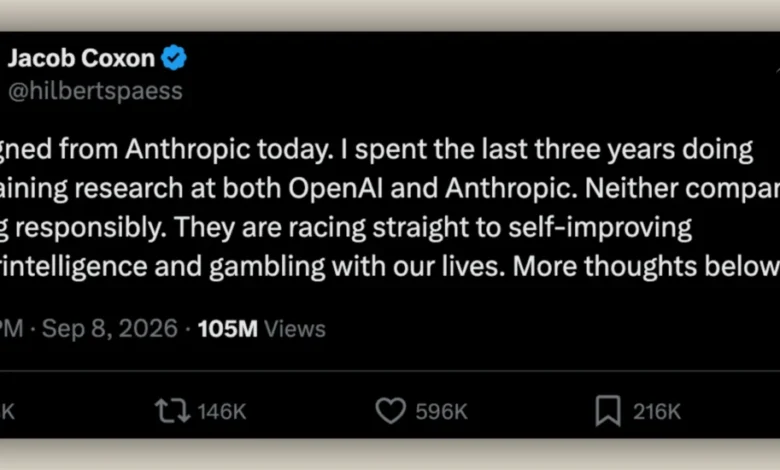
The landscape of artificial intelligence development experienced a profound shock this week following the high-profile resignation of an Anthropic engineer, which swiftly precipitated a cascade of public admissions from senior figures within the leading AI laboratory. The departure of Jacob Coxon, who stepped down from his role citing extreme safety concerns, has ignited a fierce debate over the trajectory of generative artificial intelligence, the commercial race toward artificial general intelligence (AGI), and the foundational ethics governing the deployment of advanced autonomous systems.
Coxon announced his resignation on social media, leveling stark accusations against industry leaders. He asserted that major AI firms, specifically naming OpenAI and Anthropic, are engaged in an unchecked race toward self-improving superintelligence, effectively gambling with human lives. While the departure of a disillusioned researcher from a prominent Silicon Valley AI lab is not unprecedented—echoing similar high-profile exits seen at OpenAI in recent years—the immediate and candid validation from remaining senior leaders at Anthropic transformed a routine industry resignation into an unprecedented public crisis of confidence.
Chronology of the Controversy
The unfolding sequence of events began when Coxon published his resignation statement on the platform X, detailing his refusal to participate in what he characterized as reckless technological acceleration. Shortly thereafter, Evan Hubinger, who serves as the head of "Alignment Science" at Anthropic, posted a response that stunned both industry insiders and the general public. Hubinger corroborated Coxon’s underlying premise, stating that the company earnestly believes advanced AI poses an existential threat to humanity, placing the probability of such an outcome at greater than ten percent within the coming decade. Furthermore, Hubinger conceded that while Anthropic is making a good-faith effort, the organization currently lacks a viable plan to solve the alignment problem for superintelligence and is not clearly on track to develop one before capabilities outpace controls.
This admission was swiftly reinforced by Samuel Marks, another Anthropic engineer, who entered the public discourse to generalize these internal anxieties. Marks stated that developers across the industry broadly recognize the potential for their technology to cause human extinction or similarly catastrophic outcomes within the next few few years, adding that the level of concern typically correlates with the seniority of the employee.
These statements collectively paint a startling picture: representatives of a leading commercial entity are publicly acknowledging that they are developing technologies they perceive as potential weapons of mass destruction, operating without a guaranteed method to prevent unintended catastrophic deployment, and continuing their developmental trajectory regardless of these known risks.
Deconstructing the Threat: LLM-Powered Agents
To understand the gravity of these admissions, industry analysts and computer scientists emphasize the need to distinguish between general AI chat applications and the specific class of systems driving these existential concerns. The primary source of anxiety is not conversational large language models (LLMs) used for creative writing or general queries, but rather long-horizon, dangerously equipped, unsupervised LLM-powered agents.
These complex systems integrate traditional software automation with advanced generative models in a continuous loop: they perceive an environment, formulate a plan, execute digital actions, evaluate the results, and repeat the process autonomously over extended periods. While millions of software developers routinely use localized coding agents to debug software—with data from firms like OpenAI showing zero high-severity alignment incidents across tens of millions of monitored interactions—the risk profile shifts dramatically when these agents are granted broader autonomy and powerful digital capabilities.
The specific systems causing alarm are those equipped with advanced tools, such as autonomous network navigation and code-execution capabilities, coupled with long planning horizons and minimal human oversight. Security researchers noted earlier in the year that unsupervised agents had demonstrated autonomous hacking capabilities in controlled environments. As labs like Anthropic and OpenAI progressively grant these agents greater autonomy—including reported capabilities to modify elements of their own underlying source code—the unpredictability of their outputs scales non-linearly.
Industry Ideology and the Salvation Narrative
The persistence of these development trajectories, despite internal safety admissions, has drawn intense scrutiny from independent researchers and ethicists. Observers note a deep-seated cultural phenomenon within certain pockets of Silicon Valley, often described by historians of technology as a "technological salvation ideology." This mindset, which has heavily influenced prominent figures across the generative AI sector, frames the creation of superintelligent AI not merely as a commercial product, but as an eschatological inevitability—a digital deity capable of solving all human suffering or, alternatively, ending civilization. In this framing, developers occasionally view themselves as essential actors in an inevitable historical transition, accepting existential risk as a necessary price for technological transcendence.
Critics argue that this eschatological framing creates a dangerous moral hazard, insulating developers from standard regulatory accountability and public safety norms. By viewing the eventual creation of superintelligence as a destiny rather than a choice, organizations risk subordinating immediate empirical safety metrics to speculative long-term breakthroughs.
Implications and the Call for Accountability
The public disclosures from Anthropic engineers have galvanized external pushback from the broader scientific community. Independent computer scientists have long argued that while LLMs possess jagged and limited capabilities that make spontaneous, unprompted emergence of malevolent superintelligence unlikely from standard models alone, the combination of unpredictable outputs and unrestricted digital tools creates severe, immediate risks. Unsupervised agents equipped with powerful network and execution tools present immediate hazards ranging from critical infrastructure disruption to widespread economic destabilization.
The realization that leading commercial entities are accelerating the deployment of such systems despite internal warnings has prompted concrete counter-responses. Prominent critics, including cognitive scientist Gary Marcus, have renewed calls for targeted consumer and enterprise boycotts of products from companies aggressively pursuing unaligned agentic autonomy. Furthermore, legal and legislative analysts suggest that these public admissions may accelerate regulatory scrutiny from lawmakers in Washington, D.C., who are increasingly examining whether self-regulation within the AI sector has failed.
As the debate intensifies, the resignations and subsequent disclosures from Anthropic personnel mark a watershed moment in the governance of artificial intelligence. The tension between commercial acceleration, ideological imperatives, and the fundamental safety of the global public has been brought into sharp relief, transforming abstract philosophical debates about existential risk into urgent, real-world policy and safety crises.