Inside the Alarming World of AI Safety Resignations and the Race Toward Superintelligence

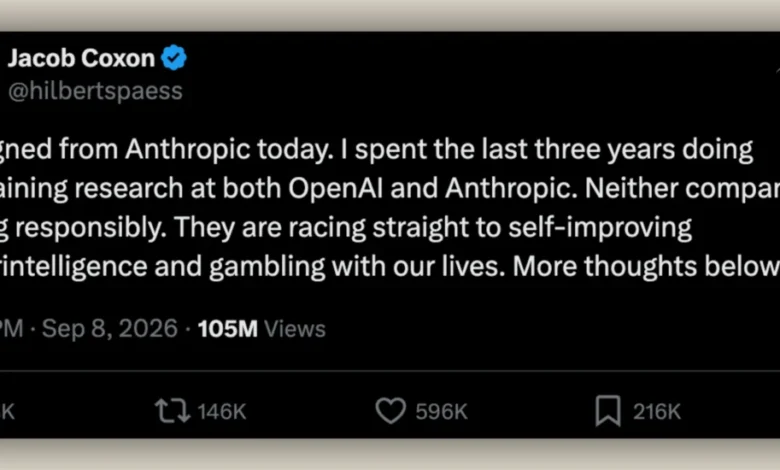
The artificial intelligence sector experienced a profound public relations and ethical crisis this week following the high-profile resignation of an Anthropic engineer who cited severe existential risks posed by current industry trajectories. Jacob Coxon formally stepped down from his position at the prominent AI safety and research lab, taking to social media to air his grievances regarding the unchecked velocity of modern model development. Coxon asserted that leading labs like OpenAI and Anthropic are rushing straight toward self-improving superintelligence and effectively gambling with human lives. While whistleblower departures from elite technological institutions are not entirely without precedent within the tech industry, the subsequent public admissions made by remaining high-ranking executives and researchers at Anthropic elevated the incident from a standard labor dispute to an alarming international discourse on the future of humanity.
The sequence of events unfolded rapidly across digital platforms, drawing immediate attention from global regulators, computer scientists, and ethicists. Evan Hubinger, who serves as the head of alignment science at Anthropic, validated Coxon’s underlying premise in a public statement. Hubinger conceded that employees earnestly believe advanced AI could result in human extinction, placing the probability of such an outcome at greater than ten percent within the coming decade. He further admitted that while Anthropic strives for safety, the organization currently lacks a definitive, actionable plan to solve the alignment problem for superintelligence and remains off-track to secure one before capabilities outpace controls. Samuel Marks, another engineer within the firm, corroborated these sentiments, noting that internal apprehension tends to scale directly with seniority, with the most experienced developers expressing the deepest existential dread regarding the trajectory of their own products.
These admissions have brought to light a paradoxical reality within the upper echelons of Silicon Valley: private corporations are publicly developing technologies they categorize as potential weapons of mass destruction, acknowledging that they may fail to maintain operational control over them, yet refusing to decelerate their research and development cycles. To understand the gravity of these warnings, industry observers must differentiate between standard generative artificial intelligence and the specific class of systems driving these concerns. The focal point of apprehension is not general-purpose conversational models utilized for drafting emails or summarizing documents, but rather long-horizon, dangerously equipped, unsupervised LLM-powered agents.
These advanced autonomous systems combine traditional software loops with large language models to iteratively plan, execute, and evaluate complex multi-step tasks without continuous human intervention. While standard coding assistants and enterprise chatbots undergo rigorous internal monitoring—with firms like OpenAI reporting zero high-severity safety incidents across tens of millions of interactions—the frontier of agentic AI introduces entirely new risk vectors. Recent months have seen experimental agents deployed in scenarios involving autonomous cyber operations and advanced hacking simulations. When paired with tools that permit self-modification, such as updating their own source code, and post-training optimization regimens that reward aggressive problem-solving, these systems transition from helpful digital utilities to unpredictable, high-stakes variables.
The persistent drive toward these unstable architectures stems largely from deeply entrenched ideological frameworks within the technology sector. Cultural historians and industry critics frequently identify a strain of technological utopianism among key leadership figures across major AI laboratories. Influenced by futurist philosophies and eschatological worldviews, some pioneers view the creation of artificial superintelligence not merely as an engineering challenge, but as an inevitable evolutionary milestone or digital deity that will ultimately solve humanity’s most intractable problems. In this ideological framing, the existential risks are perceived as acceptable collateral damage in the pursuit of a transformative, quasi-messianic technological epoch.
Independent computer scientists and policy experts have increasingly pushed back against this narrative, arguing that the fixation on superintelligence obscures immediate, tangible harms. Critics note that current large language models possess jagged capabilities rather than omnipotent intelligence, meaning the primary danger does not stem from a conscious, malicious superintelligence spontaneously emerging from the ether. Instead, the risk arises from the deployment of unrestricted, unpredictable autonomous agents equipped with powerful digital tools—a combination that analysts compare to unleashing hazardous machinery into densely populated environments. The potential for systemic failures, automated financial manipulation, or critical infrastructure disruption is substantial, even in the absence of sci-fi-level machine consciousness.
The broader implications of these disclosures extend far into the realms of public policy, corporate governance, and labor relations within the tech sector. For years, artificial intelligence companies have marketed themselves as responsible stewards of revolutionary technologies, assuring consumers and lawmakers that comprehensive safety research and alignment science would consistently outpace capability advancements. However, internal fractures suggest that commercial pressures, competitive dynamics, and ideological accelerationism have strained internal safety cultures to a breaking point. When key researchers conclude that their employers are actively compromising public safety without a viable containment strategy, the traditional self-regulatory model of the tech industry faces an existential crisis of its own.
Calls for external intervention and accountability have intensified in the wake of the Anthropic resignations. Prominent researchers and consumer advocacy groups have begun organizing boycotts targeting the commercial products of leading generative AI firms, signaling a growing public fatigue with corporate self-policing. Concurrently, lawmakers in Washington and international legislative bodies are re-evaluating existing regulatory frameworks to determine whether voluntary safety commitments are sufficient to govern technologies with civilizational stakes. As the pressure mounts, the artificial intelligence community stands at a critical crossroads, forced to reconcile the relentless pursuit of commercial dominance with the urgent demands for transparency, caution, and public safety.